Five of Wands Tarot Card Meaning
Five figures raise crossing staffs with no clear winner. Discover what the Five of Wands reveals about rivalry, unresolved conflict, and finding a wiser way through.
- rivalry
- strife
- competition
- disagreement
- conflicting intentions
Card at a glance
- Number
- Five
- Element
- Fire
- Astrology
- Lord of Strife, Saturn in Leo (Golden Dawn)
- Keywords
- rivalry, strife, competition, disagreement, conflicting intentions, testing your strength
 Five · Five of Wands
Upright meaning
Rivalry, strife and competition
Upright, the Five of Wands often appears when resistance is active. Several people want the same role. A group disagrees about priorities. You may be trying to prove your ability in an environment where everyone else feels equally determined. Imagine rehearsing with a small theater company. Every actor has an idea about how a scene should work, and each tries to demonstrate it at once. The tension might become part of a creative process if everyone can take turns and listen. It can also spoil the work when no one is allowed to finish a thought. This card encourages discernment about the situation you are actually in. You may need to sharpen an argument, compete fairly, or defend a reasonable preference. If the conflict is becoming harmful, support and clear boundaries deserve attention. There is also a warning against turning comparison into your measure of worth. Another person's strength need not decide what you are capable of making.
- Rivalry
- Strife
- Competition
- Disagreement
- Conflicting intentions
- Testing your strength
Reversed meaning
Conflict avoidance or resolution, disputes and trickery
Many contemporary tarot readers interpret the reversed Five as tension subsiding. People may finally be ready to cooperate, or someone decides to stop competing. A different modern reading sees conflict pushed out of sight: the room is quieter because nobody feels able to disagree. Waite's older reversed meaning is sharper. In The Pictorial Key to the Tarot, he associates the reversal with litigation, disputes, trickery, and contradiction. The wording gives the card an atmosphere of quarrels becoming formalized or entangled in untrustworthy behavior. How can these interpretations be used responsibly? Suppose you and a colleague have reached a clear agreement after weeks of arguments. The modern resolution reading fits that change. If a disagreement has developed into accusations and contested agreements, Waite's historical language may provide an apt symbol for the seriousness of the dispute. A reversed Five is not evidence that a lawsuit or betrayal is imminent. Choose a reversal method and allow the facts, question, and surrounding cards to guide you.
- Conflict avoidance or resolution
- Disputes
- Trickery
- Litigation
Card symbolism
-
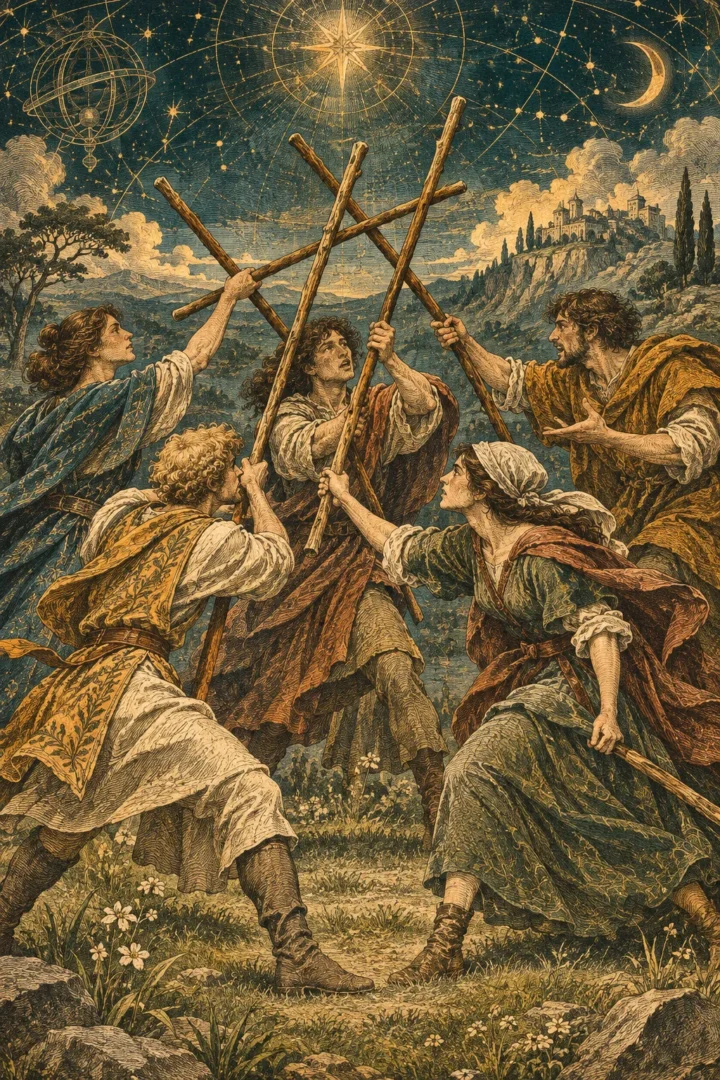
Five people, five staffs, no visible referee
Waite described the figures as young people raising staffs in something resembling a mock battle.
-
The crossing wood
The wands are held at different heights, crossing above and between the figures.
-
Distinct clothing and open ground
The figures wear different colors and styles of clothing.
In depth interpretation
Five figures crowd into a small patch of open ground. Their wooden staffs cross overhead at strange angles. Each person seems intent on something, yet the picture offers no clear leader, referee, or winner. It is difficult to tell whether we are watching a game become heated or an argument that nobody knows how to end.
The Five of Wands represents competition, clashing energies, disagreement, and the struggle to find your place among other strong wills. Upright, it often points to friction that demands your attention. Reversed, it can describe conflict being avoided or settling down, although older tarot meanings also warn of disputes growing more serious.
There is a question hidden inside all that movement: what are the people actually fighting for? The answer changes the reading.
The spiritual meaning: five fires in one small space
If you have ever tried to speak while several people are talking at once, you know the feeling in this card. Your own words start rising in volume. You may be perfectly certain you have something important to say, yet the noise makes it harder to hear what anyone else is asking for.
The Wands suit carries the symbolism of Fire: passion, will, movement, and the urge to create. In the Five, that energy has multiplied. Each figure has a staff. No one appears to have found a way to move with the others.
The image can describe a disagreement with family or friends, a competition for an opportunity, or a private season when several desires are pulling at you. You want rest, adventure, closeness, recognition, and freedom. Every wish has energy. They cannot all direct the same afternoon.
The Five invites you to notice the quality of the struggle. A lively challenge can sharpen your understanding, but some contests become exhausting because the rules are unfair. The Four of Wands has people gathering beneath a welcoming garland; here, their energy is tangled. The Six of Wands shows how recognition may follow a contest. Ask whose needs are being heard and what continuing the struggle might change.
What Pamela Colman Smith put into the picture
Five people, five staffs, no visible referee
Waite described the figures as young people raising staffs in something resembling a mock battle. The scene leaves the boundary between play and genuine hostility uncertain. That ambiguity is central to the card.
In a reading about a sports competition or creative debate, the staffs can evoke testing your abilities alongside others. In a relationship marked by intimidation, the same crowded scene may feel distressing. Your lived circumstances matter more than the assumption that every struggle is harmless.
No one in the picture is visibly governing the contest. One question worth asking is whether everyone involved has agreed to the same rules.
The crossing wood
The wands are held at different heights, crossing above and between the figures. Their paths interrupt one another. Smith gives us movement without a coordinated direction.
This detail can suggest competing efforts. Perhaps people are working hard toward slightly different goals, or each believes that yielding will mean losing something precious. It can also evoke the discomfort of having your own attention divided among too many demands.
Notice where the staffs intersect. An argument often becomes easier to understand when you identify the single decision or scarce resource everyone is reaching toward.
Distinct clothing and open ground
The figures wear different colors and styles of clothing. A contemporary reader might see individual perspectives or temperaments in those differences. The picture itself does not tell us which person is right or assign a fixed personality to each color.
There is no throne, castle wall, or clear finish line to settle the scene. That open ground gives the reading an unsettled feeling. The outcome depends partly on what the participants do next.
Five of Wands upright meaning
Upright, the Five of Wands often appears when resistance is active. Several people want the same role. A group disagrees about priorities. You may be trying to prove your ability in an environment where everyone else feels equally determined.
Imagine rehearsing with a small theater company. Every actor has an idea about how a scene should work, and each tries to demonstrate it at once. The tension might become part of a creative process if everyone can take turns and listen. It can also spoil the work when no one is allowed to finish a thought.
This card encourages discernment about the situation you are actually in. You may need to sharpen an argument, compete fairly, or defend a reasonable preference. If the conflict is becoming harmful, support and clear boundaries deserve attention.
There is also a warning against turning comparison into your measure of worth. Another person's strength need not decide what you are capable of making.
Is the Five of Wands playful competition or real conflict?
The Five of Wands can describe either. Waite's description moves between an imitated battle and the much more serious struggle for prosperity. The Rider-Waite-Smith illustration keeps the outcome unresolved.
Three questions help interpret this ambiguity:
1. Can everyone stop participating without being punished? A voluntary contest has a different character from pressure that a person cannot safely escape.
2. Do people understand the stakes? A disagreement about an artistic choice is different from a conflict over someone's wages, housing, or dignity.
3. Is the struggle creating understanding? A challenge that helps people learn may be useful. Repeated humiliation, deception, or intimidation needs a different response.
These are practical interpretive questions drawn from the image, rather than a traditional three-part rule attached to the card. They help readers avoid using a cheerful keyword such as "healthy competition" to explain away a genuinely troubling situation.
The Five of Swords makes a revealing comparison. In Smith’s Wands picture, several people are still engaged in an energetic contest. The Swords scene shows what happens after a struggle has driven people apart. If both cards appear, ask whether the competition has begun to damage the relationship it was meant to serve.
Five of Wands reversed meaning: resolution, avoidance, or escalation?
Many contemporary tarot readers interpret the reversed Five as tension subsiding. People may finally be ready to cooperate, or someone decides to stop competing. A different modern reading sees conflict pushed out of sight: the room is quieter because nobody feels able to disagree.
Waite's older reversed meaning is sharper. In The Pictorial Key to the Tarot, he associates the reversal with litigation, disputes, trickery, and contradiction. The wording gives the card an atmosphere of quarrels becoming formalized or entangled in untrustworthy behavior.
How can these interpretations be used responsibly? Suppose you and a colleague have reached a clear agreement after weeks of arguments. The modern resolution reading fits that change. If a disagreement has developed into accusations and contested agreements, Waite's historical language may provide an apt symbol for the seriousness of the dispute.
A reversed Five is not evidence that a lawsuit or betrayal is imminent. Choose a reversal method and allow the facts, question, and surrounding cards to guide you.
Five of Wands in love and relationships
In love, the Five of Wands often asks how two people handle differences. There could be disagreements over time, family expectations, affection, or responsibilities at home. Some couples enjoy lively debate. Others have reached a point where familiar arguments leave both people feeling unheard.
If you are dating, pay attention to whether playful teasing feels welcome to both of you. Attraction can carry a competitive spark, especially when each person is testing how much space they have to be themselves. Care and respect become clearer through ordinary behavior.
For an established relationship, look beyond the subject of a recurring argument. A disagreement about weekend plans might be carrying an unspoken wish for rest or closeness. The card encourages you to listen for the need underneath the raised voices.
Reversed, there may be room for repair. If peace has required one person to stay silent about something important, that deserves a gentle and honest conversation.
What does the Five of Wands mean as feelings?
In a feelings position, the Five can symbolize attraction complicated by tension, rivalry, defensiveness, or uncertainty about how to approach someone. It can also describe your own divided feelings. The card gives no reliable way to identify a secret rival or an unspoken third party.
Five of Wands for career and money
Work can bring out this card's competitive side. You may be interviewing for a sought-after role, presenting an idea among several proposals, or discovering that a team has no agreed way to resolve differences.
A productive response begins with understanding what each person is trying to achieve. In an ordinary disagreement about how a project should be completed, clearer roles and an agreed decision process may help. When the issue involves unfair treatment or serious misconduct, professional support and documented facts matter more than a symbolic reading.
In financial questions, the Five can reflect contested resources, pressure to keep up with others, or disagreement over spending. Look at the terms, evidence, and obligations involved. If the matter is legal or financial, avoid assuming the card has decided the outcome.
Saturn in Leo and the Lord of Strife
In the Golden Dawn's Book T, the Five of Wands is called Lord of Strife and associated with Saturn in Leo. The text describes the force of opposition and struggle, with boldness and generosity appearing alongside difficult possibilities such as rashness and cruelty. The reading changes according to the card's surrounding dignity in that system.
The Golden Dawn's symbolic card design uses crossing wands and fire. It differs from Smith's scene of five human figures. The astrological attribution belongs to that specific esoteric tradition and need not be treated as a secret explanation for every detail of the Rider-Waite-Smith artwork.
As a spiritual image, the Five offers a way to examine pride, courage, and the limits we meet when other people have wills as strong as our own. Where could your fire illuminate something worth addressing? Where has it begun to burn the people you hope to reach?
How to read the Five of Wands in a spread
In a present position, the Five of Wands often describes active friction or rivalry. As advice, it encourages you to identify what is really at stake and decide how to participate. As an outcome, it can suggest that competing forces still need attention. A surrounding card can change the meaning dramatically.
Worked reading: is this disagreement helping our creative group?
Suppose a community project is divided over its next event. You draw the Five of Wands for the present, the Three of Pentacles as advice, and Justice as the factor that needs attention.
The Five captures the energetic contest: people care enough to argue, and the group has become stuck in competing proposals. The Three of Pentacles directs attention to craft and cooperation, inviting the group to acknowledge different areas of expertise. Justice places fairness, clear agreements, and accountability at the center.
Together, the reading suggests a practical experiment: clarify who has decision-making responsibility, let each person explain their priorities, and agree how the final choice will be made. If someone has been treated unfairly, the Justice card gives that concern weight. A spirited debate alone cannot settle it.
Now imagine the Five appearing beside the Five of Pentacles instead. The question could turn toward who feels excluded or who is carrying the cost of the contest. The same staffs might feel less playful. That is why the Five of Wands should never be reduced to "everyone is just arguing."
Five of Wands as advice: listen to the five voices
Place the card before you and study the people rather than the wood. Imagine asking each participant, "What matters enough to you that you have raised your staff?"
In your journal, name three things you can identify about a current disagreement: the issue being contested, what you most want protected, and what you might not yet understand about another person's experience.
If it is safe to do so, choose one small way to make the next conversation clearer. You might ask a question before offering another argument. If the situation is unsafe or coercive, your first responsibility is to seek appropriate support.
Is the Five of Wands a yes or no card?
The Five of Wands is usually a complicated answer. A question about entering a contest may receive an encouraging prompt to prepare for competition, especially if the stakes are understood. Questions about relationships or agreements often call for resolving friction before an easy yes is available. Reversed, examine whether the conflict is truly easing or has moved into a more difficult form.
A note on tradition
This interpretation follows Pamela Colman Smith's Rider-Waite-Smith image, first issued in 1909. Waite described a scene that resembles sport or strife and connected it with competition for fortune. His reversed meanings include disputes and litigation. The Golden Dawn's Book T adds the title Lord of Strife and the Saturn-in-Leo correspondence. Contemporary readings sometimes treat the reversal as resolution or conflict avoidance, which is a separate interpretive approach.
Frequently asked questions
How can the Five of Wands help me handle a disagreement?
Before trying to win, ask each person what they want to protect. If the disagreement is healthy, everyone can disagree without being punished or silenced. If the exchange is becoming harmful, name the boundary and decide how to create enough safety for a real conversation.
Does the Five of Wands mean a third party in love?
Competition can be one interpretation when the situation already involves rivals. The image cannot establish infidelity or reveal that another person is secretly involved.
Does the reversed Five of Wands predict a lawsuit?
Waite associated the reversal with litigation, among other forms of dispute. That is a documented historical meaning, not a prediction of legal action. If an actual dispute is escalating, respond to the evidence and seek suitable advice.
How does the Five of Wands differ from the Five of Swords?
The Five of Wands shows an unresolved contest among several figures. The Five of Swords depicts a more distinctly lopsided aftermath, with a figure holding swords as others walk away. The images invite different questions about competition, loss, and the consequences of winning.

Keep reading
Explore the Wands
Every card page names the tradition behind each meaning, so you can compare readings instead of taking one as fixed.
Cards to explore alongside this one
Their symbols reveal useful similarities and differences for your next reading.

Five of Swords
conflict, hollow victory, hurt pride, defeat

Seven of Wands
courage, opposition, defending a position, competitive advantage

Knight of Swords
decisive action, urgency, ambition, direct speech
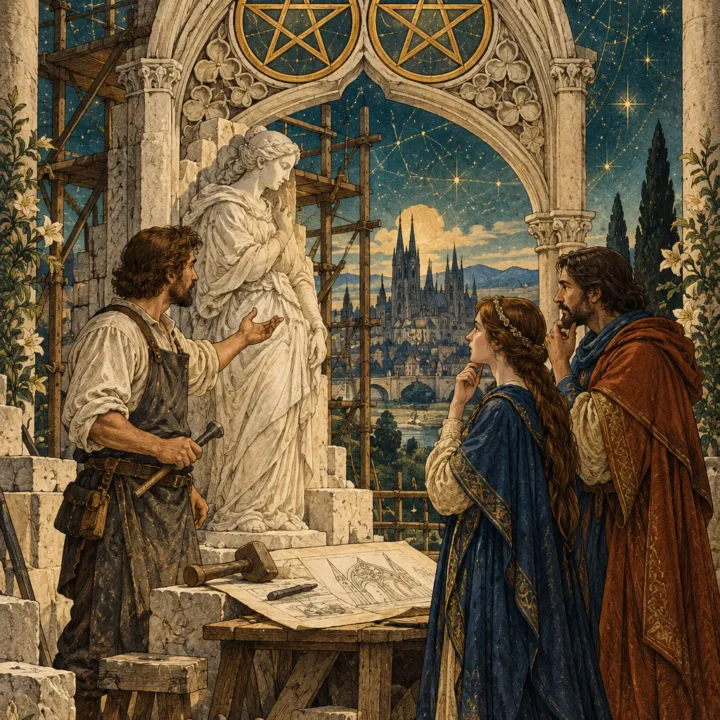
Three of Pentacles
skill, collaboration, apprenticeship, useful feedback
Sources and further reading
- Arthur Edward Waite, The Pictorial Key to the Tarot, Five of Wands (validated page) Read the text
- Golden Dawn, Book T, Lord of Strife (Saturn in Leo) Read the text
- The Morgan Library & Museum, Pamela Colman Smith and the Rider-Waite-Smith deck Read the text
- Biddy Tarot, Five of Wands, contemporary interpretive baseline Read the text