Knight of Swords Tarot Card Meaning
An armored rider charges into a windy sky with sword raised. The Knight of Swords invites courage while asking whether speed is outrunning wisdom.
- decisive action
- urgency
- ambition
- direct speech
- haste
Card at a glance
- Number
- Knight
- Element
- Air
- Astrology
- Golden Dawn Book T: mounted Knight, Lord of the Wind and the Breezes (Fire of Air); cross-deck rank mapping disputed
- Keywords
- decisive action, urgency, ambition, direct speech, haste, courage
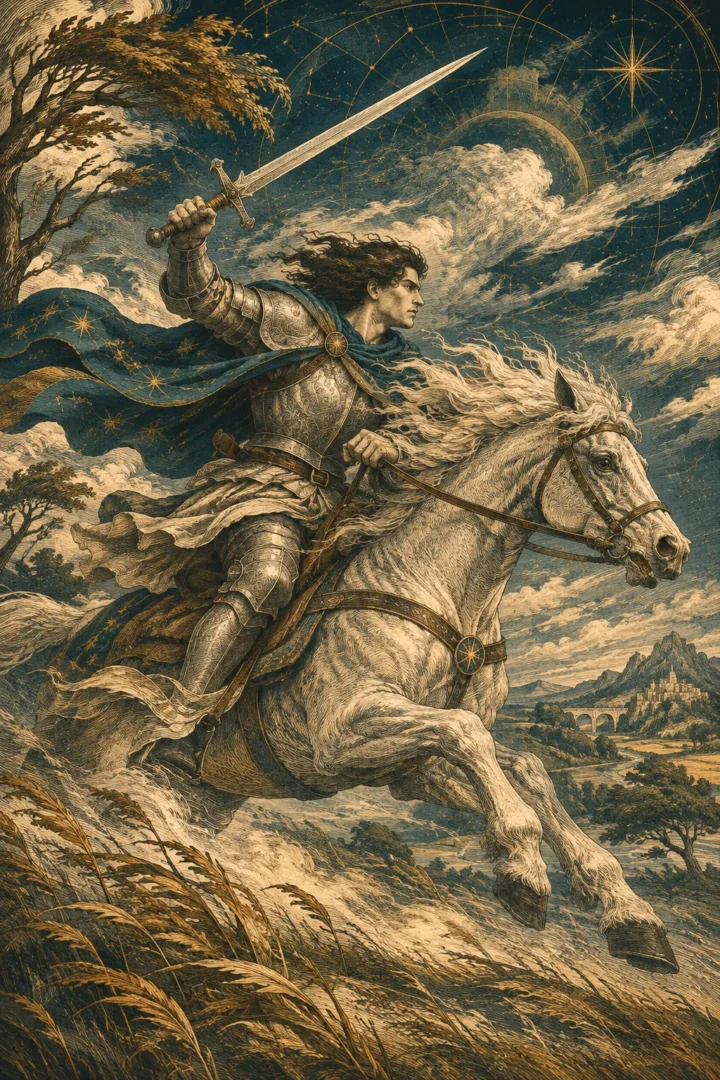 Knight · Knight of Swords
Upright meaning
decisive action, courage, swift thinking
Upright, the Knight of Swords brings urgency and a willingness to act on an idea. Its challenge is ensuring that speed serves a worthwhile purpose.
- decisive action
- courage
- swift thinking
Reversed meaning
rash decisions, conflict, scattered urgency
Reversed, the Knight can describe action that outruns judgment, a sharp argument, or the frustration of rushing without a clear direction.
- rash decisions
- conflict
- scattered urgency
Card symbolism
-
The charging horse
Smith depicts the armored rider moving at speed, emphasizing action already underway.
-
The sword held forward
The blade leads the movement, bringing thought, conviction, and conflict into the foreground.
-
Windblown trees and clouds
The landscape bends and races around the rider, giving urgency a visible form.
In depth interpretation
An armored rider drives a horse forward at full speed, sword raised against the wind. The trees bend, clouds race across the sky, and the landscape seems to rush past. The journey is already underway.
The Knight of Swords represents swift action, mental determination, direct communication, courage, and the danger of haste. Upright, it encourages a clear response when something needs doing. Reversed, it can reflect impulsiveness, harsh speech, scattered effort, or determination that has lost touch with its purpose.
The card’s energy is exhilarating. Its central question is whether you know what you are riding toward.
The spiritual meaning: conviction in motion
The Swords suit deals with ideas, judgment, and communication. The Knight puts those qualities on horseback. A thought has become an intention, and intention is becoming action.
Sometimes we need this courage. You may have delayed a necessary conversation, put off submitting an application, or waited for permission that will never arrive. The Knight invites movement where endless consideration has become a way of avoiding risk.
Yet speed can narrow attention. You may be eager to defend a truth and forget to listen. You may pursue a goal so fiercely that you fail to notice the people who will be affected.
Spiritual maturity here is the ability to act decisively while remaining answerable for your conduct. The Knight asks you to keep your values close enough to ride with you.
The symbols of the Knight of Swords
The horse in full charge
Smith depicts a horse and armored rider in powerful forward movement. There is little of the leisurely confidence of a traveler with time to spare. The card speaks to events that feel urgent.
A horse can carry intention over distance. It cannot decide whether the destination deserves the effort. In a reading, ask who is directing the movement and why.
The sword raised against the wind
The rider holds the sword high. The weapon suggests a conviction, argument, or mission carried into the world.
It may be the courage to state a difficult fact. It may also be the temptation to treat every disagreement as a fight. Consider the difference through your own circumstances.
Trees and clouds in motion
The wind seems strong enough to bend the landscape. The Air element of the Swords suit is palpable.
What happens to attention when the environment is moving quickly? The Knight may need to pause just long enough to notice a detail that changes everything.
When speed helps and when it hides uncertainty
The Knight can arrive when your mind is eager to turn a conviction into action. In an advice position, this can be an invitation to speak, submit the work, or defend a clear boundary. Yet an obstacle position may reveal rushing as a way of avoiding the discomfort of uncertainty. You are moving quickly because you do not want to stop and ask whether the direction is right.
With the Page of Swords, the Knight may need to learn more before charging. With Temperance, urgency can be shaped into sustained effort. Beside the Five of Swords, look carefully at the cost of turning every disagreement into combat.
Imagine receiving a message that angers you. The card does not automatically say to send the first reply that comes to mind. It asks whether the response you are about to make will still represent your values tomorrow.
Knight of Swords upright: the moment to act
Upright, the Knight may appear when a decision must be implemented, a message delivered, or a promising idea pursued with confidence. It can describe a person who responds quickly and speaks directly, though court cards are not restricted to literal people.
Imagine discovering a recurring error in a project that affects several colleagues. You document the facts, alert the right people, and organize a fix before the problem spreads. That is the Knight’s decisiveness with a useful purpose.
The card can also describe a phase of intense learning or advocacy. You may feel called to defend a principle or challenge an accepted view.
Action is most valuable when it remains open to correction. Leave enough room for evidence that complicates your first impression.
Knight of Swords reversed: when momentum turns into force
Reversed, the Knight may signal rushing into conflict, speaking before understanding, or scattering your energy across several urgent tasks. You might be trying to solve a problem faster than anyone can explain it.
Another possibility is being stuck behind a wall of frustration. You know you need to move, but every attempt begins with impatience and quickly becomes exhausting.
Waite’s older meanings include bravery and skill alongside hostility and resistance; his reversal warns of imprudence. Modern readings of impulsiveness deepen that tension.
Before acting, ask yourself what result would genuinely improve the situation. If you cannot state it clearly, the first task may be to slow down.
Knight of Swords in love and relationships
In love, the Knight can indicate intense conversation, direct interest, an eagerness to define a connection, or the arrival of change at a faster pace than expected.
In a feelings position, it may symbolize strong mental attention, determination, or agitation. It cannot prove that someone is about to declare love or send a message.
Reversed, conversations might become competitive or hurried. Notice whether both people have time to speak and whether the pace feels comfortable.
The Knight of Cups often approaches through feeling and imagination. The Knight of Swords moves through thought, argument, and direct action. A spread containing both may ask how these approaches can be balanced.
Work, ambition, and money
The Knight is well suited to moments demanding quick analysis, clear priorities, and assertive communication. It may describe a deadline, a bold proposal, or a fast-moving change.
Its shadow appears when urgency becomes a permanent way of operating. At work, identify what must happen today and what only feels urgent because it is emotionally charged.
Financially, avoid treating momentum as evidence that an investment or purchase is wise. Speed may be attractive, yet the terms still deserve careful review.
Worked reading: should I send that message now?
Imagine a colleague has made a decision without consulting you. You are angry and ready to reply immediately. You draw the Knight of Swords for your impulse, Justice for the principle, and Temperance for your approach.
The Knight recognizes the desire to act. Justice asks you to identify what was unfair and what you can substantiate. Temperance invites a measured tone that keeps the possibility of cooperation open.
Together, these cards suggest drafting the message, checking its facts, and sending it when you can name a constructive request. The point is not to suppress your conviction. It is to give that conviction a chance to be heard.
If Five of Swords appeared instead of Temperance, the reading would pay closer attention to escalation and the temptation to humiliate.
The Knight of Swords and the Golden Dawn’s mounted ruler
The Golden Dawn’s Book T names its mounted Swords figure the Knight of Swords while giving him the esoteric title Lord of the Wind and the Breezes: the King of the Spirits of Air. This senior mounted role is associated with Fire of Air. Smith’s Rider-Waite-Smith Knight also charges on horseback, making the visual relationship easy to recognize.
Across tarot schools, however, there are two common ways of mapping these courts. Matching the horses associates Waite’s Knight with the Golden Dawn’s mounted ruler. Matching by court rank associates Waite’s Knight with the Golden Dawn Prince. Neither method should be passed off as the only historical reading.
Waite emphasizes bravery and speed alongside anger and destructive force. In this article, those qualities are interpreted primarily through Smith’s rider. The esoteric title adds context without determining what a particular person will do.
Knight of Swords as advice: give courage a direction
Write one sentence stating what you want your action to accomplish. Under it, list the two facts most important to that outcome.
If you can act now with care, move. If your urgency is being fueled by anger alone, give the feeling room to settle before it makes a decision for you.
Is the Knight of Swords a yes or no card?
It may favor decisive action when a clear plan and trustworthy information are already in place. Reversed, it encourages you to check whether haste is increasing the risk.
Frequently asked questions
Does the Knight of Swords mean fast communication?
It can symbolize a direct message or rapidly developing conversation, but it cannot guarantee that a particular person will contact you.
Is the Knight of Swords aggressive?
The card includes boldness and conflict among its possibilities. Strong energy can serve protection or problem-solving as well as argument. Context matters.
Does Knight of Swords reversed mean a fight?
It may reflect tension or careless words, but it is not a fixed prediction of an argument.
How is the Knight different from the Chariot?
The Chariot often concerns disciplined direction and the work of integrating opposing forces. The Knight of Swords concentrates on swift intellectual action and its immediate consequences.
Tradition note: This reading centers on Pamela Colman Smith’s Rider-Waite-Smith Knight and Waite’s descriptions. The Golden Dawn courts use different rank conventions, so this article avoids equating them directly.

Keep reading
Explore the Swords
Every card page names the tradition behind each meaning, so you can compare readings instead of taking one as fixed.
Cards to explore alongside this one
Their symbols reveal useful similarities and differences for your next reading.
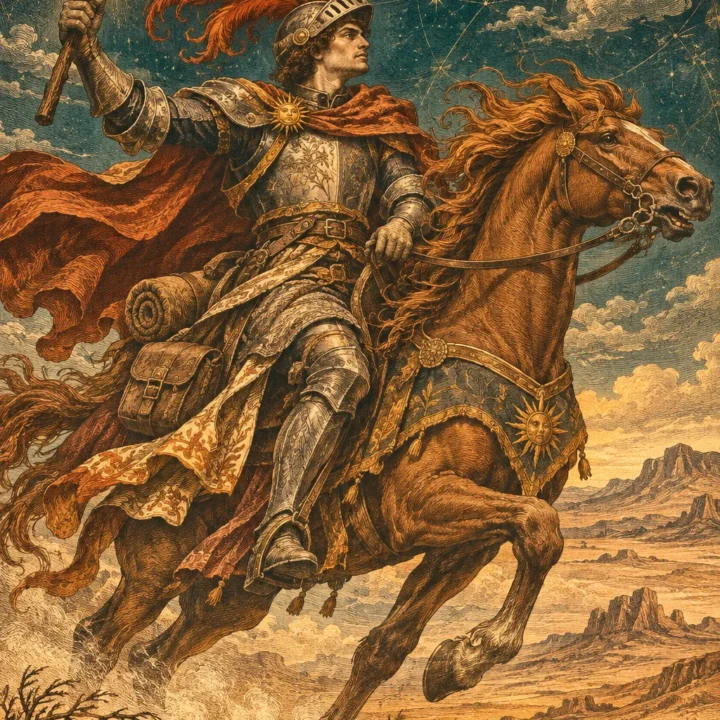
Knight of Wands
movement, passion, initiative, adventure
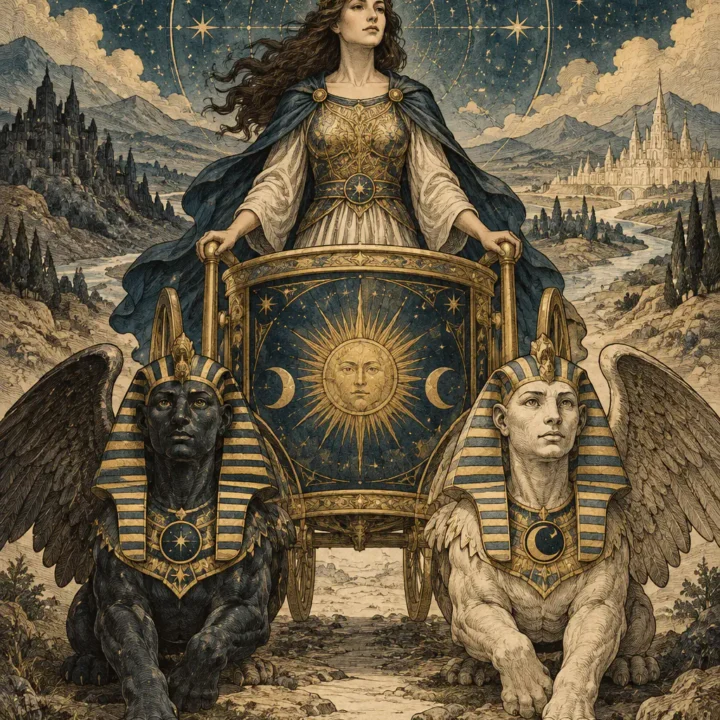
The Chariot
resolve, direction, self-command, movement
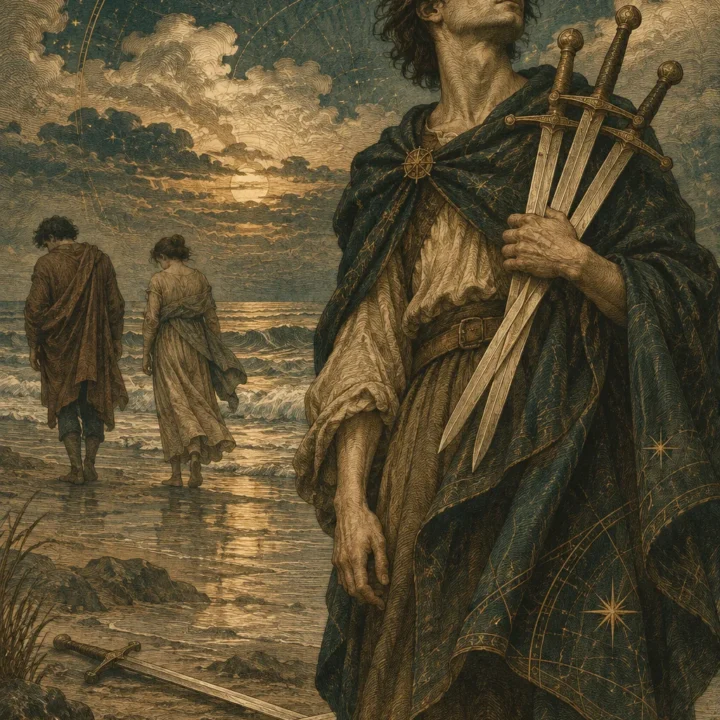
Five of Swords
conflict, hollow victory, hurt pride, defeat
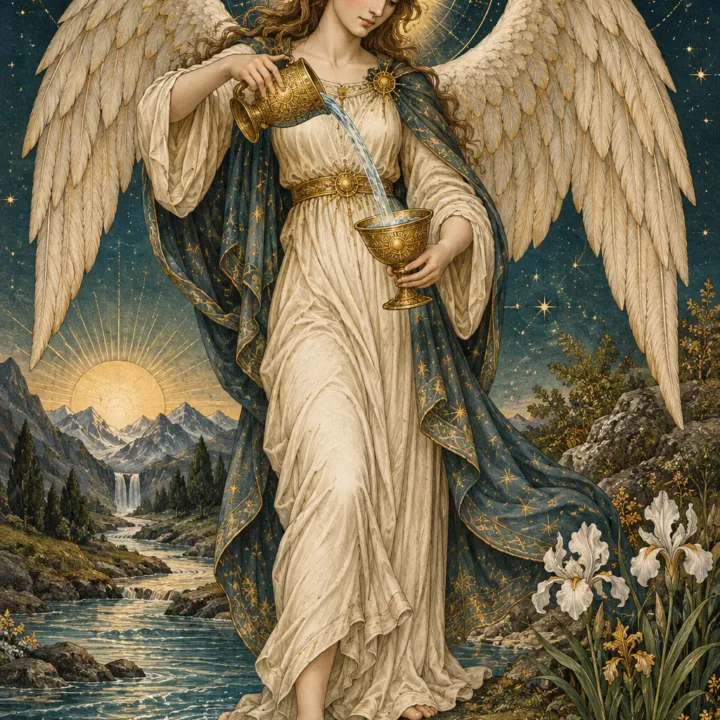
Temperance
moderation, integration, proportion, harmony
Sources and further reading
- A. E. Waite, The Pictorial Key to the Tarot, Part III (Swords, Knight of Swords) Read the text
- Golden Dawn, Book T, tarot titles, attributions, and card descriptions Read the text
- The Morgan Library & Museum, Pamela Colman Smith and her tarot art Read the text
- Victoria and Albert Museum, A History of Tarot Cards Read the text