Seven of Wands Tarot Card Meaning
A solitary figure holds the high ground as six staffs rise toward him. The Seven of Wands asks what deserves your defense and whether your position is truly sound.
- courage
- opposition
- defending a position
- competitive advantage
- debate
Card at a glance
- Number
- Seven
- Element
- Fire
- Astrology
- Lord of Valour, Mars in Leo (Golden Dawn)
- Keywords
- courage, opposition, defending a position, competitive advantage, debate, perseverance
 Seven · Seven of Wands
Upright meaning
Courage, opposition and defending a position
Upright, the Seven often appears when you need to defend something already underway. You might be explaining a difficult decision, protecting time for important work, or standing up for a person whose needs are being overlooked. Imagine opening a small neighborhood music program. After a successful first season, several people want it to serve different audiences. Some suggestions are useful; others would erase the original purpose. The Seven invites you to remember why you began and to speak clearly about what the program can offer. You have enough experience now to explain your choice. The card is also connected with negotiation and verbal debate in Waite's account. You may need to present evidence, understand other interests, and decide what you can reasonably change. A firm response can include room for correction. Success is possible in this card, as the height suggests. It remains conditional. The figure must act wisely, and the world beyond the frame still has a part to play.
- Courage
- Opposition
- Defending a position
- Competitive advantage
- Debate
- Perseverance
Reversed meaning
Anxiety, uncertainty and indecision
The reversed Seven of Wands can feel like standing on a hill while suddenly forgetting why you climbed it. The questions keep coming, and your certainty begins to fray. In Waite's older interpretation, the reversal emphasizes perplexity, embarrassment, anxiety, and indecision. Those meanings focus on the person's response to opposition. Contemporary readings often emphasize exhaustion, difficulty asserting oneself, or giving ground too quickly. These approaches can meet in a person who has a defensible position but is struggling to choose a response. They can also describe different situations. Someone who is overwhelmed by repeated unfair demands may need practical support. Someone who has become defensive about every question may need space to examine their assumptions. There is a useful limit to the card's encouragement. Holding your ground is not always the right outcome. If you discover that a position harms others or no longer reflects your values, changing it can be a responsible choice. The Seven asks you to understand the ground beneath your feet.
- Anxiety
- Uncertainty
- Indecision
- Overwhelm
- Yielding
- Defensiveness
Card symbolism
-
The high ground is an advantage, not a moral verdict
The figure stands above his opponents on a craggy rise.
-
The six unseen challengers
Only their staffs enter the picture.
-
The uneven ground and mismatched footwear
The figure's footing is awkward, and his shoes appear different in Smith's image.
In depth interpretation
A young figure stands on a rocky rise, his staff raised across his body. Six more staffs climb toward him from below, held by opponents we cannot see. His high position offers an advantage, but his footing looks hurried. He has the strange courage of someone who must decide what to defend while the challenge is already underway.
The Seven of Wands represents courage, opposition, defending progress, and holding a position when others challenge it. Upright, it often asks you to stand behind a considered choice or protect something you have built. Reversed, it can bring uncertainty, exhaustion, and difficulty deciding how to respond. The card offers encouragement, but the outcome still depends on what you do with the advantage you hold.
Look again at the figure on the hill. His view is wider than that of his challengers. Is he using it to see clearly?
The spiritual meaning: courage after recognition
There is a particular vulnerability in becoming visible. You finish a project, find your voice, or make a choice that matters deeply to you. Other people notice. Some celebrate with you. Others have questions, competing interests, or expectations you had not anticipated.
The Seven of Wands meets you on that exposed ground. In the numbered Wands sequence, it follows the Six of Wands, where a rider is publicly honored. The progression offers a useful interpretive story: success can attract scrutiny, and recognition may require you to decide what you are prepared to stand behind. The Eight of Wands then brings a different challenge, when events move quickly enough that timing becomes part of the reading.
The figure in Smith's painting has the higher ground. He has a real advantage, yet he remains active and alert. Courage here is the willingness to engage with a challenge using the resources available to you.
The card is especially meaningful when you feel outnumbered. Six staffs approach one person, but we know nothing about the people holding them. Some objections may be unkind. Others may be necessary questions. If you draw this card, let it help you name the actual pressure you face before assigning every challenger the same intention.
You have something worth considering from that high place: your experience, your relationships, your work, and the reasons you made your choice.
What the symbols reveal
The high ground is an advantage, not a moral verdict
The figure stands above his opponents on a craggy rise. A. E. Waite associated this placement with a possible victory because the challengers may struggle to reach him. He also applied the image to discussion, trade negotiations, and competition.
That gives the Seven a more specific meaning than simply "setting boundaries." You may have evidence, a respected position, or resources that help you respond to a difficult question. The high ground describes your circumstances. The image does not tell us whether your argument is fair.
This distinction matters when you consult tarot about a dispute. A reader may feel certain that the Seven proves they are right because the figure stands above the others. It does not. The valuable question is how to use an advantageous position responsibly.
The six unseen challengers
Only their staffs enter the picture. Their faces, motives, and numbers beyond the visible staffs remain unknown. Smith allows the pressure to feel immediate while leaving important information outside the frame.
That is a vivid metaphor for situations where criticism arrives from several directions. An email, a remark, and a difficult conversation can begin to feel like an entire world turning against you. Notice which challenges are real, which are imagined, and which deserve an answer.
If you are facing unfair treatment, the card can support a clearer account of what happened. If someone has raised a legitimate concern, courage may involve hearing it fully.
The uneven ground and mismatched footwear
The figure's footing is awkward, and his shoes appear different in Smith's image. Some modern interpreters see that as a sign that he has been caught unprepared. Waite's written card description does not assign that detail a fixed meaning.
It can still be useful as visual reflection. You may be capable of defending a decision while feeling surprised by the moment. Preparation, support, and a steadier way of standing can help.
The body tells a story that the raised wand alone cannot: even a favorable position asks for effort.
Seven of Wands upright meaning
Upright, the Seven often appears when you need to defend something already underway. You might be explaining a difficult decision, protecting time for important work, or standing up for a person whose needs are being overlooked.
Imagine opening a small neighborhood music program. After a successful first season, several people want it to serve different audiences. Some suggestions are useful; others would erase the original purpose. The Seven invites you to remember why you began and to speak clearly about what the program can offer. You have enough experience now to explain your choice.
The card is also connected with negotiation and verbal debate in Waite's account. You may need to present evidence, understand other interests, and decide what you can reasonably change. A firm response can include room for correction.
Success is possible in this card, as the height suggests. It remains conditional. The figure must act wisely, and the world beyond the frame still has a part to play.
Seven of Wands reversed meaning
The reversed Seven of Wands can feel like standing on a hill while suddenly forgetting why you climbed it. The questions keep coming, and your certainty begins to fray.
In Waite's older interpretation, the reversal emphasizes perplexity, embarrassment, anxiety, and indecision. Those meanings focus on the person's response to opposition. Contemporary readings often emphasize exhaustion, difficulty asserting oneself, or giving ground too quickly.
These approaches can meet in a person who has a defensible position but is struggling to choose a response. They can also describe different situations. Someone who is overwhelmed by repeated unfair demands may need practical support. Someone who has become defensive about every question may need space to examine their assumptions.
There is a useful limit to the card's encouragement. Holding your ground is not always the right outcome. If you discover that a position harms others or no longer reflects your values, changing it can be a responsible choice. The Seven asks you to understand the ground beneath your feet.
How is the Seven of Wands different from the Five and Nine?
Three Wands cards can describe struggle, but their images tell different stories.
The Five of Wands shows a group of figures caught in a crowded contest without a clear advantage or result. The Seven isolates one person on higher ground, asking how they will answer challenges to a position. The Nine of Wands depicts someone already wounded and watchful, with the experience of earlier difficulty written on their body.
That sequence helps refine a reading. If you are considering an unfamiliar competition, the Five may be closest to your question. If you have already earned a place and now face objections, the Seven brings the clearer image. If prolonged resistance has left you exhausted and cautious, the Nine asks how you are recovering.
A spread can include several of these energies at once. Let each picture contribute its own part of the story.
Seven of Wands in love and relationships
In love, this card commonly relates to boundaries and pressure on a connection. A couple may be deciding how to handle opinions from relatives, competing responsibilities, or a disagreement about the kind of life they want together.
If you are dating, consider whether you can express your preferences without having to fight for basic respect. Mutual consent and the freedom to disagree matter more than the romance of "fighting for love."
In an established relationship, the Seven can support a conversation about what you want to protect. Perhaps you need regular time together, or space for individual interests. Its shadow appears when every honest question becomes an attack in one person's eyes.
Reversed, ask whether you are exhausted by avoidable arguments or giving up important needs to prevent conflict. A tarot card cannot tell you that your partner is secretly defending the relationship. Their communication and behavior reveal what they are actually willing to do.
Seven of Wands as feelings
As feelings, the Seven may suggest guardedness, determination, or a desire to protect one's position. It can also describe the reader's own experience of feeling challenged. Without direct communication, it cannot establish another person's intentions.
Seven of Wands for career and money
At work, the Seven can appear when you are defending a proposal, negotiating responsibilities, or responding to criticism after a visible success. It is particularly useful when you can explain the value of your approach from experience.
Suppose you lead a project that has attracted several last-minute requests. You may need to clarify which changes support the goal and which would undermine what the team has agreed to deliver. That is an example of making use of your vantage point.
For money, the card may symbolize protecting your budget, negotiating a fair agreement, or resisting pressure to spend. It is no substitute for knowing the terms or seeking financial and legal guidance when necessary.
Reversed, pay attention to confusion about what you have agreed to or whether you are carrying the whole dispute alone. Written expectations and trustworthy advice can provide more help than another round of argument.
Mars in Leo and the Lord of Valour
In the Golden Dawn's Book T, the Seven of Wands bears the title Lord of Valour and corresponds to Mars in Leo. Its description connects the possibility of victory with courage exercised in the face of opposition. The same historical text includes quarrelling and threats among the card's difficult expressions.
The Golden Dawn's drawing uses crossed staffs and a central wand, rather than Smith's lone person on a hill. The two traditions are related but have distinct imagery. Together, they give the card a richer spiritual question: how can strength remain purposeful when pride or fear tries to direct it?
You may find this card in a season when speaking calmly feels harder than raising your voice. Courage may begin with understanding what you truly need to say.
Worked tarot reading: should I defend my idea at work?
Imagine asking whether to defend a proposal that colleagues have challenged. You draw the Seven of Wands for the situation, Justice for the central question, and the Three of Pentacles for advice.
The Seven shows that you have a position to explain and a degree of advantage from the work you have already done. Justice invites scrutiny of the decision itself. Does it treat the people involved fairly, and can you support the reasoning with evidence? The Three of Pentacles draws attention to collaboration and the skills other people bring.
Read together, the cards suggest that you should prepare your argument and remain open to specific improvements. The Seven supplies courage, Justice gives the argument a standard to meet, and the Three asks whether the outcome will benefit from other people's expertise.
If the Seven appeared with the Four of Pentacles instead, you might reflect on whether protecting a position has become protecting control for its own sake. The cards can illuminate motives, but they do not decide who is right.
Seven of Wands as advice: choose the ground
Look closely at the six approaching staffs. Write down the real questions or demands you face, one per line. Beside each, name what it asks of you and whether it affects something you truly value.
Then study the place where the figure stands. What gives you a good vantage point? Perhaps it is experience, a clear agreement, or support from someone who understands the situation.
Choose one challenge worth addressing first. If a conversation is safe, speak plainly and listen carefully to the reply. If pressure has become harmful, seek practical support. Courage becomes more useful when you know what it is serving.
Is the Seven of Wands a yes or no card?
The Seven of Wands leans toward a conditional yes when the question concerns defending a well-considered position. It suggests that opposition is part of the situation and that your choices will matter. Reversed, reconsider how much uncertainty or exhaustion is affecting the decision. The card does not guarantee victory.
A brief note on tradition
Pamela Colman Smith illustrated the Seven of Wands for the Rider-Waite-Smith deck first published in 1909. Waite interpreted the figure's elevated position through courage, debate, commerce, and possible success. His reversed meanings focused on anxiety and indecision. The Golden Dawn's Book T titled the card Lord of Valour, with Mars in Leo. Modern readings commonly extend the imagery to boundaries, overwhelm, and defensiveness.
Frequently asked questions
Does the Seven of Wands mean I will win?
The figure holds a promising position, and Waite associated the card with possible success. It cannot guarantee a result. A good vantage point helps only when you understand the challenge and respond appropriately.
Does the Seven of Wands mean someone is jealous of me?
Competition may be relevant to a question about others' reactions, but the card cannot establish jealousy or hidden motives. The opposition in the artwork is deliberately unseen.
What do the mismatched shoes mean?
Some contemporary readers see them as a detail of hurried preparation or uncertain footing. It is a visual interpretation, not a meaning explicitly given by Waite. The more useful question is whether you feel ready to defend your position.
What is the difference between the Seven of Wands and Strength?
The Seven depicts external pressure and an active stand. Strength explores courage, gentleness, and our relationship with intense inner forces. Together, the cards can invite a firm response guided by compassion.

Keep reading
Explore the Wands
Every card page names the tradition behind each meaning, so you can compare readings instead of taking one as fixed.
Cards to explore alongside this one
Their symbols reveal useful similarities and differences for your next reading.
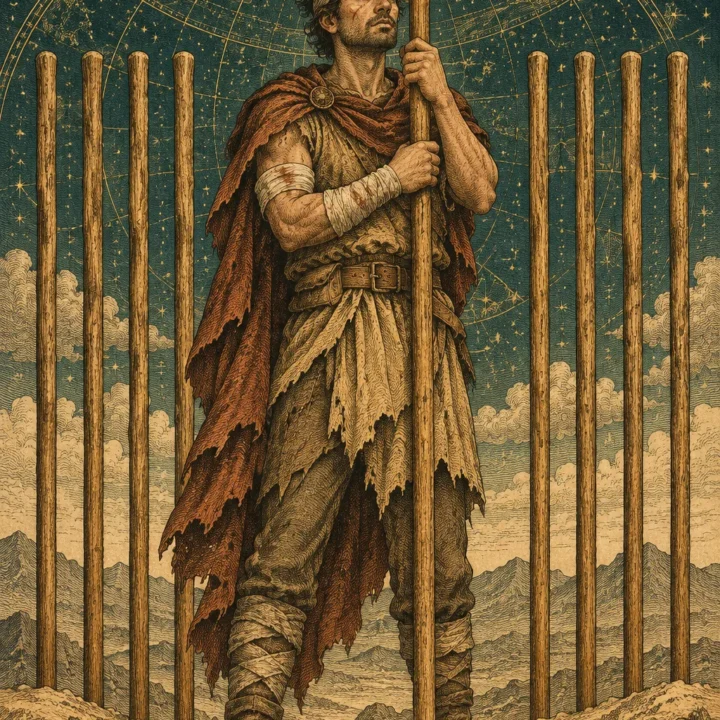
Nine of Wands
strength under pressure, vigilance, perseverance, resilience
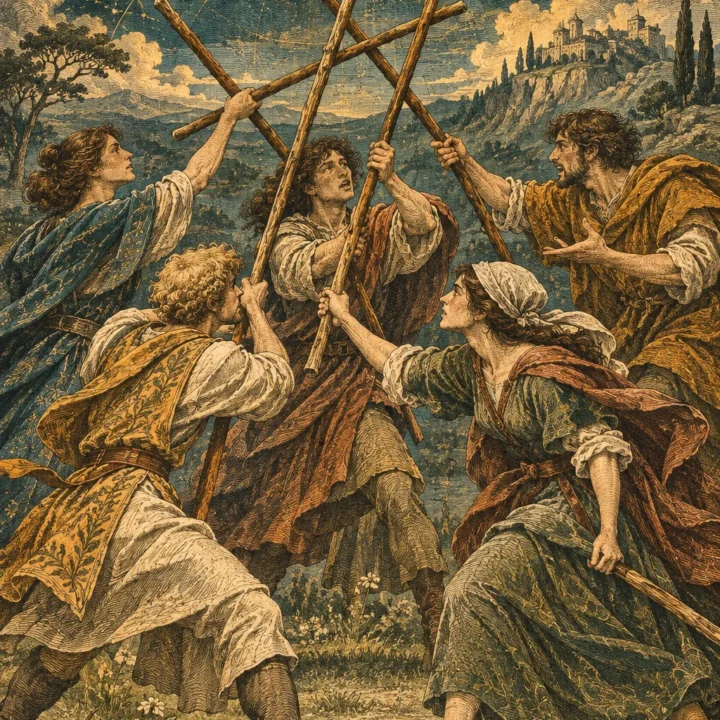
Five of Wands
rivalry, strife, competition, disagreement

Strength
courage, compassion, patience, steadiness

Queen of Swords
discernment, boundaries, truthful compassion, independence
Sources and further reading
- A. E. Waite, The Pictorial Key to the Tarot, Seven of Wands Read the text
- Golden Dawn, Book T, Lord of Valour, Mars in Leo Read the text
- Biddy Tarot, Seven of Wands, contemporary meanings and card description Read the text
- Labyrinthos, Seven of Wands and its imagery across decks Read the text