Justice Tarot Card Meaning
A crowned figure holds balanced scales and an upright sword. Explore how Justice invites honest decisions, fair treatment, and a clearer view of responsibility.
- fairness
- honesty
- accountability
- clarity
- considered decisions
Card at a glance
- Number
- XI
- Element
- Air
- Astrology
- Libra (Golden Dawn)
- Keywords
- fairness, honesty, accountability, clarity, considered decisions
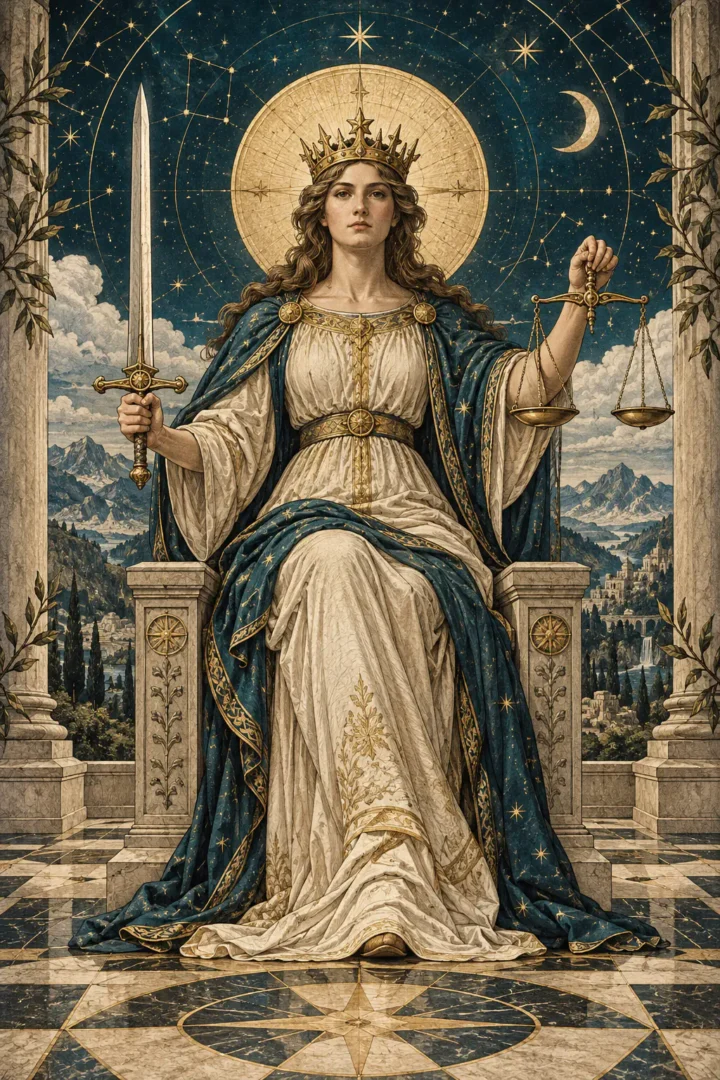 XI · Justice
Upright meaning
Fairness, honesty and accountability
Upright, Justice often appears when honesty and careful judgment are especially important. A decision may have consequences for another person, or you may be entering an agreement whose terms deserve close attention.
- Fairness
- Honesty
- Accountability
- Clarity
- Considered decisions
Reversed meaning
Bias, injustice and avoidance
Reversed, Justice may describe a story being told from only one angle. Important information has been ignored, a judgment rests on an assumption, or someone with power is using different rules for different people.
- Bias
- Injustice
- Avoidance
- One-sided judgments
- Dishonesty
Card symbolism
-
The scales
Justice holds an old symbol of measured judgment. The two pans invite comparison and proportion.
-
The raised sword
The sword stands upright beside the figure’s head. It evokes a decision that can finally be spoken aloud.
-
The pillars and purple veil
Two pillars frame the throne, with a veil stretched behind it. The setting recalls the seated figure of The High Priestess, although the atmosphere here is more public and deliberate.
-
The robe, mantle, and crown
The figure wears a red robe and a green mantle, with a crown above a composed face. The strong colors give her presence weight and dignity.
In depth interpretation
A crowned figure sits between two pillars, a sword held upright in one hand and a pair of scales in the other. Behind the throne hangs a purple veil. The scales are balanced, though we cannot see what has been weighed. The sword catches the light with a sharper certainty than anything else in the room.
Justice is the tarot card of fairness, truth, responsibility, and decisions that carry consequences. Upright, it often suggests a moment for clear judgment and honest agreements. Reversed, it may reveal bias, withheld information, unfair treatment, or a difficulty accepting your part in what has happened.
If you drew Justice, look at the scales. What belongs on them that you have been leaving out of the story?
The spiritual meaning of Justice
You may remember a moment when you desperately wanted to be understood. You explained your side of an argument, expecting the other person to recognize how unfairly you had been treated. Then they described something you had missed. The situation became more complicated, and perhaps a little more honest.
Justice holds space for those difficult moments of recognition. Its spiritual teaching begins with a willingness to look carefully at what happened, including the part we would rather avoid. An apology, a fair decision, or a boundary often grows from that more complete view.
The card also asks a deeper question about the world around us. People do not always receive fair treatment. Institutions can be biased, and power is not shared equally. If you have been harmed, Justice does not ask you to discover a secret way you deserved it. The image can help you name an imbalance and consider what support or repair may be possible.
There is tenderness in a truthful accounting, even when the result is uncomfortable. You may discover that you were carrying responsibility that belonged to someone else. Or you may find one small thing you can put right. The scales invite you to weigh what is actually there.
A useful companion is the King of Swords. Justice asks what would make a judgment fair; the King places that judgment in the hands of someone who must answer for it. Together, they invite you to think about who has authority in your situation and whether the process allows for correction.
The symbols in Justice
In Pamela Colman Smith’s Rider-Waite-Smith illustration, Justice is a seated figure with a remarkably simple set of objects. Every detail contributes to the atmosphere of a decision about to be made.
The scales
Justice holds an old symbol of measured judgment. The two pans invite comparison and proportion. In a reading, they can draw attention to an agreement where one person gives far more than another, or a decision being made without enough information.
You might ask whether both sides have had a chance to speak. The answer can change the entire meaning of a conflict, especially when everyone involved is certain of their own account.
The raised sword
The sword stands upright beside the figure’s head. It evokes a decision that can finally be spoken aloud. Swords in tarot frequently concern thought, language, and discernment; here, the weapon’s formal position gives those qualities moral weight.
A decision often changes relationships or obligations. The sword asks you to consider how you will express your judgment and whether you are prepared to stand by it once the room falls quiet.
The pillars and purple veil
Two pillars frame the throne, with a veil stretched behind it. The setting recalls the seated figure of The High Priestess, although the atmosphere here is more public and deliberate. In the Rider-Waite-Smith symbolism, Justice attends to the practical moral world in which decisions affect other people.
The veil reminds us that motives and circumstances may remain partly unseen. You can make a careful decision while admitting that your knowledge has limits.
The robe, mantle, and crown
The figure wears a red robe and a green mantle, with a crown above a composed face. The strong colors give her presence weight and dignity. She seems prepared to act after considering what is before her.
When this image appears during a painful dispute, notice the steadiness of her posture. You can be firm about what happened while allowing yourself time to choose the next step.
Justice upright meaning
Upright, Justice often appears when honesty and careful judgment are especially important. A decision may have consequences for another person, or you may be entering an agreement whose terms deserve close attention.
Imagine discovering that a close friend was hurt by something you said in public. Your first reaction may be to defend your intentions. Justice could encourage you to ask what was heard, listen to the impact, and decide whether you owe an apology. A more truthful conversation becomes possible once both experiences are acknowledged.
The card can also support advocacy. Perhaps someone is being treated unfairly at work, or a family arrangement has left one person carrying an unreasonable burden. Justice encourages the work of gathering facts and considering what would help restore fair treatment.
Justice reversed meaning
Reversed, Justice may describe a story being told from only one angle. Important information has been ignored, a judgment rests on an assumption, or someone with power is using different rules for different people.
The imbalance can also happen within you. You might punish yourself for a mistake long after making amends, or excuse your own behavior because you can explain why you were upset. The reversal invites a more accurate account of what happened and what remains unresolved.
When the unfairness is external, consider the resources available to you. Keep records, seek reliable advice, and ask for support where appropriate. The card cannot settle a dispute, but it can help you recognize which questions deserve a proper answer.
Justice in love and relationships
In love, Justice is often concerned with reciprocity. Two people may care deeply for each other while discovering that their daily responsibilities are uneven. One manages most of the appointments, family visits, or household decisions. The other may not realize how much invisible work has accumulated.
A Justice reading can open a conversation about the agreements you have made and the ones you have simply fallen into. Perhaps both partners need clearer expectations or a way to make repairs after conflict.
For someone dating, this card may invite attention to consistency. Does the person speak respectfully when you disagree? Are promises matched by actions? Reversed, Justice can reflect dishonesty, unequal effort, or a recurring dispute that needs more than another apology.
Justice as feelings
Asked about someone’s feelings, Justice may suggest a person thinking carefully about the relationship or weighing the responsibilities that come with it. They could be considering whether the connection is fair, sustainable, or aligned with what they believe is right.
The card cannot tell you their private verdict. If you need to know whether they intend to commit, discuss it directly. Your own feelings belong on the scales as well.
Justice for career and work
At work, Justice often appears around evaluations, agreements, professional standards, and situations where someone must make a consequential decision. A promotion process may need transparent criteria. A team may be reviewing how work and recognition are distributed.
Picture a manager responding to a complaint from two colleagues. Each tells a convincing story. Justice would encourage the manager to ask what happened, examine the relevant records, and let both people explain their experience. Fairness may require correcting the process that led to the conflict.
Reversed, the card can expose inconsistent expectations, discrimination, or pressure to overlook an ethical concern. Where your rights or livelihood may be affected, check the relevant policies and seek qualified guidance.
Justice for money and legal matters
In money readings, Justice often brings attention to agreements, debts, purchases, and the obligations we accept when we sign our names. It can be a useful prompt to read the terms carefully and discuss shared expenses openly.
The image is also associated with legal proceedings because its scales and sword resemble familiar symbols of law. Drawing Justice does not establish who will win a case, whether a contract is enforceable, or when a ruling will arrive. Those questions require evidence and advice from appropriate professionals.
A reversed Justice card can reflect a concern about unfair terms or a payment dispute. Document the facts you know and consider how the situation might be addressed through the channels available to you.
Justice in spiritual practice
Justice can become a contemplative practice of honest self-examination. You might look back on a difficult day and ask where you acted according to your values, where you lost your way, and whether a relationship needs repair.
Some readers connect the card with karma. That word carries specific meanings within Hindu, Buddhist, and other religious traditions, while popular tarot often uses it loosely to mean that everyone gets what they deserve. The image of Justice offers ample room for reflection on consequence without assuming that suffering is a punishment from the universe.
For readers who use Golden Dawn correspondences, Justice is linked with Libra, the zodiac sign symbolized by scales. The connection emphasizes proportion and relationship within that esoteric system.
Justice as advice: the two pans
Place Justice in front of you and name a decision or disagreement. Draw two columns on a sheet of paper. In the first, write what you know directly: words, actions, dates, agreements, or commitments. In the second, write what you have inferred or what remains uncertain.
Look over the page. Is there something you need to ask, verify, or acknowledge? If another person is involved, consider whether they have had an opportunity to tell their side in a way that feels safe.
Below the two columns, write one sentence beginning, ‘A fair next step would be…’ Choose an action within your responsibility. The exercise may help you make a more careful choice even when the full situation remains unresolved.
Is Justice a yes or no card?
Justice often leans yes when a question concerns truthful communication, transparent agreements, or a fair process. The answer is less definite when you are asking whether another person or institution will behave fairly. Reversed, it may suggest that missing information or an imbalance should be addressed before you proceed.
How to read Justice in a tarot spread
The position helps identify where an accounting is needed. In the past, Justice may point to an agreement or decision that still shapes the present. As a challenge, it can reveal bias or reluctance to take responsibility. As an outcome, it may suggest a decision, agreement, or clearer understanding whose actual fairness depends on circumstances.
Imagine asking how to repair a friendship after a disagreement. You draw Justice as the present, the Page of Swords as advice, and the Six of Pentacles as a possible direction. You might read this as a need to examine what happened carefully, approach the conversation with curiosity, and work toward a more balanced exchange. The cards offer guidance for how you participate; they cannot promise the friend’s response.
A brief note on tarot tradition
Pamela Colman Smith illustrated Justice for the Rider-Waite-Smith deck first published in 1909. Its upright sword, scales, pillars, and seated figure draw on older European images of the virtue of Justice. Waite distinguished this card’s moral and practical concerns from the more concealed spiritual mysteries represented by The High Priestess.
Justice is numbered XI in the Rider-Waite-Smith deck, while many Tarot de Marseille decks place it at VIII. The Golden Dawn assigns Justice to Libra. Readers using different decks may encounter different numbering conventions or interpretive emphases.
Frequently asked questions
Does Justice mean a court case will go in my favor?
The card can be meaningful when you are facing a legal or formal decision, but it cannot predict a verdict. Review the available evidence and seek advice suited to the situation.
Is Justice the same as Judgement in tarot?
They are separate Major Arcana cards. Justice focuses on fairness, decisions, and accountability. Judgement often concerns awakening, calling, and responding to a moment of reckoning or renewal.
Why is Justice card XI in some decks and VIII in others?
The Rider-Waite-Smith deck follows the numbering that places Strength at VIII and Justice at XI. Many Marseille-style decks retain Justice at VIII and Strength at XI. The image and title are more reliable guides than the number alone.
Can Justice mean I need to apologize?
It can, when you recognize that your actions caused harm. The card may also help you see when you have been assuming responsibility for someone else’s choices. Ask what you can truthfully acknowledge and what repair is possible.

Keep reading
Explore the Major Arcana
Every card page names the tradition behind each meaning, so you can compare readings instead of taking one as fixed.
Cards to explore alongside this one
Their symbols reveal useful similarities and differences for your next reading.

King of Swords
authority, judgment, clear thinking, responsibility
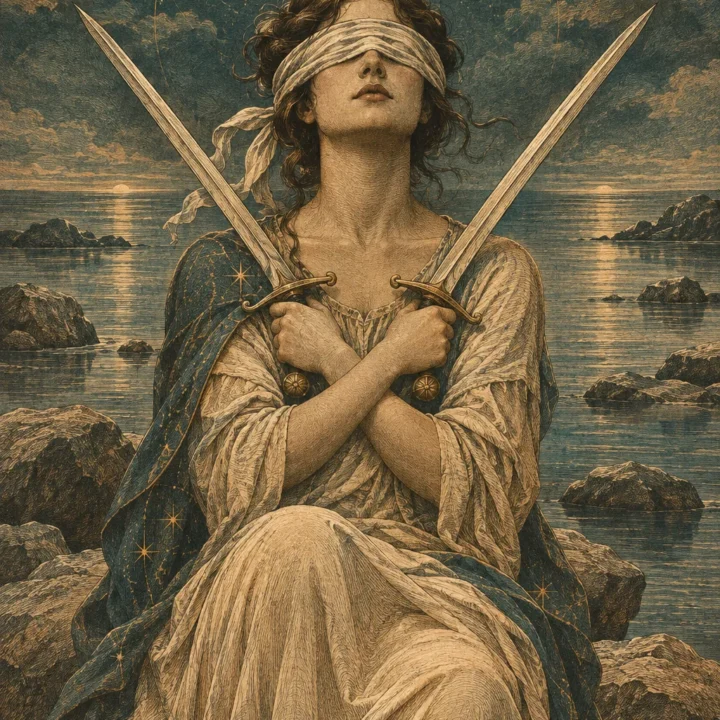
Two of Swords
indecision, guarded peace, boundaries, suspended choice
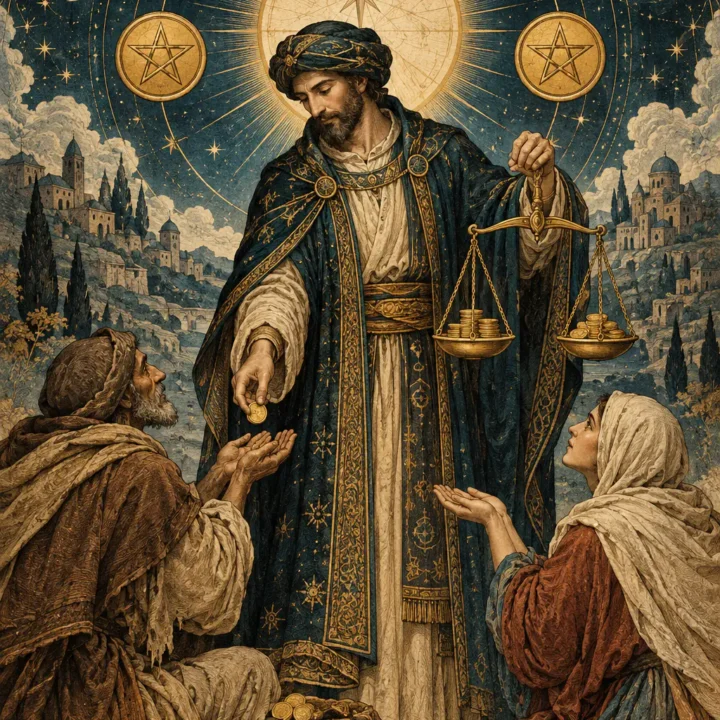
Six of Pentacles
generosity, assistance, reciprocity, shared resources

The Emperor
structure, reliability, discipline, leadership
Sources and further reading
- Arthur Edward Waite, The Pictorial Key to the Tarot, Part II, Justice Read the text
- Arthur Edward Waite, The Pictorial Key to the Tarot, Part III, divinatory meanings Read the text
- Golden Dawn, Notes on the Tarot, Justice/Libra Read the text
- Victoria and Albert Museum, A history of tarot cards Read the text