Four of Wands Tarot Card Meaning
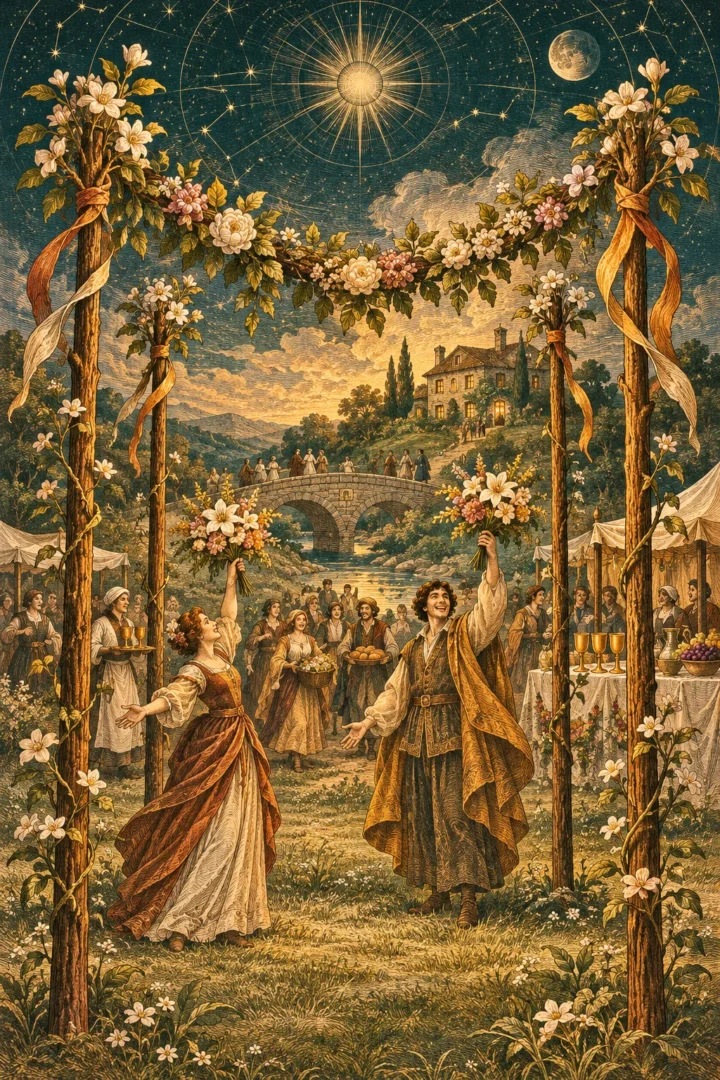
Under a garland of flowers, people gather beside a bridge leading home. The Four of Wands celebrates the joy of belonging and the harmony that survives even its historical reversal.
- welcome
- celebration
- peace
- refuge
- harmony
Card at a glance
- Number
- Four
- Element
- Fire
- Astrology
- Lord of Perfected Work, Venus in Aries (Golden Dawn)
- Keywords
- welcome, celebration, peace, refuge, harmony, community, completion
 Four · Four of Wands
Upright meaning
Welcome, celebration and peace
Upright, the Four of Wands often marks a stage when an effort has produced something worth recognizing. You might move into a home, celebrate a commitment, finish a difficult project, or discover that the community around you has become a real source of support. Imagine a group of volunteers who have worked for months to restore a neglected neighborhood garden. On the first evening it is ready, they bring folding chairs and share a simple meal. The flowers are still small, and there is more work to come. Yet the gathering matters because the place now belongs to everyone who helped make it. The Four encourages you to mark such moments without waiting for every future problem to be solved. Completion in this card can mean that a particular stage is settled enough to celebrate. It also brings a gentle responsibility. If you have found a refuge, how will you help care for it? A welcoming home is sustained through the ordinary ways people listen, contribute, and make room for one another.
- Welcome
- Celebration
- Peace
- Refuge
- Harmony
- Community
- Completion
Reversed meaning
Private celebrations, disrupted plans and belonging that needs care
Here is one of the most useful distinctions in the Four of Wands' history. In The Pictorial Key to the Tarot, Waite explicitly says that its reversed meaning remains unchanged. He goes on to associate the reversed card with prosperity, increased happiness, beauty, and adornment. Many contemporary tarot guides follow a different reversal method. They treat a reversed card as a blocked, delayed, private, or shadowed version of its upright theme. In those readings, the reversed Four might describe an event that has been postponed, a home that needs attention, or a milestone celebrated quietly. Both approaches exist in tarot practice, though they should not be presented as if Waite taught the modern negative reversal. His interpretation was distinctly favorable. Consider two situations. If a couple postpones their wedding because the arrangements have become overwhelming, a modern reversed reading about delayed celebration may fit. If someone has finally made their home welcoming after a long unsettled period, Waite's continued positive meaning could offer a meaningful lens. A useful approach is to decide how you treat reversals in your deck, then read the card in the context of the question and its neighbors. The upside-down orientation alone does not establish that a relationship or household is in trouble.
- Private celebrations
- Disrupted plans
- Belonging that needs care
Card symbolism
-
Four staffs and a flowering garland
The wands stand planted in the foreground, bearing a garland high between them.
-
Two people lifting bouquets
Two figures hold flowers aloft in the middle distance.
-
The bridge, moat, and old house
Waite's own description points out a bridge over a moat leading to an old manorial house.
In depth interpretation
Four flowering staffs frame an open space. A garland stretches between them, and beyond it two people raise bouquets in welcome. Behind the gathering, a bridge crosses toward an old house. You can almost hear the voices of people arriving, the happy noise of preparations finally giving way to celebration.
The Four of Wands represents harmony, welcome, belonging, a milestone reached, and the joy of having somewhere to rest after effort. Upright, it often describes a celebration, a supportive home, or a shared accomplishment. Reversed, many modern readers explore delayed festivities or unsettled belonging. Yet in A. E. Waite's original interpretation, this is one of the unusual cards whose favorable meaning stays intact when reversed.
The scene holds a beautiful possibility: a place can be made ready for joy. Someone has prepared the garland. Someone has opened the way. And the people who arrive can finally take part in what has been built.
The spiritual heart of the Four of Wands: joy has a dwelling place
Think of an evening when you reach a friend's house and hear familiar voices before the door opens. You know where to put your coat. There is space at the table. For a little while, you can lay aside the effort of navigating the world and simply join the people around you.
The Four of Wands has that feeling. Its warmth comes from the sense that a shared space has been lovingly prepared. It might be a new home, an old friendship, a welcoming spiritual community, or a celebration marking the end of long work.
Its meaning goes beyond a wedding or party. In the Rider-Waite-Smith image, the garland hangs above an open entrance, and people gather near a house. What matters is the relationship between the welcoming space and the people able to enter it.
If this card appears in your reading, ask what is making room for joy. Sometimes the answer is a ceremony. Sometimes it is the quiet agreement that everyone will share the work of keeping a home kind.
Symbols in the Four of Wands
Four staffs and a flowering garland
The wands stand planted in the foreground, bearing a garland high between them. Their arrangement resembles a ceremonial frame, open enough to pass through.
You could read the four staffs as a place that has become stable enough to receive people. Their flowers evoke the season after effort, when something has grown and there is reason to gather.
Pamela Colman Smith gives us the threshold before the house. We do not see a door closing or a figure keeping anyone out. The image invites reflection on welcome: what would help someone feel able to cross into your world?
Two people lifting bouquets
Two figures hold flowers aloft in the middle distance. Their gestures lend the scene its festive atmosphere. They may be greeting someone, enjoying a gathering, or participating in a celebration. The card does not identify a particular ceremony.
That ambiguity is useful. The Four of Wands can accompany a wedding, but the image does not require one. It can just as meaningfully describe friends marking a graduation, neighbors opening a shared garden, or a community welcoming someone home.
There is an important human element here. Shared joy becomes more powerful when people witness one another's milestones.
The bridge, moat, and old house
Waite's own description points out a bridge over a moat leading to an old manorial house. These small background details give the picture more depth than an image of a party alone.
The bridge suggests a way across a boundary; the house offers a place of refuge beyond it. As an editorial reading of Smith's imagery, that pairing can raise a tender question: who has access to the safety and welcome being celebrated?
A home may be beautiful, yet a person can feel lonely inside it. A gathering may be joyful for most people while leaving one guest unsure where they belong. The bridge reminds us that welcome is something we help others experience through our choices.
Four of Wands upright meaning: honoring what has been built
Upright, the Four of Wands often marks a stage when an effort has produced something worth recognizing. You might move into a home, celebrate a commitment, finish a difficult project, or discover that the community around you has become a real source of support.
Imagine a group of volunteers who have worked for months to restore a neglected neighborhood garden. On the first evening it is ready, they bring folding chairs and share a simple meal. The flowers are still small, and there is more work to come. Yet the gathering matters because the place now belongs to everyone who helped make it.
The Four encourages you to mark such moments without waiting for every future problem to be solved. Completion in this card can mean that a particular stage is settled enough to celebrate.
It also brings a gentle responsibility. If you have found a refuge, how will you help care for it? A welcoming home is sustained through the ordinary ways people listen, contribute, and make room for one another.
Why is the reversed Four of Wands still positive in Waite's tarot?
Here is one of the most useful distinctions in the Four of Wands' history. In The Pictorial Key to the Tarot, Waite explicitly says that its reversed meaning remains unchanged. He goes on to associate the reversed card with prosperity, increased happiness, beauty, and adornment.
Many contemporary tarot guides follow a different reversal method. They treat a reversed card as a blocked, delayed, private, or shadowed version of its upright theme. In those readings, the reversed Four might describe an event that has been postponed, a home that needs attention, or a milestone celebrated quietly.
Both approaches exist in tarot practice, though they should not be presented as if Waite taught the modern negative reversal. His interpretation was distinctly favorable.
Consider two situations. If a couple postpones their wedding because the arrangements have become overwhelming, a modern reversed reading about delayed celebration may fit. If someone has finally made their home welcoming after a long unsettled period, Waite's continued positive meaning could offer a meaningful lens.
A useful approach is to decide how you treat reversals in your deck, then read the card in the context of the question and its neighbors. The upside-down orientation alone does not establish that a relationship or household is in trouble.
Four of Wands in love and relationships
In love, the Four of Wands is often associated with feeling at home with someone. It may appear around meeting each other's families, moving in together, celebrating an anniversary, or deciding how to build a shared life.
If you are single, the card can direct attention to the communities and friendships where you feel most welcomed. A fulfilling romantic relationship is one possible expression of belonging, but it is not the only one.
For established partners, the Four invites you to celebrate what you have made together. Maybe you have navigated a demanding season or created a home where friends and family feel comfortable visiting. Recognition can help you remember why those shared efforts matter.
A modern reversed reading could raise questions about whose wishes a celebration serves, or whether one partner feels excluded from decisions. In Waite's favorable reversal, the emphasis remains on harmony and happiness. Let real communication guide any decision about commitment.
What does the Four of Wands mean as feelings?
In a feelings position, the Four of Wands can symbolize comfort, affection, and enjoyment of shared space. It may reflect the pleasure of being included in someone's world. The card alone cannot confirm a proposal, marriage, or another person's private plans; look at what they actually share and build with you.
Four of Wands for career and money
At work, the Four can appear after a group reaches a meaningful milestone. A project is launched, a team finally settles into a healthy rhythm, or colleagues take time to recognize one another's contribution.
This is a useful reminder for people who move quickly from one deadline to the next. If an important stage is complete, acknowledge the labor behind it. Shared recognition strengthens the community that will carry future work.
In money matters, the card can accompany plans involving a home, gathering, or celebration. Think about the resources that help people feel secure and the costs that come with making a space welcoming. A joyful event deserves a plan that you can live with afterward.
Reversed, decide which interpretive tradition you are using before assuming that expense, delay, or disagreement is implied. A card is not a replacement for reviewing the actual budget or agreement.
The Lord of Perfected Work: Venus in Aries
In the Golden Dawn's Book T, the Four of Wands is called the Lord of Perfected Work and corresponds to Venus in Aries. Its description emphasizes finishing something built through effort and the rest that follows labor. The same tradition recognizes the possibility of anxiety and hurried action even in an otherwise favorable card.
The Golden Dawn's card design differs from Smith's flowered entrance. Its symbolic language can nevertheless offer a complementary way of understanding the Four's spiritual character: active Fire has reached a moment of settlement, where harmony can be enjoyed.
There is a beautiful human lesson here. The work of making a refuge matters partly because people will be able to rest within it.
Reading the Four of Wands in a spread
In a present position, this card can show belonging, a celebratory season, or a foundation that is already supporting you. As advice, it often invites you to acknowledge a milestone or make more room for community. As an outcome, it suggests a possible period of harmony or shared celebration, without guaranteeing a specific event.
Worked reading: should we celebrate our milestone when things still feel unfinished?
Imagine drawing the Four of Wands as the present, the Ten of Pentacles as the foundation, and the Five of Pentacles as the challenge.
The Four suggests that you have reached something worth honoring, perhaps moving into a family home or completing a community project. The Ten of Pentacles draws attention to the people and traditions that give the occasion meaning. The Five of Pentacles introduces a different perspective: someone could be feeling left out, or the resources available might not stretch as far as hoped.
Together, these cards invite you to celebrate with care. You might choose a smaller gathering that welcomes everyone comfortably. The Four's joyful invitation becomes more meaningful because the Five asks whose experience needs attention.
If the Four appeared reversed, Waite's interpretation could preserve the favorable celebration. A modern shadow reading might instead ask whether the event needs adjustment. In both approaches, the surrounding cards help make the reading more specific.
Four of Wands as advice: prepare a place for joy
Place the Four before you and look first at the open garland, then at the bridge leading toward the house. Think of a place or group that has helped you feel at home. What made that welcome real?
Choose one small way to continue the feeling. Thank someone who helped you reach a milestone. Invite a person who has been left on the edges of a gathering. Make a simple ritual of gratitude for work completed.
If celebration feels complicated, name what would make it more welcoming. Perhaps the plan needs to be simpler, or a conversation needs to happen first. The Three of Wands watches the results of an undertaking reach the wider world; here, that effort gathers people into a place of welcome. The Five of Wands will ask what happens when shared energy turns into disagreement.
Is the Four of Wands a yes or no card?
The Four of Wands generally leans yes to gathering, celebrating, settling into a home, or honoring a shared accomplishment. Waite's interpretation remains favorable when reversed. A modern reversal approach may invite a check on timing, inclusion, or expectations before proceeding.
A note on tradition
This reading centers on the Rider-Waite-Smith image illustrated by Pamela Colman Smith and first published in 1909. Waite associated the Four with refuge, peace, harmony, a harvest-home gathering, and the completion of labor. His reversed interpretation did not turn the card negative. The Golden Dawn's Book T supplies the Lord of Perfected Work title and Venus-in-Aries attribution.
Contemporary readers often include relationship milestones, private celebrations, and modern shadow meanings. These can illuminate a reading when their method is understood and the question supports them.
Frequently asked questions
Does the Four of Wands mean marriage?
It is often read in connection with weddings, engagements, or celebrating a committed relationship. The figures in the image are participating in a gathering whose specific purpose is not identified. The card cannot by itself predict marriage.
Is the Four of Wands a soulmate or twin-flame card?
Some contemporary readers use these labels when the Four appears in a relationship spread, especially because its imagery suggests a warm shared home. Those labels are not established by Waite's description, and the card cannot prove that a relationship is destined. Mutual care and real compatibility matter.
Does the Four of Wands always mean a party?
No. The celebration is an important visual clue, but a quiet sense of refuge can be equally central. A supportive home, a team that has found harmony, or a moment of peace after prolonged work can express the card's meaning.
Why does the Four of Wands sometimes appear during family conflict?
A card of harmony can highlight the quality you want to create, the place where it is missing, or the need to make a shared space more welcoming. Interpret its role in the spread alongside the actual situation rather than using it as proof that a difficult relationship will resolve on its own.

Keep reading
Explore the Wands
Every card page names the tradition behind each meaning, so you can compare readings instead of taking one as fixed.
Cards to explore alongside this one
Their symbols reveal useful similarities and differences for your next reading.
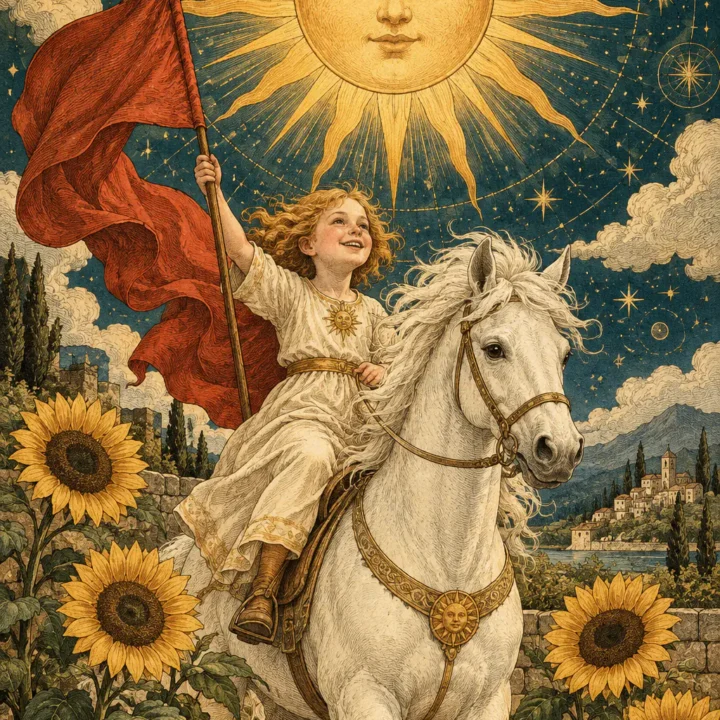
The Sun
joy, openness, clarity, confidence
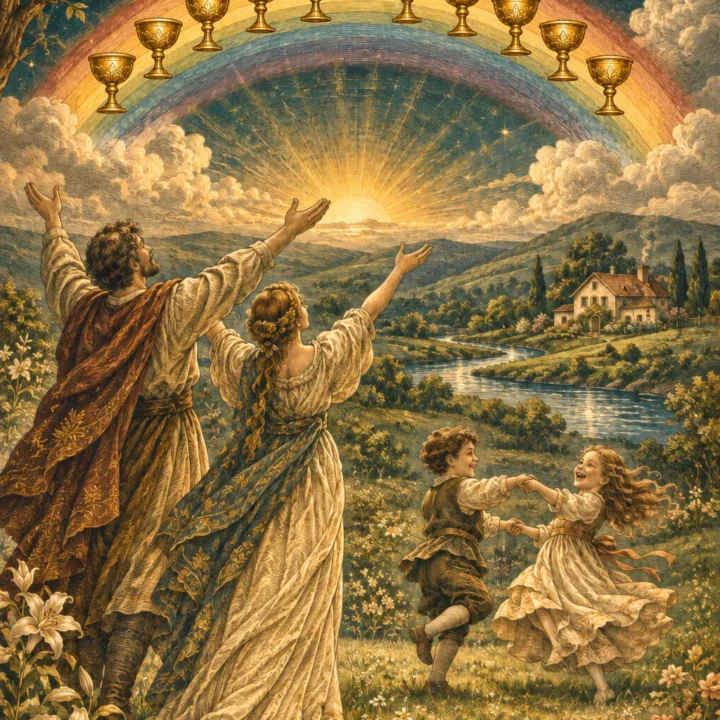
Ten of Cups
emotional fulfillment, family and chosen family, shared joy, harmony

Three of Cups
friendship, reunion, celebration, community

Ten of Pentacles
legacy, belonging, inheritance, continuity
Sources and further reading
- A. E. Waite, The Pictorial Key to the Tarot, Four of Wands (validated original text) Read the text
- Golden Dawn, Book T, Lord of Perfected Work and Venus in Aries (historical text) Read the text
- The Morgan Library & Museum, Pamela Colman Smith and the Rider-Waite-Smith deck Read the text
- Scryway, Four of Wands, modern interpretations and Waite comparison Read the text