Three of Pentacles Tarot Card Meaning
A sculptor speaks with two visitors beneath a decorated stone arch. Discover how the Three of Pentacles brings craft, shared plans, and meaningful cooperation into focus.
- skill
- collaboration
- apprenticeship
- useful feedback
- shared achievement
Card at a glance
- Number
- Three
- Element
- Earth
- Astrology
- Mars in Capricorn; Lord of Material Works (Golden Dawn)
- Keywords
- skill, collaboration, apprenticeship, useful feedback, shared achievement
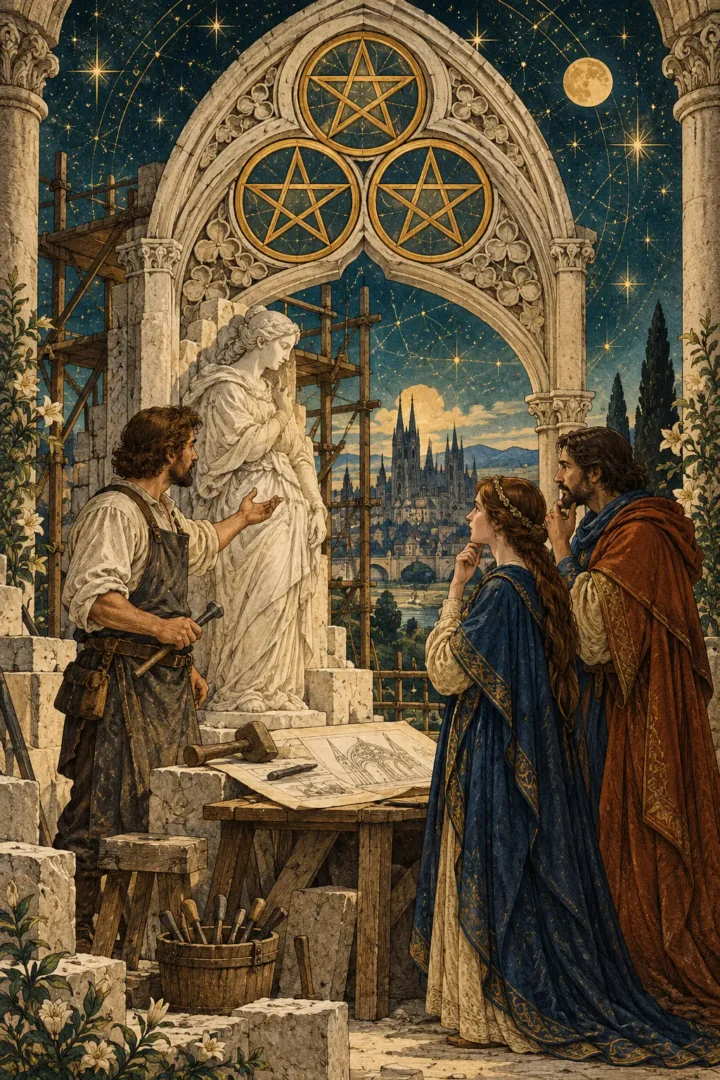 Three · Three of Pentacles
Upright meaning
Skill, collaboration and apprenticeship
Upright, the Three of Pentacles often appears when someone’s abilities are becoming useful to a wider group. Your work may be noticed, a teacher may offer guidance, or a project may reach the stage where several people need to agree on the next step.
- Skill
- Collaboration
- Apprenticeship
- Useful feedback
- Shared achievement
Reversed meaning
Miscommunication, undervalued work and weak planning
Reversed, the meeting beneath the arch becomes more difficult to imagine. Perhaps the drawing is confusing, the worker is being ignored, or nobody agrees about the finished result.
- Miscommunication
- Undervalued work
- Weak planning
- Mismatched standards
Card symbolism
-
The craftsperson on the bench
The worker stands above the floor, near the carving he is making. His position brings him face to face with the people who have come to examine the plans.
-
The visitors and their plans
Two robed figures stand beside the bench; one holds a drawing. Their clothing suggests different roles within the building’s life, although the card does not identify every person for us.
-
The stone arch and three pentacles
The pentacles appear as part of the building’s decoration, high above the conversation. They have found their place within something larger than any one worker.
-
The unfinished work
Nothing in the image suggests that the building is complete. The figures are still discussing what comes next.
In depth interpretation
A craftsperson stands on a wooden bench beneath a stone arch, tools in hand. Two visitors have stopped to speak with him. One holds a drawing, and all three seem absorbed in the building taking shape around them. Above their heads, three pentacles are set into the stone. You can almost hear the quiet conversation: a question, an explanation, perhaps a suggestion that makes the work better.
The Three of Pentacles is the tarot card of craftsmanship, collaboration, learning, and recognition earned through genuine effort. Upright, it often appears when your skills are ready to meet other people’s knowledge or when a shared project needs care. Reversed, it may point toward poor communication, a lack of respect for someone’s contribution, or work that has lost its purpose.
If you drew this card, look at the little gathering beneath the arch. Which person feels most familiar to you right now: the one making, the one carrying the plan, or the one watching it all come together?
The sacred art of building with others
There is a particular happiness in finding people who understand what you are trying to make. Perhaps someone hears the song you’ve been working on and offers exactly the missing note. A mentor recognizes how far you’ve come. A friend sees the shape of an idea while you’re still struggling to explain it.
The Three of Pentacles brings that kind of meeting into focus. It recognizes the hours of private practice behind a visible piece of work, then introduces another person who can help it become something more. Shared effort can carry a special intimacy when everyone respects what the others know.
The scene takes place in a religious building. That setting gives the ordinary gestures of measuring, carving, and discussing plans a sense of devotion. Someone will eventually enter this place to pray, gather, or find quiet. The hands shaping it are contributing to an experience they may never witness.
You may recognize a spiritual version of this card whenever care becomes part of a practical task. Preparing a meal for a celebration, repairing a place people love, teaching a child a skill, or helping a community organize its work can all become ways of expressing what matters to you.
The encounter has a shadow too. Collaboration asks people to listen, and sometimes one voice dominates the room. The Three of Pentacles encourages you to notice whose knowledge is being welcomed and whose contribution remains invisible.
Symbols in the Three of Pentacles
Pamela Colman Smith’s Rider-Waite-Smith design shows work in progress. The setting is beautiful, though the people are busy with a very practical conversation.
The craftsperson on the bench
The worker stands above the floor, near the carving he is making. His position brings him face to face with the people who have come to examine the plans. The elevation gives his expertise a visible place in the scene.
Think about something you have learned through repetition. You know the material, the tools, or the people who will use your work. That experience matters when a decision is being made. The card can encourage you to speak with confidence about what you know.
The visitors and their plans
Two robed figures stand beside the bench; one holds a drawing. Their clothing suggests different roles within the building’s life, although the card does not identify every person for us.
The drawing adds an important detail. An inspiring vision needs to meet the realities of construction. A plan is valuable when the people responsible for carrying it out can question it and make it workable.
The stone arch and three pentacles
The pentacles appear as part of the building’s decoration, high above the conversation. They have found their place within something larger than any one worker.
The arch may invite you to consider the purpose of your own efforts. What are you building that will continue to matter after the present task is finished? The question could concern your profession, a relationship, or a community you help sustain.
The unfinished work
Nothing in the image suggests that the building is complete. The figures are still discussing what comes next. There is room for revision, and that is part of the card’s beauty.
You can bring unfinished work into a conversation without apologizing for its incompleteness. A draft, sketch, rehearsal, or early proposal may be exactly what another person needs to see in order to help.
Three of Pentacles upright meaning
Upright, the Three of Pentacles often appears when someone’s abilities are becoming useful to a wider group. Your work may be noticed, a teacher may offer guidance, or a project may reach the stage where several people need to agree on the next step.
Imagine an apprentice carpenter who has spent months mastering basic joints. One afternoon, the experienced builders invite her to help plan a complicated staircase. The invitation recognizes her growing skill, and it gives her another opportunity to learn.
For a reading about your own life, the card may suggest seeking feedback from someone whose judgment you trust. You could be ready to share a draft, join a community effort, or collaborate with a person whose strengths differ from yours.
There is also a reminder about recognition. Praise feels wonderful, but the most valuable feedback often tells you something precise. Someone who can explain why a choice works is offering you knowledge you can carry forward.
Three of Pentacles reversed meaning
Reversed, the meeting beneath the arch becomes more difficult to imagine. Perhaps the drawing is confusing, the worker is being ignored, or nobody agrees about the finished result.
You may have experienced the frustration of pouring care into a project while receiving feedback that arrives too late or contradicts earlier instructions. In a team, the problem might be unclear responsibilities. In a personal practice, you could be repeating a method that no longer helps you improve.
The card may also point toward pride that makes learning harder. Skill is precious, yet it can become rigid when we refuse to consider another perspective.
Waite’s older reversed meanings include mediocrity and pettiness. Read with care, those terms can draw attention to the quality of the work and the behavior surrounding it. They do not make a judgment about your worth as a person.
Three of Pentacles in love and relationships
In love, the Three of Pentacles often brings attention to the life two people are making together. Affection has practical expressions: remembering an appointment, planning a move, sharing the labor of caring for a home, or making a difficult decision as a team.
Imagine a couple renovating a small apartment. One has a clear design in mind, while the other understands the budget and practical repairs. Their differing knowledge could become a source of conflict or an opportunity to create something that suits them both.
For someone single, the card may suggest meeting a person through a shared interest, study, or project. It can also invite you to consider whether a new relationship leaves room for both people’s strengths.
Reversed, notice where one partner has become the sole organizer or where suggestions are treated as criticism. Cooperation becomes possible when people can discuss the work involved without fear of being belittled.
Three of Pentacles as feelings
When the question concerns someone’s feelings, this card may evoke respect for your abilities, appreciation of your presence, or interest in what you could create together. Sometimes it describes a bond that grows through shared activity rather than dramatic declarations.
The details of your real connection matter. Admiring someone as a colleague or friend is different from wanting romance. Look at what the person communicates and whether the interest is mutual.
Three of Pentacles for career and work
Career questions are a natural home for the Three of Pentacles. It can describe an apprenticeship, a successful team, recognition for specialized knowledge, or a role that benefits from working with people in different disciplines.
Suppose a small business is preparing to launch a new service. The person who understands clients, the person who manages operations, and the person who designs the experience all see different problems. A productive meeting allows those differences to strengthen the result.
Reversed, the card can reveal an uneven distribution of credit, poorly defined ownership, or a workplace that values impressive presentations more than the quality of the work. It may be time to clarify expectations or ask for more useful feedback.
If you’re considering a new position, learn who will review your work and how decisions are made. A supportive environment can help ability develop into mastery.
Three of Pentacles for money
In money readings, the Three of Pentacles often concerns income connected with a developed skill, a paid collaboration, or a project whose value must be agreed upon. It can also appear when you are hiring someone to do important work.
Take the plans in the card seriously. Before agreeing to a service, understand what is included, who is responsible for which tasks, and how changes will be handled. Clear arrangements protect the relationship between client and craftsperson.
Reversed, examine vague terms, delayed payment, or the possibility that someone’s labor is being undervalued. The card encourages a fairer conversation grounded in actual agreements.
Three of Pentacles in spiritual practice
The monastery setting offers a lovely question: what does devoted work look like when nobody is watching? It may be as humble as preparing a room for a gathering, carefully copying a prayer into a journal, or learning a traditional craft from someone willing to teach.
Spiritual communities are sustained by people whose labor is easy to overlook. The person repairing the chairs or arranging the space contributes to the atmosphere that others experience as sacred.
The Golden Dawn called this card the Lord of Material Works and associated it with Mars in Capricorn. Its older occult imagery differs from Smith’s monastery scene, though both emphasize constructive effort and what can be made through disciplined attention.
Three of Pentacles as advice: invite a third perspective
Choose something you are making or trying to improve. It could be a professional project, a shared household routine, or a personal creative practice. Picture it beneath the arch in the card.
Write down what you already know how to do well. Then name one part of the work where another person’s experience could help. Choose someone whose knowledge you respect and ask a specific question.
When they answer, listen for information you can use. You are free to disagree with an opinion, and you may also discover an idea that makes the work stronger. Let the conversation become part of the craft.
Is the Three of Pentacles a yes or no card?
The Three of Pentacles often leans yes when a question concerns study, collaboration, skill development, or sharing work with people who can help it grow. Reversed, it suggests checking the plan or working relationship before proceeding. The card cannot guarantee approval, a job offer, or another person’s agreement.
How to read the Three of Pentacles in a spread
In the past position, this card can describe training or cooperation that brought you to the present. As a challenge, it may suggest a gap in communication or a skill you are still developing. As advice, it often encourages consultation and a clear plan.
Imagine asking how to make a community project sustainable. You draw the Three of Pentacles in the present, Justice as advice, and the Six of Pentacles as a possible direction. The story could concern skilled people ready to work together, a need for fair responsibilities and agreements, and the possibility of resources being shared more thoughtfully. The cards help identify what the group should discuss.
A brief note on tarot tradition
The Rider-Waite-Smith Three of Pentacles, illustrated by Pamela Colman Smith and published in 1909, shows a sculptor at work in a religious building. Arthur Edward Waite linked it with skilled labor and the recognition that follows developing a craft. The Golden Dawn’s Book T gives the corresponding card the title Lord of Material Works and associates it with Mars in Capricorn. Its earlier design is different, so the monastery imagery belongs specifically to the Rider-Waite-Smith tradition.
Frequently asked questions
Does the Three of Pentacles mean a promotion?
It can suggest that skilled work is being recognized or that you are ready for more responsibility. Recognition is one possibility within the card’s wider meaning. A promotion depends on the actual process and the people making the decision.
How does the Three of Pentacles differ from the Eight of Pentacles?
The Eight of Pentacles shows a worker repeating and refining a craft. The Three places skilled work within a conversation among people building something together. One often emphasizes practice; the other brings the value of shared standards into view.
Is the Three of Pentacles only about professional teamwork?
No. It can speak to a family project, a friendship, a spiritual community, or a relationship where people share responsibility for something meaningful.
What if I’m doing all the work myself?
The card can highlight an uneven arrangement. Consider which tasks require help, who has a stake in the outcome, and whether responsibilities need to be discussed more clearly.

Keep reading
Explore the Pentacles
Every card page names the tradition behind each meaning, so you can compare readings instead of taking one as fixed.
Related Pentacles cards
Three of Pentacles is part of the Pentacles. Cards from the same group often appear together in readings.

Ace of Pentacles
opportunity, stability, resources, practical progress
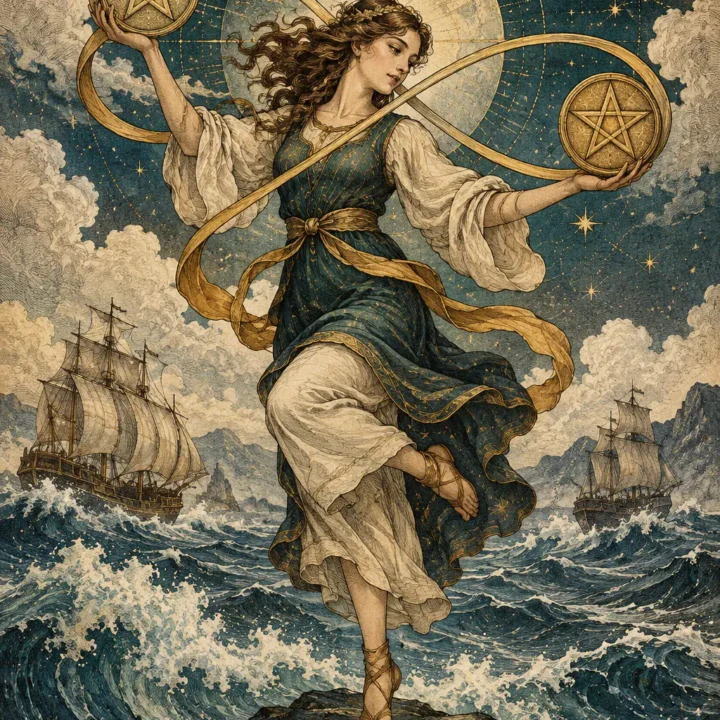
Two of Pentacles
adaptability, changing priorities, flexibility, timing

Four of Pentacles
security, savings, ownership, protection
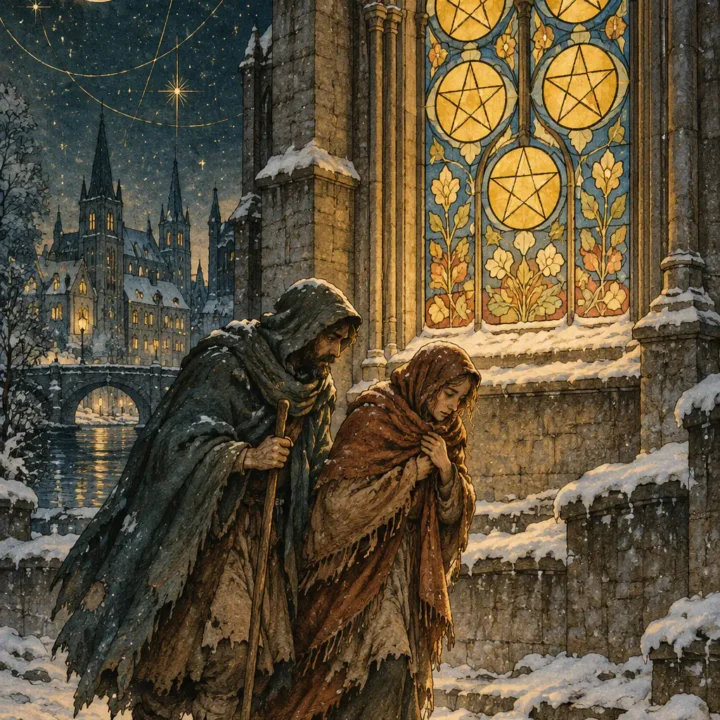
Five of Pentacles
hardship, scarcity, insecurity, exclusion
Sources and further reading
- Arthur Edward Waite, The Pictorial Key to the Tarot, Part III, Three of Pentacles Read the text
- Golden Dawn, Book T, Lord of Material Works and Mars in Capricorn Read the text
- Victoria and Albert Museum, A history of tarot cards Read the text