Five of Swords Tarot Card Meaning
A victor holds swords while others walk away. The Five of Swords asks what an argument has cost, and whether being right has become more important than care.
- conflict
- hollow victory
- hurt pride
- defeat
- ethical choice
Card at a glance
- Number
- Five
- Element
- Air
- Astrology
- Lord of Defeat; Venus in Aquarius (Golden Dawn)
- Keywords
- conflict, hollow victory, hurt pride, defeat, ethical choice, making amends
 Five · Five of Swords
Upright meaning
conflict, a hollow victory, wounded pride
Upright, the Five of Swords raises the cost of winning an argument or losing one, including damaged trust and the temptation to humiliate.
- conflict
- a hollow victory
- wounded pride
Reversed meaning
repair, unresolved resentment, stepping away
Reversed, the Five may suggest a wish to repair conflict, lingering shame, or the need to leave a destructive argument behind.
- repair
- unresolved resentment
- stepping away
Card symbolism
-
The figure holding swords
A foreground figure carries three blades and looks toward people walking away, leaving the meaning of victory uneasy.
-
The retreating figures
Two others have departed, making the social cost of the encounter visible.
-
Clouds above the shore
Jagged clouds and a broad coastal setting keep the mood unsettled even after the confrontation ends.
In depth interpretation
A figure stands holding several swords while two others walk away along the shore. The battle appears to be over. Nobody in the picture looks especially relieved.
The Five of Swords concerns conflict, defeat, pride, harsh communication, and victories that leave something valuable behind. Upright, it asks what you are gaining and what the encounter is costing. Reversed, it can point toward repair, surrendering a grudge, or the difficulty of moving beyond a quarrel.
The image offers an uncomfortable possibility: even when you have won the argument, you may still have lost the moment that mattered.
The spiritual meaning: the cost of being right
Disagreements do not always make enemies of us. Some are necessary, and defending a boundary can be an act of self-respect. The Five asks you to recognize when a conflict has changed its purpose.
Perhaps you began by asking to be heard but ended up collecting evidence of another person’s flaws. Perhaps you were hurt and now want the other person to feel equally hurt. Or perhaps someone else has treated you that way, and leaving the exchange is the wiser choice.
Swords are tools of judgment and language. The Five reveals what happens when those tools are drawn into a struggle for status.
Spiritual insight here involves accountability. What can you own about your conduct? What is not yours to repair alone? The card makes room for boundaries as well as reconciliation.
What the Five of Swords image reveals
The figure in the foreground
Smith places a person holding three swords nearest to the viewer, while two other swords lie on the ground. The figure looks toward the departing people. It is tempting to decide immediately who is the villain, but a picture does not provide that full history.
We can see possession of weapons and the aftermath of conflict. We cannot know the terms on which the swords were taken. This uncertainty matters in a real reading.
The people who walk away
Two figures leave the scene, one with a bowed posture. Their departure emphasizes the human consequences. An argument can end while its hurt remains.
Ask whether someone has left a conversation because they felt defeated, because they needed safety, or because continuing would only deepen the damage. The card cannot answer that without context.
The restless sky
Jagged clouds hang over the shore. The scene has space, yet little peace. This is an apt picture of replaying an argument after the words have stopped.
Sometimes your next task is simply to stop rehearsing the last thing you wished you had said.
Five of Swords upright: when the conflict changes you
Upright, the Five can appear after a harsh exchange, a competitive environment, or a decision that leaves one person feeling diminished. You may be wondering whether to defend your point, apologize for your part, or step away.
Imagine a team meeting in which a colleague challenges your work. You respond with a clever remark that wins laughter from the room. Later you realize the joke made future cooperation harder. The Five does not necessarily tell you your underlying criticism was wrong. It asks whether the way you delivered it served the larger purpose.
The card can also represent losing to someone who refuses to engage fairly. In that case, the spiritual work may be accepting that you cannot persuade everyone and choosing how to protect your energy.
Notice whether you are seeking understanding or demanding a victory.
Five of Swords reversed: is there a path back?
Reversed, the Five may describe regret, an apology that needs to be offered, or the decision to stop feeding an argument. Sometimes the people involved are beginning to recognize the damage. Sometimes the silence is full of resentment.
Do not treat reversal as an automatic promise of reconciliation. Repair requires honest acknowledgment and changed behavior. You can forgive someone internally without restoring a relationship that is unsafe.
Waite’s older account emphasizes degradation and loss, with little promise of an easy reversal. Modern readers often see a possibility of making amends. The hope is meaningful when it remains a possibility rather than a prediction.
Ask what a responsible next step would look like if the other person never agreed with you.
The Five of Swords from the perspective of the people who leave
The person carrying the swords receives most of the attention in this card. Look instead at the figures walking away. We know they have withdrawn; we cannot know whether they have lost, refused an unfair contest, or simply reached their limit. That uncertainty makes the card especially useful for examining the dignity of disengagement.
Imagine two colleagues caught in a public argument. One raises their voice and demands an answer; the other leaves. From the outside, departure may look like defeat. It could also be the most responsible way to stop the exchange from becoming humiliating. If you are the person leaving, ask whether the boundary is protecting something important or avoiding a conversation that can be held safely later.
Placed as an obstacle, the Five can reflect the need to have the last word. As advice, it might invite an apology, a firmer boundary, or a decision not to keep playing. Near Justice, attention shifts to accountability and facts. Near the Seven of Swords, ask whether the next move is being made indirectly and why.
The spiritual task is to decide what you want to preserve after the argument ends.
Five of Swords in love and relationships
The card can describe arguments in which hurtful words become weapons. It may also illuminate the exhaustion of repeatedly defending a boundary.
If you are reading for a specific relationship, look at patterns over time. One disagreement is different from ongoing contempt or intimidation. The card does not authorize you to diagnose someone else’s character.
In a feelings position, the Five may suggest defensiveness, wounded pride, or fear of losing control. These are interpretive possibilities, not access to someone’s secret thoughts.
With Two of Cups, a spread might ask how mutual care can shape a difficult discussion. With Justice, it may emphasize accountability and fairness.
Work and money: the price of a contest
At work, the Five can point toward destructive competition, office politics, or a negotiation where a short-term victory threatens long-term trust. Consider how to protect your interests while keeping accurate records and clear boundaries.
Financially, it may ask whether a decision is driven by the need to prove something. If you are about to take a risk simply because someone doubted you, the Five invites a return to your own priorities.
It does not forecast a lawsuit, business failure, or financial loss.
Worked reading: should I reopen an argument with my sister?
Imagine a family disagreement that ended with both people upset. You draw the Five of Swords for the dynamic, Queen of Cups for your inner resource, and Ace of Swords for the next step.
The Five recognizes the temptation to score another point. The Queen of Cups asks for compassion without asking you to erase your needs. The Ace encourages a specific, honest sentence about what happened.
One possible response is to reach out when you feel ready, acknowledge your own sharp words, and explain what boundary still matters. You can do that without demanding an immediate resolution.
If The Emperor appeared instead of the Queen, the reading might emphasize structure and limits, particularly if old patterns keep repeating.
Defeat in the Golden Dawn
Book T calls the Five of Swords the Lord of Defeat and associates it with Venus in Aquarius. Waite’s written meanings emphasize degradation and loss; Smith adds a narrative image that makes the aftermath of winning and losing uneasy.
Modern language about hollow victory is a reading of that scene. The underlying ethical question is especially relevant: what becomes of a relationship after the contest ends?
Five of Swords as advice: decide what you truly want to preserve
Before replying to a difficult message, finish this sentence: I want this conversation to accomplish ____. Then look at the reply you have drafted. Does it move toward that aim?
If your aim is safety or a firm boundary, leaving the exchange may be enough. If your aim is repair, choose words that make responsibility possible.
Frequently asked questions
Is the Five of Swords a yes or no card?
It generally counsels caution about actions fueled by revenge, pride, or escalating conflict. A difficult choice can still be right. The card asks you to consider the cost and the manner in which you proceed.
Does the Five of Swords mean someone is a narcissist?
No. Tarot cannot diagnose a person or establish a mental health condition. Focus on observable behavior and its effect on you.
Does reversed mean an apology is coming?
It can symbolize the wish for repair, but it cannot promise another person’s action. You can decide how to respond to what is actually offered.
Is the Five of Swords always about losing?
No. The scene includes a person holding the weapons after others withdraw. The card often explores the complexity of victory as well as defeat.
How is it different from the Seven of Swords?
The Five focuses on open conflict and its aftermath. The Seven of Swords concerns strategy, secrecy, or an indirect approach whose ethics depend on context.
Tradition note: The Rider-Waite-Smith design by Pamela Colman Smith, Waite’s language of loss, and the Golden Dawn title Defeat are the principal traditions used here. Ideas about repair and the cost of winning are contemporary interpretations of those themes.

Keep reading
Explore the Swords
Every card page names the tradition behind each meaning, so you can compare readings instead of taking one as fixed.
Cards to explore alongside this one
Their symbols reveal useful similarities and differences for your next reading.
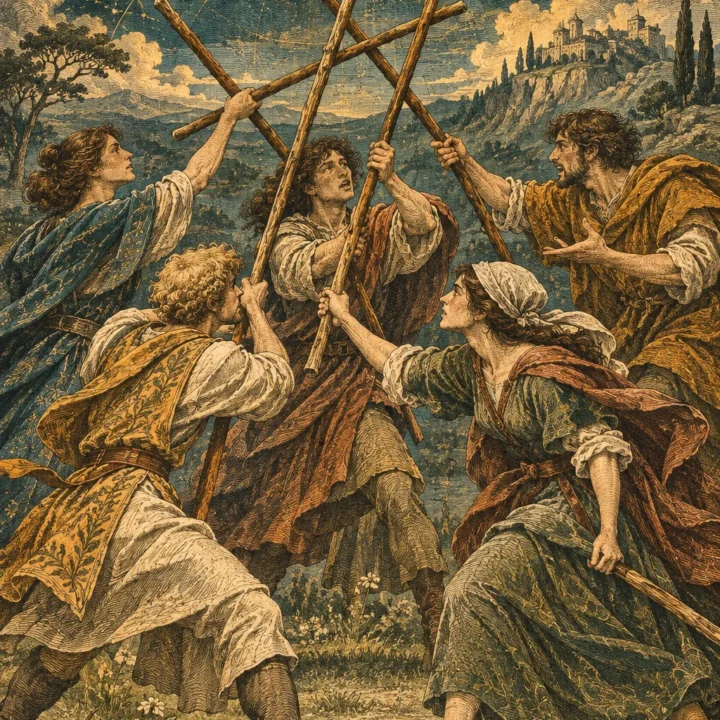
Five of Wands
rivalry, strife, competition, disagreement

Seven of Swords
strategy, secrecy, independent action, evasion

Justice
fairness, honesty, accountability, clarity

Six of Swords
transition, moving on, passage, recovery
Sources and further reading
- A. E. Waite, The Pictorial Key to the Tarot, Part III (Swords, Five of Swords) Read the text
- Golden Dawn, Book T, tarot titles, attributions, and card descriptions Read the text
- The Morgan Library & Museum, Pamela Colman Smith and her tarot art Read the text
- Victoria and Albert Museum, A History of Tarot Cards Read the text