Knight of Cups Tarot Card Meaning
A gentle Knight carries a golden cup beside a river. Explore the Knight of Cups as a symbol of heartfelt approaches, creative invitations, and promises that deserve care.
- an invitation
- approach
- emotional expression
- romance
- creativity
Card at a glance
- Number
- Knight
- Element
- Water
- Astrology
- Lord of the Waves and the Waters, the King of the Hosts of the Sea; Fire of Water within that court system.
- Keywords
- an invitation, approach, emotional expression, romance, creativity, diplomacy, a considered proposal.
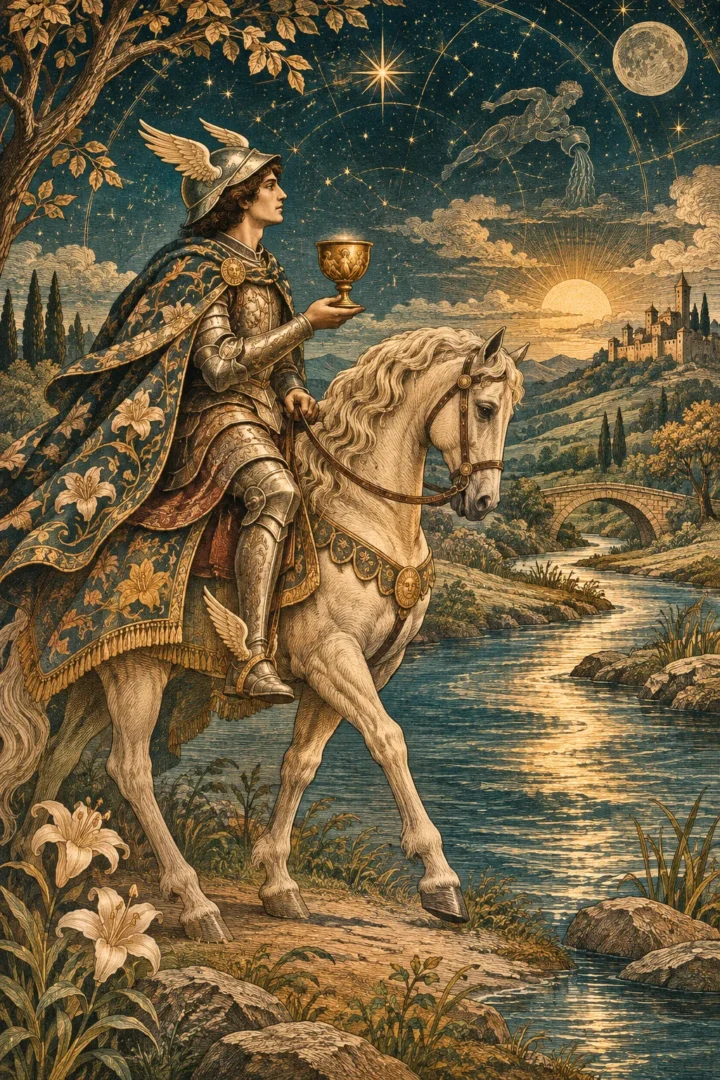 Knight · Knight of Cups
Upright meaning
an invitation, approach, emotional expression
Upright, this Knight often appears when a heartfelt approach is possible. Someone may invite you to spend time together, propose a project, offer help, or begin a conversation that has been waiting.
- an invitation
- approach
- emotional expression
- romance
- creativity
- diplomacy
Reversed meaning
unreliable promises, romantic idealization, moodiness in contemporary practice; trickery
Contemporary readers often describe the reversed Knight as moody, idealistic, or caught in the beauty of a dream without attending to its practical demands. You might be excited by someone's words and gradually discover that their follow-through is inconsistent.
- unreliable promises
- romantic idealization
- moodiness in contemporary practice; trickery
- duplicity
- and fraud in Waite's historical list.
Card symbolism
-
A horse moving with care
Unlike the restless mount of the Knight of Wands, the Knight of Cups rides a horse that appears measured and calm. Smith makes the difference visible through the animal's posture.
-
The cup held before him
The Knight holds a cup rather than a sword or staff. His object belongs to the suit of feeling, relationship, imagination, and spiritual receptivity.
-
Wings on his helmet and boots
The knight's helmet and boots bear small wings. Waite associated the winged helmet with imaginative grace, describing a dreamer whose vision is also influenced by sensory experience.
-
The fish-patterned cloak and the river
Fish-like motifs decorate the knight's garment, reinforcing the watery character of the suit. A river curves through the dry landscape ahead.
In depth interpretation
A knight rides a pale horse beside a winding river. He wears armor beneath a patterned cloak, and small wings adorn his helmet and boots. In one hand he carries a golden cup, held carefully as he approaches the landscape ahead. His horse is moving at an unhurried pace. The knight seems to have come with something worth offering.
The Knight of Cups represents heartfelt approaches, invitations, romantic expression, artistic vision, and the movement of feeling toward another person or purpose. Upright, it often appears when an offer is being considered or someone is finding the courage to express what matters to them. Reversed, it can warn that a beautiful promise needs closer examination, particularly where the intention or terms are uncertain.
Notice how he carries the cup. The Knight has begun to move, and he seems intent on keeping its contents safe through the journey. What would it mean to bring that kind of care to something you hope to share?
The spiritual meaning: carrying your heart into the world
There comes a time when a feeling asks you to do something about it. You have been thinking of someone, perhaps remembering a kindness or wanting to mend a difficult conversation. You imagine the words you might say. Eventually you decide to speak.
The Knight of Cups belongs to that tender movement. He brings a vessel across the landscape, approaching a place we cannot see. The gesture suggests that something meaningful has already taken shape within him and is now being offered into the world.
This card can appear in a romantic reading, when affection is ready to be expressed. It is equally at home with an artist proposing a collaboration, a friend offering reconciliation, or a person deciding to act upon a long-held spiritual calling.
The Knight's pace is part of his wisdom. He seems attentive to the cup he carries. An offer of love, help, or creative work needs a way to reach the other person without overwhelming them.
If you draw this card, consider what you are ready to offer and what kind of response you can genuinely welcome. The most meaningful gestures give another person room to decide how they feel.
The white horse, winged helmet, and cup
A horse moving with care
Unlike the restless mount of the Knight of Wands, the Knight of Cups rides a horse that appears measured and calm. Smith makes the difference visible through the animal's posture.
That quiet movement can give the Knight a particular meaning in a reading about romantic pursuit or a proposal. You may be ready to approach someone, yet want to do so in a way that respects the connection already between you.
A slower pace does not automatically prove that the rider is reliable. It is a quality of the illustration, one that encourages care and deliberation.
Imagine offering an apology after a disagreement. You might choose the right moment, explain your part honestly, and allow the other person time to respond. The Knight's measured approach can help you picture the manner of that conversation.
The cup held before him
The Knight holds a cup rather than a sword or staff. His object belongs to the suit of feeling, relationship, imagination, and spiritual receptivity.
A cup is something that can be offered, received, filled, or emptied. That makes it a compelling emblem for a proposal. The person approaching you may have affection, ideas, or goodwill to share. The meaning of the offer will emerge through what it asks and what both parties choose.
Waite explicitly connected this court card with approaches, invitations, and propositions. The knight's vessel gives that older divinatory language a vivid human shape.
If you are the person carrying the cup, ask what you actually want to communicate. If someone else is approaching, consider what would help you understand the gesture without needing to guess at their inner life.
Wings on his helmet and boots
The knight's helmet and boots bear small wings. Waite associated the winged helmet with imaginative grace, describing a dreamer whose vision is also influenced by sensory experience.
The details can bring a light, almost poetic quality to the figure. His journey may be guided by an idea of beauty, intimacy, or connection that he wishes to make real.
It is tempting to treat the wings as a promise of divine communication. The artwork does not establish that an angel has sent the knight or that every message is spiritually guaranteed.
You may find the image most useful when considering what imagination contributes to an approach. It can give someone the courage to express affection, but the recipient still needs to be met as a real person.
The fish-patterned cloak and the river
Fish-like motifs decorate the knight's garment, reinforcing the watery character of the suit. A river curves through the dry landscape ahead.
The water adds feeling to an otherwise stony world. One possible reading is that the knight is carrying emotional life toward a place that needs care. Perhaps you are bringing compassion into a difficult conversation or introducing something beautiful into a practical undertaking.
The river also marks a boundary in the landscape. To travel with a feeling is to discover what happens when it meets other people and real circumstances.
Knight of Cups upright: an invitation from the heart
Upright, this Knight often appears when a heartfelt approach is possible. Someone may invite you to spend time together, propose a project, offer help, or begin a conversation that has been waiting.
Imagine a musician who has spent months hoping to gather friends for a small concert. One evening she writes to someone whose work she admires and offers to create a performance together. The message expresses genuine warmth, and it also gives the other person an opportunity to choose.
The Knight can describe the courage of making that offer. He can equally describe the experience of receiving one.
His romantic reputation is familiar, but the card has wider uses. A proposal could involve an artistic venture, a renewed friendship, or a meaningful community project. The common element is the movement of feeling into a gesture that another person can consider.
The Knight also asks you to pay attention to how the approach is made. Does it respect the other person's wishes? Is there enough clarity for a sincere response?
Knight of Cups reversed: how to recognize an unreliable offer
Contemporary readers often describe the reversed Knight as moody, idealistic, or caught in the beauty of a dream without attending to its practical demands. You might be excited by someone's words and gradually discover that their follow-through is inconsistent.
Waite's historical reversal is more severe. He associated the card with trickery, artifice, duplicity, and fraud. The Golden Dawn's parallel mounted figure could also become untruthful when poorly dignified.
Those traditions are worth understanding, especially when you are considering an offer. Yet a reversed card is not evidence that anyone is lying, cheating, or committing fraud. Tarot can help you ask better questions; it cannot establish an accusation.
Suppose a potential collaborator speaks beautifully about a project but cannot explain who will pay the costs or how decisions will be made. A reversed Knight might reflect the distance between an appealing invitation and a workable agreement.
Sometimes the problem is innocent overenthusiasm. A person may sincerely want to deliver more than they presently can. In another situation, the terms may be genuinely misleading. The difference can only be established through details and conduct.
If you feel uncertain, ask for concrete information before making a commitment. There is no need to condemn the dream in order to examine the promise.
Does the Knight of Cups mean a romantic proposal?
A proposal or romantic approach is a natural interpretation. Waite included invitation and proposition among the upright meanings, and the knight carries a cup in a manner that resembles an offering.
That does not mean he necessarily predicts an engagement, marriage, or confession of love. In many readings, the proposal could be a request for a date or simply an opening conversation.
The question and the surrounding cards matter. If you are asking about a job, the Knight is unlikely to need a romantic interpretation. If you are considering a relationship, he can direct attention toward how affection is being communicated.
A real commitment is made through words and choices by the people involved. The card gives you an evocative way to think about the approach.
Knight of Cups in love and relationships
In a new relationship, the Knight often speaks of romantic gestures, tenderness, and the pleasure of expressing attraction. You may be drawn to someone who communicates imaginatively, or discover a desire to speak more openly yourself.
The image can encourage you to enjoy courtship while remaining curious about the actual person. A beautiful message matters, and so does the consistency with which someone treats you.
For an established couple, the Knight may suggest a renewed approach. Perhaps one person is ready to invite the other into a shared creative experience or make an honest effort to reconnect after a difficult period.
Reversed, pay attention to how words and actions fit together. If an apology sounds moving but the same harmful behavior continues, the relationship needs more than eloquence. The card can support reflection on this pattern without diagnosing a person's character.
Knight of Cups as feelings
As feelings, the Knight can suggest affection, romantic interest, idealism, or the wish to approach someone. It may also show the kind of gesture the reader hopes to receive.
The card does not grant access to another person's private thoughts. Whether the feelings are mutual becomes clearer through communication and real behavior.
Is the Knight of Cups a player?
Some contemporary love readings turn a reversed Knight into a charming but unreliable pursuer. That can be one shadow interpretation when the question already involves inconsistent behavior.
It is unfair to assign the label to a real person based on the card alone. The Knight's imagery invites you to consider what sincerity looks like in practice: respect for boundaries, clarity, and the willingness to follow through.
Knight of Cups as a person or role
A court card may describe someone who is imaginative, courteous, artistic, and responsive to emotion. The Knight could represent a person making a meaningful approach or a quality you want to embody when inviting another person into a project.
The traditional illustration is masculine, but its roles are available to people of any gender or age. The figure need not be a stranger arriving at your door.
Sometimes you are the Knight. You have a cup to carry, and the reading asks whether you are prepared to share it openly.
In a position representing the challenge, this same quality can become difficult when you are so enchanted by how an idea feels that you overlook what another person has actually said.
Knight of Cups for career, creativity, and money
The Knight can be a lovely card in questions about artistic work. He appears when someone has a vision they want to offer to others, perhaps through music, storytelling, design, or a project that carries emotional meaning.
A job offer or partnership invitation may also fit. The Knight emphasizes the human encounter around the proposal: who is approaching, why the work matters, and whether the people involved can communicate well.
A creative promise still needs a viable structure. If you have been invited into a project, ask about responsibilities, timelines, compensation, and what happens when plans change.
In money readings, the reversed Knight's historical language of deception is a reason to pay attention to possible misrepresentation when the facts already raise concerns. It is not a reliable method of detecting fraud. Contracts and independent information are essential.
The Golden Dawn's Knight of Cups is also called a King
The Golden Dawn's Book T labels the mounted figure Knight of Cups, while also calling him the King of the Hosts of the Sea. In this printed arrangement he is Fire of Water. Later authors sometimes compare courts by rank rather than by their mounted or seated imagery, so the correspondence needs its named context.
That terminology can be confusing for readers familiar with a Rider-Waite-Smith deck. In Book T, the mounted figure bears the Knight title and a King role within the Golden Dawn court hierarchy. Its chariot-riding Prince corresponds to a different court position. Court names should be compared within their own systems.
The imagery is also distinct. Book T describes a winged warrior on a white horse moving above the sea, peacock emblems on the armor, and a crab emerging from the cup. Smith instead gives us a quieter rider in a dry landscape, holding a cup without a visible creature rising from it.
Book T associates the mounted figure with graceful, poetic qualities and warns that its expression can become idle or untruthful when poorly dignified. The elemental language of Fire of Water suggests feeling given a force of movement.
Reading the traditions together can enrich the Knight's spiritual role. An emotion has acquired enough energy to travel. The question is how it will be carried.
How does the Knight differ from the Page and Knight of Wands?
The Page of Cups stands at the water's edge studying a fish rising from his cup. The emotional image has only just appeared, and the Page's attention is inward and curious.
The Knight of Cups carries his cup across the landscape. He has begun to approach the world with an offer. In a reading, that difference can help you distinguish discovering a feeling from making it known to another person.
The Knight of Wands brings a useful second contrast. Waite associated that fiery rider with departure and a change of residence. The Knight of Cups carries associations of arrival and approach.
If the two Knights appear together, ask whether the situation involves a departure, an invitation, or both. A person might be leaving one situation because a meaningful new connection is drawing them elsewhere.
This comparison offers more precision than treating every mounted figure as an impulsive adventurer.
Worked reading: should I accept a beautiful but vague collaboration offer?
Imagine a friend invites you to help create a weekend festival of music and stories. Their vision is infectious, and you love what the event could mean to the community. But the invitation includes few details about cost, preparation, or who will make the decisions.
You draw the Knight of Cups for the offer, Justice for what needs attention, and the Three of Pentacles for how to proceed.
The Knight captures the heartfelt nature of the invitation. The project could be genuinely meaningful. Justice asks for clarity and fairness: what will each person be responsible for, and what commitments are being made? The Three of Pentacles brings the focus to skills, collaboration, and the actual work required to create the event.
Together, the cards suggest responding warmly while requesting a practical plan. You could meet with the organizers, clarify your role, and agree to an initial stage before promising more.
If The Moon replaced Justice, the reading might emphasize uncertainty and the need to check assumptions. It would not prove dishonesty. A promising offer deserves enough light that the people involved can make a choice they understand.
Knight of Cups as advice: carry an honest offer
Imagine yourself holding the cup. What would you like to bring into another person's life? It might be affection, an apology, a creative invitation, or a simple offer of help.
Write down what you truly wish to say. Consider what you are prepared to do after the words have been spoken.
If you have been invited into something meaningful, notice what attracts you and what you still need to understand. Ask about the practical details with the same care you give the feeling behind the proposal.
The Knight encourages a generous approach. His cup becomes a gift when the person receiving it is free to respond.
Is the Knight of Cups a yes or no card?
The Knight of Cups often leans yes toward a sincere invitation or an opportunity to express affection. Reversed, it encourages scrutiny of unclear promises and the practical consequences of a commitment. The card does not guarantee that a proposal will be accepted or that another person's intentions are trustworthy.
A note on tradition
Pamela Colman Smith pictured the Rider-Waite-Smith Knight of Cups as a gentle rider carrying a vessel. Waite emphasized approach, invitation, proposition, and, in reversal, the risk of deception. The Golden Dawn's Book T offers a more forceful mounted figure, with peacock imagery, a crab in the cup, and the Fire-of-Water correspondence. Modern practitioners often read the Knight through romance, creativity, and moodiness. Those traditions share themes while differing in image and court structure.
Frequently asked questions
Does the Knight of Cups mean someone is coming toward me?
Approach and arrival belong to Waite's original upright meanings. The card can be relevant when the question concerns an invitation or contact, but it cannot promise a specific person's arrival or give a reliable date.
What should I ask before accepting a Knight of Cups invitation?
Ask what is being offered, what both people expect, and what happens after the lovely first gesture. Whether the invitation concerns romance or a creative project, the cup deserves a thoughtful answer based on the relationship as it actually exists.
Why is his horse moving slowly?
Smith's illustration shows a calm horse, and Waite describes the Knight as riding quietly. Modern readers often interpret that measured pace as a considerate emotional approach. It remains a symbolic reading rather than proof of any person's intentions.
Is the reversed Knight of Cups always deceptive?
No. Waite's reversed list includes duplicity and fraud, whereas modern practice also emphasizes moodiness or unrealistic expectations. A reversed card is a prompt for discernment. Actual evidence is needed before concluding that someone has deceived you.
Why is the Knight called a King in Golden Dawn tarot?
Book T uses a court structure in which its mounted Knight is described as the King of the Hosts of the Sea. Its Prince appears in a chariot, and the roles do not map neatly by name onto every later deck. The designation belongs to that specific esoteric system.

Keep reading
Explore the Cups
Every card page names the tradition behind each meaning, so you can compare readings instead of taking one as fixed.
Cards to explore alongside this one
Their symbols reveal useful similarities and differences for your next reading.
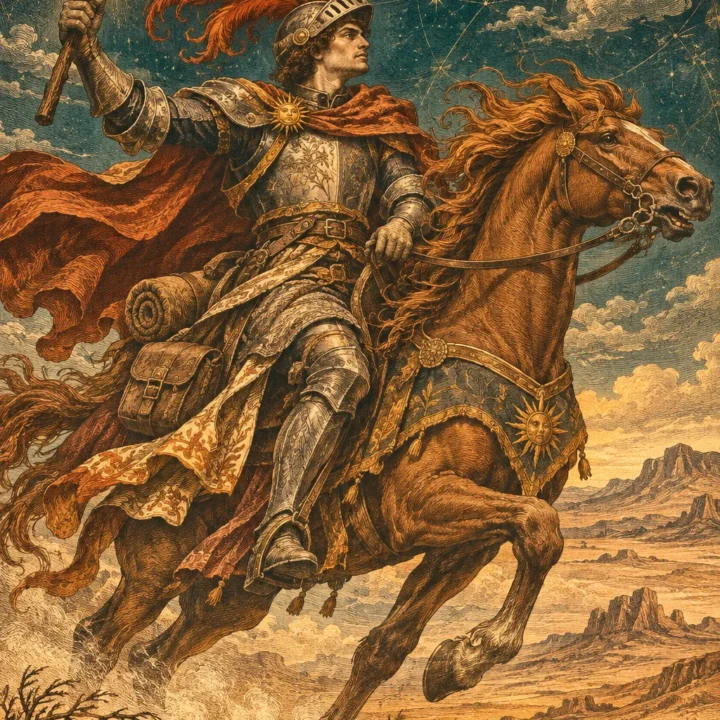
Knight of Wands
movement, passion, initiative, adventure
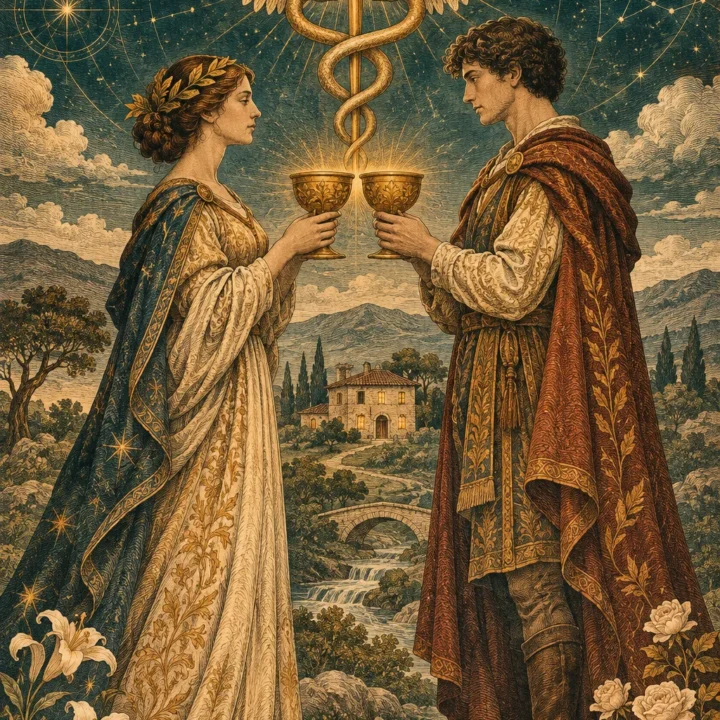
Two of Cups
attraction, partnership, mutual respect, friendship
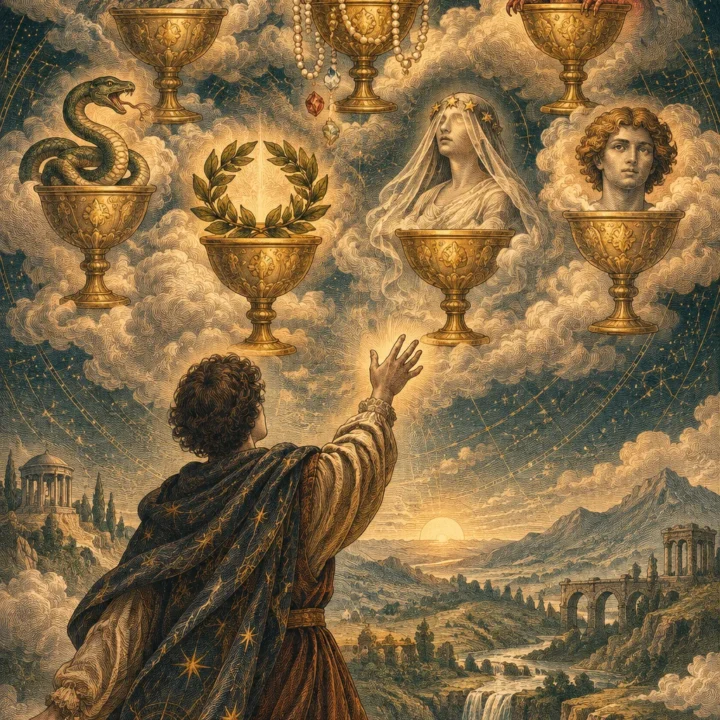
Seven of Cups
imagination, choices, visions, temptation
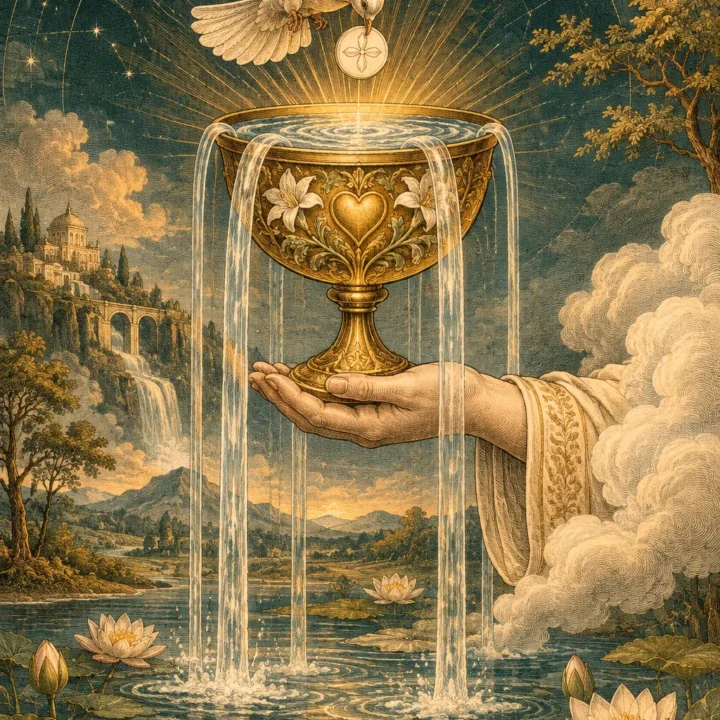
Ace of Cups
new feelings, love, compassion, emotional renewal
Sources and further reading
- A. E. Waite, The Pictorial Key to the Tarot, Knight of Cups, main and additional divinatory meanings Read the text
- Golden Dawn, Book T, Lord of the Waves and the Waters and King of the Hosts of the Sea Read the text
- Biddy Tarot, Knight of Cups, contemporary practitioner meanings Read the text
- Labyrinthos, Knight of Cups, modern imagery and interpretation Read the text