Seven of Cups Tarot Card Meaning
Seven cups hover in clouds, each carrying a different vision. The Seven of Cups asks which dream deserves to enter your life and what it would take to make it real.
- imagination
- choices
- visions
- temptation
- wishful thinking
Card at a glance
- Number
- Seven
- Element
- Water
- Astrology
- Lord of Illusionary Success, associated with Venus in Scorpio.
- Keywords
- imagination, choices, visions, temptation, wishful thinking, uncertain opportunities, desire.
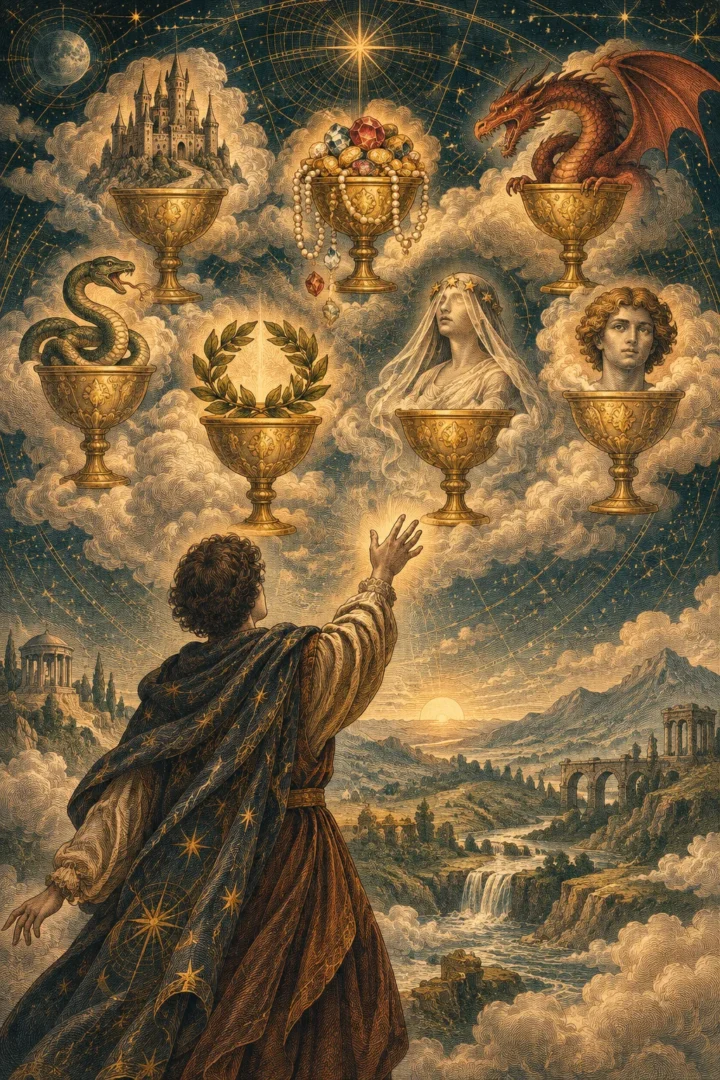 Seven · Seven of Cups
Upright meaning
imagination, choices, visions
Upright, the Seven of Cups often appears when your desires pull in several directions. You may be considering new opportunities, imagining different kinds of relationships, or feeling restless because nothing available seems to contain everything you want.
- imagination
- choices
- visions
- temptation
- wishful thinking
- uncertain opportunities
Reversed meaning
determination, a chosen project, clarity after confusion; sometimes continuing fantasy or overwhelm in modern readings.
Many contemporary readers understand the reversed Seven as confusion easing or a person narrowing down their choices. Others describe a reversal as deeper escapism, becoming so attached to fantasy that decisive action feels difficult.
- determination
- a chosen project
- clarity after confusion; sometimes continuing fantasy or overwhelm in modern readings.
Card symbolism
-
The silhouetted figure
The person stands with their back to us, one arm raised. We cannot see their expression or know which cup they want. That absence matters.
-
Cups floating on clouds
All seven vessels hover in cloud, away from a stable surface. It is a striking contrast with the Cups cards where people exchange real vessels, or where a cup rests beside someone who must decide whether to receive it.
In depth interpretation
A dark figure stands before seven golden cups floating in a cloud. A castle rises from one, jewels spill from another, and a dragon leans out of a third. Elsewhere appear a serpent, a laurel wreath, a mysterious veiled figure, and a human face. The person below them raises an arm, caught in the strange light of all these possible worlds.
The Seven of Cups represents imagination, temptation, competing desires, and the difficulty of knowing which vision deserves your energy. Upright, it invites you to explore dreams that fascinate you while looking carefully at what each one promises. Reversed, it can describe confusion giving way to purpose, or a desire that finally becomes a concrete project.
Every cup is vivid. Yet none rests on the earth. What would it take for one of these visions to become part of your life?
The spiritual meaning: meeting the world of possibility
You know the feeling of imagining several lives at once. Perhaps you could move to another city, learn an unfamiliar craft, begin a relationship, or finally make the work you have kept in your heart for years. Each future seems to glow when you picture it. Choosing feels difficult partly because every possibility has something beautiful to offer.
The Seven of Cups opens that inner theater. Smith's cups seem to hover between the visible world and a realm of vision. The figure cannot simply pick up the castle or the jewels. They exist as enchanting images, suspended above ordinary ground.
Imagination has a sacred place in a spiritual life. It helps us sense possibilities before we know how to reach them. In a reading, the Seven may arrive when you are awakening to a wider range of desires, including ones that surprise you.
The card also asks you to become a thoughtful companion to your own longing. What draws you toward a particular dream? What do you believe it would change about your days? Sometimes a vision reveals an honest need, even if the picture you have built around it is unlikely to unfold exactly as imagined.
There is no shame in having dreams that are still taking shape. The Seven offers a chance to listen to them closely enough to discover which ones deserve a place in your life.
What are the seven visions in the cups?
The Rider-Waite-Smith card shows a human head, a veiled luminous figure, a serpent, a castle, jewels, a wreath of victory, and a dragon. These are recognizable parts of Pamela Colman Smith's artwork. Assigning every object a single, inherited meaning would go further than the evidence allows.
Instead, let the images raise different questions about desire. A castle might draw your attention toward security or status. Jewels could suggest resources and possessions. The wreath evokes recognition and accomplishment. The human head can call up questions of attraction, identity, or being known.
The veiled figure is particularly mysterious. You might experience it as an image of spiritual yearning or of something not yet understood. The serpent and dragon carry very different associations across traditions; depending on the reader, they can evoke fascination, danger, wisdom, or power.
A detail sometimes noticed in reproductions is a small skull-like mark beneath the wreath. It can make triumph feel less simple, inviting reflection on the cost or impermanence of success. That is a reading of the picture, not a fixed explanation given by Waite.
The cups hold a mixture of appealing and unsettling things. They are useful precisely because the card gives you room to notice which images attract you, and why.
The silhouetted figure
The person stands with their back to us, one arm raised. We cannot see their expression or know which cup they want. That absence matters.
When you read the Seven for yourself, the figure may feel like a mirror. You become the person who must look at the choices. A friend or tarot reader can help you explore the images, but neither can tell you which future will feel meaningful once you begin living it.
The figure's posture suggests attention caught by possibility. The card invites you to notice where your attention goes when many promises are competing for it.
Cups floating on clouds
All seven vessels hover in cloud, away from a stable surface. It is a striking contrast with the Cups cards where people exchange real vessels, or where a cup rests beside someone who must decide whether to receive it.
The cloud can symbolize imagination and the unknown. It also makes a practical distinction visible: an opportunity described in appealing language is still a possibility until you know what it requires.
A dream may be worth pursuing because you have tested it, learned from it, and chosen to continue. The Seven encourages that kind of contact with reality while keeping your sense of wonder alive.
Seven of Cups upright: the gifts and trouble of many options
Upright, the Seven of Cups often appears when your desires pull in several directions. You may be considering new opportunities, imagining different kinds of relationships, or feeling restless because nothing available seems to contain everything you want.
Imagine someone who loves writing and receives invitations to contribute to three projects. One sounds prestigious, another promises freedom, and the third involves a subject close to their heart. As they imagine each path, it becomes a beautiful story. The real decision begins when they discover the workload, the people involved, and the kind of life each project would require.
The card may also appear when a plan depends on a promise that has not been tested. A person might describe a venture as easy or transformative. The Seven asks you to learn what is actually on offer before allowing the vision to decide for you.
There is room for creative dreaming here. You may be in the early stage of a genuine calling. Give yourself permission to imagine more than one future, then begin learning about them.
If the card appears in an advice position, choose one possibility to investigate carefully. You will learn more from a real conversation or a modest experiment than from endlessly arranging ideal versions of the future in your mind.
When abundant possibilities give way to a difficult choice, the Two of Swords may be the next card to consider. The Seven asks which visions deserve to become real. The Two explores what makes the decision feel risky and what information you may need before committing.
Seven of Cups reversed: when the dream begins to have a shape
Many contemporary readers understand the reversed Seven as confusion easing or a person narrowing down their choices. Others describe a reversal as deeper escapism, becoming so attached to fantasy that decisive action feels difficult.
Waite's historical reversed meanings are more active than many modern summaries suggest. He associated the reversal with desire, will, determination, and a project. In that interpretation, the scattered visions may be gathering around something a person genuinely intends to do.
Suppose you have spent months imagining what it would be like to study music seriously. One day you choose an instructor, set aside practice time, and sign up for your first lesson. The reversed Seven could describe the moment the wish becomes an undertaking.
That does not mean every reversed Seven promises success. A chosen project still needs care, information, and energy. Its value lies in the movement from a cloud of possibilities toward a desire you are willing to test.
If you feel more lost when this card appears reversed, look at whether you are avoiding a difficult truth or trying to keep every option open indefinitely. The question and surrounding cards help you choose an appropriate reading.
Why does Waite call the visions insubstantial?
In The Pictorial Key to the Tarot, A. E. Waite associated the Seven with fantasy, contemplation, and partial attainment without lasting substance. His language emphasizes the experience of seeing possibilities that have not yet become durable realities.
That is more nuanced than saying that imagination is always deceptive. The image recognizes how compelling a vision can be. Its caution concerns what happens when someone mistakes the experience of imagining success for the work or relationship that would make it real.
A new relationship, for example, may inspire hopes of companionship and safety. Those hopes are worth understanding. The person you are getting to know will reveal their character through time and conduct, beyond what you imagined at the beginning.
One way to use the Seven is to ask what you hope a vision will provide and what evidence you have that the path can provide it. The dream becomes clearer as it meets the world.
Seven of Cups in love and relationships
In love, the Seven of Cups often describes strong romantic imagination. You may be attracted to several people, imagining a future with someone you barely know, or trying to decide what kind of partnership would suit your life.
If you are single, the card invites you to notice whether a beautiful idea of a relationship has begun to replace curiosity about the actual person. What do you know about their interests, values, and willingness to meet you with care?
For an established couple, the Seven can appear when you have different dreams about the future. One of you imagines travel, the other a quieter home, and neither has yet explained what those wishes mean emotionally. The card can help begin an honest conversation about the longings beneath each picture.
Reversed, a choice may become clearer as you learn what both people genuinely want. An imagined future still needs mutual consent and practical commitment.
What does the Seven of Cups mean as feelings?
As feelings, the Seven may suggest fascination, longing, curiosity, or uncertainty about what someone wants. It can also reflect your own expectations surrounding the connection. The card cannot reveal another person's secret intentions or determine whether their attraction will last.
Seven of Cups for work, creativity, and money
The Seven belongs to those times when many appealing directions seem possible. You may be choosing a creative project, considering different roles, or hearing about a business idea that promises to transform your work.
At work, compare the opportunity with what a normal week would actually involve. An impressive title can hide an exhausting routine. A less glamorous project might give you time and companionship that matter more.
For creative practice, the Seven is especially fertile. It can be the beginning of a novel, an exhibition, a song, or a new spiritual study. The question is how to give one vision enough attention to find its form.
Money requires particular care. Jewels and castles are seductive images, but the card cannot validate a financial promise. Look at terms, costs, and evidence before treating a possibility as a realistic return.
Reversed, you may be ready to concentrate on a chosen path. The earliest useful step is often small enough to reveal whether the experience matches your hopes.
Venus in Scorpio: the Golden Dawn's empty cups
In the Golden Dawn's Book T, the Seven is the Lord of Illusionary Success, associated with Venus in Scorpio. Its design differs greatly from Smith's cloud of fantastic objects. The Golden Dawn shows seven cups arranged beneath lotuses that do not pour water, leaving the vessels empty.
That visual difference is revealing. Smith lets us see the dazzling contents of imagined possibilities. The Golden Dawn's symbolic arrangement asks us to consider apparent success that has no lasting nourishment behind it.
Both approaches can illuminate the card without being treated as identical. If the scene before you is full of promises, ask what would actually fill the cup once the first excitement has passed.
The Golden Dawn correspondence belongs to a particular Western esoteric tradition. It adds a layer of meaning while leaving room for your own response to Smith's visions.
Worked reading: which creative opportunity should I choose?
Imagine you have three invitations to develop a project. One offers visibility, one a reliable team, and another a subject you love. You draw the Seven of Cups for the present, Justice for what must be weighed, and the Eight of Pentacles for practical guidance.
The Seven describes the imaginative pull of each possibility. Justice asks you to look at commitments and fairness: what are you being promised, what will you owe, and are the expectations clear? The Eight of Pentacles returns your attention to the actual work. Which path would allow you to practice your craft and keep improving?
Together, the cards suggest making the invitations tangible. You could request a project outline, speak to the collaborators, and try a small piece of the work before accepting a long commitment. The choice may become easier as you learn how each opportunity feels outside the cloud.
If The Moon appeared in place of Justice, the reading would emphasize uncertainty and the importance of investigating what is difficult to see. The Seven's possibilities would still be present, but the need to examine assumptions would become more urgent.
This spread cannot select a job or project on your behalf. It gives you a way to bring the dream into contact with real life.
Seven of Cups as advice: bring one vision down to earth
Spend a few moments with the seven cups. Notice which one first draws your attention. You might choose an image that attracts you or one that makes you uneasy. Ask what it seems to promise.
Write down the feeling you hope to experience if that promise becomes real. Then name one way you could investigate it. If the vision concerns living elsewhere, perhaps you could visit or speak with someone who already lives there. If it concerns a creative practice, you could attend a lesson or try a small project.
You are allowed to enjoy the dream while you learn what it asks of you. There is no need to settle every possibility today. A little contact with the world can make the next choice gentler.
Is the Seven of Cups a yes or no card?
The Seven of Cups often leans toward not yet when a decision depends on uncertain promises or several attractive options. It encourages investigation and a clearer sense of your priorities. Reversed, determination may be growing, though an actual decision still needs sufficient information. The card cannot guarantee that a particular dream will come true.
A brief note on tradition
Pamela Colman Smith illustrated the Rider-Waite-Smith Seven of Cups with seven fantastic visions rising from clouds. Waite emphasized imagination and the absence of lasting substance, while associating the reversal with will and determination. The Golden Dawn's Lord of Illusionary Success uses seven empty cups and the Venus-in-Scorpio correspondence. Contemporary readings often focus on choices and overwhelm. The different traditions help distinguish the gift of imagination from the need to bring a vision into lived experience.
Frequently asked questions
Does the Seven of Cups mean I have seven real choices?
The seven vessels hold visions, and their contents are not all practical opportunities. The number belongs to the image. It does not establish that seven people, offers, or events exist in your life.
Does the Seven of Cups mean someone is hiding something?
The card can raise questions about unclear expectations or wishful thinking. It cannot prove that another person is lying. If the situation involves an important decision, seek reliable information and ask direct questions.
What if every vision in the Seven of Cups appeals to me?
Choose one vision to explore without promising it your future. Ask someone who has lived that experience, try a modest first step, or write down what the reality would require. You can let the other cups remain beautiful possibilities while you learn.
What is the difference between the Seven and Eight of Cups?
In the Seven, a person contemplates visions that have not yet taken shape. By the Eight, the cups are part of an established situation that a traveler has begun to leave. Their difference helps distinguish choosing among imagined futures from reconsidering an established situation. The Six of Cups reminds us that memories can shape the futures we imagine, especially when we hope to recreate something once loved.
Keep reading
Explore the Cups
Every card page names the tradition behind each meaning, so you can compare readings instead of taking one as fixed.
Cards to explore alongside this one
Their symbols reveal useful similarities and differences for your next reading.

The Moon
intuition, dreams, mystery, imagination
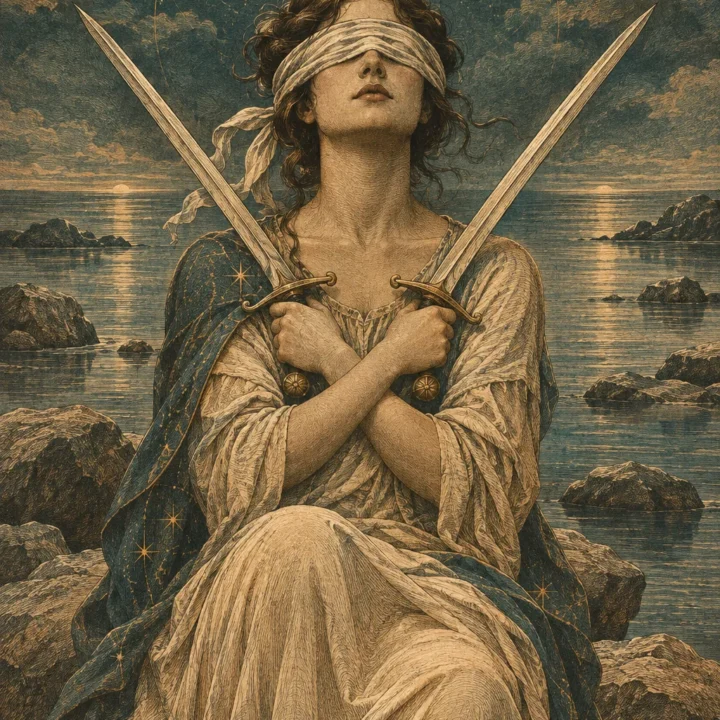
Two of Swords
indecision, guarded peace, boundaries, suspended choice
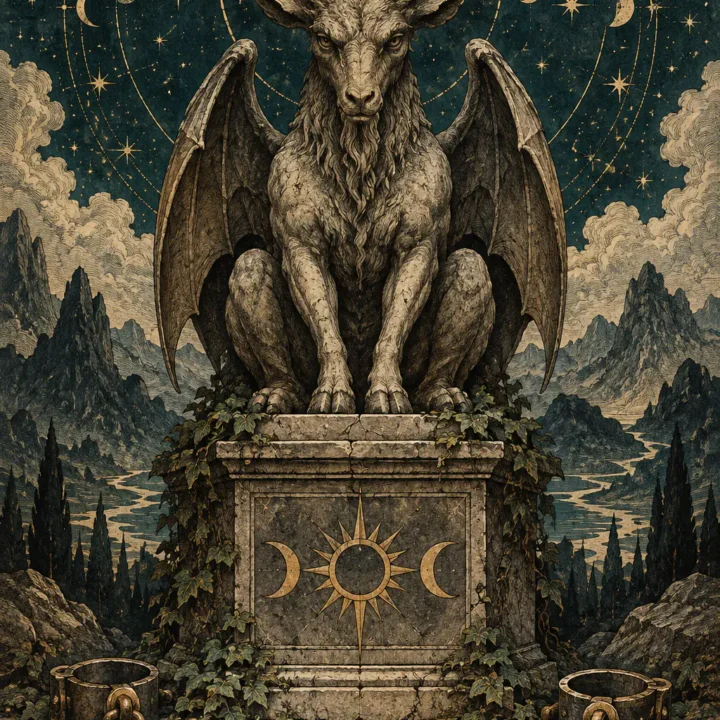
The Devil
attachment, temptation, compulsion, power
Ace of Swords
clarity, breakthrough, truth, discernment
Sources and further reading
- A. E. Waite, The Pictorial Key to the Tarot, Seven of Cups Read the text
- Golden Dawn, Liber LXXVIII / Book T, Lord of Illusionary Success, Venus in Scorpio Read the text
- Biddy Tarot, Seven of Cups, contemporary interpretation Read the text
- Labyrinthos, Seven of Cups, contemporary interpretation and deck comparison Read the text