Ace of Cups Tarot Card Meaning
A dove descends toward a cup overflowing above water lilies. The Ace of Cups invites you to recognize a new opening of the heart and what might nourish it.
- new feelings
- love
- compassion
- emotional renewal
- receptivity
Card at a glance
- Number
- Ace
- Element
- Water
- Astrology
- Root of the Powers of Water.
- Keywords
- new feelings, love, compassion, emotional renewal, receptivity, spiritual grace.
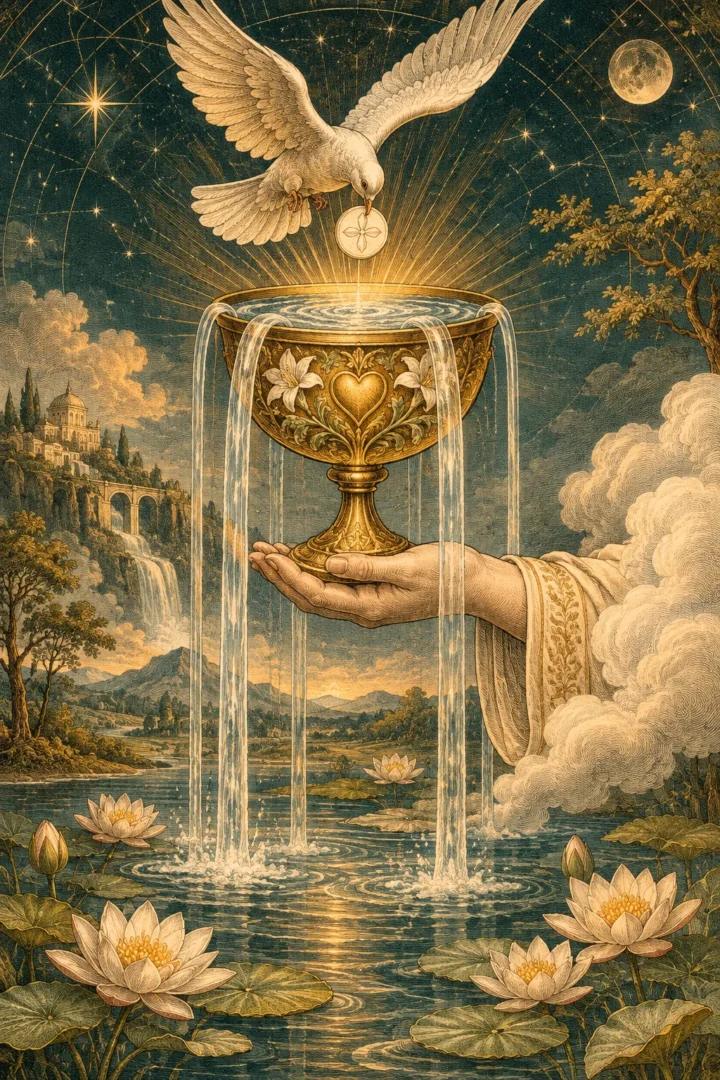 Ace · Ace of Cups
Upright meaning
new feelings, love, compassion
Upright, the Ace often speaks to the arrival of a fresh emotional possibility. You may meet someone who awakens tenderness, feel drawn to reconnect with a friend, or discover a new source of joy in a familiar part of your life.
- new feelings
- love
- compassion
- emotional renewal
- receptivity
- spiritual grace.
Reversed meaning
emotional withdrawal, uncertain affection, inner emptiness
A reversed Ace of Cups often appears when emotional life feels constricted. Perhaps you want closeness but are afraid to ask for it. You may be surrounded by people and still feel lonely, or find that an activity once full of meaning has become strangely empty.
- emotional withdrawal
- uncertain affection
- inner emptiness
- instability
- a need to replenish.
Card symbolism
-
The cup held by a cloud-borne hand
Smith makes the cup a vessel large enough to receive a descending dove and the water that flows through it. The hand appears from a cloud, echoing the other Aces in the Rider-Waite-Smith deck.
-
The dove and the cross-marked wafer
The dove is one of this card's most distinctive details. It descends with a small circular wafer marked by a cross, moving toward the cup. In Waite's description the wafer is a Host, an explicitly Christian Eucharistic image.
-
The streams, falling drops, and lilies
Water flows from the rim into a pool dotted with white water lilies. The flowers give the abundance somewhere to arrive. Their floating blossoms suggest a living world nourished by the water.
In depth interpretation
A hand emerges from a pale cloud, carrying a golden cup above a pool of water lilies. Clear streams spill over its rim. A dove descends toward the vessel with a small, marked wafer in its beak. The cup is already full, yet the water continues to flow.
The Ace of Cups is a card of emotional awakening, love, compassion, spiritual nourishment, and the possibility of a new connection. Upright, it often appears when your heart is becoming ready to receive something meaningful. Reversed, it can describe feelings that have become difficult to express or a kind of nourishment that no longer reaches you.
Sit with the image for a moment. Nothing in the scene is trying to grasp the water. The cup is held steadily enough to receive it. What might change if you gave your own feelings that much room?
The spiritual meaning: an opening of the heart
There are moments when something gentle finds its way through a life you thought you understood. You hear a friend's familiar voice and discover you have missed them. A piece of music moves you without warning. After a long period of keeping busy, you notice that you want to feel close to someone again.
The Ace of Cups belongs to those moments. It evokes the first movement of a feeling that deserves attention, even before you know where it will lead. The waters are already overflowing in Pamela Colman Smith's picture. Their movement suggests there is more available than the cup can contain.
This card can speak of romance, although its reach is wider. It may be the return of gratitude, a deepening friendship, an unexpected experience of forgiveness, or a sense that your spiritual practice has become nourishing again.
An Ace begins a suit. There are no lovers standing opposite one another, no family gathered beneath a rainbow, and no completed story. The card shows a gift offered into the world. You are meeting the possibility of love and emotional life at their source.
If you have been distant from your feelings, the Ace asks you to pay attention to what has begun to stir. You need not give it a name immediately.
What the symbols in the Ace of Cups reveal
The cup held by a cloud-borne hand
Smith makes the cup a vessel large enough to receive a descending dove and the water that flows through it. The hand appears from a cloud, echoing the other Aces in the Rider-Waite-Smith deck.
You might read the offered vessel as a spiritual opportunity to receive. It can also remind you that receiving involves ordinary choices. You may have to make time for a conversation, accept kindness without dismissing it, or acknowledge a feeling you have kept at a distance.
The hand does not show who will receive the gift or how long the moment will last. The card describes an opening rather than an outcome already secured.
The dove and the cross-marked wafer
The dove is one of this card's most distinctive details. It descends with a small circular wafer marked by a cross, moving toward the cup. In Waite's description the wafer is a Host, an explicitly Christian Eucharistic image.
That source matters. The motif evokes sacred nourishment, grace, and the meeting of divine and earthly life within the Christian symbolic language Waite used. In a spiritual reading, it can open a meditation on receiving love as something worthy of reverence.
Readers from other traditions are free to approach the image through their own beliefs, while recognizing the symbolism's particular origin. Calling the wafer a generic magical symbol would lose something important about what Smith and Waite placed in the scene.
The streams, falling drops, and lilies
Water flows from the rim into a pool dotted with white water lilies. The flowers give the abundance somewhere to arrive. Their floating blossoms suggest a living world nourished by the water.
You may notice an odd detail when comparing descriptions: Waite writes of four streams pouring from the cup, while Smith's illustration is commonly counted as showing five. Some modern guides associate five streams with the five senses. That is a contemporary interpretive layer; it is not a five-senses explanation given by Waite in his card entry.
For a reading, the precise count rarely changes the essential image. The cup is overflowing, and the pool below receives it. Ask where affection or compassion is entering your life and what would allow it to nourish something real.
Ace of Cups upright: when feeling begins to flow
Upright, the Ace often speaks to the arrival of a fresh emotional possibility. You may meet someone who awakens tenderness, feel drawn to reconnect with a friend, or discover a new source of joy in a familiar part of your life.
Imagine visiting a community garden after a difficult season. At first you intend to stay only a few minutes. Someone invites you to help water the seedlings. You remain, talk, and leave feeling unexpectedly connected to the people and the place. The Ace can live in that first quiet return of warmth.
The card encourages openness to what is genuinely present. It does not ask you to assume that every affectionate beginning is destined to last. A feeling deserves to be experienced before it is made to carry the weight of a permanent promise.
This can also be a creative card. Music, prayer, poetry, and caring work sometimes become ways of expressing something the heart has not yet put into everyday speech. Follow the activity that leaves you feeling more alive and attentive.
The Ace has an almost devotional quality: love begins to flow when there is space for it to be received.
Ace of Cups reversed: what happens when the cup no longer nourishes?
A reversed Ace of Cups often appears when emotional life feels constricted. Perhaps you want closeness but are afraid to ask for it. You may be surrounded by people and still feel lonely, or find that an activity once full of meaning has become strangely empty.
Modern tarot readers sometimes interpret this reversal as self-love or a need to turn compassion inward. That can be helpful, particularly when you have been giving more attention than you can comfortably sustain.
Waite's older language is markedly different. He described a reversed house of the false heart, alongside change and instability. These meanings suggest a place or emotional arrangement that no longer feels trustworthy or settled. They need not imply that someone is deliberately deceiving you.
Suppose you keep agreeing to social plans because you are worried about disappointing friends, but each gathering leaves you exhausted. A reversed Ace might illuminate the distance between the warmth you hope to feel and the way the arrangement actually affects you. The question becomes how to create conditions where affection can be given freely.
The reversal invites an honest look at what is being poured out, what is being held back, and what you need. It offers no reason to mistrust a person without evidence.
Does the Ace of Cups mean a new relationship?
A new relationship is one possible expression of the Ace of Cups. The card's central theme is emotional opening, which can also occur within a relationship you already have or in friendship, family, community, and spiritual life.
The distinction matters because the image shows only one offered cup. When you want to know whether feelings are mutual, you need to consider both people's words and actions. The Two of Cups, with two figures exchanging vessels, offers a more direct picture of mutual recognition.
In an outcome position, the Ace can suggest the possibility of a heartfelt beginning. If the question concerns a specific person, treat it as a reason to notice what is developing, rather than a promise that they will confess love.
Ace of Cups in love and relationships
If you are single, the Ace often suggests that you are beginning to feel available for connection. You might be more curious about meeting someone, or find that you enjoy affection and attention after a long quiet period.
For an established couple, it can mark a return of tenderness. Perhaps a difficult conversation finally makes room for kindness, or the two of you discover a new way to spend time together that feels emotionally renewing.
There is something beautiful about the Ace appearing after a stretch of emotional fatigue. Its imagery can remind you that the heart has seasons. If you have needed time to recover, you can honor that pace.
Reversed, pay attention to emotional needs that have gone unspoken. A gentle, direct conversation may provide more clarity than trying to infer the other person's thoughts from the cards.
Ace of Cups as feelings
In a feelings position, the Ace often symbolizes affection, vulnerability, tenderness, or the wish for greater closeness. Its imagery tells us about the quality of feeling being explored. It cannot establish what someone secretly intends or whether affection will develop into commitment.
Ace of Cups for career, creativity, and money
At work, the Ace of Cups can describe a new source of purpose. You might discover that a role allows you to care for people, contribute to something meaningful, or express a creative part of yourself that has been neglected.
Imagine someone who has spent years organizing events and decides to volunteer with a local arts group. They may not be changing careers. The experience offers emotional nourishment and a sense of belonging that had been missing.
In financial readings, the Ace does not promise wealth. Its value lies in asking what a decision will make possible in your life. A purchase, job change, or commitment can be emotionally appealing while still requiring a realistic understanding of cost and risk.
Reversed, you may be choosing from obligation while overlooking what you need to remain engaged. Notice that tension, then consider the practical options available.
Root of the Powers of Water: the esoteric background
In the Golden Dawn's Book T, the Ace of Cups is called the Root of the Powers of Water. The design shows an angelic hand supporting a cup from which a fountain rises and falls into waters with lotuses and water lilies.
This framework places the Ace at the source of the element's vitality. The Golden Dawn describes beauty, pleasure, happiness, and fertility among its possibilities. Smith's later Rider-Waite-Smith picture introduces the striking dove and sacramental wafer into an already rich watery symbol.
The two sources can deepen each other while remaining distinct. The Golden Dawn's elemental fountain speaks of the root of a living power. Smith's Eucharistic motif invites a more particular encounter with sacred nourishment.
Your own reading can give the image space to speak without claiming that every reader must share one theological interpretation.
Worked reading: am I ready to let a new friendship grow?
Imagine that an old disappointment has made you cautious about opening up to people. Someone new has been warm and consistent, and you want to know how to approach the friendship. You draw the Ace of Cups for the present, Temperance for guidance, and the Six of Pentacles for what to notice.
The Ace shows an emotional beginning. You are discovering that you want connection again. Temperance invites patience and a pace that feels sustainable. The Six of Pentacles draws attention to reciprocity, including whether both people make room for each other's needs.
Together, the cards suggest allowing the friendship to develop through ordinary exchanges. You could accept a simple invitation, share a little of your life, and notice how the other person responds. The Ace brings tenderness into the reading; the neighboring cards show how tenderness can become part of a trustworthy relationship.
If The Star appeared instead of the Six of Pentacles, the emphasis might shift toward renewing your sense of hope after disappointment. That would be a different question from whether an exchange is balanced.
The spread offers a compassionate way to explore the situation. It does not certify another person's reliability.
Ace of Cups as advice: make room for what nourishes you
Set the card before you and look at the space between the cup and the pool. Imagine one feeling or form of care you would like to welcome more fully.
You could write a few lines about it, send a sincere message, or spend a quiet evening doing something that helps you listen to yourself. If it suits your spiritual practice, fill a small bowl with water and let it represent the space you are making for renewal. The gesture is a personal reflection, not a ritual that guarantees an outcome.
What would help your cup remain steady as life continues around you?
Is the Ace of Cups a yes or no card?
The Ace of Cups often leans yes when the question concerns allowing a new connection, expressing affection, or exploring a meaningful creative or spiritual beginning. Its encouragement concerns openness and emotional potential. Reversed, examine whether the circumstances support the kind of connection you want. For a decision involving another person's consent, the card cannot answer on their behalf.
A short note on tradition
This article centers on the Rider-Waite-Smith deck illustrated by Pamela Colman Smith and first published in 1909, with Waite's Pictorial Key as one textual source. Its Christian Host is visible within Smith's artwork and named by Waite. The Golden Dawn's earlier Root of the Powers of Water is a related, differently pictured esoteric tradition. Contemporary interpretations about self-love and emotional availability add a living layer that should be read in context.
Frequently asked questions
Does the Ace of Cups mean pregnancy?
The Ace has associations with fertility and beginnings in older tarot practice. It cannot confirm pregnancy or predict a medical outcome. In a personal reading, fertility might also be understood symbolically as an idea, relationship, or life chapter developing.
Why is there a dove on the Ace of Cups?
The dove carries a cross-marked Host toward the cup, drawing on Christian sacramental imagery. Readers often connect the bird with grace, peace, and spiritual love, but the specific wafer is part of the image's documented religious language.
Why do some guides say there are five streams and Waite says four?
Waite's written description mentions four streams. Smith's illustrated cup is often counted as sending out five. Several modern guides attach five-senses symbolism to that visual reading, but it should not be attributed to Waite without further evidence.
What is the difference between the Ace of Cups and the Two of Cups?
The Ace presents a single overflowing vessel, an image of emotional potential and an offered gift. The Two depicts an exchange between people, emphasizing mutual recognition, affection, or agreement. Their sequence helps distinguish the beginning of feeling from the experience of sharing it.

Keep reading
Explore the Cups
Every card page names the tradition behind each meaning, so you can compare readings instead of taking one as fixed.
Cards to explore alongside this one
Their symbols reveal useful similarities and differences for your next reading.

Two of Cups
attraction, partnership, mutual respect, friendship

The Star
hope, inspiration, trust, renewal
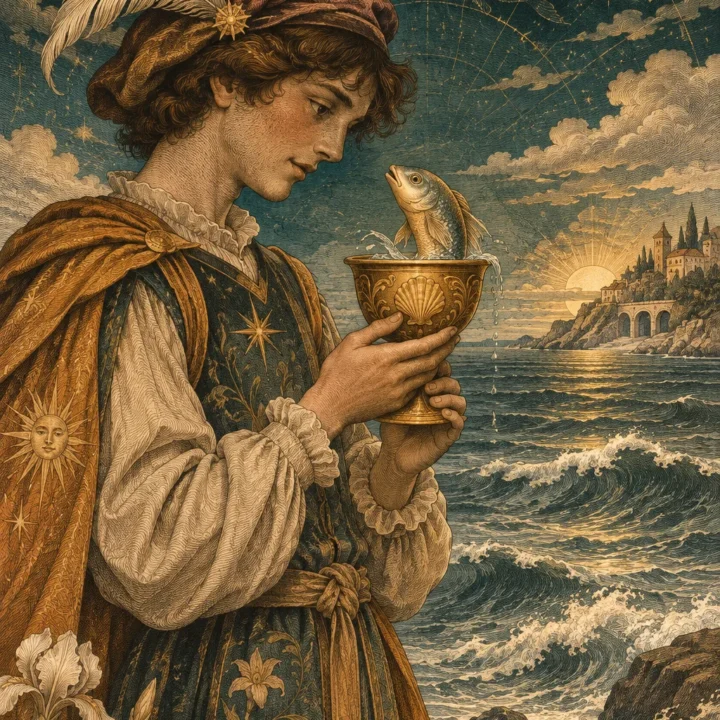
Page of Cups
imaginative insight, emotional news, kindness, study

Knight of Cups
an invitation, approach, emotional expression, romance
Sources and further reading
- A. E. Waite, The Pictorial Key to the Tarot, Part III (Cups: Ace) Read the text
- S. L. MacGregor Mathers and Harriet Felkin, Golden Dawn Book T, Root of the Powers of Water Read the text
- The Morgan Library & Museum, Pamela Colman Smith and the Rider-Waite-Smith tarot Read the text
- Biddy Tarot, Ace of Cups, contemporary upright and reversed meanings Read the text
- Labyrinthos, Ace of Cups, contemporary practice and deck comparison Read the text