Four of Cups Tarot Card Meaning
Beneath a tree, a seated figure ignores a cup offered from a cloud. The Four of Cups invites you to explore what you truly want before choosing.
- emotional weariness
- discontent
- boredom
- introspection
- a pause before accepting an offer.
Card at a glance
- Number
- Four
- Element
- Water
- Astrology
- Lord of Blended Pleasure, Moon in Cancer.
- Keywords
- emotional weariness, discontent, boredom, introspection, a pause before accepting an offer.
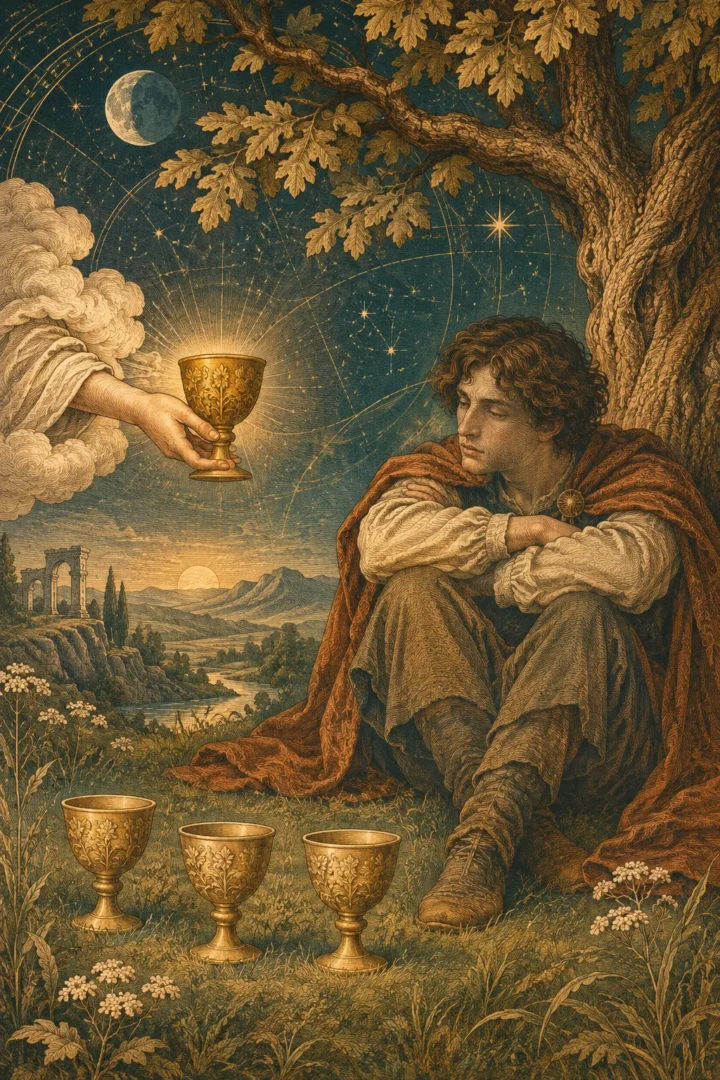 Four · Four of Cups
Upright meaning
emotional weariness, discontent, boredom
Upright, the Four of Cups often marks a period when ordinary pleasures feel less engaging. You might be discouraged by an unresolved situation or uncertain about an offer that others think you should find exciting.
- emotional weariness
- discontent
- boredom
- introspection
- a pause before accepting an offer.
Reversed meaning
fresh possibilities, new relationships, renewed interest
Reversed, the Four of Cups is frequently interpreted as a return of interest. The figure begins noticing life again, and an invitation that previously seemed dull can feel unexpectedly welcome.
- fresh possibilities
- new relationships
- renewed interest
- deepened withdrawal in some modern readings.
Card symbolism
-
Three cups resting on the earth
The three cups are arranged before the seated figure. They appear close and available, yet his expression gives no sign of pleasure.
-
A hand carrying the fourth cup
The new vessel appears in a cloud-borne hand, echoing the mysterious offerings in the four Aces of the Rider-Waite-Smith deck. It arrives from beyond the figure's immediate world.
-
Folded arms beneath a tree
The figure's arms are folded over his body. Some readers see resistance in this gesture; others recognize a posture of concentration or self-protection.
In depth interpretation
A young figure sits beneath a tree, his arms folded as he gazes at three cups on the grass. From a cloud, a hand offers a fourth. The cup is close enough to notice, yet the figure remains absorbed in his own thoughts. We cannot see the thought that holds him there.
The Four of Cups represents emotional discontent, contemplation, withdrawal, and the difficulty of recognizing what might nourish you. Upright, it often appears when something that once felt satisfying has lost its brightness, or when an invitation arrives at a moment you cannot meet it. Reversed, it may bring new interest, a change of perspective, or the beginning of a fresh connection.
There is a quiet mystery in this scene. We do not know what is inside the offered cup. The card invites you to look at it with fresh eyes and decide what feels true for your life.
The spiritual meaning: listening during a season of discontent
Sometimes you find yourself in a perfectly ordinary, pleasant moment and realize that you are not enjoying it. A friend invites you somewhere, and you feel unable to say yes. A project that once excited you has become a series of tasks. The things you are supposed to appreciate seem strangely distant.
The Four of Cups understands that experience. In Pamela Colman Smith's picture, the seated figure has three cups before him and another being offered. The familiar is close, and something unexpected has entered the scene. Still, his attention has gone inward.
He might be disappointed. He could be tired or simply preoccupied. We see his posture, though the reason for it remains hidden from us.
That uncertainty is part of the card's spiritual depth. When you feel detached from what once sustained you, it helps to ask what has changed. You might need to grieve an earlier season, rest after too many demands, or discover a kind of joy that no longer resembles what you expected.
There are times when a quiet pause becomes a place of insight. The Four invites you to make that space meaningful by noticing what you genuinely feel and what you are ready to consider next.
The quiet of the Four of Swords has another quality. Its resting knight is making room after strain, while the seated figure here may be questioning what still feels nourishing. When the two appear together, consider whether your sense of disengagement is asking for rest, a change in priorities, or both.
What the symbols in the Four of Cups reveal
Three cups resting on the earth
The three cups are arranged before the seated figure. They appear close and available, yet his expression gives no sign of pleasure.
You might imagine them as experiences, relationships, or achievements that have become familiar. Perhaps they once made you happy. Perhaps they never met the need you hoped they would.
In a practical reading, these vessels encourage an honest inventory. Which parts of your life have been nourishing? What now feels repetitive or incomplete? You need not declare those experiences worthless to acknowledge that something has shifted.
A hand carrying the fourth cup
The new vessel appears in a cloud-borne hand, echoing the mysterious offerings in the four Aces of the Rider-Waite-Smith deck. It arrives from beyond the figure's immediate world.
Many modern readings call this a missed opportunity. That description captures the risk of being too absorbed to see an opening. Yet the picture leaves two important things unresolved: whether the seated figure will notice, and whether the offered cup is something he wants.
This is a valuable distinction. Seeing an opportunity clearly does not obligate you to accept it. An honest reading considers the invitation itself, your capacity to respond, and what accepting it would ask of you.
The cloud can be approached as a spiritual mystery, a reminder that life sometimes offers possibilities we could not have planned. What matters is learning to encounter them with attention.
Folded arms beneath a tree
The figure's arms are folded over his body. Some readers see resistance in this gesture; others recognize a posture of concentration or self-protection.
The tree gives him shelter. He has chosen a place where he can stop moving and consider what he sees. We can imagine him remaining for a few minutes or a very long time, and the image offers no clock to tell us which is true.
If you are reading about your own withdrawal, ask what the quiet is helping you understand. Then consider whether it has begun to isolate you from people or experiences you care about.
Four of Cups upright: when satisfaction fades
Upright, the Four of Cups often marks a period when ordinary pleasures feel less engaging. You might be discouraged by an unresolved situation or uncertain about an offer that others think you should find exciting.
Imagine a skilled baker who has spent years preparing the same pastries. Customers praise the work, and the bakery is doing well, but the daily routine has lost its earlier sense of discovery. A friend suggests teaching a class. The baker has no immediate enthusiasm and would rather sit quietly with a cup of tea.
The Four can describe the need to understand that feeling. Is the baker tired from a demanding season? Has the work become too repetitive? Would teaching feel alive once there is room to think about it?
Waite's historical upright interpretation includes weariness, aversion, and the experience of becoming saturated with familiar pleasures. He also describes an extraordinary gift that the figure cannot find comforting. The point is that even something valuable can feel distant when a person is in a season of discontent.
This card encourages you to recognize the feeling before making a decision that will affect your future. It can be useful to ask for time, gather information, or speak with someone who understands the situation.
Is the fourth cup always an opportunity you should accept?
No. The Four of Cups depicts an offer and a person who has not responded to it. The card does not establish that the offer is safe, worthwhile, or suited to the person receiving it.
A simple reading method is to consider three questions.
What is actually being offered? Describe the real invitation, agreement, or possibility without adding what you hope it means.
What is your present capacity? You may be tired, distracted, grieving, or simply interested in something else. Your feelings can provide useful information, even if they are still difficult to understand.
What would help you decide? A conversation, a trial experience, practical details, or time to reflect might reveal whether the opportunity deserves a place in your life.
These are interpretive questions inspired by the artwork. They are meant to support discernment. They do not belong to a fixed historical tarot doctrine.
The fourth cup can be a reminder to look up. You retain the freedom to choose what you receive.
Four of Cups reversed: renewal, new relations, or deeper withdrawal?
Reversed, the Four of Cups is frequently interpreted as a return of interest. The figure begins noticing life again, and an invitation that previously seemed dull can feel unexpectedly welcome.
Waite's older reversed meanings support a similar, though more specific, direction. He included novelty, new instruction, and new relationships, along with a sense that something is about to happen. The old interpretation is more hopeful than a simple doubling of the card's boredom.
Some contemporary readers follow a different reversal method and see a person withdrawing further inward. The distinction matters. If your energy is returning after rest, the first approach may fit. If the world still feels overwhelming and you have become increasingly isolated, the second may speak more directly to what you are experiencing.
Imagine hearing about a neighborhood reading group after months of declining invitations. You might find that this particular gathering awakens curiosity because it offers a gentler way to spend time with people. The reversed Four could capture that fresh interest without promising that every social difficulty has ended.
If disconnection is persistent or distressing, the card can become a starting point for conversation with someone supportive. It is not a diagnosis and cannot establish the cause of the feeling.
Four of Cups in love and relationships
In a love reading, the Four of Cups may describe someone who feels uncertain about how to respond to affection. Perhaps a connection has grown familiar, and both people have stopped talking about what they need. A new person may be showing interest when you are still processing an earlier relationship.
If you are single, the card can appear when you are tired of dating or need space away from expectations. It invites curiosity about what would make meeting someone feel genuinely welcome.
For couples, the Four sometimes highlights a quieter phase in which appreciation has become hard to express. A familiar evening together may feel routine because you have not had the energy to pay attention to one another's changing lives.
Reversed, a new conversation could begin. You may be ready to reconsider an old assumption or explore a shared activity that feels fresh. The useful change comes through what both people actually do.
What does the Four of Cups mean as feelings?
As feelings, the Four can suggest ambivalence, emotional distance, contemplation, or the wish to be left alone for a while. It cannot reveal that someone is secretly in love but refusing to admit it. If you are asking about another person, give greater weight to their communication and actions.
Four of Cups for friendship, community, and spiritual life
The Four can be particularly revealing after the shared celebration of the Three of Cups. A gathering that once felt welcoming may now require more energy than you have available. You might have outgrown part of a social circle, or simply need a quiet evening after several busy weeks.
That does not mean your friends have failed you. The card invites you to explore what kind of connection you can welcome in the current season. Sometimes a one-to-one conversation feels more nourishing than a large gathering.
In a spiritual practice, the Four can arise when familiar rituals feel flat. You might light a candle, pull a card, or sit in prayer and notice that the feeling you once expected is absent. It is possible to respect the practice while allowing your relationship with it to change.
Consider what first drew you toward that practice. Perhaps you need a new question, a teacher, a place of silence, or simply a period without demanding a particular experience of yourself.
Four of Cups for work, creativity, and money
At work, this card often appears when motivation has faded and a new proposal fails to excite you. You may be doing competent work that no longer draws on the interests that once made it meaningful.
The Four can encourage you to investigate what is being offered before ruling it out. If a colleague suggests a different project, find out what the work entails. Your lack of immediate enthusiasm could be telling you something useful about your present responsibilities.
For creative people, discontent may come after a period of output. Your attention could need new material, a different rhythm, or a chance to work without a deadline.
In money matters, the fourth cup is no guarantee of profit. An offer should be assessed through its terms and consequences. Feeling bored with your current situation is rarely a sufficient reason to accept a financial risk.
Moon in Cancer and the Lord of Blended Pleasure
In the Golden Dawn's Book T, the Four of Cups is called the Lord of Blended Pleasure and linked with Moon in Cancer. Its symbolic design has four cups arranged in two levels. Water flows into the upper pair and then into the lower pair, yet the lower cups do not overflow.
That detail distinguishes the Four from the abundant movement of the Three of Cups, whose vessels overflow more freely. The older system describes pleasure mixed with anxiety and a period when happiness may be approaching its end.
Smith's later image approaches the same tension through a person sitting under a tree, contemplating three cups while another is offered. It becomes a vivid human experience: having something nearby does not always mean feeling nourished by it.
The Golden Dawn attribution belongs to a particular Western esoteric tradition. It offers an additional symbolic way to understand the card without making the astrological meaning compulsory for every tarot deck.
Worked reading: should I consider an offer that leaves me cold?
Imagine you have been offered a new role at work. It sounds attractive to other people, but you feel strangely disconnected from the prospect. You draw the Four of Cups as the present, The Hermit for what deserves attention, and the Ace of Pentacles for the opportunity itself.
The Four describes your lack of enthusiasm and the need to understand it. The Hermit invites private reflection on what matters to you now. The Ace of Pentacles suggests a tangible opening that deserves a careful look, including its practical conditions.
Together, these cards encourage you to ask questions about the role, give yourself time to reflect, and consider whether it offers something you genuinely value. You might request a meeting with the team or a clearer description of the work before making a choice.
If The Star appeared instead of the Ace of Pentacles, the reading might direct more attention toward renewing your sense of hope or purpose. The offered cup in the Four remains a mystery until the rest of the situation gives it shape.
Four of Cups as advice: spend time with the offered cup
Place the Four before you and look at the hand emerging from the cloud. Think of an invitation you have recently dismissed, or one you have been unable to answer.
Write down what you know about it and what you are imagining. Then ask how you feel when you picture accepting it. Your answer may change as you learn more.
If the offer deserves further consideration, choose one small step that creates clarity. You could ask a question, visit a place, or give yourself a realistic deadline for a decision.
There is also value in discovering that your answer is no. The card's quiet figure reminds you that some choices require time to become clear.
Is the Four of Cups a yes or no card?
The upright Four of Cups often leans toward not yet. Disinterest or uncertainty may need attention before a meaningful commitment can be made. Reversed, its themes of renewed curiosity and fresh relationships can make the answer more hopeful. The card cannot tell you whether a real offer is suitable without knowing its terms and your circumstances.
A note on tradition
This interpretation follows Pamela Colman Smith's Rider-Waite-Smith image, first published in 1909, and Waite's description of discontent in the presence of an offered cup. His reversed meaning includes new relations and fresh instruction. The Golden Dawn's earlier Blended Pleasure uses four vessels with a distinctive pattern of water flow and the Moon-in-Cancer correspondence. Current readers also interpret the card through emotional withdrawal, reflection, and the decision to decline or accept invitations.
Frequently asked questions
How can I tell whether I need rest or a new direction?
Notice what happens after you have genuinely rested. Does the familiar begin to feel nourishing again, or does the desire for change remain? You can explore the offered cup through a small conversation or experiment before deciding whether to receive it.
Is the Four of Cups about depression?
The image can resonate with low motivation or emotional withdrawal, but tarot cannot identify a medical condition. Persistent loss of interest or distress deserves care and, when appropriate, professional support.
What is the difference between the Four and the Ace of Cups?
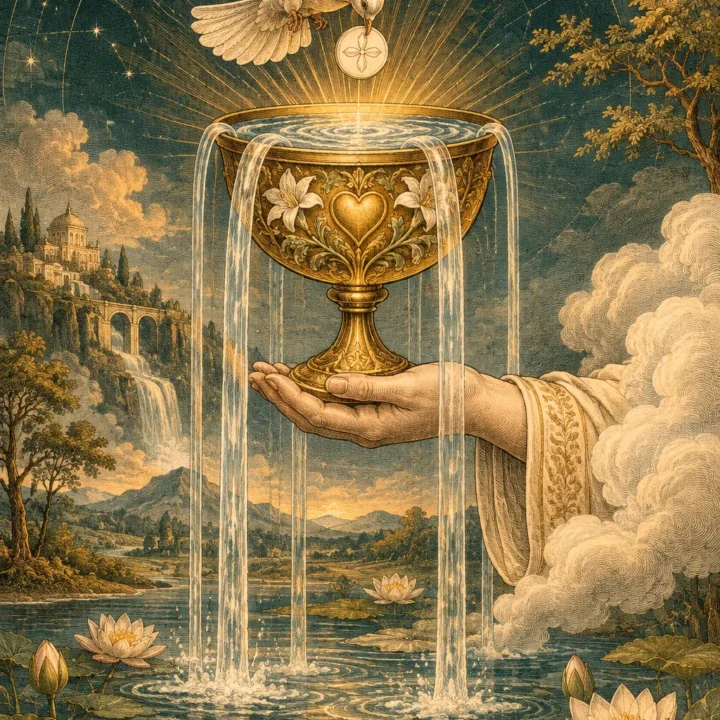
The Ace shows an overflowing vessel offered into the world, suggesting the possibility of emotional renewal. The Four depicts a person who has several cups nearby and is uncertain how to receive another. It explores the conditions under which an emotional gift feels welcome. The Five of Cups presents a different sorrow, when something cherished has already been lost.
Why is the reversed Four of Cups sometimes positive?
Waite's reversed list includes novelty, instruction, and new relationships. Many modern readers also interpret the reversal as a return of interest after a quiet or dissatisfied period. The card's meaning still depends on the question and your chosen approach to reversals.

Keep reading
Explore the Cups
Every card page names the tradition behind each meaning, so you can compare readings instead of taking one as fixed.
Cards to explore alongside this one
Their symbols reveal useful similarities and differences for your next reading.

Four of Swords
rest, retreat, contemplation, recovery

Seven of Cups
imagination, choices, visions, temptation

Eight of Cups
departure, searching, emotional dissatisfaction, changing priorities
Ace of Cups
new feelings, love, compassion, emotional renewal
Sources and further reading
- A. E. Waite, The Pictorial Key to the Tarot, Part III, Four of Cups Read the text
- Golden Dawn, Book T, Lord of Blended Pleasure, Moon in Cancer Read the text
- Biddy Tarot, Four of Cups, contemporary meanings Read the text
- Labyrinthos, Four of Cups, contemporary symbolism and practice Read the text