Three of Cups Tarot Card Meaning
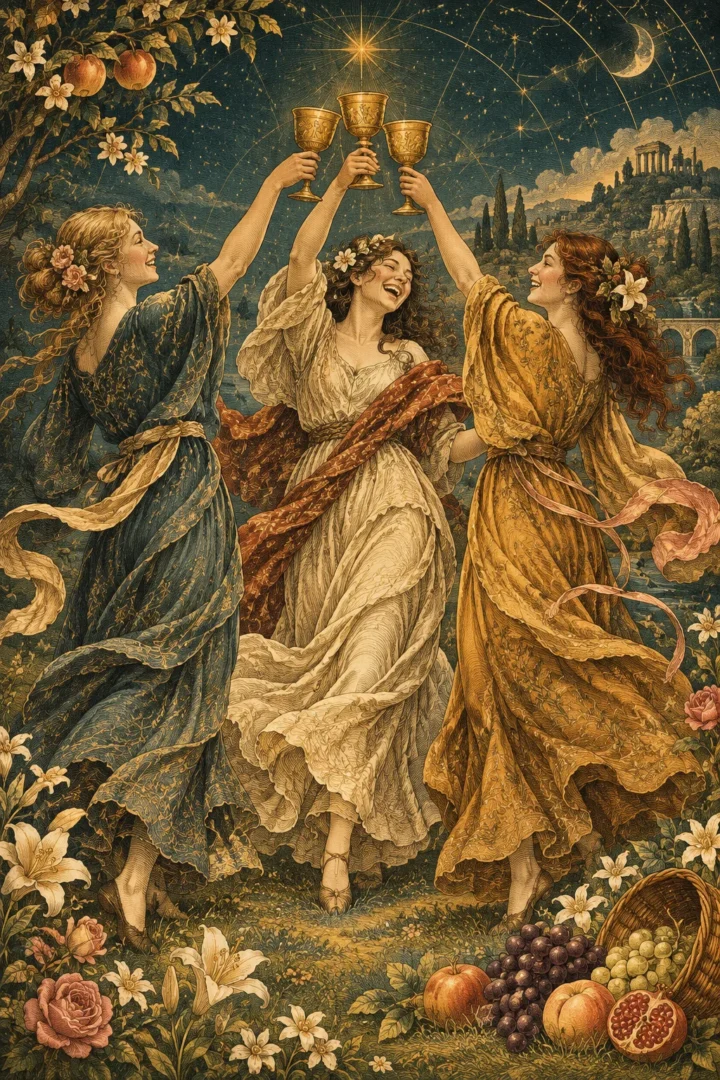
Three women raise cups amid fruit and flowers. The Three of Cups celebrates belonging, friendship, and the warmth of joy that people choose to share.
- friendship
- reunion
- celebration
- community
- creative collaboration
Card at a glance
- Number
- Three
- Element
- Water
- Astrology
- Lord of Abundance, Mercury in Cancer.
- Keywords
- friendship, reunion, celebration, community, creative collaboration, shared relief.
 Three · Three of Cups
Upright meaning
friendship, reunion, celebration
Upright, the Three of Cups often arrives when people are ready to share good news. There may be a reunion, a family gathering, a friendship growing stronger, or a creative milestone that belongs to more than one person.
- friendship
- reunion
- celebration
- community
- creative collaboration
- shared relief.
Reversed meaning
group tension, isolation, excess
Modern tarot practice commonly reads the reversed Three of Cups as a strained friendship, a social scene that has become excessive, or a growing need for solitude. Perhaps a gathering drains you, or a creative group expects everyone to behave in the same way.
- group tension
- isolation
- excess
- withdrawal
- an ending or an undertaking brought swiftly to completion.
In depth interpretation
Three women raise their cups together in a garden scattered with fruit and flowers. Their dresses move with the rhythm of a dance. No one stands above the others, and the moment seems to belong to all three. You can almost hear the laughter that brought them into this circle.
The Three of Cups represents friendship, celebration, shared joy, support, and the healing that can happen in good company. Upright, it often marks an occasion worth celebrating or a relationship sustained by the people who show up for one another. Reversed, it can describe a gathering that has become exhausting or exclusive, a need for time apart, or the end of a joyful period. Older interpretations also associate the reversal with achievement and bringing a matter to a close.
The heart of this card lives in the space between the raised cups. Joy has found people willing to share it.
The spiritual meaning: a circle with room to belong
Perhaps you have known the comfort of arriving somewhere and discovering that people saved a place for you. You sit down, the conversation welcomes you in, and some part of your body relaxes. For a little while, you are able to enjoy being known.
The Three of Cups carries that feeling. The three figures in Pamela Colman Smith's painting have come together to acknowledge something good. They have their separate bodies and clothes, yet their attention moves toward the same shared moment.
The Cups suit begins with an overflowing vessel. In the Two of Cups, two people exchange a pledge. Here, affection has reached a wider circle. The Four of Cups will ask what happens when a person needs quiet and finds that even welcome company can feel difficult to receive. A friendship group, a chosen family, a team of makers, or a community gathered for a meaningful occasion can give this card its human form.
This is why the Three sometimes appears after a difficult period. A wedding or a birthday may be the obvious event, though the deeper gift can be discovering that people are willing to rejoice with you. Another person seeing your relief or happiness can make the experience feel more fully real.
A good circle has room for the people who belong to it to remain themselves. The card invites you to notice where you experience that freedom.
What the dancing women and harvest reveal
Three cups lifted toward the center
The figures hold their vessels high, directing them toward a common space. Their gestures are active. Each person participates in the celebration rather than simply watching someone else enjoy it.
If you are reading about a friendship, this is a useful detail. Are you joining a relationship where everyone has room to contribute? Can you celebrate another person's good news without fearing it takes something away from your own?
The picture does not establish that every group is equal or harmonious. It offers an ideal to measure against the real situation.
Fruit, flowers, and the ground beneath the dance
Flowers and harvest produce appear around the women's feet. Smith's scene belongs to a season when the earth has given something worth gathering. The abundance is tangible beneath their celebration.
One way to read this is as an invitation to recognize the work that precedes joy. Someone cooked, cultivated, practiced, organized, helped, or waited. The dance honors a real occasion, even when we are not shown exactly what brought the figures together.
If this symbol feels important, ask what has grown in your life and who helped tend it. Perhaps a friendship has survived a difficult year, or a project has finally reached the point where everyone can gather to admire what they made.
The circle and the figure turned away
One woman's face is partly hidden from us. It is tempting to invent a story about a secret or a person excluded from the group, especially in a reversed reading.
The image does not tell that story. All three figures are taking part in the dance. You can use the shape of the circle to reflect on belonging, yet you do not need to assign a private motive to a person whose expression is unseen.
The important question concerns your own circle. Who gets invited into its joy, and whose effort is recognized?
Three of Cups upright: celebrate what has become real
Upright, the Three of Cups often arrives when people are ready to share good news. There may be a reunion, a family gathering, a friendship growing stronger, or a creative milestone that belongs to more than one person.
Imagine a choir preparing for a small concert. During rehearsals, the singers struggle with a difficult passage. They keep practicing and listening to one another. After the performance, they gather outside the hall, laughing at how nervous they had been. The Three of Cups lives in that shared release.
The card can also describe the invitation to reconnect. You may have been so occupied with work or responsibilities that you have forgotten how much a familiar friendship nourishes you. A simple meal or walk could restore something that does not need a grand occasion.
In some readings, the Three brings consolation after a difficult chapter. Waite's traditional upright meanings included solace and healing alongside victory and merriment. You might find that being with trusted people allows you to feel your grief and your joy more freely.
The card's encouragement is gentle: let people witness what matters to you when it is safe and welcome to do so.
Three of Cups reversed: when the celebration changes
Modern tarot practice commonly reads the reversed Three of Cups as a strained friendship, a social scene that has become excessive, or a growing need for solitude. Perhaps a gathering drains you, or a creative group expects everyone to behave in the same way.
There is a quieter possibility too. A happy season may simply be ending. The friends in a group move to different cities, a beloved annual event reaches its last year, or someone needs time away from a busy social life.
Waite's historical reversed meanings are interesting here. He included dispatch, achievement, expedition, and an end, alongside excess in physical enjoyment. His reversal does not automatically predict gossip, infidelity, or isolation. It may bring an undertaking to completion, or describe the momentum of a celebration that has gone too far.
Suppose friends have just finished organizing a community fundraiser. The celebration may be over because the work has been completed. A historically informed reversed Three might fit that ending. If the organizers are exhausted and hurt by unequal demands, a modern reading about strained group dynamics may be more useful.
Ask how the gathering actually feels, what has been accomplished, and whether the people involved have room to rest.
Does the reversed Three of Cups mean cheating or a love triangle?
No single Three of Cups card can establish that someone is cheating. Some contemporary love readings use the reversed image of three people to explore a relationship complicated by a third party. That is a possible interpretive theme when the question already involves boundaries or outside influence.
It is not the core of Waite's reversed meaning, and Smith's image shows three women celebrating together rather than a hidden affair.
If you feel worried about a partner, consider what has actually happened. A reading can help you name insecurity or social pressure, but it cannot reveal another person's private actions. Honest communication and reliable information matter.
The same three figures may represent something far kinder: friends supporting a relationship through a demanding season.
Three of Cups in love, friendship, and feelings
In love, the Three of Cups often brings a lightness that comes from friendship. You might be enjoying dates that include laughter, meeting each other's communities, or feeling welcomed by people who matter to your partner.
For established couples, it may appear around a celebration or a return to shared social life. If you have become isolated together, the card can invite you to remember friends and family who bring warmth into your days.
For someone single, the Three is often most compelling as a friendship card. Spending time with people who genuinely enjoy your company can give your emotional life richness, whether or not romance develops.
As feelings, the Three can suggest appreciation, warmth, companionship, and pleasure in someone's company. It offers little basis for declaring romantic commitment, and it cannot read another person's thoughts. The closeness you share becomes clearer through the time you spend together.
Reversed, notice the quality of your social relationships. Do you feel supported, pressured to perform, or uncertain that you belong? A friendship worth tending should leave some space for your real needs.
Three of Cups for career, creativity, and money
At work, this card can describe the joy of collective achievement. A group completes an undertaking, colleagues celebrate an important result, or a collaboration leaves everyone feeling proud of their contribution.
Its challenge is easy to miss. A warm team gathering can still conceal unequal work. Maybe one person has organized every event, followed up with everyone, and kept the project moving while others receive the praise. The Three invites you to let shared joy include fair acknowledgment.
For creative projects, the card often encourages making with others. You could join a workshop, share music, or ask someone to contribute an idea. The experience of being seen by fellow makers may be as valuable as the finished work.
In money matters, the Three can reflect spending on celebrations or the shared resources needed for an event. The feeling of abundance is meaningful, but financial decisions still deserve realistic figures.
Mercury in Cancer and the Lord of Abundance
In the Golden Dawn's Book T, the Three of Cups is the Lord of Abundance, assigned to Mercury in Cancer. The earlier esoteric image shows three cups overflowing through the action of lotus flowers and streams of water. Its traditional interpretations include hospitality, dancing, pleasure, and plenty.
Smith's Rider-Waite-Smith card presents abundance through people. We see a garden, harvest produce, and three women lifting cups together. The two traditions are related, yet their artwork invites different kinds of attention.
The Golden Dawn imagery emphasizes the flow of plenty between vessels. Smith's dance asks who is there to receive and share the good things life has brought. You can let both images enrich your reading without assuming that every visual detail was intended to carry an older occult code.
How to read the Three of Cups with surrounding cards
The meaning of celebration changes with the role the card plays. In a present position, it may describe a supportive community or a milestone approaching. As advice, it can encourage reconnection or recognition of shared effort. In a challenge position, you may need to look at who feels excluded or how much a group is demanding from its members.
Worked reading: should we celebrate our project's success now?
Imagine volunteers who have finished restoring a neighborhood garden. They want to hold a celebration, but some members have quietly taken on more work than others. You draw the Three of Cups for the present, the Six of Pentacles for what needs attention, and Temperance as advice.
The Three invites the group to honor something good. The Six of Pentacles turns attention toward how resources and help have been shared. Temperance suggests careful coordination and a sustainable pace.
Together, the cards could encourage a gathering that genuinely includes the people whose work made the garden possible. The team might first ask who needs rest, share the remaining preparations fairly, and choose a celebration that everyone can enjoy.
If the Three appeared with the Three of Pentacles instead of Temperance, the reading might focus more on craftsmanship and recognizing each participant's skill. The scene of three women dancing is the same, yet the neighboring card changes what deserves emphasis.
The Three of Cups as advice: invite someone into the joy
Look at the raised cups and imagine the moment before they touch. Think of something good that has happened recently, even if it seemed too small to celebrate.
Who helped make it possible? Who would genuinely enjoy hearing about it? There may be someone you could thank, invite, or encourage.
If your social world feels complicated, the card can help you recognize which gatherings nourish you. A heartfelt invitation to one trusted person may be more meaningful than an elaborate celebration.
The circle has its beauty because people have chosen to come together.
Is the Three of Cups a yes or no card?
The Three of Cups generally leans yes for sharing good news, reconnecting with supportive friends, celebrating a milestone, or beginning a collaborative experience. Reversed, the answer becomes more dependent on the health of the group and your available energy. A card cannot guarantee that an event will succeed or that another person will attend.
A short note on tradition
This reading centers on the Rider-Waite-Smith tarot illustrated by Pamela Colman Smith, first published in 1909. Waite described three maidens raising cups and associated the card with fulfillment, solace, and celebration. His reversed list included both completion and sensual excess. The Golden Dawn's earlier Lord of Abundance used a different symbolic design featuring overflowing cups and lotus flowers. Contemporary interpretations of social isolation and third-party involvement belong to later reading practice.
Frequently asked questions
Does the Three of Cups mean a reunion?
A reunion is a fitting interpretation when the question already involves friends, relatives, or a community coming back together. The three figures celebrate a shared moment, but the card cannot promise that a particular person will return.
Is the Three of Cups about friendship or romance?
Friendship and group belonging are especially prominent. It can appear in romantic readings, often through celebrations or the social world surrounding a relationship. The Two of Cups more directly depicts a one-to-one exchange.
Does the Three of Cups mean pregnancy?
Some modern readings associate the card with fertility celebrations or happy family news. That symbolism cannot establish pregnancy or predict a medical outcome. The illustrated harvest is best understood as abundance and something worth celebrating within the reading's context.
Why can the reversed Three of Cups mean completion?
Waite's reversed list includes achievement, dispatch, and an end. That differs from the familiar modern focus on isolation or gossip. In an undertaking that has finished, the card may show the joyful season drawing to its natural close.

Keep reading
Explore the Cups
Every card page names the tradition behind each meaning, so you can compare readings instead of taking one as fixed.
Cards to explore alongside this one
Their symbols reveal useful similarities and differences for your next reading.
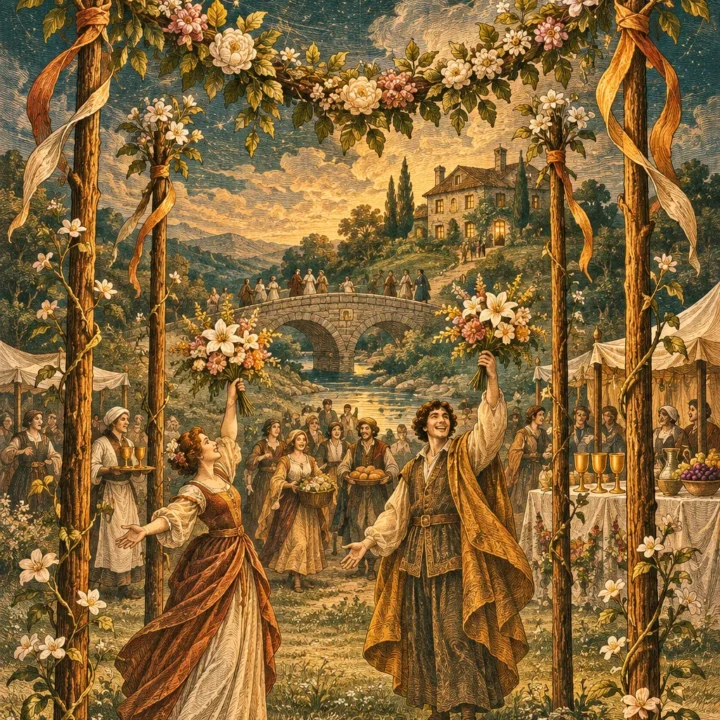
Four of Wands
welcome, celebration, peace, refuge

Ten of Cups
emotional fulfillment, family and chosen family, shared joy, harmony
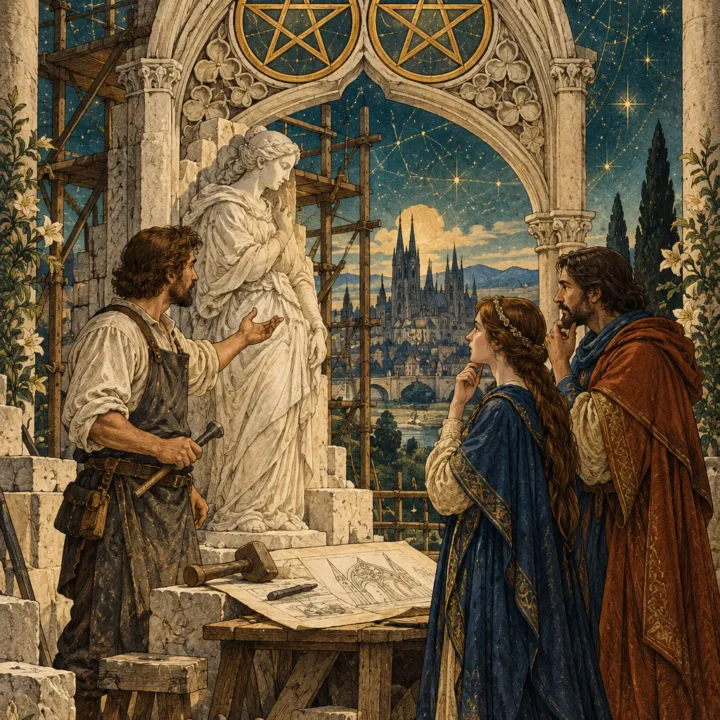
Three of Pentacles
skill, collaboration, apprenticeship, useful feedback
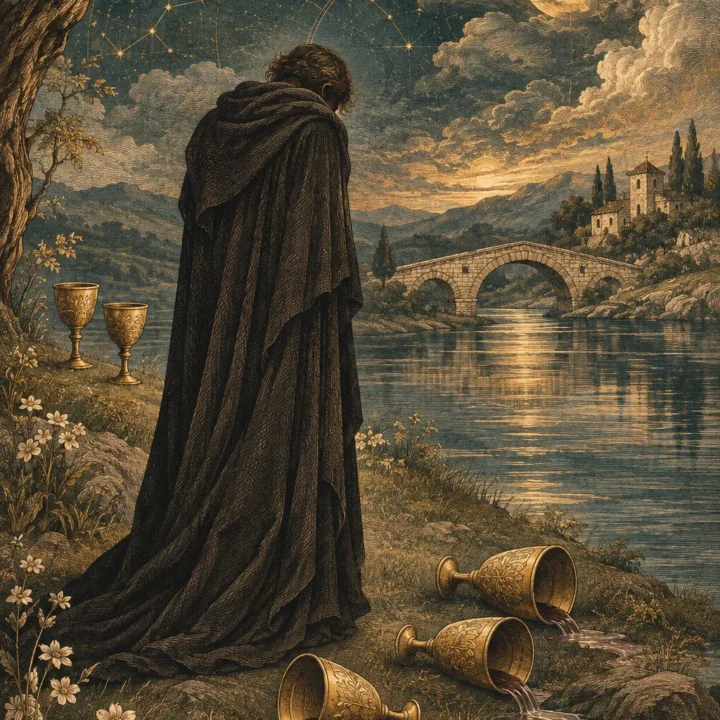
Five of Cups
sadness, loss, disappointment, regret
Sources and further reading
- A. E. Waite, The Pictorial Key to the Tarot, Part III, Three of Cups Read the text
- Golden Dawn, Book T, Lord of Abundance, Mercury in Cancer Read the text
- Biddy Tarot, Three of Cups, contemporary meanings Read the text
- Labyrinthos, Three of Cups, modern practice and imagery Read the text