Eight of Cups Tarot Card Meaning
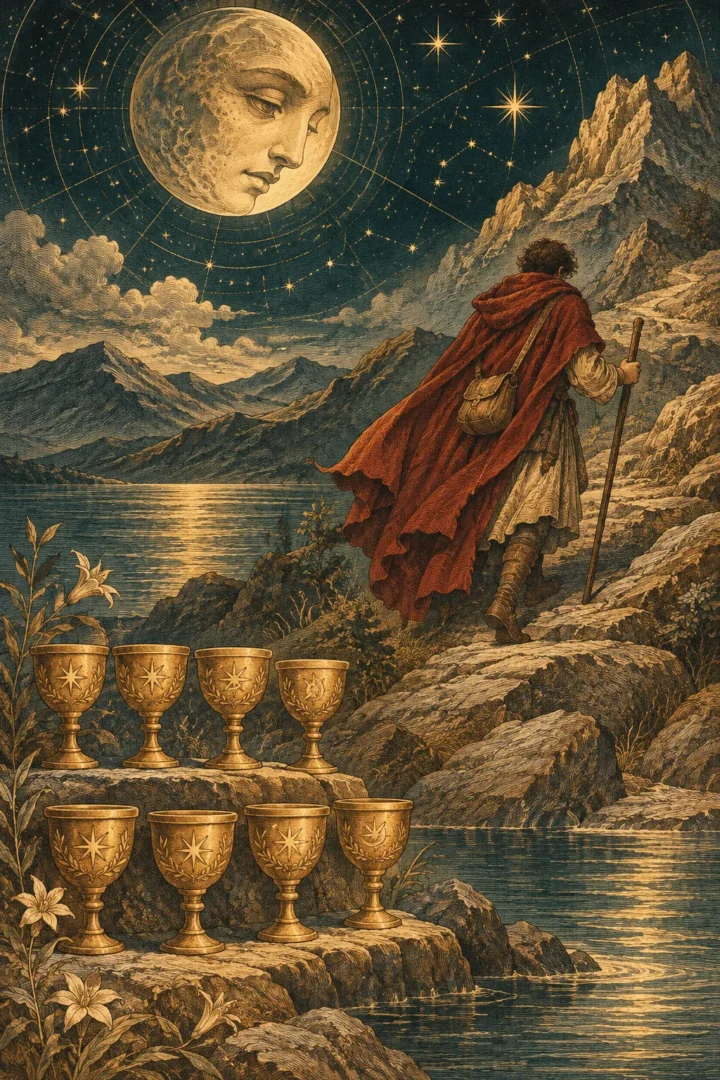
A cloaked traveler walks away from eight untouched cups beneath a mysterious moon. The Eight of Cups asks what it means to leave a chapter that once mattered.
- departure
- searching
- emotional dissatisfaction
- changing priorities
- leaving an established situation.
Card at a glance
- Number
- Eight
- Element
- Water
- Astrology
- Lord of Abandoned Success, associated with Saturn in Pisces.
- Keywords
- departure, searching, emotional dissatisfaction, changing priorities, leaving an established situation.
 Eight · Eight of Cups
Upright meaning
departure, searching, emotional dissatisfaction
Upright, the Eight often appears when a person is reconsidering a commitment that used to feel important. You may be leaving a group, a familiar role, a place, or a project because the experience no longer supports the life you are trying to build.
- departure
- searching
- emotional dissatisfaction
- changing priorities
- leaving an established situation.
Reversed meaning
hesitation, revisiting a choice, difficulty leaving in contemporary readings; great joy and feasting in Waite's reversed list.
Many modern guides interpret the reversed Eight as difficulty moving on, returning to an earlier commitment, or wandering between decisions. You may be uncertain whether to stay, or discover that a departure was made before the underlying problem was understood.
- hesitation
- revisiting a choice
- difficulty leaving in contemporary readings; great joy and feasting in Waite's reversed list.
In depth interpretation
Eight golden cups stand beside the water, carefully arranged in two levels. A traveler in a red cloak has turned away from them and begun climbing toward a rocky landscape. His walking staff meets the earth. Above him, a strange moon watches the road.
The Eight of Cups represents emotional departure, disillusionment, seeking meaning, and the difficult choice to leave something that no longer nourishes you. Upright, it often appears when a commitment or way of life has changed in significance. Reversed, modern readers may explore hesitation or a return to unfinished feelings, while older cartomancy gives this card a surprisingly joyful reversal.
The cups are still standing. That makes the departure mysterious. What has changed inside the traveler that he can no longer remain beside them?
The spiritual meaning: following a call you cannot yet explain
There are moments when your life still looks familiar, yet you feel a quiet pull toward something else. You continue the same routines, spend time with people you care about, and complete tasks you once chose with enthusiasm. Somewhere within it, a question has begun to grow.
The Eight of Cups belongs to this kind of departure. Smith's traveler walks away from vessels that are intact. The picture leaves us wondering whether he has grown beyond an earlier wish, realized that it was never quite his own, or become unable to find nourishment in something he once loved.
He has no visible companion. The landscape ahead looks demanding, and the moon offers uncertain light. There is courage in the scene, although we cannot know whether his journey will bring the answer he seeks.
When the Eight appears in your reading, consider the part of your life that is changing its meaning. Sometimes the call is toward study, service, solitude, or a spiritual practice that asks for more attention. Sometimes you are responding to a real disappointment. The card can help you name the difference.
You do not have to dramatize a departure to understand it. A change of direction can begin through an honest conversation, an experiment, or the decision to stop promising what you cannot sustain.
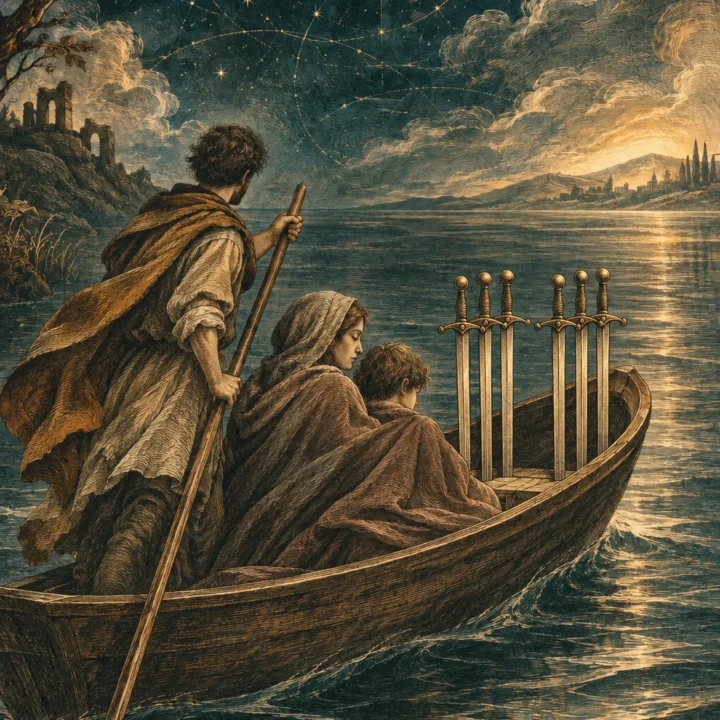
The Six of Swords offers a companion image of leaving. It emphasizes the crossing itself: the practical help, uncertainty, and memories that accompany a difficult move. If the Eight of Cups brings your reason for departing into focus, the Six can help you ask what would make the passage safer and more supported.
What the eight cups, staff, and moon reveal
Eight cups still standing
The cups occupy the foreground in an orderly arrangement, with five along the bottom and three higher up. None is overturned. Unlike the Five of Cups, which depicts vessels spilled onto the earth, this card shows an arrangement the traveler has deliberately left behind.
Many modern readers focus on a gap in the upper row, interpreting it as a missing ninth cup. It is an evocative way of describing the feeling that something is incomplete, though there are eight cups in an Eight of Cups card. No lost ninth vessel is actually shown.
The gap works best as a reflective image rather than a literal rule. You could have a career, relationship, or home that appears complete to others while experiencing a need that remains difficult to name.
The cups offer another question: what have you accomplished that still deserves respect, even if you no longer want to stay beside it?
The red-cloaked traveler and walking staff
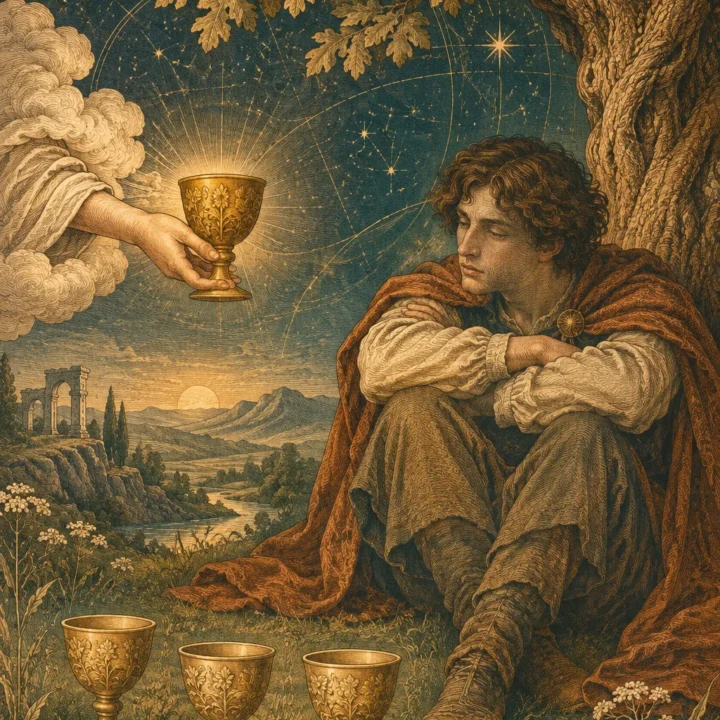
The figure carries a staff as he climbs into the distance. He is moving through the landscape rather than merely looking toward it, which distinguishes this card from the seated uncertainty of the Four of Cups.
The staff can suggest support, experience, and the practical effort that a journey requires. Perhaps you know more than you did when you first entered the situation you now wish to reconsider. Your earlier choices have taught you something useful.
His back is turned. We do not see his face or the moment he made the decision. If you are consulting the Eight about another person, it would be easy to fill that silence with assumptions. Let their words and conduct tell you what they actually intend.
The water, mountains, and unusual moon
The traveler leaves the cups near the water and heads toward rough, pale heights. The journey seems to move from an established emotional world into something less familiar.
Above the scene is a moon drawn with a face and a crescent-like shape within a larger disk. It gives the landscape an almost dreamlike light. Readers sometimes describe the image as an eclipse, though the painting itself is best approached as symbolic rather than a precise astronomical diagram.
In a spiritual interpretation, the strange moon can evoke a journey taken without full clarity. You may know what is no longer working before you know where you will feel at home next.
The mountains invite patience. A meaningful change may require more than the first brave step.
Eight of Cups upright: knowing when a chapter has changed
Upright, the Eight often appears when a person is reconsidering a commitment that used to feel important. You may be leaving a group, a familiar role, a place, or a project because the experience no longer supports the life you are trying to build.
Imagine spending years in a choir that once gave you friendship and joy. Over time, its commitments grow, your schedule changes, and rehearsals begin to feel like obligations. You still respect the people and the music. The Eight could describe the quiet realization that your relationship with the choir needs to change.
You might decide to step away completely. You might ask to participate less often. The card helps you investigate what departure would mean before the decision becomes final.
An important part of the picture is that nothing proves the cups are worthless. Waite described the figure leaving the sources of his earlier satisfaction, enterprise, or concern. The situation may still be valuable to others. Your experience of it has changed.
There can be grief in walking away from a good thing. The Eight makes room for that tenderness.
Is the Eight of Cups telling you to leave?
The Eight of Cups strongly evokes departure, though it cannot tell you to end a relationship, resign from a job, or move home without understanding the situation.
Start by identifying what is missing. A need for rest, fair treatment, meaningful work, or spiritual depth will call for different responses. Some needs can be met within an existing commitment. Others reveal that the arrangement has become unsuitable or harmful.
Next, consider whether the situation could change through communication or practical support. A friend may be willing to repair a misunderstanding. A role might improve with a clearer agreement. Sometimes an honest attempt reveals that moving on is necessary.
Then look toward the mountains in the card. What would departure require, and how would you prepare? The decision becomes more thoughtful when you know the realities on both sides.
The Eight can help you listen to a longing while leaving the choice in your hands.
Eight of Cups reversed: why did Waite associate it with joy?
Many modern guides interpret the reversed Eight as difficulty moving on, returning to an earlier commitment, or wandering between decisions. You may be uncertain whether to stay, or discover that a departure was made before the underlying problem was understood.
Waite's own reversed list offers a striking contrast. He associated the reversed Eight with great joy, happiness, and feasting. That is far more celebratory than the modern image of someone afraid to leave.
His upright account is varied too. Alongside decline or a matter losing importance, he acknowledges earlier interpretations involving gentleness, honor, modesty, and joy. The card did not arrive in his work with one simple story attached.
The different reversal methods can illuminate different moments. If a person has finally found relief after leaving an exhausting arrangement, the traditional joy may resonate. If they remain in an unresolved situation because change feels frightening, a modern hesitation reading may fit better.
Neither orientation gives a guaranteed outcome. Notice what has actually happened and how the people involved are experiencing the change.
Can leaving be an act of love?
Sometimes the Eight of Cups appears in a relationship reading when affection remains but the shape of the relationship no longer works. Two people can care deeply for each other and still have needs or life directions that are difficult to reconcile.
The card can also represent leaving an old pattern within a relationship. Perhaps you have grown tired of avoiding difficult conversations, or the two of you are trying to change a routine that keeps causing hurt. Departure might mean walking away from a habit together.
The image does not declare the traveler selfish or noble. It shows a person choosing movement for reasons we cannot see. In your own reading, ask what care for yourself and others would require in the actual circumstances.
If you are experiencing coercion or unsafe behavior, safety and appropriate support matter more than a tarot interpretation.
Eight of Cups in love, relationships, and feelings
If you are single, the Eight of Cups may arise when you are losing interest in an old romantic possibility or reassessing what companionship should mean for you. You might be ready to stop investing energy in a connection that has not developed through mutual effort.
For an established couple, the card can signal emotional distance or the need to examine what has changed. You may find that an honest conversation opens a new path within the relationship. At other times, the needs involved reveal a more lasting divergence.
In a feelings position, the Eight may symbolize longing for change, emotional fatigue, or a wish for space. It cannot establish whether another person is preparing to leave or whether they will return. Their behavior and communication are the evidence you can act on.
Reversed, consider whether a person is reconsidering a decision or experiencing renewed pleasure in the relationship. Both belong to different interpretive approaches, so the context matters.
Eight of Cups for work, creativity, and money
At work, the Eight often appears when achievement no longer brings the satisfaction you expected. Perhaps a role has developed into something that no longer uses your abilities, or a successful project has become difficult to sustain.
Imagine a craftsperson who has built a steady business selling one popular design. The sales are good, but repeating the same work has gradually crowded out their desire to experiment. The Eight may invite them to examine how to regain creative meaning. That could involve a new collection, a change in schedule, or a different career direction.
The cups do not justify abandoning a stable income without planning. Financial realities belong in the decision. If you are considering leaving paid work or making a costly change, understand your obligations and the alternatives available.
In a creative reading, the Eight can be particularly poignant. You may have made something you are proud of and still sense that the next stage will ask you to create differently.
Saturn in Pisces: the Lord of Abandoned Success
In the Golden Dawn's Book T, the Eight is the Lord of Abandoned Success, associated with Saturn in Pisces. Its visual design uses an angelic hand and eight cups, with water flowing into only some of the vessels. The two central cups receive water, which reaches the lower cups; the upper three remain empty.
The older image suggests a success that has failed to become lasting nourishment. Its text also includes temporary results and the tendency to lose interest after achieving something.
Smith's Rider-Waite-Smith scene turns that symbolic condition into a human journey. The traveler has left a set of cups behind and moves toward a destination we cannot see.
Together, these traditions raise a tender question. What happens when something once fulfilling no longer gives you the same kind of life? The answer may involve a change in the undertaking or a change in your relationship to it.
The Saturn-in-Pisces attribution belongs to the Golden Dawn system. It can deepen a reading for those who work with astrological tarot, while Smith's imagery remains meaningful on its own.
How the Eight of Cups differs from the Seven and the Hermit
The cloud-borne visions of the Seven of Cups suggest possibilities that are still taking shape. By the Eight, a traveler is leaving an established arrangement of vessels. Something has already been built or experienced, and its meaning is being reconsidered. The Nine of Cups offers a different kind of pause: the moment of recognizing that what you have gathered does nourish you.
The Hermit offers a different companion image. A cloaked figure stands alone holding a lantern on a mountain. Its emphasis often concerns wisdom, solitude, and the light used to find a path. The Eight's traveler has left his cups behind, and we are not told what understanding he hopes to find.
If both appear in a spread, you could explore whether a change of surroundings is connected with a deeper desire for quiet reflection. The comparison helps you ask better questions about the journey.
Worked reading: should I leave a job that no longer feels meaningful?
Imagine that you have a steady job with colleagues you respect. The role has gradually become less satisfying, and you are thinking about leaving, though the uncertainty worries you. You draw the Eight of Cups for the present, the Four of Pentacles for what needs attention, and Temperance for advice.
The Eight names your changing relationship with work. The Four of Pentacles directs attention to the security and resources you want to protect. Temperance suggests finding a workable transition, one that respects your needs and the obligations you already have.
Read together, the cards encourage investigation before departure. You might explore a different role, discuss changes to your current work, calculate what a transition would require, or try a new kind of project outside working hours.
If The Hermit appeared instead of Temperance, the reading would give greater weight to private reflection and discovering what you truly want from work. The Eight's movement would still be present, though the pace of the next step might change.
The cards cannot decide whether resigning is the right choice. They can help you understand what the decision is really about.
Eight of Cups as advice: honor what you are leaving
Look first at the eight standing cups. Imagine that they hold experiences you have already lived: skills, relationships, obligations, and joys. Which of them have mattered to you? Which have become heavy to carry?
Then turn your attention to the traveler's path. Where are you hoping to go, and what would you need to know before making the journey? Write down one modest step that could give you more clarity.
You may discover that the step is a conversation about changing the arrangement you have. You may discover it is the beginning of a real departure. Both can be approached with care.
Before leaving a meaningful chapter, give yourself permission to acknowledge what it gave you. Gratitude can accompany change, even when the decision is difficult.
Is the Eight of Cups a yes or no card?
The Eight of Cups often leans toward reconsidering a situation that no longer meets important needs. For a question about leaving, its symbolism can feel encouraging, but it does not guarantee that departure is wise or safe. Reversed, look closely at whether joy is returning or whether hesitation is keeping the question unresolved.
A brief note on tradition
Pamela Colman Smith illustrated a solitary traveler walking away from eight cups in the Rider-Waite-Smith deck first published in 1909. Waite connected the card with decline and departure, but recorded contrary upright associations and a joyful reversed meaning. The Golden Dawn's Lord of Abandoned Success uses a different cup arrangement, with the upper vessels left empty and Saturn in Pisces as its correspondence. Contemporary readers often emphasize spiritual searching, leaving an unfulfilling situation, and hesitation when reversed.
Frequently asked questions
Does the Eight of Cups mean a breakup?
It can appear when a relationship is changing or someone is considering leaving. It cannot prove that a breakup is coming. A meaningful reading considers whether the relationship can be repaired and what both people actually want.
What is missing from the stacked cups?
The arrangement has a visible gap in the upper level, which many readers treat as a symbol of incomplete fulfillment. All eight cups are present. The image does not establish that a ninth, literal cup was lost.
Can I honor the Eight of Cups without leaving?
Yes. The journey can begin by changing a pattern, renegotiating a responsibility, or making time for a neglected calling. Notice what the traveler is seeking, then ask whether a new way of living could make room for it where you are.
Why can the reversed Eight of Cups be positive?
Waite listed great joy, happiness, and feasting for the reversal. Many modern readers instead explore indecision or reluctance to move on. The two approaches come from different interpretive practices and are best read in relation to the question.

Keep reading
Explore the Cups
Every card page names the tradition behind each meaning, so you can compare readings instead of taking one as fixed.
Cards to explore alongside this one
Their symbols reveal useful similarities and differences for your next reading.
Six of Swords
transition, moving on, passage, recovery

The Hermit
reflection, solitude, discernment, inner guidance

Death
endings, transition, transformation, release
Four of Cups
emotional weariness, discontent, boredom, introspection
Sources and further reading
- A. E. Waite, The Pictorial Key to the Tarot, Eight of Cups Read the text
- Golden Dawn, Liber LXXVIII / Book T, Lord of Abandoned Success, Saturn in Pisces Read the text
- Biddy Tarot, Eight of Cups, contemporary interpretation Read the text
- Labyrinthos, Eight of Cups, contemporary interpretation and deck comparison Read the text