Five of Cups Tarot Card Meaning
Three cups have fallen, two still stand, and a bridge waits beyond the river. The Five of Cups invites you to honor loss and discover what remains when you are ready.
- sadness
- loss
- disappointment
- regret
- grief
Card at a glance
- Number
- Five
- Element
- Water
- Astrology
- Lord of Loss in Pleasure, associated with Mars in Scorpio.
- Keywords
- sadness, loss, disappointment, regret, grief, unmet expectations, what remains.
 Five · Five of Cups
Upright meaning
sadness, loss, disappointment
Upright, the Five of Cups often comes during a season of disappointment. An outcome did not match your hopes. An important relationship changed. You worked toward something meaningful, and the result leaves you with difficult feelings.
- sadness
- loss
- disappointment
- regret
- grief
- unmet expectations
Reversed meaning
emotional recovery or acceptance in modern readings; news, alliances, ancestry
In contemporary tarot, the reversed Five of Cups often suggests acceptance, self-forgiveness, or the beginning of life after a disappointment. You may be finding that an experience which once dominated your days has begun to take a different place in your memory.
- emotional recovery or acceptance in modern readings; news
- alliances
- ancestry
- return
- and questionable projects in Waite's list.
Card symbolism
-
Three overturned cups: the shape of disappointment
Three cups lie on the ground in front of the figure. Their contents have spilled. Smith lets us see the result of an event without explaining the event itself.
-
Two upright cups: the remainder is real
Behind the figure stand two cups that have not fallen. Their position forms one of the card's most important visual tensions.
-
The river, bridge, and small building
A river separates the grieving figure from a structure in the distance. The bridge offers a visible crossing, though the figure has not turned toward it.
In depth interpretation
A figure in a black cloak stands beside three overturned cups. Two more remain upright a little way behind him. Beyond the river, a stone bridge curves toward a small building on the opposite bank. We cannot see his face, although the weight of his disappointment seems to fill the whole landscape.
The Five of Cups represents grief, regret, disappointment, and the difficult work of living with a loss. Upright, it often appears when something you hoped for has changed or ended. Reversed, many modern readers see the first signs of acceptance; older traditions include reunion, kinship, news, and the return of people or concerns from the past.
The two standing cups are important. They do not make the three fallen ones any less precious. The card invites you to notice what has survived when you are ready to look.
The spiritual meaning: making room for what has been lost
There are days when one absence seems to change the shape of everything around it. A familiar voice is missing from a gathering. A friendship no longer feels the same. You look at a future you once imagined and discover that it will take a different form.
The Five of Cups understands why your attention goes first to what has fallen. In Pamela Colman Smith's scene, the figure is turned toward three spilled cups. There are no words to tell us what happened, how long ago it happened, or whether the loss could have been prevented.
This is a card that deserves a gentle reading. Grief asks for room. Even when parts of life remain loving and full, they cannot simply be exchanged for what you miss.
Yet the picture has depth beyond the dark cloak. There is a river, a crossing, a place across the water, and two vessels still standing. The wider landscape remains present, even while the figure struggles to take it in.
Spiritually, the Five invites you to honor the meaning of what has changed. The experience may eventually lead you toward a different relationship with your memories, your hopes, or the people who remain close. You do not have to know what that relationship will be today.
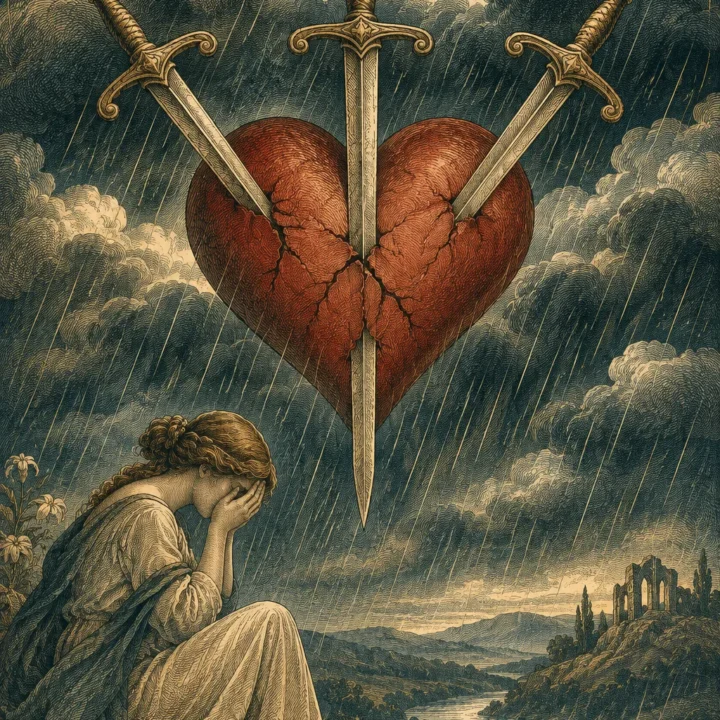
If grief is the heart of your question, spend a moment with the Three of Swords as well. Its pierced heart gives the wound a stark image, while the Five of Cups invites attention to what has spilled and what remains standing. Together, they create room to mourn without insisting that you feel hopeful before you are ready.
What the five cups and distant bridge reveal
Three overturned cups: the shape of disappointment
Three cups lie on the ground in front of the figure. Their contents have spilled. Smith lets us see the result of an event without explaining the event itself.
In a personal reading, these cups might evoke a promise broken, an anticipated celebration that never happened, or the emotional cost of a decision. They can also bring attention to regret, especially when you are replaying how things might have unfolded differently.
Look at the cups carefully. We cannot know whether they were knocked over by the figure, by someone else, or by chance. The image gives no warrant for blaming the person who is grieving.
This matters when a reading touches a painful experience. The card can help you examine responsibility where it is genuinely relevant. It should never turn every loss into a lesson you supposedly needed to learn.
Two upright cups: the remainder is real
Behind the figure stand two cups that have not fallen. Their position forms one of the card's most important visual tensions.
They can suggest relationships, abilities, sources of support, or possibilities that remain after a disappointment. But calling them instant replacements would make the image less compassionate.
Imagine someone who had hoped to build a life in a particular city. The plan falls through, and they feel deeply sad. They may still have supportive friends and meaningful work. Those things matter, even while the hoped-for future deserves to be mourned.
The standing cups can be recognized at a pace that respects the loss.
The river, bridge, and small building
A river separates the grieving figure from a structure in the distance. The bridge offers a visible crossing, though the figure has not turned toward it.
Many contemporary readers understand the bridge as a path toward healing or renewed belonging. That is a useful interpretation of Smith's design. The card does not show the figure walking across it, and Waite did not prescribe a journey across the bridge as a fixed divinatory rule.
In a reading, the crossing can raise a question about the support or change that might eventually become possible. Is there a conversation you want to have, a place where you feel welcome, or a way to begin participating in life again?
You are allowed to remain on the near bank while you discover what the river means to you.
Five of Cups upright meaning: when hope meets reality
Upright, the Five of Cups often comes during a season of disappointment. An outcome did not match your hopes. An important relationship changed. You worked toward something meaningful, and the result leaves you with difficult feelings.
Suppose you have spent months preparing an exhibition with a friend. At the last moment, the project is canceled. You feel sad about the lost work, and perhaps hurt that your friend has already moved on to other plans. The Five can describe both the disappointment and the different ways people respond to it.
It is possible to acknowledge what remains without demanding that you feel grateful for it immediately. Your skills, the work you made, and the people who supported you still belong to your story. They may become useful later.
In Waite's older divinatory language, this card also concerns inheritance or transmission that fails to meet expectations. That wording extends the card beyond a simple portrait of sorrow. You may receive something from the past that carries mixed feelings: an obligation, a family story, a responsibility, or an outcome that resembles what you hoped for only partly.
For an upright reading, ask what has genuinely been lost and what you expected the outcome to provide. Those details make room for a more precise interpretation.
Is the Five of Cups telling you to focus on the positive?
The two standing cups make this an easy card to oversimplify. Popular interpretations sometimes urge you to turn around, see what is left, and move on. That can be useful at the right moment, but it may sound painfully premature when the loss is fresh.
The Five of Cups contains both absence and remainder. The picture gives them different places in the same landscape. Neither part needs to erase the other.
Consider three questions when this card appears:
What has changed, and why does it matter to you? Name the disappointment in ordinary language.
What remains important, even if you cannot take comfort in it yet? Think of people, practices, or values that still have a place in your life.
What kind of support would make the next step possible? It may be rest, help with a practical task, time with someone trustworthy, or an honest conversation.
The point of this reflection is to understand your experience. You do not need to reach a cheerful conclusion for the reading to be worthwhile.
Five of Cups reversed meaning: recovery, return, and an unfinished past
In contemporary tarot, the reversed Five of Cups often suggests acceptance, self-forgiveness, or the beginning of life after a disappointment. You may be finding that an experience which once dominated your days has begun to take a different place in your memory.
Waite's reversed associations are more varied. He names news, alliances, kinship, ancestry, return, and false projects. In his additional meanings, he also mentions a relative returning after a long absence. These are documented historical readings rather than a promise that someone will come back.
They can be especially relevant when grief is connected with family or belonging. Perhaps a dispute has changed the shape of an old relationship. You may be learning family history, returning to a place that holds strong memories, or reconsidering a plan that never rested on sound expectations.
The reference to false projects adds a caution. A wish to repair the past may draw you toward an arrangement that cannot give what you hope it will. Look at the real conditions before asking an old connection to carry too much emotional weight.
A reversed Five can therefore hold hope alongside the need for discernment. Let the surrounding cards and the living situation tell you which direction deserves attention.
Does the Five of Cups predict an ex returning?
A return belongs to Waite's reversed meanings, and romantic questions are one reason people search for it. The card cannot identify an ex's intentions or guarantee a reunion.
If you are longing for contact, the Five may be reflecting the significance of what was lost. A reversed reading could invite you to consider whether reconnecting would be healthy and mutually wanted. Where communication is possible and appropriate, the other person's choices will provide the answer.
Sometimes the return has little to do with a person. A family custom, an old skill, or a forgotten source of comfort may find a place in your life again.
Five of Cups in love, friendship, and feelings
In love, the Five often describes a relationship that has disappointed you or a period when tenderness is difficult to reach. This may follow a breakup, an argument, or an expectation that the two of you have not discussed honestly.
For someone single, the card can appear when the memory of a past connection makes it hard to trust a new one. There is value in recognizing the history without allowing it to write every chapter that follows.
For couples, the Five may point toward something that needs to be grieved together: a plan that changed, a breach of trust, or a season of closeness that has passed. Some relationships find a new shape after such experiences, but repair requires willing participation.
As feelings, the card can symbolize sadness, regret, or a sense of missing what a connection used to provide. It offers no reliable access to another person's private emotions. Their behavior and communication remain more useful than a guess about what is hidden under the cloak.
Reversed, reconciliation may be a topic worth exploring if there is evidence of care, accountability, and mutual interest. It is equally possible that healing involves leaving the relationship in the past.
Five of Cups for work, creativity, and money
At work, the Five can appear after an application is declined, a project falls through, or a professional partnership ends unhappily. You may be tempted to measure months of effort only by the final result.
Imagine a small team that loses funding for an art program. The disappointment is real. So are the relationships built while planning it and the skills that may serve another undertaking. The two standing cups can help the team notice that remainder when people are ready to consider next steps.
The historical association with inheritance or patrimony sometimes appears in financial readings, but it is not evidence of an actual legacy or windfall. When money, contracts, or family property are involved, rely on documents and appropriate advice.
Reversed, an old proposal or former colleague may return to your attention. Examine whether the circumstances have truly changed before restarting an arrangement that previously disappointed you.
Mars in Scorpio: the Lord of Loss in Pleasure
In the Golden Dawn's Book T, the Five of Cups bears the title Lord of Loss in Pleasure and corresponds to Mars in Scorpio. Its symbolic design shows five cups without water, with drooping lotus flowers above them. The text emphasizes disappointment and the ending of an enjoyment that once seemed available.
The contrast with the Rider-Waite-Smith illustration is revealing. Smith shows three spilled vessels while two remain standing. The Golden Dawn's cups are all empty. These are distinct designs within related esoteric traditions, and their differences give the card different emotional emphases.
You might use the Golden Dawn image to contemplate the felt emptiness after a loss, and Smith's scene to remember that a life can contain both sorrow and surviving connections. Neither design needs to dictate how quickly someone should feel better.
How to read the Five of Cups with surrounding cards
In a present position, the Five can describe grief or expectations that have been disappointed. As a challenge, it may invite you to acknowledge the consequences of an event before attempting to change the story. As advice, it can encourage gentleness and a clearer view of what remains.
Worked reading: how do I move forward after a friendship ends?
Imagine a friendship has recently ended after a painful disagreement. You draw the Five of Cups for the present, The Star for what could help you, and the Six of Pentacles for a practical next step.
The Five honors the disappointment. The Star introduces hope and the possibility of feeling connected to life again. The Six of Pentacles asks about the balance of giving and receiving, including which relationships offer support now.
Together, the cards invite a small, compassionate plan. You might spend time with someone who has listened well, return to a practice that steadies you, or consider what reciprocity will mean in future friendships. None of this requires minimizing the friendship you have lost.
If Death appeared in place of The Star, the spread would place greater emphasis on accepting a transition whose former shape cannot be preserved. If the Five were reversed, Waite's themes of return and kinship might become relevant, but they would not establish that reconciliation is about to happen.
Five of Cups as advice: a reflection beside the river
Find a quiet moment and look at the river in Smith's image. Imagine giving the three fallen cups names, perhaps experiences, hopes, or promises whose loss you have been carrying.
Then look at the cups behind the figure. You may want to name one relationship or source of meaning that still feels available. If nothing comes to mind, allow that uncertainty to remain. The exercise is a way of paying attention, not a test of gratitude.
Finally, consider the bridge. What small act of care would help you feel supported on this side of the water? A message to a friend, an evening without obligations, or help with something practical may be enough for today.
Is the Five of Cups a yes or no card?
The Five of Cups generally invites caution when a decision rests on disappointment, regret, or an attempt to recover something that has changed. It is often read as leaning no or not yet, especially for questions about repeating a painful arrangement. Reversed, new alliances or recovery may be possible, but the facts of the situation matter more than a simple prediction.
A brief note on tradition
Pamela Colman Smith illustrated the Rider-Waite-Smith Five of Cups for the deck first published in 1909. Waite associated it with partial loss, disappointing inheritances, and difficult expectations, with kinship and return among his reversed meanings. The Golden Dawn's earlier Lord of Loss in Pleasure has a different design in which none of the cups holds water. Modern readings commonly emphasize grief, acceptance, and the slow return of hope.
Frequently asked questions
What do the two standing cups mean?
They are the part of the scene that remains intact after three cups have fallen. In a reading, they can represent surviving relationships, values, resources, or possibilities. Their presence does not cancel the figure's grief.
Does the Five of Cups mean someone regrets losing me?
Regret is one possible theme, particularly in a relationship question. The card cannot confirm another person's thoughts or prove that they want to reconnect. Give weight to what they actually communicate.
Does the Five of Cups always mean a breakup?
No. It can describe disappointment connected with work, friendship, family, spiritual practice, or an unmet personal hope. The suit concerns emotional significance, and the question determines where the loss belongs.
How is the Five of Cups different from the Four of Cups?
The Four of Cups depicts a person withdrawn in the presence of an offer and several available cups. The Five shows a loss that has already occurred. The Five's central question concerns how to live with what changed, while the Four explores the difficulty of receiving what is currently offered. The Six of Cups turns toward memory and the tenderness that may eventually grow from it.

Keep reading
Explore the Cups
Every card page names the tradition behind each meaning, so you can compare readings instead of taking one as fixed.
Cards to explore alongside this one
Their symbols reveal useful similarities and differences for your next reading.
Three of Swords
heartbreak, grief, separation, painful truth

The Star
hope, inspiration, trust, renewal
Six of Swords
transition, moving on, passage, recovery
Six of Cups
childhood memories, nostalgia, kindness, innocence
Sources and further reading
- A. E. Waite, The Pictorial Key to the Tarot, Part III, Five of Cups Read the text
- Golden Dawn, Book T, Lord of Loss in Pleasure, Mars in Scorpio Read the text
- Biddy Tarot, Five of Cups, contemporary meanings Read the text
- Labyrinthos, Five of Cups, contemporary interpretation Read the text