The Hermit Tarot Card Meaning
An elder stands above a snowy mountain with a star shining inside his lantern. The Hermit invites quiet reflection and the sharing of wisdom earned through experience.
- reflection
- solitude
- discernment
- inner guidance
- study
Card at a glance
- Number
- IX
- Element
- Earth
- Astrology
- Virgo (Golden Dawn)
- Keywords
- reflection, solitude, discernment, inner guidance, study
 IX · The Hermit
Upright meaning
Reflection, solitude and discernment
Upright, The Hermit often suggests that a question deserves your undivided attention. You might be reviewing an important relationship, researching a new direction, or trying to understand why an old ambition has lost its appeal.
- Reflection
- Solitude
- Discernment
- Inner guidance
- Study
Reversed meaning
Loneliness, withdrawal and avoidance
Reversed, The Hermit may describe a retreat that has become lonely. You keep declining invitations, putting off difficult conversations, or telling yourself that you must figure everything out before anyone can see you again. Solitude can feel safer than risking disappointment.
- Loneliness
- Withdrawal
- Avoidance
- Refusal of support
- Excessive caution
Card symbolism
-
The lantern and six-pointed star
The star inside the lantern glows with an almost sacred clarity. Many readers see it as a symbol of spiritual understanding or insight gathered through experience.
-
The snowy mountain
The traveler stands high above a pale, difficult landscape. The height can suggest perspective, while the snow makes the journey feel demanding and quiet.
-
The staff
In the Hermit’s hand, the staff is both humble and useful. It has accompanied him through the journey and now gives his body something firm to lean on.
-
The grey cloak and lowered gaze
His plain cloak conceals much of his figure, and his face is angled toward the ground. The atmosphere feels private.
In depth interpretation
An old traveler stands alone on a snowy height. His cloak falls in heavy folds, a staff steadies his steps, and a lantern glows beside his face. Inside that lantern shines a six-pointed star. The darkness beyond it is vast. Somehow, he seems at home there.
The Hermit speaks of quiet wisdom, careful reflection, and time away from the voices that have become louder than your own. Upright, he can suggest an inward journey, a season of study, or guidance earned through experience. Reversed, he may reveal isolation, fear of seeking help, or a retreat that has begun to keep life at a distance.
If you drew this card, imagine standing on that mountain for a moment. Who would you like to share the view with when you return?
The Hermit’s spiritual meaning: a light worth carrying
You may know the feeling of being surrounded by advice and still unable to hear what you believe. Friends mean well. Family has strong opinions. Every article seems to offer a different answer. Eventually, you want an evening when no one is asking you to decide.
The Hermit understands that longing. He offers a kind of spiritual hospitality to the part of you that needs quiet. A walk without your phone, an hour with an old journal, or a few minutes of prayer can create space for something easily drowned out by daily demands.
There is a beautiful detail in the card’s history. Arthur Edward Waite saw the Hermit as someone who had reached a height and now held up his light where others could see it. That image adds generosity to the solitude. What you learn while you are alone may one day help a person who is still finding their way.
The card can arrive during a spiritual search, though its wisdom also belongs to ordinary experience. Perhaps you have discovered what you need after a difficult friendship, or become less certain about beliefs you once defended fiercely. The Hermit gives you permission to grow into the understanding at your own pace.
The Four of Swords offers another image of being alone. Its still knight is recovering after strain, while the Hermit’s lantern draws him into a search for insight. A spread containing both may invite you to rest before expecting yourself to find the answer you came looking for.
The symbols in The Hermit card
Pamela Colman Smith’s Rider-Waite-Smith image is spare compared with many Major Arcana cards. There are no attendants, elaborate buildings, or crowded landscapes. Almost every detail draws us back to the person holding the light.
The lantern and six-pointed star
The star inside the lantern glows with an almost sacred clarity. Many readers see it as a symbol of spiritual understanding or insight gathered through experience. A lantern has a practical quality too. You carry it close enough to see the ground beneath your feet.
When this detail catches your eye, consider one thing you know now that you did not understand a year ago. That small piece of wisdom may matter more in your present situation than a grand answer about the future.
The snowy mountain
The traveler stands high above a pale, difficult landscape. The height can suggest perspective, while the snow makes the journey feel demanding and quiet. We cannot see the path he took to reach the summit.
Perhaps you have been through a season that changed how you see the world. The mountain invites you to recognize the effort involved in arriving at this understanding. It may also ask whether you are ready to come down and use it.
The staff
In the Hermit’s hand, the staff is both humble and useful. It has accompanied him through the journey and now gives his body something firm to lean on. You might see it as a symbol of a practice, friendship, or principle that helps you remain steady when answers are uncertain.
A support does not have to be impressive. Sometimes it is a regular conversation with someone wise, a notebook you return to, or an ordinary ritual that helps you find your center.
The grey cloak and lowered gaze
His plain cloak conceals much of his figure, and his face is angled toward the ground. The atmosphere feels private. You can imagine a person who has grown less interested in being admired and more interested in living faithfully by what he has learned.
If you feel weary of performing certainty for others, the Hermit may invite you to let the performance go for a while.
The Hermit upright meaning
Upright, The Hermit often suggests that a question deserves your undivided attention. You might be reviewing an important relationship, researching a new direction, or trying to understand why an old ambition has lost its appeal.
Imagine someone who has spent years working toward a promotion. Just as the opportunity arrives, they discover they no longer want that particular life. The Hermit could describe the weekend they spend alone, walking and writing, until they can admit this change without shame.
The card can also signal the value of an experienced guide. A thoughtful mentor, spiritual elder, or trusted friend may see something you have missed. Their guidance becomes most helpful when it leaves you better able to make your own choices.
The Hermit reversed meaning
Reversed, The Hermit may describe a retreat that has become lonely. You keep declining invitations, putting off difficult conversations, or telling yourself that you must figure everything out before anyone can see you again. Solitude can feel safer than risking disappointment.
Another possibility is avoiding reflection altogether. You fill every quiet moment with activity because an uncomfortable question has started waiting for you whenever the room is still.
The reversal asks you to notice how the silence feels. Does it leave you refreshed and more connected to your life? Or are you losing touch with the people and practices that usually sustain you? You may need company, support, or a gentler way to begin the conversation with yourself.
The Hermit in love and relationships
In love, The Hermit often turns attention toward the individual lives within a partnership. Even a close relationship needs room for private interests, spiritual practices, and time to consider personal needs.
For someone single, the card may accompany a deliberate pause from dating. Perhaps you want to understand what you have learned from an earlier relationship before becoming involved again. That pause can be meaningful when it arises from a genuine desire for clarity.
In an established relationship, imagine one partner asking for a quiet weekend after a demanding month. The request may be a way of recovering energy. It helps when both people can discuss what that space means and how they will stay connected.
Reversed, The Hermit can suggest emotional distance that has become painful. When someone repeatedly disappears instead of addressing conflict, the pattern deserves attention. A reading cannot tell you whether they intend to return.
The Hermit as feelings
As a feelings card, The Hermit can suggest someone who is reserved, thinking deeply, or uncertain about how to approach a connection. They may be focused on another important part of their life. The card can also mirror your own wish for reassurance during a quiet period.
Rather than guessing what another person is hiding, consider what you know through their words and actions. A clear question about availability or intentions may be kinder to you than waiting for an imagined revelation.
The Hermit for career and work
The Hermit has a natural home in research, scholarship, craft, and any work that asks for concentration. You may be ready to develop a specialty, work independently for a while, or reconsider a career goal that once felt obvious.
Think of an editor who keeps returning to a difficult manuscript. At first, the problem seems to be a single sentence. With time, the editor discovers that the entire argument needs a different foundation. The Hermit can describe the patient attention that makes such discoveries possible.
Reversed at work, the card can reveal an uncomfortable form of isolation. Perhaps you have taken on too much and stopped asking colleagues for help. Expertise becomes easier to carry when there are people you trust to share the burden.
The Hermit for money
With money, The Hermit often points toward study and thoughtful review. You might be learning about an agreement, reconsidering your spending habits, or seeking qualified guidance before a consequential decision.
Reversed, it can suggest avoiding financial facts because they feel overwhelming, or refusing advice when a second perspective could be useful. The card encourages careful attention. Any commitment still needs to be grounded in real numbers and circumstances.
The Hermit in spiritual practice
You may feel the Hermit’s presence while sitting with a sacred text, beginning a dream journal, or returning to a prayer that has accompanied you for years. The quiet makes details easier to notice. A familiar phrase can suddenly carry a meaning that escaped you before.
There is also a communal future hidden in the image of the lantern. Sometimes the most meaningful result of private study is the compassion you bring to another person’s question. You remember what it felt like to be uncertain, so you speak with greater care.
The Hermit’s Golden Dawn correspondence is Virgo, associated in that system with discernment and attentive practice. The association can enrich a reading for those who use astrological correspondences; the card’s quiet guidance remains accessible without them.
The Hermit as advice: follow the lantern
Place The Hermit before you and think about a question that has been occupying your thoughts. Write it at the top of a page. Underneath, write what you already know from experience, including the parts you find difficult to admit.
Now imagine that the lantern illuminates only a small circle of ground. What could you discover within that circle? Perhaps you need to ask one person a question, spend an afternoon learning something, or acknowledge a wish you have been ignoring.
Choose a time to return to the question after taking that step. The Hermit’s light becomes useful through your willingness to carry it into life.
Is The Hermit a yes or no card?
The Hermit often suggests waiting for greater understanding when a question asks for an immediate decision. He can lean yes for study, reflection, seeking a mentor, or taking a healthy period of solitude. Reversed, he may prompt you to seek support instead of postponing an important conversation.
How to read The Hermit in a tarot spread
Notice his position. In the past, the Hermit can describe a solitary experience that shaped your outlook. As a challenge, he may point to distance or reluctance to ask for help. As an outcome, he can suggest a period of personal study or a clearer understanding of what matters.
Imagine asking whether to return to education and drawing The Hermit as the present, the Three of Pentacles as advice, and the Ace of Swords as an outcome. The story might describe serious private reflection, the value of learning with others, and the clarity that comes from understanding your options. The spread can help you ask better questions about the course ahead.
A brief note on tarot tradition
The Rider-Waite-Smith Hermit was illustrated by Pamela Colman Smith and published in 1909. Waite described the lantern’s star as a light already attained and held high for others. His older divinatory list also included caution and more troubling associations with secrecy, showing how interpretations differ across tarot practices. The Golden Dawn system linked The Hermit with Virgo; older decks did not necessarily share that correspondence.
Frequently asked questions
Does The Hermit mean someone will leave me?
It can reflect a need for space or emotional distance, particularly when the reading concerns a relationship. The card cannot establish another person’s plans. Speak with them when you need clarity about where the relationship stands.
Why is there a star inside the lantern?
The Rider-Waite-Smith illustration places a six-pointed star within the lantern. It can be read as a symbol of spiritual illumination. In Waite’s account, the figure holds up a light of understanding that has already been reached.
Can The Hermit represent an older person or mentor?
Yes. The robed elder may evoke someone whose experience has become a source of guidance. A person can also embody the card’s reflective qualities at any age.
What is the difference between The Hermit and The High Priestess?
Both invite quiet attention. The High Priestess sits before a veiled mystery, while the Hermit carries a lantern across a mountain landscape. One may evoke contemplative receptivity; the other often draws attention to insight developed through a long journey.

Keep reading
Explore the Major Arcana
Every card page names the tradition behind each meaning, so you can compare readings instead of taking one as fixed.
Cards to explore alongside this one
Their symbols reveal useful similarities and differences for your next reading.
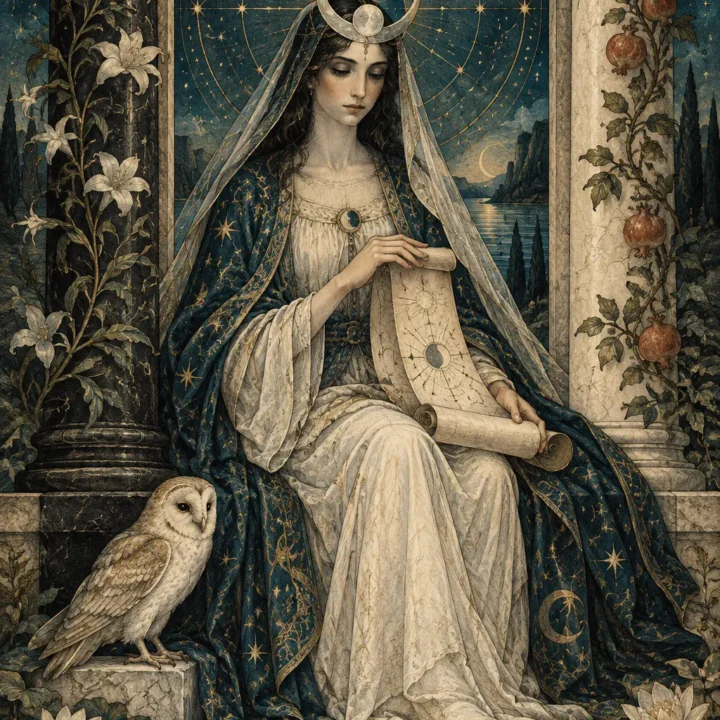
The High Priestess
intuition, contemplation, inner knowledge, privacy
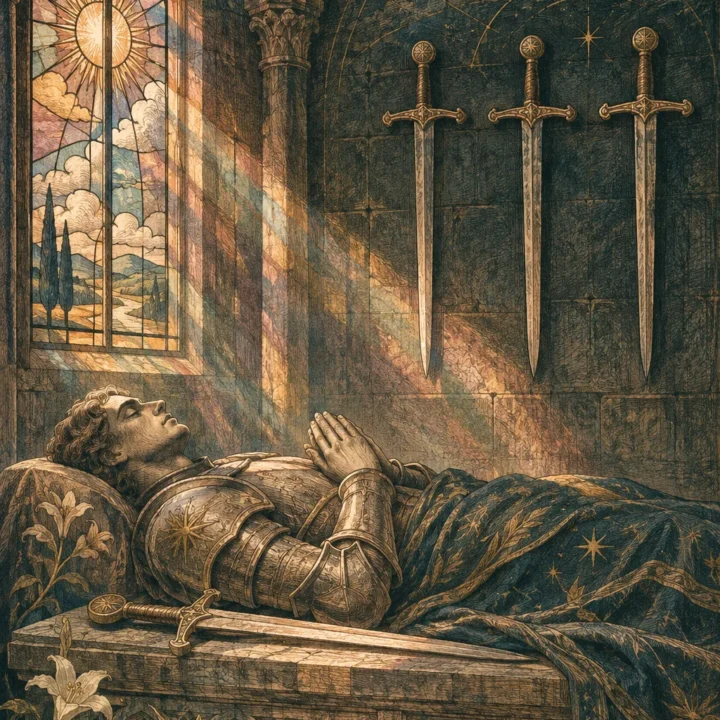
Four of Swords
rest, retreat, contemplation, recovery
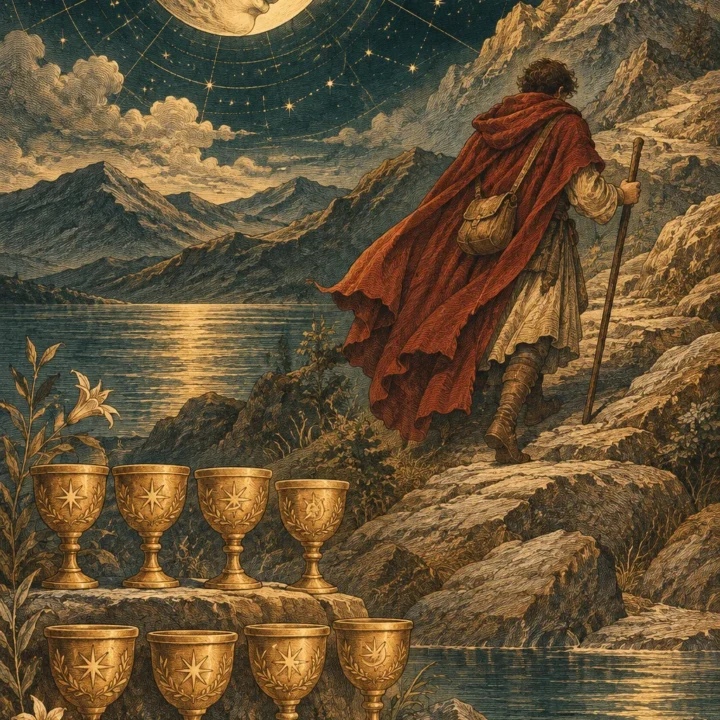
Eight of Cups
departure, searching, emotional dissatisfaction, changing priorities

The Star
hope, inspiration, trust, renewal
Sources and further reading
- Arthur Edward Waite, The Pictorial Key to the Tarot, Part II, The Hermit Read the text
- Arthur Edward Waite, The Pictorial Key to the Tarot, Part III, divinatory meanings Read the text
- Golden Dawn, Notes on the Tarot, The Hermit/Virgo Read the text
- Victoria and Albert Museum, A history of tarot cards Read the text