Ten of Cups Tarot Card Meaning
A rainbow of ten cups shines over two adults and dancing children near a home. Discover how the Ten of Cups speaks to shared joy and genuine belonging.
- emotional fulfillment
- family and chosen family
- shared joy
- harmony
- friendship
Card at a glance
- Number
- Ten
- Element
- Water
- Astrology
- Lord of Perfected Success, associated with Mars in Pisces.
- Keywords
- emotional fulfillment, family and chosen family, shared joy, harmony, friendship, a welcoming home, belonging.
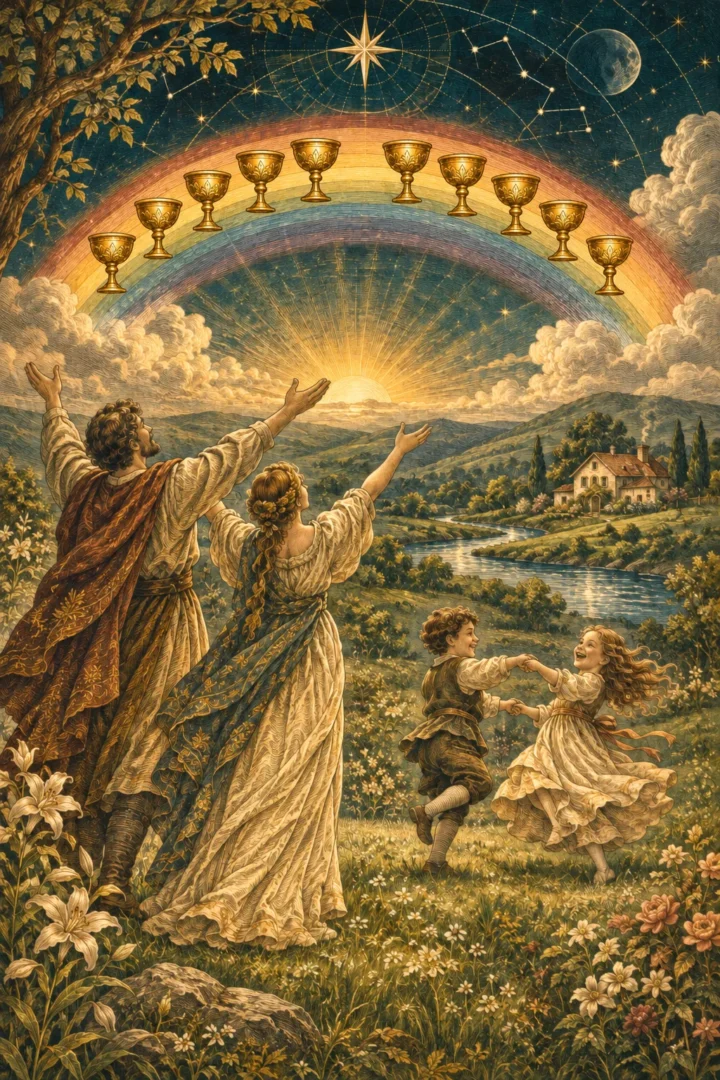 Ten · Ten of Cups
Upright meaning
emotional fulfillment, family and chosen family, shared joy
Upright, the Ten of Cups often appears when relationships provide steadiness and joy. You might be celebrating a commitment, reconnecting with relatives, building a home, or recognizing that a friendship group has become a vital part of your life.
- emotional fulfillment
- family and chosen family
- shared joy
- harmony
- friendship
- a welcoming home
Reversed meaning
distance or strained bonds in contemporary practice; a false peace, indignation, and violence in Waite's older divinatory list.
Many contemporary readers interpret a reversed Ten as family tension, misaligned expectations, or the pain of feeling disconnected from people you love. Perhaps you have built a household that looks settled from the outside, yet important conversations keep being postponed.
- distance or strained bonds in contemporary practice; a false peace
- indignation
- and violence in Waite's older divinatory list.
Card symbolism
-
Ten cups held in a rainbow
The cups form a shining arc that seems suspended beyond the reach of the people below. The rainbow brings a sense of blessing and wonder into the scene. It can evoke the beauty of a joyful moment that nobody could have entirely planned or controlled.
-
The adults watching in wonder
The two adults stand near each other, one with an arm around the other while their free arms lift toward the rainbow. They seem delighted by what they see.
-
The children who do not notice the rainbow
The children are dancing. Waite made the striking observation that they have not seen the wonder above them, and are happy in their own way.
-
The river, house, and land beyond
Beyond the people, a river curves through the fields toward a house. Smith gives the happy scene a physical setting, with a place where life will continue after the moment has passed.
In depth interpretation
A rainbow curves over a green landscape, carrying ten golden cups in its colored arc. Below it, two adults stand with their arms raised toward the sky. Nearby, two children dance together, absorbed in their own happiness. A house and a river rest in the distance.
The Ten of Cups represents shared fulfillment, loving relationships, belonging, and the feeling of being at home in your life. Upright, it often appears when a bond or community offers real emotional support. Reversed, it invites attention to strained relationships, an ideal of happiness that does not match daily experience, or anger that has been hidden beneath a peaceful appearance.
Look closely at the children. They are not watching the rainbow. The wonder above them is real to the adults, while the children are already enjoying the day in their own way. Perhaps happiness belongs to a household in more than one form.
The spiritual meaning: the blessing of belonging
Think of a place where you can arrive tired and still feel welcome. Perhaps it is a home you share with family, a friend's kitchen, a familiar garden, or a community where people know your stories. You do not need to perform a special version of yourself to belong there.
The Ten of Cups holds that sense of arrival. The rainbow fills the sky, yet the ground beneath it is unmistakably ordinary. There is water, a small home, green land, and people sharing a moment of joy.
The suit has traveled through longing, disappointment, memory, temptation, and departure. By the Ten, the picture gives us the possibility of emotional life woven into a place and into relationships that endure beyond a single beautiful moment.
For some readers, this card will feel like an image of family happiness. For others, the people who make life feel safe are friends, neighbors, a partner, or a community created by choice. The Ten invites you to consider the relationships through which love becomes something you can live.
Its spiritual depth is found in how the people respond to one another. The adults are moved by a wonder in the sky. The children have found something joyful on the ground. There is space for more than one experience of happiness within the same scene.
What allows the people in your life to feel cherished in their own ways?
The rainbow, dancing children, and distant home
Ten cups held in a rainbow
The cups form a shining arc that seems suspended beyond the reach of the people below. The rainbow brings a sense of blessing and wonder into the scene. It can evoke the beauty of a joyful moment that nobody could have entirely planned or controlled.
Rainbow imagery carries different religious and cultural associations, including covenant and hope in some biblical traditions. The Rider-Waite-Smith artwork does not give every reader one prescribed theology. You may experience the arc as sacred gratitude, a shared dream, or the surprising feeling that life has offered a place to rest.
Notice that the cups are up in the sky. They belong to the vision of fullness, while the life beneath the rainbow happens through people and place. In your own reading, the question is how a beautiful ideal of harmony can take shape in ordinary relationships.
The adults watching in wonder
The two adults stand near each other, one with an arm around the other while their free arms lift toward the rainbow. They seem delighted by what they see.
Waite described them as a husband and wife. That reflects his reading of the 1909 image, and the scene has become famous as a picture of traditional domestic happiness. Yet tarot can be read by people whose closest bonds take many forms.
You can keep the historical description while reflecting on who shares your own hopes. A loving home might involve a partner, relatives, trusted friends, or people who have chosen to care for one another across generations.
The adults' embrace also invites a practical question. When you imagine a happy future, does the person beside you have room to imagine it with you?
The children who do not notice the rainbow
The children are dancing. Waite made the striking observation that they have not seen the wonder above them, and are happy in their own way.
This detail changes the reading. It suggests that people can share a joyful life while experiencing its beauty differently. One person appreciates security after a long struggle. Another is delighted by games, familiar voices, or a quiet afternoon.
In a question about family or community, that can be especially useful. What feels like fulfillment to each person involved? A home that is peaceful for one family member may need to become more welcoming or flexible for someone else.
The card cannot tell you what your children, partner, or friends secretly feel. It can encourage you to ask them.
The river, house, and land beyond
Beyond the people, a river curves through the fields toward a house. Smith gives the happy scene a physical setting, with a place where life will continue after the moment has passed.
Waite attached a less familiar meaning to the Ten: the town, village, or country where the person asking the question lives. This is worth remembering when the card appears in a reading about relocation, community, or putting down roots.
It does not identify a place you are destined to move. The landscape opens a question about belonging. What makes a place feel like home for you, and for the people who would share it?
Ten of Cups upright: happiness you can share
Upright, the Ten of Cups often appears when relationships provide steadiness and joy. You might be celebrating a commitment, reconnecting with relatives, building a home, or recognizing that a friendship group has become a vital part of your life.
Imagine a group of neighbors who have helped one another through several hard years. They meet for a meal in someone's garden. Children play nearby while the adults talk. Nothing dramatic happens, but the evening feels precious because everyone remembers what it has taken to remain connected.
This is the Ten in a form that could easily go unnoticed. The rainbow may be a sense of gratitude that rises over ordinary life.
The card can also symbolize a shared milestone, such as a wedding, an adoption, a reunion, or a move into a new home. Its meanings are broad enough to include moments of reconciliation and the quiet relief of finding a place where you are valued.
It is helpful to remember that lasting harmony asks for care. The people beneath the rainbow have lives that will continue when the sky changes. A reading can invite you to appreciate what is working and notice how it is being sustained.
Does the Ten of Cups require marriage or children?
Waite described the adults as a married couple, reflecting the conventional family in Smith's illustration. The symbolism of belonging can reach far beyond that household.
The card also speaks of friendship, contentment, and a place to call home. Its blessing can belong to people whose lives look very different from the pictured family.
For someone living alone, belonging may be found among friends or neighbors, or in a home made peaceful through personal rituals.
Ask whose happiness has room to grow in the life you are making together.
Ten of Cups reversed: when the picture of peace does not fit
Many contemporary readers interpret a reversed Ten as family tension, misaligned expectations, or the pain of feeling disconnected from people you love. Perhaps you have built a household that looks settled from the outside, yet important conversations keep being postponed.
Waite's historical reversed interpretation is more severe than ordinary miscommunication. He included the repose of a false heart, indignation, and violence. In his vocabulary, a peaceful appearance can conceal anger or a breakdown in goodwill.
That tradition deserves care. A reversed card is never evidence that someone is violent or that harm will occur. If there is actual intimidation, coercion, or violence in a relationship, respond to those realities and seek appropriate support. The image is not a reason to stay within an unsafe situation for the sake of appearing harmonious.
In less serious situations, the reversal can illuminate the strain of trying to recreate an ideal. Perhaps everyone has been told what a happy family holiday should look like, and no one has been asked what would make it enjoyable for them.
The Ten invites a more compassionate question: what does real peace require from the people who share this life?
Can the Ten of Cups mean a happy ending?
The card often evokes fulfillment that has reached beyond one person's wish into relationships and place. It can be a lovely outcome card when a question concerns belonging, reconciliation, or a shared celebration.
Yet the picture does not promise a permanent ending to difficulty. Its importance is the quality of the life being depicted. Even joyful homes have disagreements, different needs, and seasons of change.
If you are asking whether a relationship will last, consider what sustains it now: respect, mutual care, the freedom to speak honestly, and the willingness to repair after harm. Those qualities are part of the real story behind any beautiful image.
You can welcome the hopeful symbolism of the Ten while leaving room for a future that unfolds through human choice.
Ten of Cups in love and relationships
In love, the Ten often suggests affection that feels settled enough to support a shared life. A couple might be planning a future, enjoying a meaningful gathering, or discovering that ordinary companionship brings more comfort than grand gestures.
For someone single, the card can encourage reflection on what emotional safety and belonging would mean in a relationship. It may also draw attention to the people already making your life rich, including friendships and chosen family.
For established couples, the Ten is especially relevant when decisions affect both partners or an entire household. A shared hope is easier to live with when each person can express what they need.
Reversed, examine whether a picture of happiness has become more important than the daily experience of the people inside it. The card can support a conversation about expectations, but it cannot settle disagreements or reveal someone else's hidden feelings.
What does the Ten of Cups mean as feelings?
As feelings, the Ten can symbolize affection, comfort, belonging, or a wish to build a shared life. It cannot establish that someone is ready for marriage or confirm a particular future commitment. Their actions and the conversations you have together offer the clearest evidence.
Ten of Cups for friendship, community, and home
The Ten has particular depth in questions about where you belong. A place might feel like home because of its people, its rhythms, or the way it allows you to live in accordance with your values.
Perhaps you have moved to a new town and are learning how to become part of the neighborhood. A shared meal, a familiar shop, or a person who remembers your name can gradually give the place meaning.
The card can also appear when a community has become important enough to protect. If a local group is changing, ask what relationships and traditions make it worth sustaining. You might discover that the deepest belonging comes through participation rather than a particular building.
The rainbow's beauty is easy to admire. The lives beneath it are where the meaning becomes tangible.
Ten of Cups for career and money
At work, the Ten of Cups often relates to the human atmosphere around an undertaking. You may be part of a team that respects its members, or a project whose success has benefited a wider community.
A satisfying career can support a happy home, particularly when it gives you time and resources for the people you care about. The Ten may encourage you to consider how an opportunity will affect your household and relationships, not only the job title or salary.
In a financial reading, its river, home, and family scene can bring attention to shared resources, housing, and long-term plans. It cannot predict property values or guarantee prosperity. Decisions involving money still need clear figures and agreements.
Reversed, a disagreement about resources may be worth discussing before it grows into resentment. The card encourages attention to the people who will live with the outcome.
Mars in Pisces: the Lord of Perfected Success
In the detailed Golden Dawn Book T entry, the Ten of Cups is called the Lord of Perfected Success and associated with Mars in Pisces. Its summary table uses the variant Perpetual Success. The older illustration shows lotus flowers pouring water through an arrangement of ten cups, with a top vessel helping to direct the flow. The water overflows the cups.
The text presents a happiness that has become lasting and inspired, and it distinguishes this quality from the more sensual satisfaction of the Nine of Cups. It also acknowledges excess and waste as shadows when the card's condition is less favorable.
Smith's later Rider-Waite-Smith image turns the flowing vessels into a rainbow overhead, while people and a home appear beneath it. The spiritual emphasis becomes more directly human: what does fullness mean when it is shared with others?
The Golden Dawn's Mars-in-Pisces attribution belongs to its own esoteric system. You can work with that tradition without assuming that every detail in Smith's landscape was designed to illustrate a planetary correspondence.
How the Ten of Cups differs from the Nine and Ten of Pentacles
The Nine of Cups places a satisfied individual before an arrangement of nine vessels. The Ten of Cups widens the scene to a shared life and a place of belonging. Both can represent deep contentment, but the pictures invite different questions about how fulfillment is experienced.
The Ten of Pentacles is another card associated with family, home, and continuity. Its imagery emphasizes generations, material resources, and established structures. A reading about inheritance or property might lead you toward those aspects.
The Ten of Cups brings emotional relationships into sharper focus. The Ten of Wands adds another practical question: who is carrying the responsibilities that allow a shared home or community to flourish? Together, the cards invite honest attention to how people support one another.
The difference can help you understand a question about moving house, starting a family, or building a long-term community. A home has both human and material dimensions, and the spread may show which needs attention.
Worked reading: will moving closer to family help us feel at home?
Imagine you and your partner are considering a move to live nearer relatives. You hope to build a warmer community for the household, but the change would increase travel costs and alter each person's daily routine. You draw the Ten of Cups for the hope behind the move, The Empress for the kind of home you want to nurture, and the Two of Pentacles for the practical balance involved.
The Ten reveals your wish for belonging. The Empress draws your attention to what would help the people in your household flourish. The Two of Pentacles asks how daily commitments, travel costs, and other responsibilities will fit into the new rhythm.
Together, the cards suggest conversations with the people whose lives would change. You might ask what each person hopes the move will provide, work out the budget, and explore what support relatives can realistically offer.
If The World appeared in place of the Two of Pentacles, the reading would shift toward how the move fits a larger life chapter and whether the new place brings a feeling of arrival.
The cards invite you to name what makes a place feel like home, then test that hope against what ordinary life there would actually require.
Ten of Cups as advice: ask what home feels like
Look at each person beneath the rainbow. The adults are looking upward. The children are playing. All four belong to the moment, though their experiences are different.
Think of the people who make up your own circle of belonging. What helps each person feel comfortable and loved? You may know some of the answers. Others are worth asking directly.
Choose one small way to make your shared life more welcoming. Perhaps it is an unhurried meal, a conversation without devices, or a change to a routine that has been difficult for someone.
If you do not have a circle that feels like home right now, begin with one place or relationship where care might grow. The Ten's vision can offer hope while you build your own experience of belonging.
Is the Ten of Cups a yes or no card?
The Ten of Cups often leans yes for questions about strengthening supportive relationships, celebrating a shared milestone, or creating a place of belonging. Reversed, it invites care with expectations and unresolved tensions. The card offers a hopeful symbol, while decisions involving other people need their active participation.
A note on tradition
Pamela Colman Smith illustrated the Rider-Waite-Smith Ten of Cups as a family beneath a rainbow of vessels, with children dancing without noticing the rainbow. Waite associated it with contentment, friendship, and the place someone lives, while giving its reversal a much darker range of meanings. The Golden Dawn's Lord of Perfected Success uses flowing lotus cups and the Mars-in-Pisces correspondence. Modern readers often extend the card to chosen family, emotional alignment, and community belonging.
Frequently asked questions
Can the Ten of Cups describe chosen family?
Yes. The card's sense of belonging can describe longtime friends, a supportive community, or the people you have chosen to build a life with. Look for the everyday gestures that let each member of that circle feel welcome. The emotional quality of home matters more to this reading than whether the people share a surname.
What does the rainbow mean in the Ten of Cups?
It holds ten golden cups above a joyful scene. Readers often associate rainbows with blessing, hope, or a harmonious future. The card can invite you to reflect on what makes shared happiness feel meaningful without turning the image into a guarantee.
Does the reversed Ten of Cups mean a breakup or violence?
Waite included severe possibilities in his historical reversal, but a tarot card cannot establish that harm will occur. Modern readers often explore distance and misaligned values. Real behavior and safety concerns deserve direct attention.
Why are the children not looking at the rainbow?
Waite explicitly noted that the children do not notice the spectacle and are happy in their own way. The detail can deepen a reading about different experiences of joy within the same household or community.
What is the difference between the Ten of Cups and Ten of Pentacles?
The Ten of Cups places emotional belonging and shared joy at the center of its image. The Ten of Pentacles explores continuity through family structures, property, and generations. Together, they can highlight how emotional and material security relate.

Keep reading
Explore the Cups
Every card page names the tradition behind each meaning, so you can compare readings instead of taking one as fixed.
Cards to explore alongside this one
Their symbols reveal useful similarities and differences for your next reading.
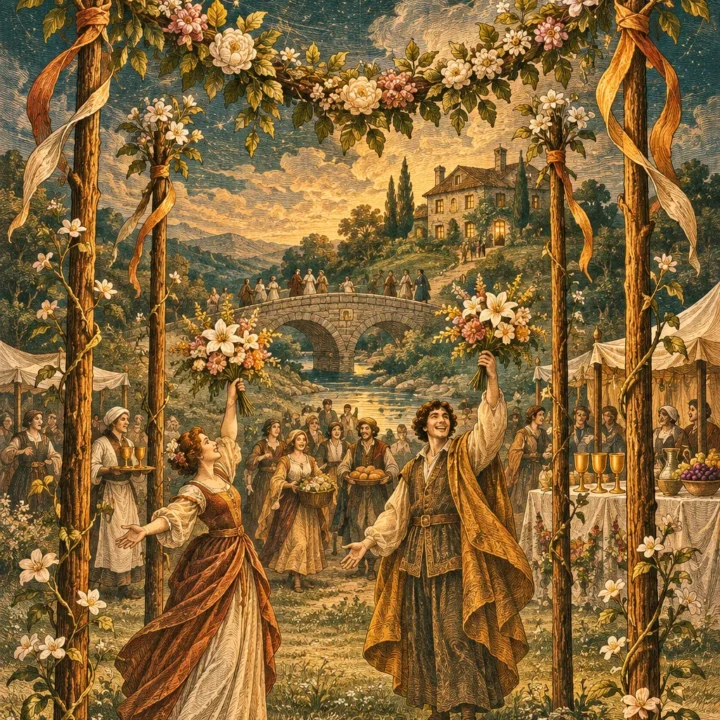
Four of Wands
welcome, celebration, peace, refuge
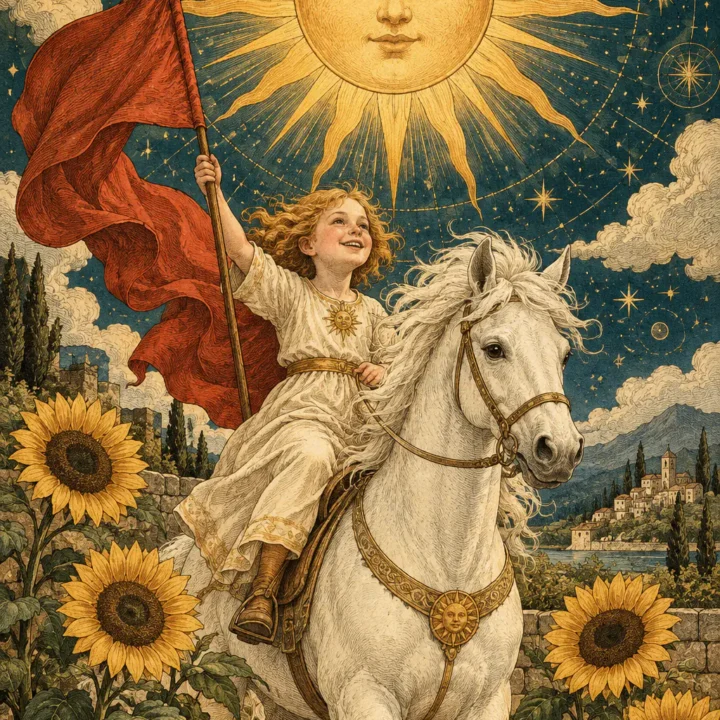
The Sun
joy, openness, clarity, confidence

Ten of Pentacles
legacy, belonging, inheritance, continuity
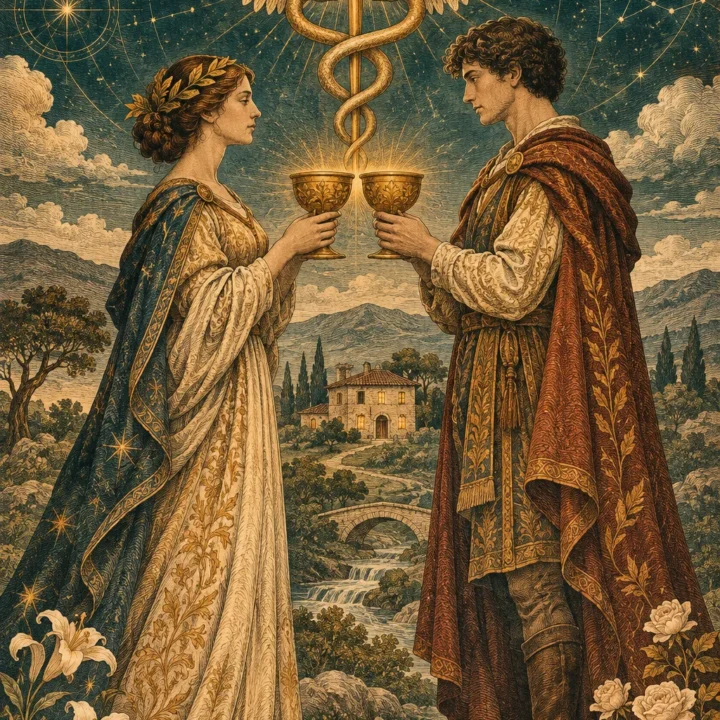
Two of Cups
attraction, partnership, mutual respect, friendship
Sources and further reading
- A. E. Waite, The Pictorial Key to the Tarot, Ten of Cups Read the text
- Golden Dawn, Book T, Lord of Perfected Success, Mars in Pisces Read the text
- Biddy Tarot, Ten of Cups, contemporary interpretations Read the text
- Labyrinthos, Ten of Cups, contemporary interpretation Read the text