Ace of Swords Tarot Card Meaning
A sword rises through a crown above bare mountains. The Ace of Swords invites clear thought, honest speech, and the courage to act on truth with care.
- clarity
- breakthrough
- truth
- discernment
- intellectual courage
Card at a glance
- Number
- Ace
- Element
- Air
- Astrology
- Root of the Powers of Air (Golden Dawn)
- Keywords
- clarity, breakthrough, truth, discernment, intellectual courage, honest communication
 Ace · Ace of Swords
Upright meaning
clarity, truth, breakthrough
The upright Ace of Swords brings a clear thought, necessary conversation, or decisive insight. Its power lies in naming what is real and choosing how to act upon it.
- clarity
- truth
- breakthrough
Reversed meaning
confusion, harsh words, certainty without understanding
Reversed, the Ace asks you to check assumptions, slow the argument, or notice where a sharp insight is being used without care.
- confusion
- harsh words
- certainty without understanding
Card symbolism
-
The crowned sword
A hand offers a sword through a cloud; its tip passes through a crown with hanging branches, suggesting both power and the responsibility of judgment.
-
The double edge
A sword can divide confusion from fact, but it can also wound when used carelessly.
-
The distant mountains
Bare peaks beyond the offered blade suggest that clear thinking is the beginning of a difficult path, not the end of it.
In depth interpretation
A sword rises out of a cloud, straight as a question you can no longer avoid. Its point passes through a crown. Far below, bare mountains stretch into the distance. This card feels like the instant a tangled thought becomes clear enough to name.
The Ace of Swords represents clarity, truth, intellectual breakthroughs, decisive communication, and the beginning of a new way of thinking. Upright, it invites you to recognize something important and respond with integrity. Reversed, it asks whether confusion, haste, or cutting words are distorting what you see.
There is relief in finally understanding. There is also responsibility. The sword has two edges, and knowing how to use it is part of the gift.
The spiritual meaning: an opening in the mind
Swords belong to the element of Air in the Golden Dawn tradition, a language of thought, speech, discrimination, and the invisible patterns that shape our decisions. An Ace is the seed of that power. This is the first realization, not the finished argument.
Perhaps you have been trying to explain why a situation feels wrong, and a quiet moment suddenly gives you the words. Perhaps you recognize that two choices you thought were equally good lead toward very different lives. The Ace offers the beginning of clarity. You still have to decide what to do with it.
A spiritual reading can also concern the stories you tell yourself. Which belief has become so familiar that you no longer examine it? The sword asks for clean attention. It encourages honesty while leaving room for the possibility that you have more to learn.
The symbols on the Ace of Swords
The offered blade and the crown
Pamela Colman Smith depicts a hand emerging from a cloud and gripping an upright sword. The crown near the point is hung with branches. The scene suggests an extraordinary force entering ordinary life, but the blade has not yet struck anything.
The crown is sometimes read as mastery or triumph. Waite’s own account stresses great force and victory, including the danger of excess. A useful reading holds those meanings together. Having a strong conviction does not automatically make it wise.
The blade’s two edges
A sword separates. Its sharpness can help you distinguish a fact from a fear, or a clear boundary from an angry reaction. Yet speech that cuts through confusion can also cut a person.
If the Ace appears before a difficult conversation, ask what actually needs to be said. You do not have to say everything you have thought at your most frustrated.
The mountains below
The mountains remain far from the hand. One way to read them is as the effort that follows insight. A moment of recognition may feel sudden, while changing a habit or repairing a relationship takes time.
Notice the difference between seeing the path and walking it. The card offers the first.
Ace of Swords upright: when the truth becomes speakable
Upright, the Ace often appears at the beginning of a clear decision, meaningful conversation, course of study, or creative idea. A scattered problem takes on shape. You can state what matters and identify the next question.
Suppose you have been unhappy at work without knowing why. After keeping a record of your week, you realize the problem is a constantly shifting role rather than the work itself. The Ace is that accurate insight. It makes a constructive conversation possible.
The card can also favor intellectual courage: challenging an assumption, correcting an error, or admitting a truth you previously avoided. The most valuable breakthrough may be the one that allows you to change your mind.
Clarity can feel exhilarating. Test it gently against the world. A true insight should become more useful as you understand its limits.
Ace of Swords reversed: when the mind becomes a weapon
A reversed Ace may describe muddled information, an argument that has lost its purpose, or a certainty reached too quickly. Perhaps an important conversation keeps turning into a contest over who is right. Perhaps you are treating one alarming thought as a settled fact.
Another possibility is that you already know what must be said but cannot find a respectful way to say it. Reversal can reveal a truth held in silence as readily as a harsh truth blurted out.
Waite’s older reversed interpretation emphasizes the danger of force running to excess. Modern readings commonly speak instead of mental fog, misunderstandings, and blocked expression. In practice, both point toward a question: what would make this insight trustworthy and constructive?
Before making a difficult decision, write down what you know, what you believe, and what you still need to ask. The difference is often illuminating.
How the Ace of Swords changes a reading
Imagine drawing the Ace as advice after a confusing conversation. The invitation is to name one verifiable truth and ask one direct question. In an obstacle position, the same blade can reveal an attachment to being right: perhaps you have gathered arguments but stopped listening. As an outcome, it can describe a clearer understanding, even when that understanding leads you to a difficult choice.
Two nearby cards make the distinction vivid. With Justice, the Ace asks how your insight will be weighed fairly and what responsibility follows. With the Five of Swords, a sharp discovery could be turned into ammunition during a disagreement. Neither pairing proves that someone is lying. Both ask what you intend to do with the words you now possess.
The crown at the sword’s tip is worth remembering. Recognition can feel like triumph, but a truth still needs patience, proportion, and a willingness to be corrected. That is how an illuminating thought becomes wisdom.
The Ace of Swords in love and relationships
In love, this Ace favors an honest conversation that clears room for understanding. Someone might finally ask for a more defined commitment, acknowledge hurt, or articulate a boundary that has been difficult to express.
If you are single, the card can signal a shift in your understanding of the relationship you want. You may begin recognizing familiar patterns before repeating them.
Reversed, watch for assumptions and language intended to win rather than connect. The card cannot disclose another person’s private thoughts. If you need clarity about their feelings, a conversation and consistent behavior are more reliable than treating the Ace as proof.
In a feelings position, it may represent strong mental attention, directness, or a wish to put something into words. It does not on its own promise romance. The Two of Cups offers a more mutual emotional image.
Career, study, and money
The Ace is especially at home in research, writing, contracts, analysis, and problem-solving. A promising idea may be arriving, but it still needs development. This is a good card for preparing clear questions before a meeting or identifying the point a proposal must prove.
With money, clarity can mean reading the terms, checking an assumption, or recognizing that a persuasive story is missing evidence. The card does not guarantee that your decision will be profitable.
If reversed, verify facts before acting. A misunderstood message or incomplete agreement can have consequences long after the excitement of a breakthrough has passed.
Worked reading: should I speak up?
Imagine you are considering a conversation about unfair expectations at work. The Ace of Swords appears for what is emerging, Justice for your guiding value, and Temperance for the approach.
The Ace names the need for clarity. Justice asks you to distinguish verifiable facts from impressions and to consider fairness for everyone involved. Temperance suggests choosing a pace and tone that allow the conversation to be heard.
Together, these cards favor preparation. Write down two examples, describe the impact, and ask for one specific change. If Five of Swords appeared in place of Temperance, the reading would draw more attention to the risk of turning the exchange into a struggle for dominance.
The reading helps you prepare for a real encounter. It cannot control how another person responds.
The Golden Dawn’s Root of the Powers of Air
In the Golden Dawn’s Book T, the Ace of Swords is the Root of the Powers of Air. This elemental title describes the source of the suit’s intellectual force. Smith’s crowned blade gives that force a memorable form.
Older traditions do not all read Swords as pleasant clarity. In Waite’s account, triumph and excess live close together. The contemporary emphasis on breakthroughs is useful when that sharper inheritance remains in view.
Ace of Swords as advice
Choose one confusion that has been draining your attention. On paper, make three short columns: what I know, what I assume, and what I need to ask. Then select one action that respects both truth and the people affected.
You may discover that the first honest act is to speak. Sometimes it is to listen longer.
Is the Ace of Swords a yes or no card?
It often leans toward yes for seeking clarity, beginning research, or having a necessary conversation. For a question about forcing an outcome, pause. A strong thought does not make an uncertain future certain.
Frequently asked questions
Does the Ace of Swords mean someone is telling the truth?
It highlights truth and communication as important themes. It cannot authenticate a statement. Compare words with evidence and behavior.
Is the Ace of Swords a new beginning?
Yes, particularly a beginning in understanding, communication, study, or decision-making. Like other Aces, it presents a seed of possibility rather than a completed result.
What is the difference between the Ace of Swords and Justice?
The Ace is an emerging insight or force of thought. Justice considers balance, responsibility, and the consequences of judgment. One helps you see; the other asks how you will weigh what you see.
What should I do when I draw the Ace of Swords reversed?
Identify the missing information or the conversation that needs a calmer approach. Reversal invites discernment, not suspicion of everyone around you.
Tradition note: These images and interpretations center on the Rider-Waite-Smith deck illustrated by Pamela Colman Smith and first published in 1909. Waite’s divinatory account and the Golden Dawn’s elemental framework inform the reading. Modern language about mental clarity and healthy communication is an interpretive application, not a universal ancient rule.

Keep reading
Explore the Swords
Every card page names the tradition behind each meaning, so you can compare readings instead of taking one as fixed.
Cards to explore alongside this one
Their symbols reveal useful similarities and differences for your next reading.
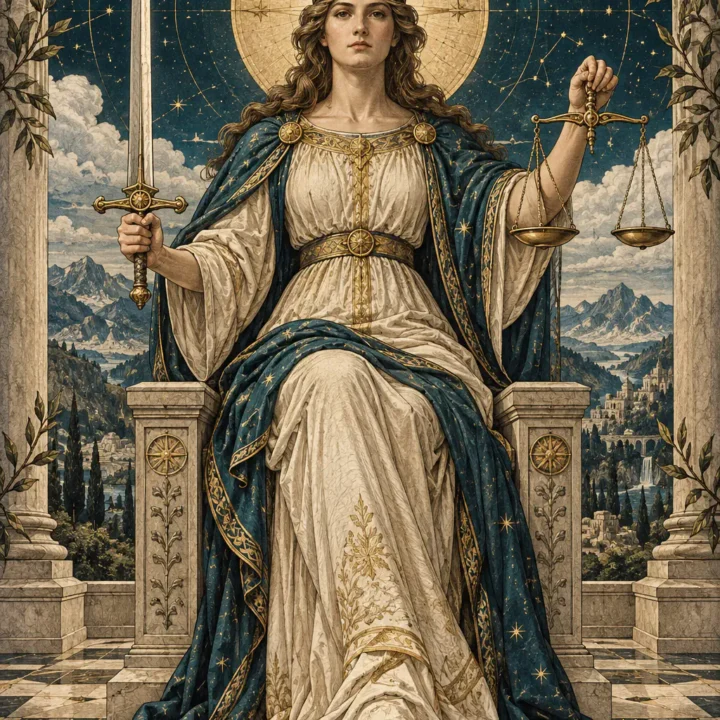
Justice
fairness, honesty, accountability, clarity

Page of Swords
curiosity, learning, questions, vigilance
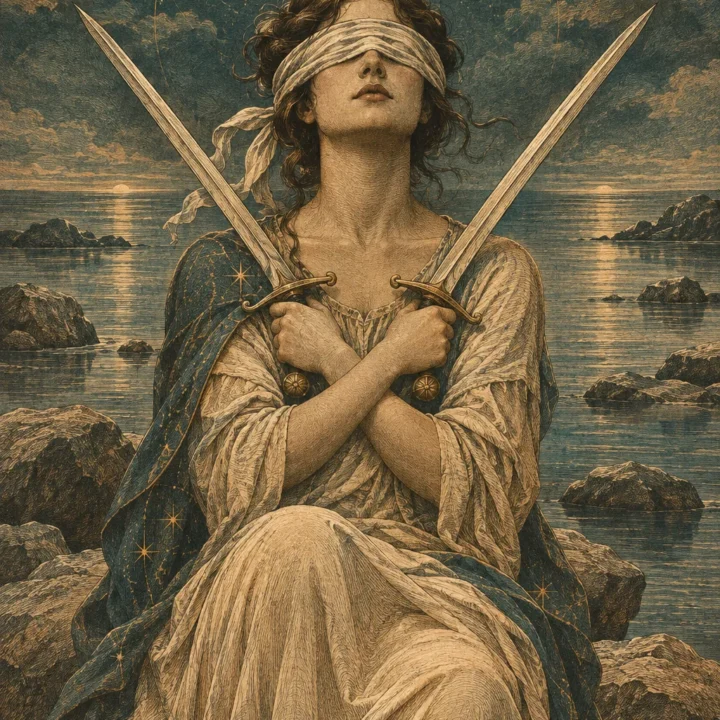
Two of Swords
indecision, guarded peace, boundaries, suspended choice

The Magician
resourcefulness, focused will, skill, communication
Sources and further reading
- A. E. Waite, The Pictorial Key to the Tarot, Part III (Swords, Ace of Swords) Read the text
- Golden Dawn, Book T, tarot titles, attributions, and card descriptions Read the text
- The Morgan Library & Museum, Pamela Colman Smith and her tarot art Read the text
- Victoria and Albert Museum, A History of Tarot Cards Read the text