Nine of Cups Tarot Card Meaning
A satisfied man rests before nine golden cups after a feast. Explore the Nine of Cups as a symbol of fulfillment, wishes, and enjoying what you have truly made possible.
- contentment
- a wish fulfilled
- enjoyment
- satisfaction
- hospitality
Card at a glance
- Number
- Nine
- Element
- Water
- Astrology
- Lord of Material Happiness, associated with Jupiter in Pisces.
- Keywords
- contentment, a wish fulfilled, enjoyment, satisfaction, hospitality, pride in a meaningful achievement.
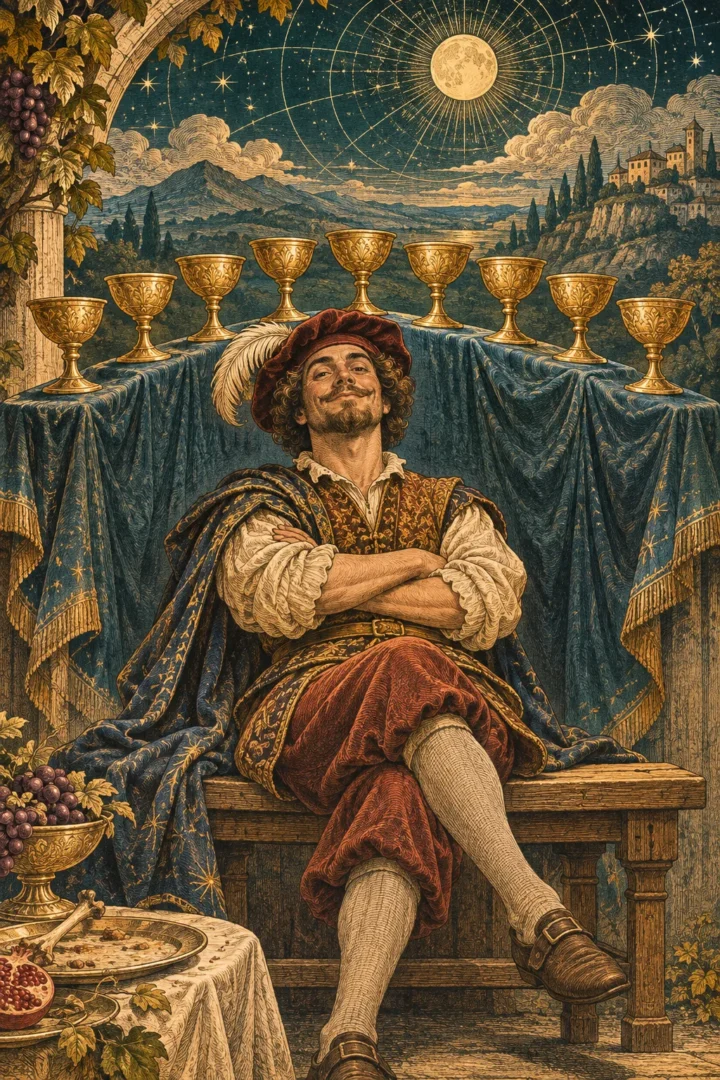 Nine · Nine of Cups
Upright meaning
contentment, a wish fulfilled, enjoyment
The Nine of Cups is widely called the wish-fulfilled card. Its association with satisfaction is well established, and the Golden Dawn's Lord of Material Happiness explicitly includes fulfillment of a wish.
- contentment
- a wish fulfilled
- enjoyment
- satisfaction
- hospitality
- pride in a meaningful achievement.
Reversed meaning
dissatisfaction or overindulgence in many modern readings; truth, loyalty, liberty
Modern tarot readers often associate the reversed Nine with excess, smugness, or the disappointment of achieving something that does not feel fulfilling. You might be spending more energy maintaining an image of success than enjoying the life beneath it.
- dissatisfaction or overindulgence in many modern readings; truth
- loyalty
- liberty
- and sometimes imperfections in Waite's historical account.
In depth interpretation
A man sits on a wooden bench with his arms folded and a satisfied expression. Behind him, nine golden cups line an arched counter draped in blue. He looks directly toward us, as though we have arrived after a feast and he is pleased to show us what he has gathered.
The Nine of Cups represents contentment, pleasure, wishes taking shape, and the satisfaction of reaching something that matters to you. Upright, it invites you to enjoy a moment of genuine fulfillment. Reversed, it can bring questions about what happiness costs, whether a success feels as good as you expected, or how honesty and freedom might change your relationship with what you have achieved.
The Nine is often called the wish card. Yet the most interesting thing in Pamela Colman Smith's picture is the man himself. He has stopped to enjoy the moment. When did you last allow yourself to do that?
The spiritual meaning: letting a good moment be enough
Some kinds of happiness arrive so quietly that you almost miss them. You finish work that has occupied your thoughts for months. You sit down after a meal with people you love. You look at a room you have made your own and recognize that you feel comfortable there.
For a moment, you are no longer trying to reach the next thing.
The Nine of Cups lives in that stillness. The man on the bench is surrounded by cups, arranged as though the evening has already given him plenty. You can imagine the conversation, the food, the welcome, and the small satisfactions that led to this pause.
The card's spiritual invitation is to notice when something you longed for has actually entered your life. Desire is often easier to recognize than fulfillment. Once a wish becomes ordinary, we can begin looking past it, searching for the next distant light.
This card can ask you to stay with what feels nourishing. Perhaps you have been practicing a craft for years and can finally hear your own voice in the work. Perhaps you are learning that solitude can be comfortable. An earlier dream may have changed shape, yet something valuable has come to rest in your hands.
The Nine honors the pleasure of recognizing enough. Its generosity begins with being able to receive the good that is already here.
What the man and his nine cups reveal
The arched display of cups
Nine vessels line the counter behind the seated man. They are arranged neatly, almost like a collection he wants us to admire. They also make the card immediately recognizable among the Cups suit, where other vessels are exchanged, spilled, or offered.
An arrangement so carefully displayed raises a helpful question. What do you want to show the world that you have accomplished? A collection of cups might stand for experiences, relationships, skills, or memories. You may have worked hard for each one.
If you feel drawn to the display, consider whether you take pleasure in the accomplishment itself or in the attention it brings. Both can be part of an honest human experience. The question is which kind of enjoyment has lasting nourishment for you.
The cups are set behind the man. He has a moment of space between himself and all the things that contributed to his satisfaction.
The folded arms and unmistakable smile
The man's posture feels settled. He looks comfortable with what surrounds him, with a trace of self-satisfaction that different readers experience differently.
One reader may see the warmth of a host who has prepared a feast. Another might notice the possibility of pride turning into boastfulness. Smith leaves room for both responses.
His folded arms also distinguish him from the traveler of the Eight of Cups. The Eight leaves an established scene in search of something more meaningful. Here, the figure has chosen to sit. In a reading about an important decision, the Nine might suggest a time to enjoy what you have created before asking what comes next.
We do not need to decide whether the man is generous from his smile alone. His character would become clearer if the scene showed how he treats the people around him. That absence opens a useful question about sharing.
The blue drapery and the feast we cannot see
The counter is covered in blue cloth. Waite wrote that the man has feasted and has plenty of refreshment behind him. The image seems to catch a moment after enjoyment, with no table of food or guests visible.
That unseen feast can be spiritually meaningful. It reminds us that a beautiful result is often the last visible part of a much longer experience. The preparation, anticipation, companionship, and effort have all shaped what the moment means.
If the Nine appears after a success, ask what you most enjoyed about reaching it. The answer may surprise you. Sometimes the best part was learning that you could make something real.
Nine of Cups upright: the pleasure of a wish taking shape
The Nine of Cups is widely called the wish-fulfilled card. Its association with satisfaction is well established, and the Golden Dawn's Lord of Material Happiness explicitly includes fulfillment of a wish.
In everyday readings, the Nine can describe the relief of a goal reached. You have passed an examination, completed a creative project, welcomed someone important into your life, or discovered a rhythm that feels right.
Imagine an amateur musician who has wanted to play a small concert for years. After many nervous rehearsals, the evening finally arrives. She makes mistakes, but the music comes alive and the audience responds warmly. On the way home, she feels a kind of contentment that cannot be reduced to applause.
That is Nine of Cups energy. The achievement matters, and so does the feeling of having lived something that once existed only in imagination.
The card can also appear when your circumstances are pleasantly settled. Perhaps you have time to cook, walk outdoors, read, and spend an evening with people you enjoy. Small experiences count. The Nine does not demand an extraordinary prize.
It encourages gratitude when gratitude arises naturally. You can enjoy a moment without making it into a promise that every future moment will be equally pleasant.
Does the Nine of Cups guarantee that a wish will come true?
The Nine is encouraging when you ask about a hope or goal, but tarot cannot guarantee a specific outcome. The traditional meanings describe satisfaction and success as part of the card's symbolic language. They do not provide a reliable method for predicting someone else's decision or the result of an external event.
The most useful question is what fulfillment would look like in the real circumstances. If you hope to reconnect with someone, their willingness matters. If your wish concerns creative work, consider what preparation can make the opportunity possible.
A further distinction matters: getting what you asked for and feeling deeply nourished by it can be different experiences. When you draw the Nine, notice which part of your wish has the strongest emotional pull.
The card can help you recognize the good that is possible while keeping your judgment grounded in the world.
Nine of Cups reversed: pleasure, honesty, and a surprising old meaning
Modern tarot readers often associate the reversed Nine with excess, smugness, or the disappointment of achieving something that does not feel fulfilling. You might be spending more energy maintaining an image of success than enjoying the life beneath it.
That reading has something to offer, particularly when you feel a gap between outer accomplishment and inner peace. Yet Waite's historical reversal takes a different path. In The Pictorial Key to the Tarot, his reversed list includes truth, loyalty, and liberty, along with errors and imperfections. The interpretation is far more varied than the usual modern description of hollow happiness.
Suppose you have accepted a promotion and now realize that its public prestige has been concealing a need for greater independence. A reversed Nine could invite you to tell the truth about what the role is giving you. Waite's idea of liberty might become more relevant than a warning about indulgence.
In a different situation, the same card could highlight a pleasant arrangement whose imperfections you have been reluctant to acknowledge.
The reversal is an opportunity to examine what your satisfaction depends on. Is there room for honest feeling? Are your commitments freely chosen? Your reading becomes clearer when it attends to the actual situation.
Nine of Cups in love and relationships
In love, the Nine of Cups often suggests personal happiness within a connection. You enjoy someone's company, feel comfortable expressing affection, or find that a relationship gives you room to be yourself.
If you are single, the card may reflect the discovery that your life already contains love and pleasure in friendships, creative pursuits, and chosen routines. Romantic interest can become part of that fullness when a healthy connection develops.
For couples, the Nine can appear around a shared celebration or a moment of appreciating how far you have come. The card's seated figure is a reminder to enjoy your relationship in the present, beyond planning every next milestone.
Reversed, you might be reevaluating whether an arrangement offers the freedom and mutual honesty you need. A happy public appearance does not tell the whole story. An ordinary conversation about needs may reveal more than trying to interpret what the other person secretly feels.
What does the Nine of Cups mean as feelings?
In a feelings position, the Nine can suggest comfort, delight, appreciation, or satisfaction. Sometimes the focus is the person's enjoyment of their own life. A tarot card cannot establish another person's hidden commitment or guarantee that affection is mutual.
The emotional tone is often warm. Its specific meaning grows from what the people involved actually share.
Nine of Cups for career, creativity, and money
At work, the Nine can symbolize a result you are pleased with: an accepted proposal, a craft improved through practice, a milestone that once seemed distant, or an opportunity to work in a way that suits your values.
The financial dimension of the card is often described as abundance or luxury. Waite's picture includes a substantial feast, and the Golden Dawn calls it Material Happiness. Neither source turns the card into a reliable promise of money.
In a financial reading, it can help you think about what enough would feel like. Are you using resources to create comfort, freedom, or experiences that matter to you? A desire to impress others may be part of the story, though no illustration can tell you what another person will earn or spend.
For creative people, the Nine is especially lovely after a demanding project. Enjoying what you have made is part of the practice. You can look at the work with affection, including the imperfect places where you learned something important.
Jupiter in Pisces and the Lord of Material Happiness
In the Golden Dawn's Book T, the Nine of Cups is the Lord of Material Happiness, associated with Jupiter in Pisces. Its earlier esoteric design has nine vessels beneath lotus flowers. Water pours into every cup, and all nine overflow.
The text celebrates pleasure, happiness, and a wish fulfilled. It also recognizes vanity, self-praise, and a person who can remain lovable and generous despite an exaggerated opinion of themselves. Those mixed qualities feel surprisingly close to the ambiguity in Smith's satisfied seated figure.
Pamela Colman Smith created a different image for the Rider-Waite-Smith deck. The fountains have become a display of goblets, with a person seated in front of them. The visual change invites you to consider the person who receives the pleasure.
Waite himself acknowledged that his description shows the material side of happiness, with other aspects beyond the picture. That remark makes space for your own spiritual reading. What gives the visible cups their deeper meaning?
The Jupiter-in-Pisces correspondence belongs to a particular Western esoteric system. You can work with its language of expansive feeling without treating the astrological attribution as a universal rule for every tarot deck.
The Nine and Ten of Cups: where does happiness live?
These two cards are often summarized as personal happiness followed by family happiness. Their images support part of that distinction. The Nine centers one seated person before a collection of cups. The Ten places several people beneath a rainbow, with a home in the background.
But a solitary figure is not proof of selfishness, and the Nine's older sources also speak of generosity. A person enjoying their own accomplishment can share its benefits. Likewise, the Ten's shared scene need not refer to a conventional household.
In a reading, ask where the fulfillment is being experienced. The Nine often brings attention to your relationship with satisfaction, especially whether you can recognize and enjoy it. The Ten widens the view toward people, place, and the conditions that support belonging.
Both are images of fullness. They can help you understand what kind of happiness the question is truly about.
Worked reading: I achieved my goal. Why do I still feel restless?
Imagine finishing a demanding professional qualification. You had hoped the achievement would change how you felt about your abilities, yet the excitement has faded quickly. You draw the Nine of Cups for what you have gained, the Nine of Pentacles for what you can recognize, and Temperance for the next step.
The Nine of Cups asks you to honor the satisfaction of having reached something real. The Nine of Pentacles turns attention to your independent skill and the resources you have cultivated. Temperance invites you to integrate the achievement into everyday life at a pace that feels sustainable.
Together, the cards suggest creating space to enjoy the skill you worked to develop. You might choose a project that uses your new ability, celebrate with someone who understands the effort, or give yourself time before taking on another demanding goal.
If the Six of Pentacles appeared instead of Temperance, the reading might turn toward sharing what you have learned or noticing how others supported your journey.
The spread offers a way to understand the restlessness. It cannot decide which next goal will bring happiness.
Nine of Cups as advice: receive the feast
Look at the cups arranged behind the seated figure. Imagine placing one small thing you have accomplished into each cup. There is no need to fill all nine. Choose what truly matters to you.
Now notice where your mind goes. Does it return to the effort that brought you here, or begin listing everything you have yet to achieve?
Give one accomplishment a little time. Share it with someone kind, make a meal you enjoy, or spend an evening doing the thing you learned to do. If your spiritual practice includes gratitude, offer a few quiet words for the people and circumstances that helped you.
The Nine invites you to experience the good that has taken shape in your life.
Is the Nine of Cups a yes or no card?
The Nine of Cups generally leans yes for questions about enjoying an achievement, pursuing a meaningful pleasure, or recognizing a positive outcome already taking shape. Reversed, consider whether the result would give you the freedom and satisfaction you actually want. A card does not guarantee that a specific wish will be fulfilled.
A note on tradition
The Rider-Waite-Smith Nine of Cups is illustrated by Pamela Colman Smith, with the description and divinatory list published by A. E. Waite in The Pictorial Key to the Tarot. The Golden Dawn's earlier Lord of Material Happiness uses overflowing cups and the Jupiter-in-Pisces correspondence. Waite's reversal includes positive themes of truth, loyalty, and liberty, which differ from the more familiar modern association with excess and dissatisfaction.
Frequently asked questions
Why is the Nine of Cups called the wish card?
Its association with satisfaction is longstanding, and the Golden Dawn's Book T explicitly includes the idea of a wish fulfilled. Modern readers commonly call it the wish card. The phrase offers a symbolic emphasis, not a guarantee that any particular wish will happen.
Does the Nine of Cups mean money or luxury?
Comfort and material enjoyment are part of its imagery and historical associations. The card can also speak of a satisfying creative, emotional, or spiritual achievement. It cannot predict income or confirm the value of an investment.
Does the Nine of Cups mean someone wants a relationship with me?
It may describe pleasure or affection within a relationship question, but the figure is alone in the artwork. The card cannot establish another person's intentions. A meaningful connection is revealed through communication and mutual action.
Why can the reversed Nine of Cups have positive meanings?
Waite included truth, loyalty, and liberty among its reversed meanings, alongside imperfection. Many contemporary readers emphasize dissatisfaction or excess. Those are different approaches, and the surrounding question helps determine which is useful.

Keep reading
Explore the Cups
Every card page names the tradition behind each meaning, so you can compare readings instead of taking one as fixed.
Cards to explore alongside this one
Their symbols reveal useful similarities and differences for your next reading.
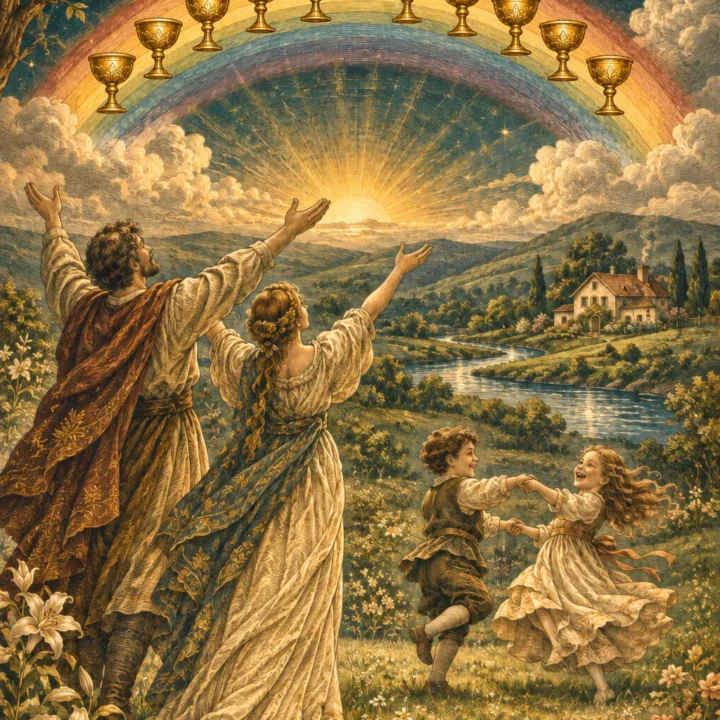
Ten of Cups
emotional fulfillment, family and chosen family, shared joy, harmony

Nine of Pentacles
independence, earned comfort, discernment, privacy
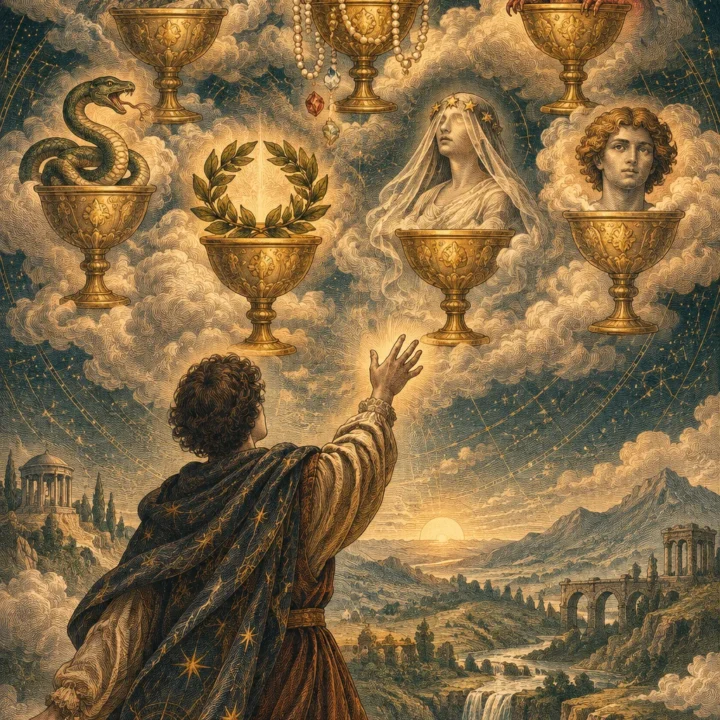
Seven of Cups
imagination, choices, visions, temptation
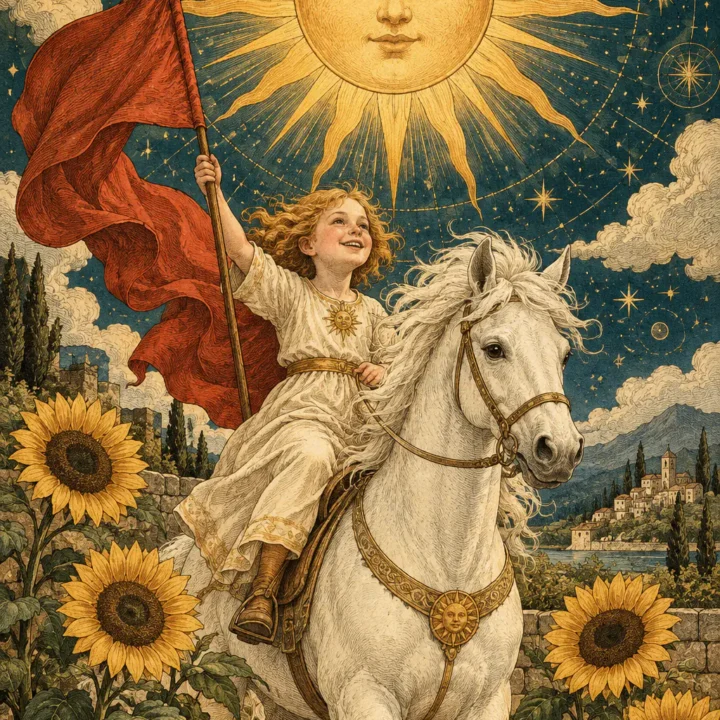
The Sun
joy, openness, clarity, confidence
Sources and further reading
- A. E. Waite, The Pictorial Key to the Tarot, Nine of Cups Read the text
- Golden Dawn, Book T, Lord of Material Happiness, Jupiter in Pisces Read the text
- Biddy Tarot, Nine of Cups, contemporary meanings Read the text
- Labyrinthos, Nine of Cups, contemporary interpretation Read the text