Death Tarot Card Meaning
An armored skeleton rides beneath a black banner marked with a white rose. Explore how the Death card helps make sense of endings, grief, and transformation.
- endings
- transition
- transformation
- release
- completion
Card at a glance
- Number
- XIII
- Element
- Water
- Astrology
- Scorpio (Golden Dawn)
- Keywords
- endings, transition, transformation, release, completion
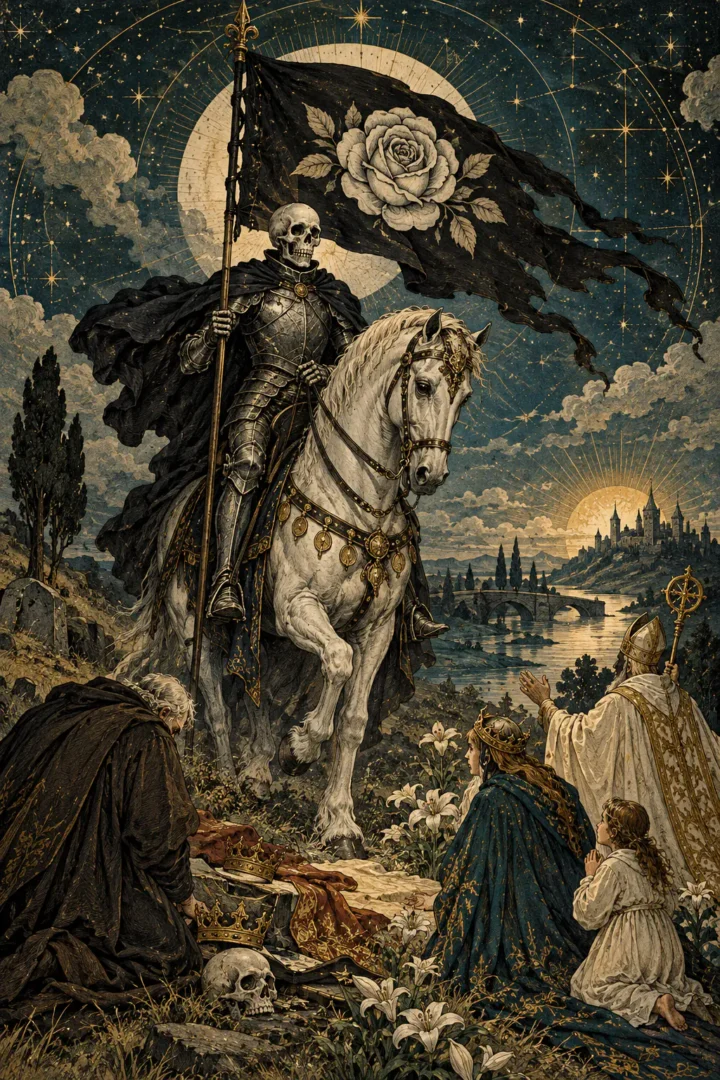 XIII · Death
Upright meaning
Endings, transition and transformation
Upright, Death often describes a situation that is changing too profoundly to return to its familiar shape. The conclusion may already have happened, or you may be approaching a decision that will close a long-running chapter.
- Endings
- Transition
- Transformation
- Release
- Completion
Reversed meaning
Resistance, lingering attachments and unfinished endings
Reversed, Death may point toward an ending that is difficult to accept. You keep returning to an old conversation, preserving belongings you no longer want, or making plans around a future that has already changed.
- Resistance
- Lingering attachments
- Unfinished endings
- Fear of change
Card symbolism
-
The skeleton in armor and the white horse
The skeleton is a familiar image of mortality, dressed here as an armored rider. Its appearance suggests a force no individual can simply order away.
-
The black banner and white rose
The rider holds a dark flag marked with a five-petaled white rose. Waite described it as a mystical rose associated with life.
-
The fallen king and the figures who remain
A crowned figure lies beneath the horse. A religious leader raises his hands while a woman and child stand close by.
-
The distant river and passing boat
A winding river and a small boat appear in the landscape. Many readers associate waterways with passage, emotion, and the journey from one state of life to another.
-
The sun between two towers
Far on the horizon, sunlight appears between two towers. The scene has a destination that the foreground figures cannot yet reach.
In depth interpretation
A skeleton in dark armor rides a white horse through a landscape where nobody can pretend that life will remain as it was. A crown lies on the ground. A child stands nearby, while a religious figure raises his hands toward the rider. The black banner carries a white rose, and far away, the sun shines between two towers.
The Death tarot card most often speaks of endings, transformation, and the difficult beauty of letting one chapter become complete. Upright, it can mark a change that has reached the point of no return. Reversed, it may reveal resistance, unfinished grief, or a familiar pattern that continues long after it has stopped serving you.
The image can be startling, especially if it appears when you are already worried about someone you love. In modern tarot readings, Death is generally understood as symbolic transformation. A tarot card cannot tell you when a person will die.
The quiet truth inside the Death card
You may know what it feels like to reach the last day of something that once defined your life. A child no longer needs you in the same way. A familiar job ends. A house that held years of memories stands empty after a move. The world continues around you while part of your identity is still catching up.
Death is a companion for these experiences. It can help you give an ending the attention it deserves. There is often grief in change, even when you chose it, because something real was present and now belongs to memory.
Sometimes the card appears when you have been trying to keep an old arrangement alive through sheer loyalty. You still show up, repeat the same conversation, or imagine that things will return to their earlier shape. The image invites you to consider what has already altered, and what honoring that truth could mean.
The sunrise in the distance offers a note of spiritual possibility. It gives the picture room beyond the immediate loss. You do not have to rush toward hope. There are times when the most meaningful thing you can do is acknowledge that a chapter mattered.
If the ending feels especially painful, compare this card with the Ten of Swords. That card dwells in the moment of finality and the strain of what has already happened. Death opens a wider meditation on transition and the life that changes around an ending. Neither image predicts physical death.
What the symbols in Death reveal
Pamela Colman Smith filled the Rider-Waite-Smith Death card with a procession of vivid details. Every figure meets the rider differently, and the landscape continues far beyond them.
The skeleton in armor and the white horse
The skeleton is a familiar image of mortality, dressed here as an armored rider. Its appearance suggests a force no individual can simply order away. The horse’s pale body lends the scene an almost ceremonial quality.
In a reading about personal change, this figure can make an ending feel undeniable. Perhaps a long chapter has finished, even though you have not yet found the words to describe its ending.
The black banner and white rose
The rider holds a dark flag marked with a five-petaled white rose. Waite described it as a mystical rose associated with life. Its brightness is striking against the surrounding black.
Look at the rose if an ending has made you question whether anything valuable remains. The symbol can suggest that meaning, affection, or a lesson survives in a changed form. It does not demand that you discover a gift inside every painful loss.
The fallen king and the figures who remain
A crowned figure lies beneath the horse. A religious leader raises his hands while a woman and child stand close by. Status, age, and social role offer no escape from the scene unfolding around them.
You might recognize this symbolism when a change affects everyone in a household or community differently. One person meets it with disbelief, another with prayer, and someone else may not understand what is happening. Their responses cannot be made identical.
The distant river and passing boat
A winding river and a small boat appear in the landscape. Many readers associate waterways with passage, emotion, and the journey from one state of life to another. The tiny vessel suggests movement taking place beyond the figures in the foreground.
The boat may draw your attention toward a quieter question: what support could help you move through the transition rather than remaining entirely alone with it?
The sun between two towers
Far on the horizon, sunlight appears between two towers. The scene has a destination that the foreground figures cannot yet reach. In spiritual readings, the distant light can represent the possibility of another way of living after the old structure has changed.
Its distance matters. The card offers no timetable for renewal, and there is no need to pretend that every ending feels hopeful at first.
Death upright meaning
Upright, Death often describes a situation that is changing too profoundly to return to its familiar shape. The conclusion may already have happened, or you may be approaching a decision that will close a long-running chapter.
Imagine a person who has been running a family business for decades. They care about the customers, the work, and the history of the place, but they are ready to retire. Closing the doors may bring relief and sorrow in the same afternoon. The Death card can honor that complexity.
In a personal reading, it might suggest releasing a habit that belonged to an earlier version of yourself, leaving an identity you have outgrown, or accepting that a particular relationship dynamic has ended. The surrounding cards help show which part of life is changing.
A sense of renewal may follow, though it can arrive gradually. For now, the card encourages honest recognition of what has come to completion.
Death reversed meaning
Reversed, Death may point toward an ending that is difficult to accept. You keep returning to an old conversation, preserving belongings you no longer want, or making plans around a future that has already changed.
There may be a practical reason the transition remains incomplete. Shared finances, family responsibilities, or uncertainty about the next step can make a clean break impossible. The reversal can ask you to distinguish the emotional attachment from the circumstances that still require attention.
Sometimes fear of change is the hardest part. You may prefer an unsatisfying but familiar role to an unknown future. The card invites a gentle investigation of what that familiarity is protecting, and which forms of support might make the next stage more manageable.
Death in love and relationships
In love, Death can represent the closing of a relationship chapter. For some couples, that means a separation. For others, it can describe a profound change in how they relate: an old pattern of conflict ends, a family grows, or a partnership is reshaped after a difficult truth has been spoken.
Imagine two people who once planned every day together but now need room for separate ambitions. The relationship might continue and become healthier, though its old form has to change. Death can symbolize the seriousness of that transition.
For someone single, the card might accompany the decision to stop seeking relationships that repeat a painful pattern. It can also suggest making space to grieve a connection before beginning another.
Reversed, consider whether a relationship has been kept in limbo by promises that never become action. Real-world behavior and mutual choices matter more than any suggestion that a bond is spiritually destined.
Death as feelings
Asked about someone’s feelings, Death may suggest that their understanding of the connection has changed, or that they are processing the end of something important. There could be grief, relief, uncertainty, or a wish to begin again in a different way.
The card cannot reveal which feeling belongs to another person, and it cannot tell you whether they will return. If you need clarity, look for what the person is willing to discuss and how they act toward you.
Death for career and work
At work, Death can appear during an ending that affects your sense of who you are. A position is eliminated, a long project finishes, or a business no longer resembles the one you joined years ago.
Suppose you trained for a profession and have begun to realize that its daily life no longer suits you. Even a welcome change of direction can involve mourning the identity you worked so hard to build. The card might help you treat that loss with respect while exploring new possibilities.
Reversed at work, Death can suggest holding tightly to a role whose purpose has changed or finding it difficult to move after an unexpected setback. Practical planning, trusted advice, and time to adjust can all help.
Death for money
In financial readings, Death may bring attention to a significant change in circumstances: the end of an income stream, repayment of a debt, the closing of a business, or a shift in the way you manage resources.
Reversed, it can reflect reluctance to change an arrangement that is becoming unsustainable. Review the numbers and obligations carefully. A tarot card cannot forecast financial losses or tell you which investment to sell.
Death and spiritual transformation
There is a long spiritual tradition of reflecting on mortality to clarify what matters. The Death card can bring that contemplation into a reading without asking you to fear the future. What would deserve your attention if you remembered that every season of life is finite?
Its imagery can be especially moving after a bereavement or another major loss. You might light a candle in memory, tell a story about the person you miss, or allow yourself to sit quietly with a photograph. Grief has its own changing rhythms, and you may need companionship while moving through them.
The Golden Dawn associated the card with Scorpio, a zodiac sign that later tarot readers often connect with deep change and hidden processes. This is one esoteric framework among several ways of approaching the image.
Death as advice: an honest farewell
Think of one chapter you believe is ending. It could be a habit, a role, an expectation, or a way of understanding yourself. Write a short letter beginning, “What I will remember is…”
Continue with a few things you genuinely valued about this chapter. Then write, “What I am ready to leave behind is…” If that second sentence feels premature, you can simply name what remains unresolved.
You can keep the letter private. The purpose is to give the experience a place in your story. When you are ready, choose one small act that acknowledges the change, such as clearing a shelf, sharing a memory, or having a conversation you have been postponing.
Is Death a yes or no card?
Death rarely gives a simple yes or no. It often suggests that the form of a situation is changing and that the original question may need to be reconsidered. Reversed, it can draw attention to an ending you are having difficulty facing. For questions about someone’s health or physical survival, seek information from appropriate medical professionals.
How to read Death in a tarot spread
The position helps reveal the role of the ending. In the past, Death can describe a change that still shapes the present. As a challenge, it may suggest unfinished grief or attachment. As an outcome, it can indicate a significant transition, with the surrounding cards adding context.
Imagine asking about a creative project that has lost its energy. You draw Death in the present, the Four of Swords as advice, and the Ace of Wands as a possible direction. The reading could suggest that the project’s old form has run its course, that rest deserves a place in the process, and that a fresh creative impulse may emerge. It leaves you free to decide what to do with the work.
A brief note on tarot tradition
Death has appeared in European tarot as a skeletal figure for centuries, often as an unnumbered or unnamed trump in some older decks. The Rider-Waite-Smith version, illustrated by Pamela Colman Smith and published in 1909, gives the figure a white horse, the rose-bearing banner, and a distant sun. Waite explored both literal mortality and spiritual transformation in his discussion, so the historical imagery should not be flattened into a single reassuring slogan. Contemporary readings usually emphasize change and endings. The Golden Dawn correspondence is Scorpio.
Frequently asked questions
Does the Death tarot card predict someone dying?
Drawing Death is not reliable evidence that anyone will die. In most contemporary readings, the card is interpreted in relation to endings and transformation. If you have a serious health concern, seek medical information rather than a tarot prediction.
Can Death mean a breakup?
It can describe the end of a relationship, especially when other cards and real circumstances point toward separation. It may also describe an old dynamic ending while the relationship continues. The people involved still make their own choices.
What is the difference between Death and The Tower?
Death often points toward the ending of a chapter and the transition that follows. The Tower more commonly evokes a disruption that exposes or overturns an unstable structure. A reading may contain both when a major ending is accompanied by upheaval.
Why does the Death card have a white rose?
The Rider-Waite-Smith banner carries a white rose against black. Waite associated the emblem with life, making it one of the card’s most evocative details. Readers may reflect on what remains meaningful even when circumstances change.
Keep reading
Explore the Major Arcana
Every card page names the tradition behind each meaning, so you can compare readings instead of taking one as fixed.
Cards to explore alongside this one
Their symbols reveal useful similarities and differences for your next reading.
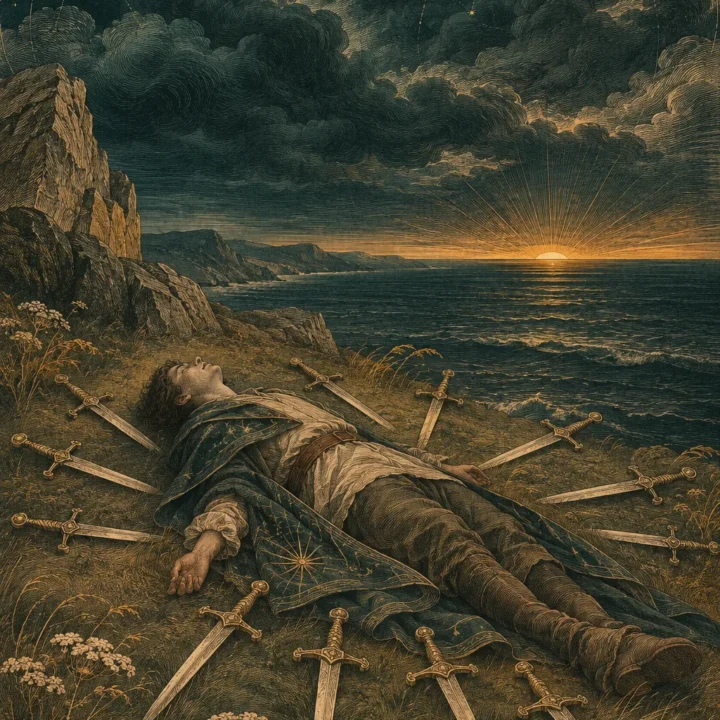
Ten of Swords
painful ending, finality, collapse, release
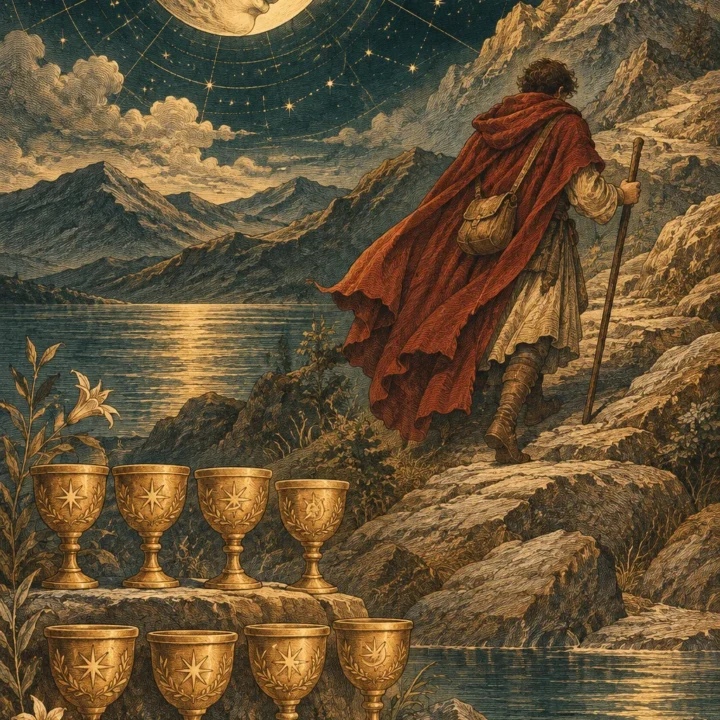
Eight of Cups
departure, searching, emotional dissatisfaction, changing priorities
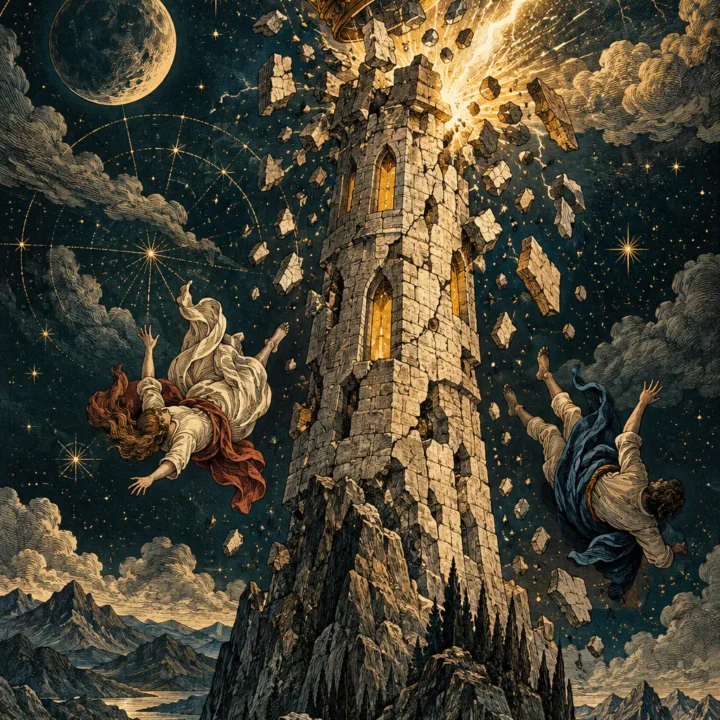
The Tower
upheaval, revelations, instability, sudden change
The Star
hope, inspiration, trust, renewal
Sources and further reading
- Arthur Edward Waite, The Pictorial Key to the Tarot, Part II, Death Read the text
- Arthur Edward Waite, The Pictorial Key to the Tarot, Part III, divinatory meanings Read the text
- The Golden Dawn’s later esoteric attribution of Death/Scorpio Read the text
- Victoria and Albert Museum, A history of tarot cards Read the text