Page of Swords Tarot Card Meaning
A young figure stands alert with a raised sword in a windy landscape. The Page of Swords celebrates curiosity while questioning what we do with information.
- curiosity
- learning
- questions
- vigilance
- communication
Card at a glance
- Number
- Page
- Element
- Air
- Astrology
- Golden Dawn: Princess of the Rushing Winds (Earth of Air); RWS: Page of Swords
- Keywords
- curiosity, learning, questions, vigilance, communication, gathering facts
 Page · Page of Swords
Upright meaning
curiosity, questioning, alert learning
Upright, the Page of Swords brings a questioning mind, intellectual curiosity, and the energy of gathering information before taking a stand.
- curiosity
- questioning
- alert learning
Reversed meaning
gossip, defensiveness, scattered attention, premature judgment
Reversed, the Page can show curiosity turning into suspicion, careless speech, or conclusions formed before the facts arrive.
- gossip
- defensiveness
- scattered attention
- premature judgment
Card symbolism
-
The raised sword
A young figure holds the blade aloft, ready to examine or respond to what is ahead.
-
The turned head and moving stance
The body is poised in one direction while the gaze checks another, conveying alertness and uncertainty.
-
The windblown landscape
Bent trees, racing clouds, and rough ground reinforce a mind that stays active and observant.
In depth interpretation
A young figure stands on uneven ground with a sword raised in both hands. The wind pushes clouds across the sky and bends the trees. The Page looks over one shoulder, alert to something beyond the edge of the picture.
The Page of Swords represents curiosity, intelligence, questioning, vigilance, and communication that has not yet found its mature form. Upright, it encourages learning and careful observation. Reversed, it can reflect scattered thought, gossip, suspicion, or the habit of drawing conclusions too quickly.
There is freshness in this card. The Page wants to know. The spiritual question is what happens after knowledge is found.
The spiritual meaning: keep the question alive
The Page is a student of the Swords suit. A thought has captured attention, and the mind is reaching toward it. This might be a new subject, an unexpected conversation, or a feeling that something deserves a closer look.
Curiosity is a spiritual practice when it helps you meet the world with openness. It becomes less useful when every unanswered question is treated as a warning.
If the Page appears in a reading, consider what you are being invited to learn. Where do you need more evidence? Where have you been repeating a familiar explanation without checking whether it still fits?
You do not have to abandon intuition. You can let it prompt better questions rather than pretending it has supplied every answer.
The symbols of the Page of Swords
The raised sword
Smith’s Page holds a sword upright while standing in a ready posture. The blade suggests the intellect as an instrument the figure is learning to use.
There is potential here, though not yet complete mastery. A sharp question can open a conversation; a sharp comment can close it.
The watchful gaze
The figure looks backward while standing poised to move. That detail gives the card a sense of alertness and divided attention.
You might recognize the feeling of learning something new and wondering what you have missed. The Page’s challenge is to balance watchfulness with trust in the process of discovery.
Wind, clouds, and uneven ground
Trees lean under the wind and clouds gather in motion. Air, the element associated with Swords in the Golden Dawn tradition, is made visible through its effects.
Thought moves quickly. The Page benefits from a practice that allows observations to settle before becoming conclusions.
Page of Swords upright: a question worth asking
Upright, the Page can indicate new study, research, important news, an honest inquiry, or someone who brings a fresh perspective. It may describe an attitude rather than a literal young person.
Imagine joining a community group that makes decisions differently from what you are used to. Instead of judging the process immediately, you ask how it developed and what has worked. That is Page energy at its best.
The Page can be especially helpful when you are preparing for a conversation. Gather facts, learn the vocabulary, and stay willing to discover something unexpected.
There is a playful side to this card too. Intellectual life need not always be solemn. Questions can lead to wonder.
Is the Page a person, a message, or part of you?
Court cards often become more useful when you let the position in the spread guide the reading. In a people position, the Page of Swords might evoke someone observant, new to a subject, and eager to ask questions. As advice, the same card asks you to become the student: learn the vocabulary, check the source, and resist the pleasure of an early verdict.
In an outcome position, the Page could suggest a new conversation, a question that emerges, or the start of a learning process. It does not promise a text from a specific person. The Ace of Swords places the emphasis on a sudden idea or realization; the Page gives that idea curious human hands and the need for practice.
Try a simple test. Before assigning the Page to someone else, ask what question you yourself have avoided asking. The card may be bringing your own attention back to life.
Page of Swords reversed: when curiosity becomes suspicion
Reversed, the Page may warn of careless messages, unchecked rumors, defensive questioning, or the exhausting habit of monitoring every signal.
Perhaps you are rereading someone’s texts to discover a hidden meaning. Perhaps you keep refreshing news about an uncertain situation until you feel less informed than when you started.
Waite associated the Page with vigilance, examining, and watching over matters; his reversed account includes the difficult side of those qualities. Modern interpretations of gossip and scattered thinking build on that theme.
Ask whether your search for information is giving you understanding or feeding a fear.
Page of Swords in love and feelings
In love, the Page can describe curiosity about a person, the wish to talk more, or a connection that is still being explored. It might also point to conversations that remain playful, awkward, or overly analytical.
In a feelings position, the Page can suggest mental interest or guarded observation. It cannot prove that someone is secretly checking your social media or that they plan to contact you.
Reversed, notice whether communication has become indirect or reactive. A straightforward question may be kinder than guessing at a hidden meaning.
The Page of Cups explores emotional openness and imagination. The Page of Swords brings investigation and language to the beginning of a story.
Page of Swords in career, study, and money
This Page is well suited to research, editing, interviews, new skills, and fact-finding. A beginner’s perspective can reveal questions experienced people have stopped asking.
At work, the card may prompt you to read a document carefully or request clarification before committing to a plan. In money matters, it favors learning terms and comparing evidence rather than reacting to rumors.
Reversed, slow down before sharing information. Accuracy matters as much as speed.
Worked reading: how can I learn without becoming overwhelmed?
Imagine beginning a challenging course. You draw the Page of Swords for your approach, Eight of Pentacles for the practice, and Temperance for what will help you sustain it.
The Page brings questions and interest. The Eight of Pentacles asks for repeated, focused effort. Temperance encourages a pace that allows learning to settle.
Together, the cards suggest keeping a list of questions, setting regular study periods, and testing your understanding through small projects.
If Seven of Swords appeared instead of the Eight, the reading could ask whether you are looking for a clever shortcut that undermines the learning itself.
The Page of Swords and the Golden Dawn’s Princess
Waite’s Page is the watchful young figure on rugged ground. In the Golden Dawn’s Book T, the lowest Swords court is listed as the Knave and named the Princess of the Rushing Winds: the Lotus of the Palace of Air. The imagery is different: its Princess is a standing warrior with her own symbols, rather than Smith’s youthful figure looking over his shoulder.
The Princess is commonly understood as Earth of Air within that esoteric court system: a way of thinking about ideas meeting practical life. This is a Golden Dawn correspondence, not a personality diagnosis or a rule that every deck must follow. It can deepen a reading in which the Page is learning to turn curiosity into something useful.
Queens and Pages map relatively clearly across the two rank systems. The Kings and Knights have a more complicated history, because Book T also calls its mounted ruler a King and its chariot figure a Prince.
Page of Swords as advice: turn suspicion into a question
Write down one question you want answered. Then identify one respectful, verifiable way of investigating it. You might ask someone directly, read the source material, or seek knowledgeable guidance.
Notice how your mind feels after gathering evidence. Curiosity ought to leave room for understanding.
Is the Page of Swords a yes or no card?
It often says investigate further, particularly when information is incomplete. It may encourage beginning a course of study or asking a question, while cautioning against premature certainty.
Frequently asked questions
Does the Page of Swords mean a message is coming?
Pages are often associated with news or communication, but this card cannot guarantee contact from a particular person.
Is the Page of Swords spying?
Waite included vigilance and surveillance among traditional themes. In a modern reading, those ideas may point to watchfulness or privacy concerns; the card cannot establish that someone is spying on you.
What is the Page of Swords as a person?
It may represent someone curious, articulate, skeptical, or quick to notice details. These are symbolic qualities, not a diagnosis or a fixed personality type.
How is the Page different from the Knight of Swords?
The Page observes and questions. The Knight of Swords acts at speed, sometimes before reflection has caught up.
Tradition note: The article uses Pamela Colman Smith’s Rider-Waite-Smith Page and Waite’s language of vigilance. Golden Dawn court ranks and elemental correspondences are not identical to every modern tarot deck, so the esoteric note is deliberately limited.

Keep reading
Explore the Swords
Every card page names the tradition behind each meaning, so you can compare readings instead of taking one as fixed.
Cards to explore alongside this one
Their symbols reveal useful similarities and differences for your next reading.
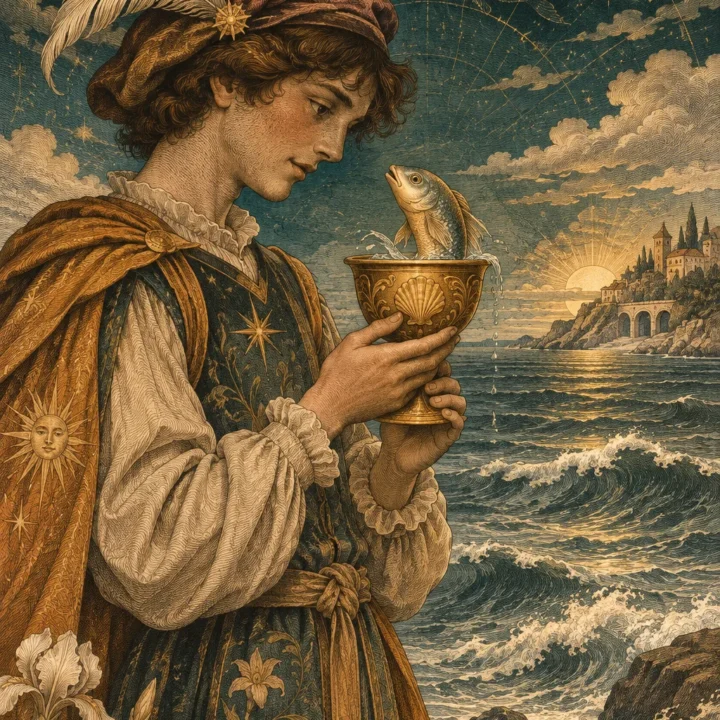
Page of Cups
imaginative insight, emotional news, kindness, study
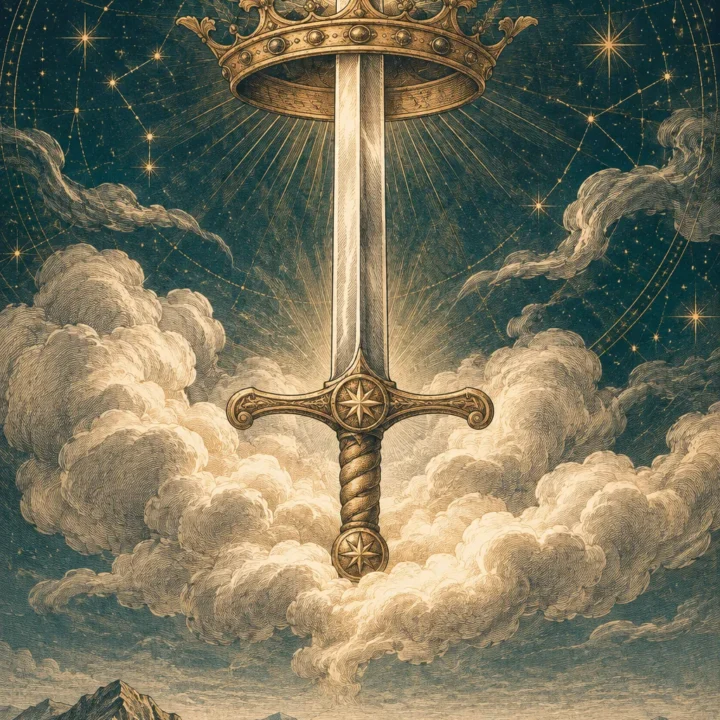
Ace of Swords
clarity, breakthrough, truth, discernment

Page of Pentacles
study, careful observation, apprenticeship, practical news

Seven of Swords
strategy, secrecy, independent action, evasion
Sources and further reading
- A. E. Waite, The Pictorial Key to the Tarot, Part III (Swords, Page of Swords) Read the text
- Golden Dawn, Book T, tarot titles, attributions, and card descriptions Read the text
- The Morgan Library & Museum, Pamela Colman Smith and her tarot art Read the text
- Victoria and Albert Museum, A History of Tarot Cards Read the text