Nine of Swords Tarot Card Meaning
A person sits awake beneath nine suspended swords. The Nine of Swords explores private worry, sleepless thoughts, and the value of compassion and support.
- worry
- sleeplessness
- guilt
- painful thoughts
- shame
Card at a glance
- Number
- Nine
- Element
- Air
- Astrology
- Lord of Despair and Cruelty; Mars in Gemini (Golden Dawn)
- Keywords
- worry, sleeplessness, guilt, painful thoughts, shame, support
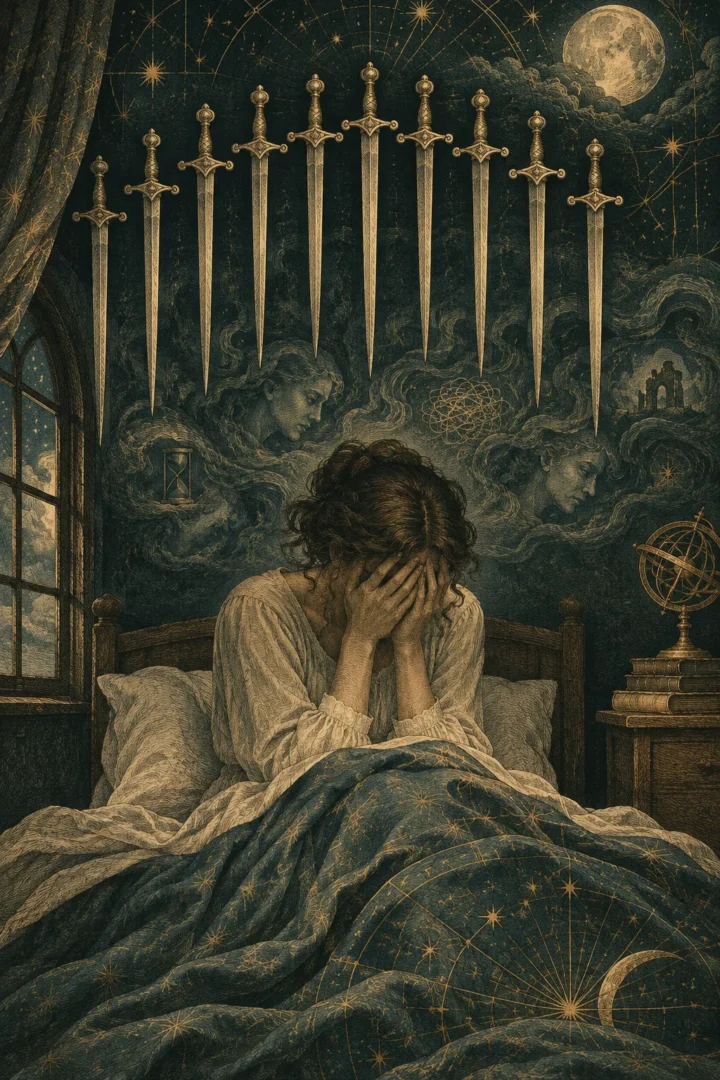 Nine · Nine of Swords
Upright meaning
worry, mental anguish, sleeplessness
Upright, the Nine of Swords reflects distressing thoughts, remorse, or fears that become especially loud in private moments.
- worry
- mental anguish
- sleeplessness
Reversed meaning
seeking help, easing shame, recurring distress
Reversed, this card can describe finding language for a private burden or recognizing that worry is still taking more space than you want.
- seeking help
- easing shame
- recurring distress
Card symbolism
-
The upright figure in bed
A person sits with face covered in their hands, showing the inward nature of distress.
-
Nine swords on the dark wall
The blades hover in the upper picture without touching the figure, placing thought and fear at the center.
-
The patterned quilt
A colorful covering contrasts with the dark wall, reminding us that the person exists within a world larger than the moment of anguish.
In depth interpretation
A person sits upright in bed with their face buried in their hands. Nine swords line the dark wall above. The room is quiet, but the image feels full of thoughts that will not let anyone rest.
The Nine of Swords symbolizes worry, anguish, guilt, troubled sleep, and the painful stories the mind can repeat in isolation. Upright, it draws attention to distress that deserves care. Reversed, it may describe the beginning of relief or an old worry that still needs support.
The card recognizes a familiar experience: a concern that seemed manageable in daylight can become enormous when you are alone with it.
The spiritual meaning: bring the fear into gentler light
The Swords suit speaks of thinking and judgment. At the Nine, thought can turn inward and become severe. You replay something you said, imagine every possible failure, or assign yourself responsibility for things you could never have controlled.
You may recognize the card after a difficult conversation or during a season of uncertainty. It can feel as if each thought calls another, until resting seems impossible.
Its spiritual invitation is compassion. A thought is an experience that deserves attention, but it is not automatically a prediction or a verdict. You can acknowledge fear without requiring yourself to believe its most frightening conclusion.
If your distress is persistent or overwhelming, talking with someone trustworthy or a qualified professional can be an important form of care. Tarot is a reflective practice, not a substitute for that support.
The Nine of Swords image
A person awake in bed
Pamela Colman Smith places the figure in an intimate setting. The face is hidden, so we cannot know whether the person is grieving, ashamed, afraid, or simply exhausted. The card gives those experiences a shared image.
There is no evidence in the picture that a feared event is happening outside the room. The emphasis is on the pain of the moment.
The nine blades overhead
Nine swords run across the dark wall above the bed. They do not pierce the figure. That difference matters when interpreting the image. Mental suffering can be deeply real even when the thoughts themselves do not describe events accurately.
Avoid turning this into a rule that all fears are imaginary. Some worries concern real problems that need practical attention. The card invites you to separate the issue from the extra cruelty of endlessly rehearsing it.
The quilt beneath
The patterned covering adds color and texture to an otherwise severe scene. It can remind a reader that this night belongs to a larger life, including relationships, memories, and resources not visible in the immediate frame.
No single symbolic meaning is established for every motif on the quilt. Its contrast with the dark wall is enough to deepen the reading.
Nine of Swords upright: when the mind will not rest
Upright, the card often appears when worry, regret, or private distress has become exhausting. Perhaps you have made a mistake and are imagining that it will define your future. Perhaps uncertainty about a loved one keeps sending your thoughts toward the worst outcome.
Imagine sending an important message at work and then interpreting each hour without a reply as evidence that you have failed. The concern may be sincere. The imagined conclusions are not yet facts.
The Nine invites you to return to what you know. If action is needed, choose one grounded step. If nothing can be resolved tonight, consider how to care for yourself while waiting.
You do not need to shame yourself for worrying. An exhausted mind deserves gentleness.
Nine of Swords reversed: when worry starts to loosen
Reversed, the Nine can describe sharing a burden that has been carried alone. A conversation may help you recognize how much fear has shaped your interpretation. You might be ready to ask for help or allow yourself to rest before having every answer.
It can also show that the cycle is continuing. You may feel ashamed of still being worried, which adds another layer of distress.
Waite’s reversed meanings include suspicion, shame, and fear. Many contemporary readers also use the reversal to describe recovery. The difference between those readings depends on the question and surrounding cards.
A card’s direction does not determine the course of your emotional health. Support and circumstances matter.
The Nine of Swords in love and relationships
In love, the Nine can reflect fear of rejection, regret over a conversation, or worry about the future of a relationship. It is especially relevant when you are trying to interpret someone else’s silence.
It does not establish that a partner is cheating or planning to leave. Before relying on a feared explanation, notice what has actually happened and what remains unknown.
Reversed, you might be ready to speak honestly about what has been weighing on you. If the relationship is safe, a gentle conversation can be more useful than another night spent trying to decode every message.
The Two of Swords holds a choice in suspension. The Nine shows the private emotional cost of a mind that keeps circling the question.
Career, study, and money
At work or school, the Nine may reflect pressure around performance, responsibility, or an uncertain result. It does not predict failure. It asks whether a concern has taken over your rest and attention.
For money matters, distinguish the problem you can measure from the fears that grow around it. A budget, conversation, or informed plan may offer a useful starting point.
Reversed, begin with the support available now. You do not have to solve a large problem alone if there are people equipped to help.
How to read the Nine without turning fear into a prediction
When the Nine appears in a future or outcome position, a frightening interpretation is tempting. Yet the image depicts a person’s present anguish, with swords hanging above rather than striking the figure. It often prompts a question about how worry will be handled, rather than a claim that the worst fear will come true.
Suppose you are waiting for results from an important application. The Nine in an obstacle position may describe the spiraling thought that you have already failed. Paired with the Ace of Swords, the reading invites a clearer separation of known facts from guesses. With the Four of Swords as advice, it emphasizes finding an interval in which you are not required to solve the problem.
Sometimes a real problem is present and needs action. The Nine asks that the action come from what is true and available, while the parts beyond your control receive gentleness. A spread is most useful when it helps you ask for support instead of turning uncertainty into another punishment.
Worked reading: why can I not stop replaying that conversation?
Imagine a difficult meeting in which you spoke sharply. You draw the Nine of Swords for what is happening now, Justice for what needs acknowledgment, and Four of Swords for the next step.
The Nine describes the mental replay. Justice asks you to assess your conduct fairly, including your own responsibility and the limits of it. The Four suggests that rest is part of responding wisely.
Together, the cards may invite one sincere apology if it is warranted, followed by a decision to stop rehearsing every possible reaction. If an apology is not appropriate, a clearer understanding of the event may be enough.
With The Star in place of Justice, the emphasis could shift toward self-compassion and the rebuilding of hope after a difficult period.
Despair and Cruelty in the Golden Dawn
The Golden Dawn titles this card the Lord of Despair and Cruelty and associates it with Mars in Gemini. Waite’s description is stark, and Smith’s night scene gives distress a deeply human form.
Today, readers often describe rumination or negative self-talk. Those ideas can help interpret the card, but no tarot image is a clinical assessment or a diagnosis.
Nine of Swords as advice: answer the thought kindly
Write down one thought that has been keeping you awake. Beneath it, write what is known, what is feared, and what support would help.
If it suits your practice, place the card face down before resting, as a small symbol that you are allowed to set the question aside for now. The gesture is a personal reminder rather than a promise of relief.
Frequently asked questions
Is the Nine of Swords a yes or no card?
It usually advises against making an important decision from a place of panic or exhausted worry. That is a suggestion to seek steadier ground, not a prediction of disaster.
Does the Nine of Swords predict bad news?
No. It can reflect fear of bad news, but it does not establish that an event will happen.
Does the Nine of Swords always mean insomnia?
No. Its imagery is often associated with sleeplessness, but the theme also includes guilt, dread, and private emotional distress.
What does reversed mean for anxiety?
It may point toward seeking support, a shift in perspective, or worry that remains difficult. Tarot cannot evaluate anxiety or predict recovery.
How is the Nine of Swords different from the Eight?
The Eight of Swords focuses on constraints and the difficulty of seeing options. The Nine turns toward the personal experience of anguish, especially when thoughts become overwhelming.
Tradition note: The interpretation draws on Pamela Colman Smith’s Rider-Waite-Smith night scene, Waite’s severe meanings, and the Golden Dawn’s Despair and Cruelty. The reflective guidance is contemporary and does not replace medical or mental health care.

Keep reading
Explore the Swords
Every card page names the tradition behind each meaning, so you can compare readings instead of taking one as fixed.
Cards to explore alongside this one
Their symbols reveal useful similarities and differences for your next reading.

The Moon
intuition, dreams, mystery, imagination

The Star
hope, inspiration, trust, renewal
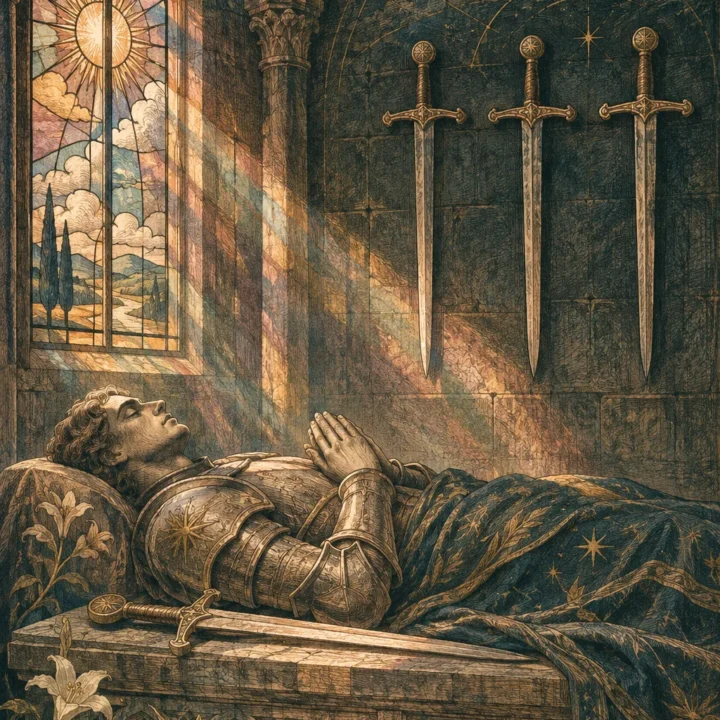
Four of Swords
rest, retreat, contemplation, recovery
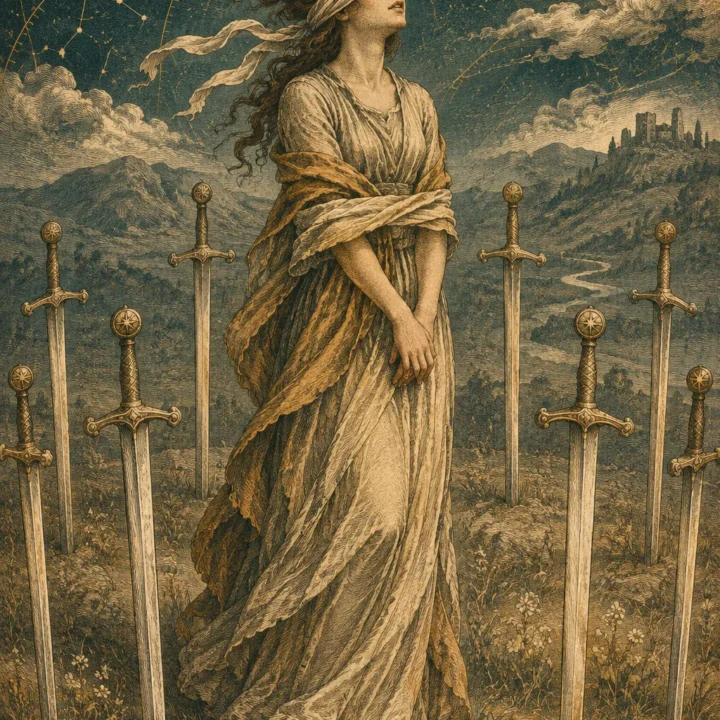
Eight of Swords
restriction, feeling trapped, uncertainty, limited options
Sources and further reading
- A. E. Waite, The Pictorial Key to the Tarot, Part III (Swords, Nine of Swords) Read the text
- Golden Dawn, Book T, tarot titles, attributions, and card descriptions Read the text
- The Morgan Library & Museum, Pamela Colman Smith and her tarot art Read the text
- Victoria and Albert Museum, A History of Tarot Cards Read the text