Three of Swords Tarot Card Meaning
Three swords pierce a heart beneath a rainy sky. The Three of Swords explores grief, painful truths, and the gentler work of making room for healing.
- heartbreak
- grief
- separation
- painful truth
- sadness
Card at a glance
- Number
- Three
- Element
- Air
- Astrology
- Lord of Sorrow; Saturn in Libra (Golden Dawn)
- Keywords
- heartbreak, grief, separation, painful truth, sadness, emotional honesty
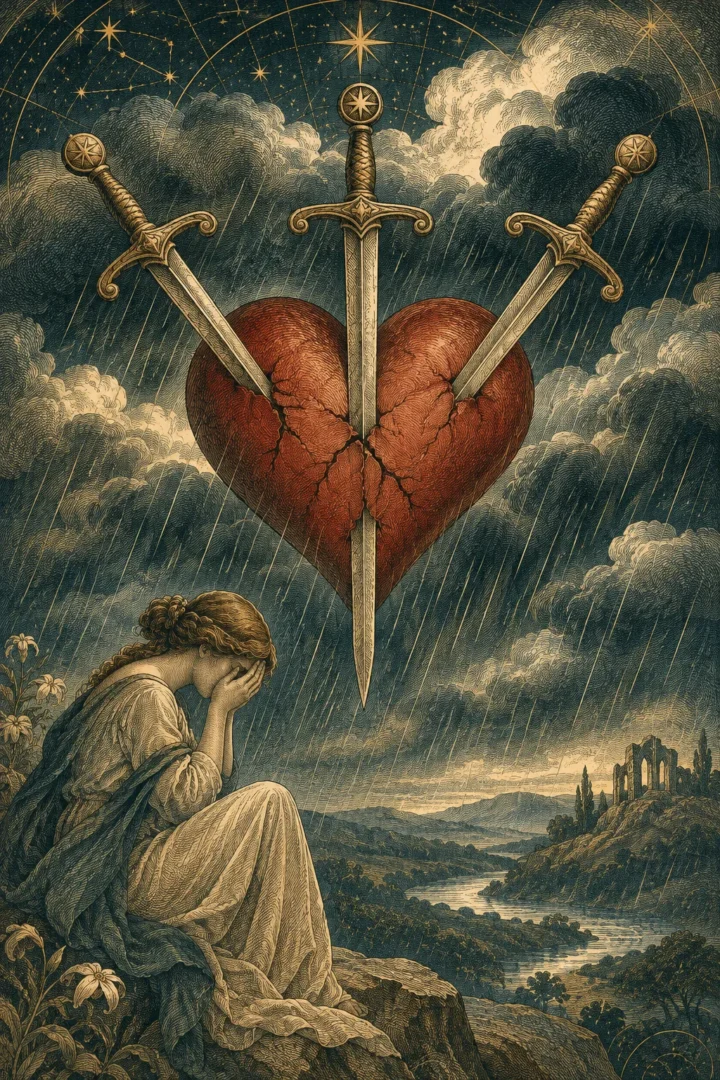 Three · Three of Swords
Upright meaning
heartbreak, sorrow, painful truth
Upright, the Three of Swords names genuine hurt, separation, or a truth that carries grief. It asks for acknowledgment before the next decision.
- heartbreak
- sorrow
- painful truth
Reversed meaning
healing, unresolved grief, difficult forgiveness
Reversed, this card can suggest grief beginning to soften or an old hurt that needs attention. Healing is not a deadline and forgiveness cannot be demanded.
- healing
- unresolved grief
- difficult forgiveness
Card symbolism
-
Three blades through one heart
Smith renders emotional pain as a direct image, without a person or narrative to assign blame.
-
Rain and dark clouds
The weather makes sorrow visible as an atmosphere surrounding the heart.
-
No visible ground
The disembodied heart concentrates attention on an experience of pain rather than a particular event.
In depth interpretation
A red heart hangs against a heavy sky. Three swords pass through it, and rain falls from the clouds behind. There is no person to explain the wound, no scene to tell you who caused it. The image asks you to recognize sorrow before you try to make a story about it.
The Three of Swords signifies heartbreak, painful truth, loss, separation, and grief. Upright, it often appears when hurt deserves to be acknowledged. Reversed, it can suggest the uneven process of healing or an old pain that has not been given much space.
The card does not announce that someone will betray you. It asks what is already hurting, what you know about it, and what kind of care would help you meet it.
The spiritual meaning: a heart that can tell the truth
Not every important realization feels liberating. Sometimes the words you have finally found are painful. You understand that a friendship has changed, that a hope has ended, or that you have been lonely even while keeping busy.
Swords speak of thought and truth. The heart belongs to a different language, one of affection and vulnerability. In Smith’s image, the two meet without protection. A truth has consequences for the feeling life.
This card encourages you to respect those consequences. There is no spiritual virtue in pretending a loss does not matter. If you have been disappointed, you are allowed to be disappointed. If you have been hurt, you do not need to demonstrate that you are already beyond it.
The Three is often called a heartbreak card. Its reach includes grief for a move, a career dream, a family change, or any meaningful possibility you must release.
What the Three of Swords image reveals
Three swords and one heart
Smith reduces the scene to a single heart pierced by three blades. The simplicity matters. There is no villain in the image and no evidence of a specific betrayal. Readers sometimes associate three swords with a love triangle, but the number alone does not establish another person.
The blades may symbolize separate experiences of hurt, or the way one painful truth can affect several parts of life. In a reading, ask what each sword brings to mind rather than imposing a fixed count.
Rain and cloud
Dark clouds fill the sky as rain falls behind the heart. The weather surrounds the wound. You might read the rain as the release of tears or as an environment that makes it difficult to see beyond present sorrow.
The clouded sky is not a promise that you will feel better tomorrow. It offers a way to name the season without assuming it will define you forever.
Why no person appears
The absence of a figure leaves the reader free to recognize their own experience. It also discourages certainty about who is responsible. Tarot can illuminate emotional patterns, but it cannot investigate events or establish guilt.
If you are tempted to read the card as proof that someone has lied, return to what you actually know.
Three of Swords upright: let the hurt have a name
Upright, the card points toward sadness that has entered your life or toward a difficult truth you need to face. You might be grieving a breakup, processing a painful conversation, or accepting that a plan you invested in will not unfold as expected.
Imagine preparing for years to join a particular creative program, then receiving a rejection. Friends immediately encourage you to apply somewhere else. Their advice may eventually help. The Three of Swords is the part of the story where you first need permission to feel the loss.
The card asks you to notice what is being mourned. Sometimes the lost thing is not a person or opportunity itself, but the future you imagined around it.
Clarity and grief can exist together. The Ace of Swords may help you name what happened, while the Three reminds you that understanding does not erase feeling.
Three of Swords reversed: healing is rarely a straight line
Reversed, the Three can suggest a wound becoming less raw. You may be finding language for an experience that once felt unspeakable. You might be ready to place a memory in a wider story of your life.
It can also describe pain pushed aside too quickly. Perhaps you have told everyone that an ending was for the best, but you still feel its absence when life grows quiet.
Many contemporary readers connect the reversal with forgiveness. Forgiveness can be meaningful when freely chosen. Nothing in the card requires you to reconcile with someone who harmed you or to abandon a necessary boundary.
Ask what would help you live more gently with this experience today. Healing may involve conversation, solitude, support, or the simple passage of time.
Three of Swords with other cards: what has actually been wounded?
The three blades often tempt readers to invent a third person in a relationship. Smith’s picture gives no such evidence. In an obstacle position, the card might identify an unspoken hurt that makes every new conversation difficult. As advice, it could ask you to acknowledge a disappointment before offering a solution. As an outcome, it raises the possibility of emotional pain that the questioner may need to consider honestly.
Pair the Three with the Five of Cups and the reading may focus on mourning what was lost while overlooking what remains. With the Five of Swords, the story is more likely to involve words or conflict that have caused harm. With the Star, healing becomes a meaningful next question.
The differences keep you from treating the heart as a universal announcement of betrayal. A useful reading begins by finding out whose feelings are being explored and which events, if any, are known.
Three of Swords in love and relationships
In love, this card can reflect disappointment, distance, an argument that wounded trust, or the grief of separation. It does not automatically mean infidelity or a permanent breakup.
If you are considering whether to stay, explore what actually happened, whether both people can take responsibility, and whether the relationship is safe. The cards do not replace those conversations and observations.
In a feelings position, the Three may represent sadness, disappointment, or fear of being hurt. It cannot tell you what another person secretly feels. If the reading concerns your own heart, it may invite a more direct acknowledgment of your needs.
Reversed, you could be rebuilding trust through consistent action or deciding that peace requires distance. Both deserve a reading shaped by context.
Work, friendship, and other losses
A painful project ending, exclusion from a group, or disappointment in a colleague can carry its own form of heartbreak. The Three gives those experiences room without equating all kinds of hurt.
At work, distinguish the emotional impact from the practical next step. If an opportunity disappears, you might first need a day to absorb the news, then request useful feedback or explore other options.
With money, the card may reflect regret or stress around a loss. It should not be used to predict a financial disaster. Let real documents and advice guide the numbers.
Worked reading: why am I finding this ending so hard?
Imagine a friendship that slowly faded. You draw the Three of Swords for what hurts, Six of Cups for what you are holding, and The Star for the care available now.
The Three recognizes the sadness of the changed bond. The Six of Cups points to shared memories and the particular ache of a history you still treasure. The Star invites you to nurture hope and a gentler relationship with yourself.
Together, the cards suggest that you can honor what the friendship meant without needing to recreate every part of it. You might write a letter you never send or speak with someone who understands the loss.
If the Five of Swords appeared instead of the Six of Cups, the reading could shift toward conflict, wounded pride, or the cost of trying to win an argument. A different card gives grief a different shape.
The Golden Dawn’s Lord of Sorrow
In the Golden Dawn’s Book T, the Three of Swords bears the title Lord of Sorrow and is associated with Saturn in Libra. The older esoteric design depicts swords and a rose being cut apart, a different visual language for disruption and grief.
Smith chose an immediately readable heart and storm. Waite’s account includes separation, rupture, and division. Modern readings add the language of emotional processing and recovery. These layers can enrich one another without becoming a single ancient teaching.
Three of Swords as advice: give grief a place
Choose a small, private way to mark what has changed. You might light a candle, write down the hope you are releasing, or speak aloud what you wish had happened. If you prefer, sit quietly with the card and name one thing you still value.
Afterward, ask what would make this week a little more bearable. The answer can be ordinary: a meal with someone kind, a walk, or a break from reminders.
You do not have to turn sorrow into a lesson immediately.
Is the Three of Swords a yes or no card?
The card often advises caution around an option already causing pain or a decision made in the middle of fresh grief. It is not a fixed no to every question. In an outcome position, it calls attention to emotional cost, which you can consider alongside real circumstances.
Frequently asked questions
Does the Three of Swords always mean cheating?
No. The three blades are not evidence of a third person. The card can describe many forms of hurt and separation.
Can the Three of Swords be positive?
It can bring the relief of emotional honesty, especially when you have been minimizing your pain. That does not make the hurt itself desirable.
Does the reversed Three of Swords mean reconciliation?
Sometimes readers understand it that way, but it can just as readily mean recovering apart. Reconciliation depends on both people’s choices.
What is the difference between the Three and Four of Swords?
The Three names the wound. The Four of Swords creates space for quiet recovery after strain. The sequence helps a reader move from recognition toward care.
Tradition note: This interpretation centers Pamela Colman Smith’s Rider-Waite-Smith image, Waite’s divinatory account, and the Golden Dawn’s Lord of Sorrow. Contemporary ideas about healing and emotional needs are offered as practical readings. The image does not establish the cause of a reader’s loss.

Keep reading
Explore the Swords
Every card page names the tradition behind each meaning, so you can compare readings instead of taking one as fixed.
Cards to explore alongside this one
Their symbols reveal useful similarities and differences for your next reading.
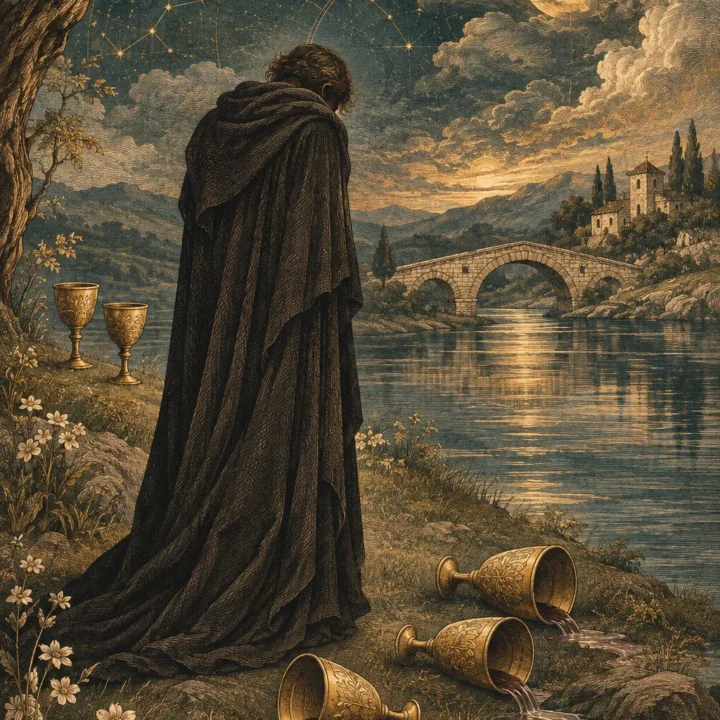
Five of Cups
sadness, loss, disappointment, regret
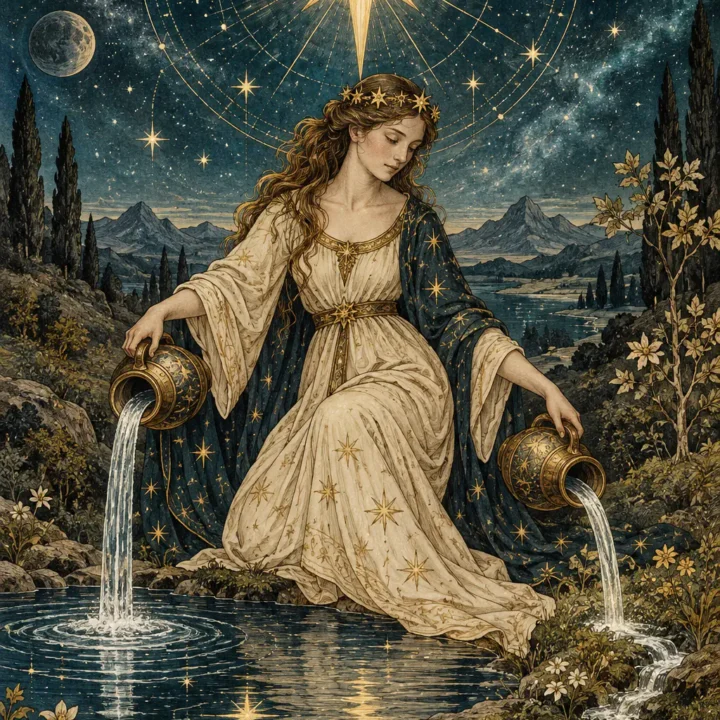
The Star
hope, inspiration, trust, renewal

Nine of Swords
worry, sleeplessness, guilt, painful thoughts
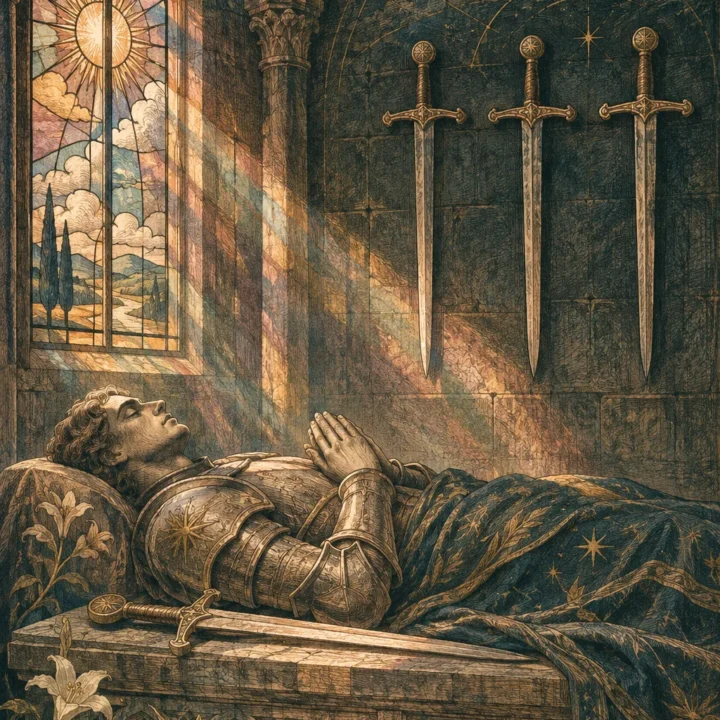
Four of Swords
rest, retreat, contemplation, recovery
Sources and further reading
- A. E. Waite, The Pictorial Key to the Tarot, Part III (Swords, Three of Swords) Read the text
- Golden Dawn, Book T, tarot titles, attributions, and card descriptions Read the text
- The Morgan Library & Museum, Pamela Colman Smith and her tarot art Read the text
- Victoria and Albert Museum, A History of Tarot Cards Read the text