Ten of Wands Tarot Card Meaning
A figure carries ten staffs toward a distant town. The Ten of Wands asks how success becomes a burden, and what happens when that weight affects other people.
- burdens
- obligation
- overwork
- success with hidden costs
- oppression
Card at a glance
- Number
- Ten
- Element
- Fire
- Astrology
- Lord of Oppression, Saturn in Sagittarius (Golden Dawn)
- Keywords
- burdens, obligation, overwork, success with hidden costs, oppression, responsibility
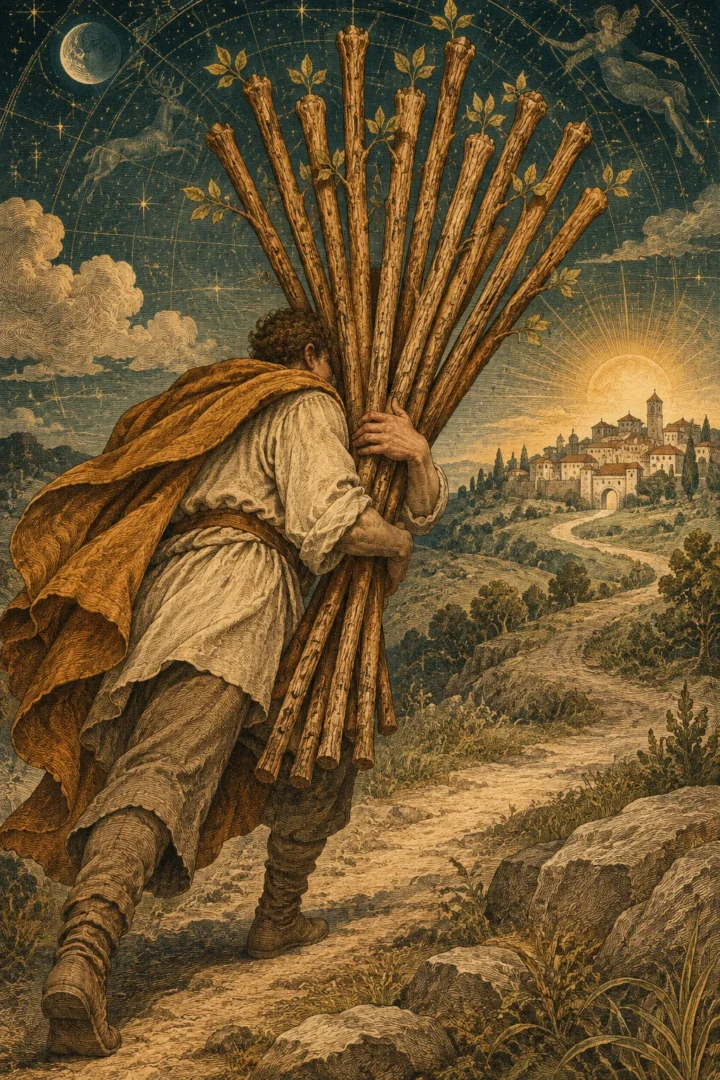 Ten · Ten of Wands
Upright meaning
Burdens, obligation and overwork
Upright, the Ten often appears when responsibilities have accumulated until even meaningful work feels oppressive. You may be meeting expectations, caring for others, or managing a growing undertaking that has outpaced your time and energy. Imagine opening a small community workshop. At first you enjoy teaching and meeting the people who attend. Then you become responsible for bookings, supplies, cleaning, marketing, and resolving every last-minute problem. The work you loved is still present, but it has become hard to reach. The Ten invites you to see the structure around your effort. Can responsibilities be shared? Have you accepted tasks that belong to someone else? Are expectations clear enough for other people to help? Sometimes the commitment must be completed before major changes are possible. If so, a realistic plan and support may make the final stretch more manageable. The card does not establish how close completion is or insist that you keep going at any cost. Waite's upright account is unusually complex. He linked the Ten with oppression, yet also with wealth, gain, and success whose weight becomes oppressive. The important question is what the achievement has asked you to carry.
- Burdens
- Obligation
- Overwork
- Success with hidden costs
- Oppression
- Responsibility
Reversed meaning
Release or unshared responsibilities and difficulty and intrigue
In contemporary tarot practice, a reversed Ten of Wands often signals letting go, delegating, simplifying, or admitting that you cannot manage everything alone. Some readers interpret the reversal as the opposite problem: a person refuses help and the burden becomes even harder to hold. Waite's reversed meanings are different. He associated the card with contradictions, obstacles, and intrigue. His older interpretation does not specifically promise relief or the successful sharing of responsibilities. This difference matters. Suppose you have finally handed part of a demanding project to an able colleague. A modern reversal focused on release may fit the change. If a project has become tangled in conflicting promises and unclear agreements, Waite's more difficult reversed reading might speak to the situation. A reversed card by itself cannot tell you whether the load will lighten. Look at the surrounding cards and the reality of the commitments involved. The hopeful possibility of putting something down becomes meaningful when there is a practical way to do it.
- Release or unshared responsibilities
- Difficulty and intrigue
Card symbolism
-
Ten staffs gathered in one person's arms
The staffs are long, awkward, and held together in a way that blocks much of the figure's sight.
-
The bent figure
We see the burden through his body.
-
The town ahead, and an overlooked warning
Most modern descriptions treat the town as a destination where the figure will eventually put down his load.
In depth interpretation
A man bends beneath ten long staffs, carrying them all toward a town in the distance. The wood rises in front of his face, hiding much of the road. He is moving forward, but he has gathered so much into his arms that even reaching his destination looks difficult.
The Ten of Wands represents excessive responsibility, the demands of success, and a burden that has become hard to carry. Upright, it often describes the weight of commitments that once felt worthwhile. Reversed, many modern readers see release or delegation, while A. E. Waite's earlier interpretation emphasizes difficulties, contradictions, and intrigue.
The town seems close. Yet the card asks something that has little to do with distance: what happens when you arrive still carrying everything in the same way?
The spiritual meaning: when the gift becomes a burden
There is a strange sadness in reaching something you once wanted and discovering how much of yourself it requires. The project succeeds, so more people depend on you. The home grows, so its responsibilities multiply. Your ability to help becomes the reason everyone asks again.
The Ten of Wands knows this kind of exhaustion. The man is still walking toward the town. He has a destination, a purpose, and perhaps something valuable to deliver. His load makes it difficult to see anything beyond the task immediately in front of him.
You may recognize this card when your sense of duty has begun to crowd out the life that gave your effort meaning. A promise can be made with love and become difficult to sustain. An ambition can be worthy and grow beyond one person's strength.
The deeper invitation of the Ten is to examine what your responsibility has become. Are you carrying an obligation freely, or have you lost the freedom to reconsider it? Has a good intention turned into a pattern that hurts you or the people relying on you?
In this final numbered Wands card, the fire that began with the Ace's living spark has become a heavy bundle. The Nine of Wands guards a position after difficulty; the Ten carries so much that the road itself is obscured. The Ten of Cups offers a companion image of fulfillment shared in a home or community. A vision needs a different kind of care when it has grown large enough to affect other lives.
What the symbols in the Ten of Wands reveal
Ten staffs gathered in one person's arms
The staffs are long, awkward, and held together in a way that blocks much of the figure's sight. Their weight is visible through his bent posture.
Every staff could stand for a responsibility: a deadline, a promise, a person to care for, a project, a household need. You might choose all of them for good reasons. Collected together, they create a problem that cannot be solved by enthusiasm alone.
The image also gives us a practical question. Which of these staffs must remain together, and which could be carried by someone else? This is an interpretive exercise, not a fixed symbolic assignment for each piece of wood.
The bent figure
We see the burden through his body. He leans into the journey and gives most of his attention to keeping the bundle under control. There is no one walking beside him to share it.
A reading may turn here toward the cost of being indispensable. Perhaps you have learned to be proud of managing everything. Yet the card can ask whether that pride has prevented you from seeing what support is available.
If the image evokes your own exhaustion, you do not need to turn that recognition into another demand to improve yourself immediately. It can be enough to name what has become too heavy.
The town ahead, and an overlooked warning
Most modern descriptions treat the town as a destination where the figure will eventually put down his load. That is a plausible interpretation of Smith's picture, but Waite gives the town a more unsettling role.
In The Pictorial Key to the Tarot, he suggests that the place the figure approaches could itself suffer from the staffs he carries. This is a striking detail. The burden may affect the people waiting at the destination, as well as the person who carries it.
Consider a leader who brings an ambitious project to completion by asking the same exhausted colleagues to absorb every new demand. The project may succeed publicly while leaving the group depleted. Read this way, the Ten asks what kind of success you are delivering and who will bear its costs.
That is a thoughtful application of Waite's unusual warning. It is not a prophecy that the town or anyone around you will come to harm.
Ten of Wands upright meaning: carrying the cost of success
Upright, the Ten often appears when responsibilities have accumulated until even meaningful work feels oppressive. You may be meeting expectations, caring for others, or managing a growing undertaking that has outpaced your time and energy.
Imagine opening a small community workshop. At first you enjoy teaching and meeting the people who attend. Then you become responsible for bookings, supplies, cleaning, marketing, and resolving every last-minute problem. The work you loved is still present, but it has become hard to reach.
The Ten invites you to see the structure around your effort. Can responsibilities be shared? Have you accepted tasks that belong to someone else? Are expectations clear enough for other people to help?
Sometimes the commitment must be completed before major changes are possible. If so, a realistic plan and support may make the final stretch more manageable. The card does not establish how close completion is or insist that you keep going at any cost.
Waite's upright account is unusually complex. He linked the Ten with oppression, yet also with wealth, gain, and success whose weight becomes oppressive. The important question is what the achievement has asked you to carry.
Ten of Wands reversed meaning: release or more complications?
In contemporary tarot practice, a reversed Ten of Wands often signals letting go, delegating, simplifying, or admitting that you cannot manage everything alone. Some readers interpret the reversal as the opposite problem: a person refuses help and the burden becomes even harder to hold.
Waite's reversed meanings are different. He associated the card with contradictions, obstacles, and intrigue. His older interpretation does not specifically promise relief or the successful sharing of responsibilities.
This difference matters. Suppose you have finally handed part of a demanding project to an able colleague. A modern reversal focused on release may fit the change. If a project has become tangled in conflicting promises and unclear agreements, Waite's more difficult reversed reading might speak to the situation.
A reversed card by itself cannot tell you whether the load will lighten. Look at the surrounding cards and the reality of the commitments involved. The hopeful possibility of putting something down becomes meaningful when there is a practical way to do it.
Can the Ten of Wands mean success?
Yes. The Ten of Wands can represent success that has created obligations or reduced your freedom. That paradox comes directly from Waite's historical interpretation and is visible in the Rider-Waite-Smith scene: the figure appears to be delivering a substantial load, but he is bent under it.
This makes the card particularly useful in questions about a promotion, a growing business, a household, or a major goal. An opportunity may look impressive while placing too much responsibility on one person.
To interpret the card, ask what has been achieved, how the achievement is maintained, and whose life is affected. The Ten can call attention to the difference between reaching a goal and creating a way to live with the result.
Its message may be surprisingly compassionate: the worth of an accomplishment does not require you to remain crushed beneath it.
Ten of Wands in love and relationships
In love, the Ten of Wands often appears when daily obligations leave little room for closeness. Work, caregiving, children, or household needs have taken over the space where a couple once rested together.
Sometimes one partner has become the person who remembers everything: appointments, supplies, family plans, conversations that need to happen. The load is not always visible to the other person. The Ten may invite a discussion about the work of keeping a shared life running.
If you are dating, the card can reflect a season when you have very little capacity for another commitment. There is value in being honest about what you can offer.
Reversed, a modern reading may suggest redistributing responsibilities. A historically informed reading may point toward disagreements or complications around those obligations. In either case, a relationship needs mutual care to become more sustainable.
Ten of Wands as feelings
As feelings, the Ten can symbolize emotional weight or someone preoccupied by obligations. It cannot establish that a particular person secretly wants a relationship but is simply too busy to show it. Their actual availability and actions are the useful evidence.
Ten of Wands for career and money
At work, the Ten is especially revealing when success has led to more demands without enough support. Perhaps your responsibilities have expanded because you are competent, or a team has grown without changing how decisions are made.
The card encourages you to examine the arrangement rather than judging your worth by how much pressure you can tolerate. What is essential? Who else has the ability or authority to take part? Which commitments need renegotiating?
In money questions, the Ten may reflect several payments, obligations to loved ones, or a costly goal that has become difficult to sustain. Actual figures and agreements matter more than a divinatory answer. The card can help you notice the emotional pressure that surrounds those decisions.
Reversed, watch for competing expectations, a plan to release a burden, or complications that need clearer terms. Practical changes should be based on the situation rather than the card's orientation alone.
The Lord of Oppression: Saturn in Sagittarius
In the Golden Dawn's Book T, the Ten of Wands bears the title Lord of Oppression and corresponds to Saturn in Sagittarius. Its traditional description explores force applied for selfish ends, with generosity and self-sacrifice also possible depending on surrounding dignity.
That is a more morally charged interpretation than the common modern reading of someone who simply has too much work to do. The Golden Dawn's symbolic card design differs from Smith's burdened traveler, so the correspondence should be treated as a related esoteric framework rather than as a literal explanation of every detail in her painting.
Together, the traditions raise a searching spiritual question. When we devote ourselves to a purpose, how do we know whether our effort is still serving it? The answer may be found in the people affected by our choices, including ourselves.
The Ten can be a reminder that fire is most useful when its energy has a wise direction and a place where life can flourish.
Worked tarot reading: should our successful community project expand again?
Imagine a community kitchen that has grown popular. The organizers want to serve more people, but a few volunteers are already doing almost all the work. You draw the Ten of Wands as the present, the Three of Pentacles as advice, and the Six of Pentacles as the question of impact.
The Ten shows the weight of success. Something good has grown, and the people carrying it are stretched. The Three of Pentacles brings attention to roles, skill, and collaboration. The Six of Pentacles asks how help and resources are shared, including whether the exchange is fair.
Read together, the cards encourage the organizers to examine the structure before increasing the demands. They might ask who can take responsibility for supplies, how volunteers will be supported, and whether growth can be sustained without passing the burden to the people the project was meant to help.
This is where Waite's unusual comment about the destination becomes valuable. The town is part of the story. A successful undertaking should be evaluated through the lives it touches.
If Justice replaced the Six of Pentacles, the reading might focus more strongly on fair agreements and accountability. These combinations do not predict whether expansion will succeed; they illuminate what deserves consideration.
Ten of Wands as advice: see the destination again
Place the card where you can study the town beyond the staffs. Name a responsibility that has grown larger than you expected. Then ask what it originally helped you create, protect, or offer.
Write down the parts of the commitment that still matter. Beside them, note which tasks need to be carried differently. You could ask for support, clarify responsibilities, change a deadline, or make a smaller promise.
Imagine arriving at the town with enough space to look up and recognize the people who live there. What would need to change for that to be possible in your own life?
You may find that the work becomes meaningful again when the weight is shared wisely.
Is the Ten of Wands a yes or no card?
The Ten of Wands suggests caution about taking on additional obligations. It can point toward completing an existing commitment, but asks you to consider what the result will require. Reversed, choose a reading method and assess whether a burden is actually being released or a new complication is emerging. The card does not promise relief or success.
A note on tradition
This article interprets Pamela Colman Smith's Rider-Waite-Smith image, first published in 1909. Waite connected the Ten with both success and oppression, and warned that the destination itself could be affected by the load. His reversal concerns difficulty and intrigue. The Golden Dawn's Book T gives the title Lord of Oppression and the Saturn-in-Sagittarius correspondence. Modern readings commonly emphasize overwork, delegation, and the need to share responsibilities.
Frequently asked questions
What if I cannot put down my responsibilities?
Some duties cannot be handed over today. Choose one task that could be delayed, simplified, or shared, and name the help you would need for the next stretch. The figure still has a destination; the card can help you see a little of the road around the staffs.
Does the Ten of Wands mean the end is near?
The town in Smith's image suggests a destination, and many readers understand the card as an approaching completion. The picture gives no timetable or guarantee that a burden will disappear on arrival.
Why does Waite say the town might suffer?
He suggests that the place the figure is approaching could be harmed by the staffs being carried. This allows a reading about responsibilities affecting a wider community, not just exhausting the person who holds them. It is a possibility in his historical text, not a prediction of harm.
What is the difference between the Nine and Ten of Wands?
The Nine depicts a guarded person anticipating opposition. The Ten shows a person already burdened by responsibilities. One directs attention to readiness, trust, and the fear of another challenge; the other to accumulated obligations and their consequences.

Keep reading
Explore the Wands
Every card page names the tradition behind each meaning, so you can compare readings instead of taking one as fixed.
Cards to explore alongside this one
Their symbols reveal useful similarities and differences for your next reading.
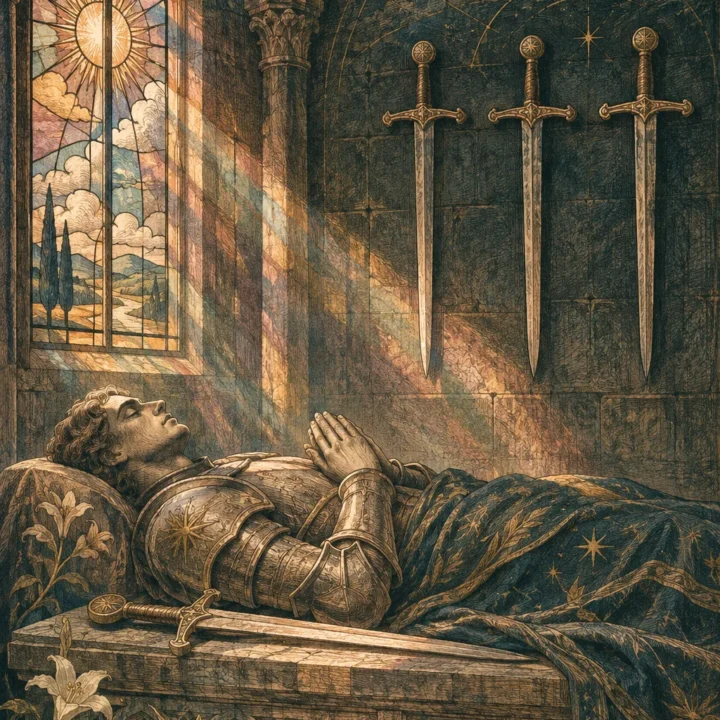
Four of Swords
rest, retreat, contemplation, recovery
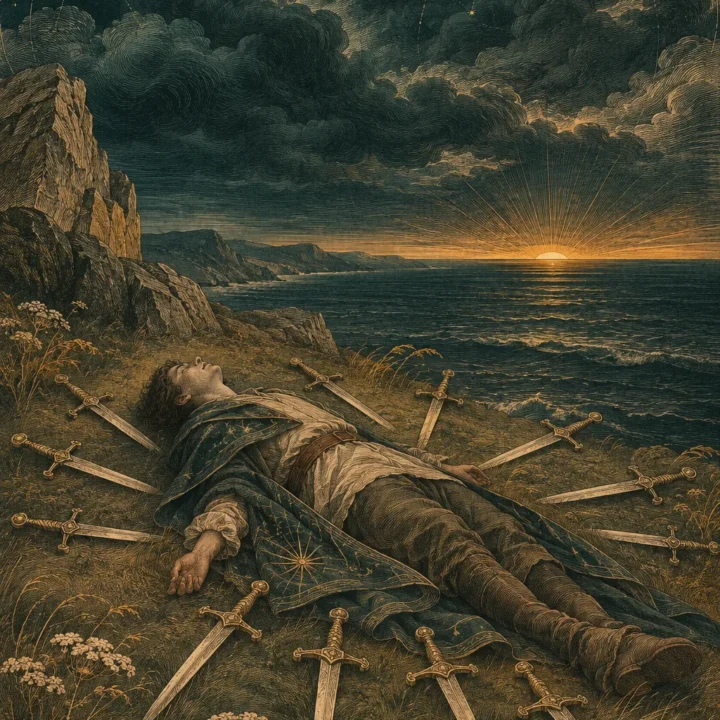
Ten of Swords
painful ending, finality, collapse, release

Eight of Pentacles
diligence, learning, craft, deliberate practice
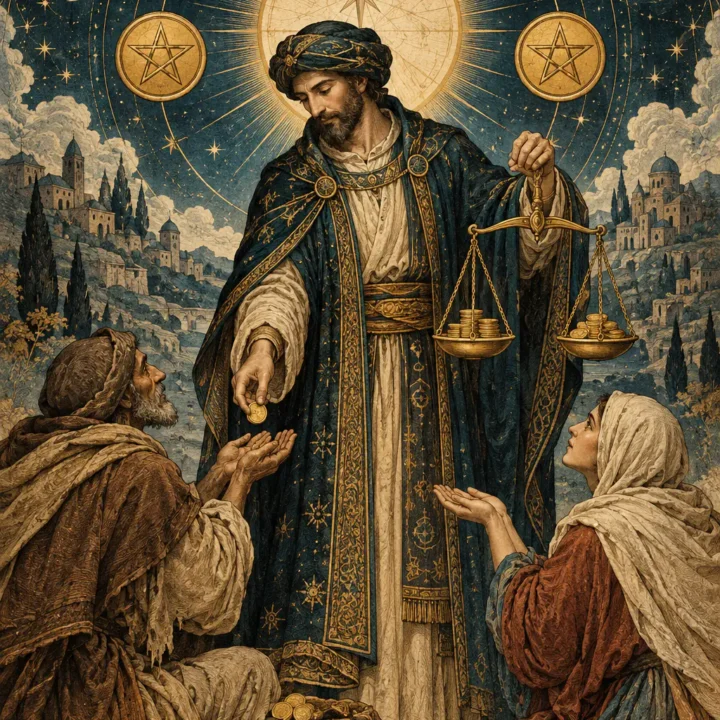
Six of Pentacles
generosity, assistance, reciprocity, shared resources
Sources and further reading
- A. E. Waite, The Pictorial Key to the Tarot, Part III, Ten of Wands Read the text
- Golden Dawn, Book T, Lord of Oppression, Saturn in Sagittarius Read the text
- The Morgan Library & Museum, Pamela Colman Smith and the 1909 tarot Read the text
- Labyrinthos, Ten of Wands, contemporary reading baseline Read the text