
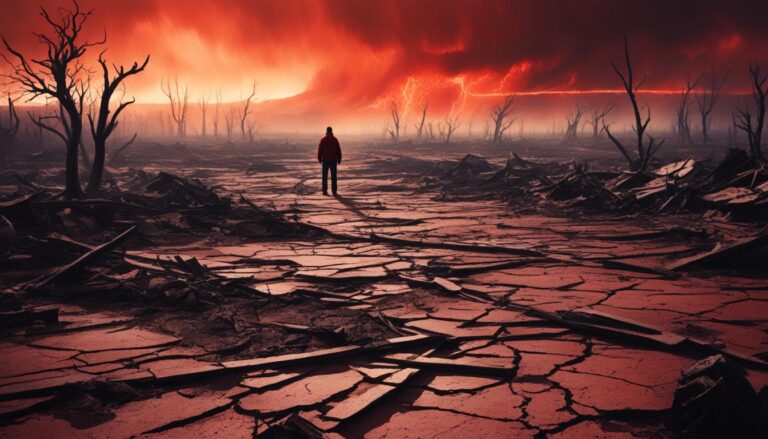
What Does a Dream About the World Ending Mean?
Quick answer
Dreams about the world ending almost always reflect a major transition in your waking life rather than literal catastrophe. Your mind is processing the collapse of something familiar — a relationship, a role, a belief — and using apocalyptic imagery because that is how big emotional change feels from the inside. Pay attention to the emotion you carry out of the dream: terror signals resistance to the change, awe signals recognition of its scale, and calm often means you have already begun to accept what is coming. The world ending in a dream typically means your world is shifting — and how you feel about that is the real message.
Had a different dream? Describe it and get a reading.
Interpret my dream →Why This Dream Sticks
End-of-world dreams belong to a category psychologists call high-arousal dreams — vivid, emotionally intense, and hard to shake after waking. Several things explain why they linger:
- The imagery activates the amygdala strongly, flagging the experience as significant and strengthening its encoding in memory.
- Apocalyptic themes carry collective weight from film, religion, and news, giving your mind a ready-made visual language for feelings of overwhelm or helplessness.
- These dreams often arise during life thresholds — job loss, a breakup, a child leaving home, a move — when your nervous system recognizes that a chapter is closing for good.
- The helplessness common in the dream mirrors real feelings of being unable to control an outcome you care about.
End-of-world dreams are worth writing down immediately on waking. The emotional tone — terror versus awe versus calm acceptance — carries as much meaning as the imagery itself, a distinction this article returns to throughout.
What the Common Variations Mean
| Dream Variation | What It Tends to Reflect |
|---|---|
| Asteroid or meteor impact | A sudden, external force you feel powerless against — an unexpected firing, a diagnosis, news that changes everything at once |
| Slow flooding or rising water | Gradual emotional overwhelm; a situation that has been building quietly and now feels unavoidable |
| Nuclear blast or war | Deep conflict — either in a close relationship or an internal war between two parts of yourself pulling in opposite directions |
| The world ends but you survive alone | Isolation anxiety or a fear that change will leave you without your support structure; also common in caregivers facing burnout |
| You watch calmly as it happens | Psychological readiness for a transformation you have already begun to accept; the ending feels necessary rather than threatening |
| Trying to warn others who ignore you | Feeling unheard in waking life — at work, in a relationship, or within a group where your concerns are dismissed |
| The end happens and then life continues differently | A hopeful signal: your mind is rehearsing what comes after the change, not just grieving the loss |
| You cause the ending | Guilt or responsibility anxiety; a fear that your choices or inaction are harming something or someone you value |
For a deeper look at how water functions in these scenarios, see our guide to flood dream meaning.
What This Dream Is Not
- Not a prediction. Dreams do not forecast literal events. The brain uses dramatic imagery as shorthand for emotion, not as prophecy.
- Not a sign something is wrong with you. End-of-world dreams are among the most frequently reported dreams across cultures and age groups. Having one does not indicate unusual anxiety or psychological instability.
- Not necessarily negative. Many people report feeling strangely peaceful during or after these dreams. If that was your experience, it often signals readiness for change rather than fear of it.
- Not always about something large. The dream can attach to transitions that feel ordinary from the outside but are emotionally significant to you — changing routines, ending a friendship, finishing a long project.
This content is for reflective purposes only and is not a substitute for professional mental health support.
A Short Practice
When you wake from this dream, before reaching for your phone, take two or three minutes to sit with it. Ask yourself one question: What in my waking life right now feels like it cannot survive in its current form? Write a single honest sentence in response — not an essay, just one sentence. That sentence is almost always closer to the dream’s meaning than any symbol dictionary.
If the same dream returns across several nights, map the emotion rather than the imagery. Note whether the feeling is grief, relief, terror, or awe. That distinction will tell you whether your mind is resisting the change or beginning to accept it. The questions in our dream interpretation guide can help you work through this systematically.
You may also find it useful to compare notes with our guide to falling dream meaning, which shares the same root theme of losing ground beneath you.
Frequently Asked Questions
Why do end-of-world dreams feel so real?
These dreams tend to occur during REM sleep when your brain’s visual and emotional processing centers are highly active but your prefrontal cortex — responsible for reality-checking — is quiet. The result is that the scenario feels completely credible while it is happening. High emotional stakes also cause your brain to consolidate the memory more firmly, which is why the images stay with you through the morning rather than fading the way most dreams do.
Is it common to have this dream more than once?
Yes. Recurring end-of-world dreams usually indicate that the underlying waking situation has not yet resolved or been emotionally processed. Rather than trying to stop the dream, look at what in your life is still in transition. Most people find that once the change is completed — or once they accept it — the dream stops on its own. Explore the full dream library to cross-reference other recurring themes that often appear alongside this one.
Should I be worried if I enjoy these dreams?
No. Enjoying an apocalyptic dream is more common than most people admit, and it does not indicate a destructive impulse. It often reflects a healthy desire for release or radical simplification — a part of you that is ready to let something go and start fresh. Pay attention to what you feel free from in the dream, because that is likely what you need to release in waking life.
Author

Before you read a fixed meaning, ask:
What happened — the central image or event, in one plain sentence.
How it happened — calm or violent, easy or forced, sudden or slow.
Who was watching — alone, one person, or a crowd.
Those three usually matter more than the symbol name alone.
Meanings reflect widely shared symbolism; your own context comes first.
Explore the next dream


Dreams are not medical, legal, or financial advice. The Dream Symbolist offers symbolic interpretation to support reflection, not diagnosis.