
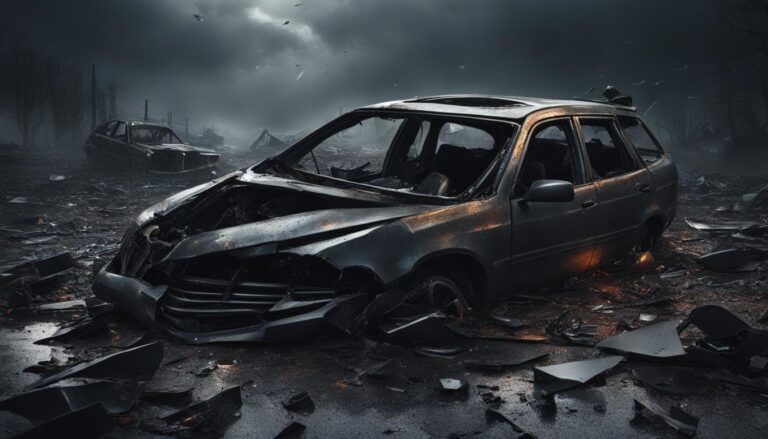
What Do Dreams About Car Crashes Mean?
Quick answer
Dreams about car crashes almost always signal a loss of control — over a decision, a relationship, or the pace of your own life. They rarely predict anything. Instead, they surface when part of you feels that something is moving too fast, is out of your hands, or is headed toward a collision you can see coming but cannot stop.
Had a different dream? Describe it and get a reading.
Interpret my dream →Why this dream sticks
Car crash dreams land hard because the imagery maps directly onto how the nervous system reads threat. Speed, impact, and loss of steering are physical metaphors the brain reaches for when waking life feels like it is accelerating beyond your capacity to manage it. The crash itself is rarely the point — it is the moment just before impact that carries the meaning: the awareness that control has slipped.
Common triggers include major life transitions (a new job, a move, the end of a relationship), chronic overcommitment, or a decision you have been postponing. The dream often intensifies when you are publicly responsible for outcomes — managing a team, parenting, navigating a crisis — because the car is a near-universal symbol for the self in motion. If you are learning to interpret your dreams more systematically, this is one of the clearest cases where emotional tone matters more than literal imagery.
What the common variations mean
| Variation | What it tends to reflect |
|---|---|
| You are driving and lose control | A waking situation where you feel responsible for an outcome but lack the means to steer it. Often appears during high-stakes decision periods. |
| Someone else is driving and crashes | Anxiety about depending on another person — a boss, partner, or institution — whose judgment you do not fully trust. |
| You are a passenger who cannot intervene | Helplessness in a situation where you have input but not authority. Common in workplace or family dynamics. |
| The crash happens but you survive unharmed | Resilience processing — your mind rehearsing a feared outcome and discovering you come through it. Often a releasing dream rather than a warning. |
| You watch a crash from outside the car | Witnessing someone else’s crisis or poor decision without direct involvement. May reflect guilt about not intervening in waking life. |
| Brakes that will not work | Inability to slow or stop a project, habit, or relationship that is clearly unsustainable. The specific thing you cannot stop is worth identifying. |
| Crash into water | Loss of control colliding with emotional overwhelm. The depth and clarity of the water often mirrors how submerged the feelings feel. See the guide to water dreams for the full range. |
| Crash with a specific person in the car | The relationship with that person is under strain or headed toward a reckoning. The crash represents the conflict, not the person’s literal safety. |
What this dream is not
Car crash dreams are not premonitions. Research on dream content consistently shows that anxiety dreams — including those involving accidents, falls, and confrontations — spike during periods of stress and do not correlate with real-world events. If you dreamed of a crash before a trip and feel afraid to drive, take that fear seriously as a signal of your stress level, not as evidence of future danger.
Recurrent crash dreams are among the most commonly reported anxiety dreams across cultures and age groups. They are part of how the brain processes scenarios it cannot resolve while awake. Working through them with dream analysis is a useful tool for that processing — not a diagnostic category.
This article is not medical or psychological advice. If crash dreams are frequent, vivid, and accompanied by significant daytime distress, speaking with a therapist is the right next step.
A short practice
Within a few minutes of waking from this dream, try the following:
- Write down who was in the car and who was driving. This single detail narrows the meaning considerably.
- Name the emotion at the moment of impact — panic, resignation, relief, numbness. The feeling is the interpretation more than the imagery is.
- Ask: what in my waking life right now feels like it is moving faster than I can manage? Write the first thing that comes up, even if it seems unrelated to driving.
- Notice whether the dream ended in disaster or whether you survived. Surviving a wreck usually signals that your mind has already begun working through the fear rather than being stuck inside it.
You do not need to resolve the dream — you need to let it point you toward the waking question it is carrying. The guide to falling dreams covers the same loss-of-control territory from a different angle and pairs well with this one.
FAQ
Why do I keep having car crash dreams even when life feels stable?
Recurrent crash dreams during calm periods often point to something unresolved beneath the surface — a decision you made months ago that you are not sure about, a relationship dynamic you have adapted to rather than addressed, or a long-running habit of overextension. Stability in circumstances does not always mean stability in how you feel about them. The dream surfaces when the gap between the two widens.
Does it matter whether the crash is my fault in the dream?
Yes. If the crash is clearly your fault, the dream tends to reflect guilt, self-criticism, or anxiety about a choice you made. If it is caused by external factors — bad weather, another driver, mechanical failure — it is more likely about circumstances beyond your control. If fault is ambiguous, that ambiguity is usually the point: you are not sure how much responsibility you carry for something in waking life.
How is a car crash dream different from one I had as a child?
Childhood crash dreams are more often rooted in specific fears absorbed from adults — parental anxiety about driving, a real accident witnessed or overheard, or the general powerlessness of being carried through the world in vehicles controlled by others. Adult crash dreams tend to be self-referential: the car represents your life, career, body, or plans. If you are revisiting a crash dream that started in childhood, it is worth asking whether the original fear was ever named and addressed, or whether it has migrated into a present-day parallel situation.
Author

Before you read a fixed meaning, ask:
What happened — the central image or event, in one plain sentence.
How it happened — calm or violent, easy or forced, sudden or slow.
Who was watching — alone, one person, or a crowd.
Those three usually matter more than the symbol name alone.
Meanings reflect widely shared symbolism; your own context comes first.
Explore the next dream


Dreams are not medical, legal, or financial advice. The Dream Symbolist offers symbolic interpretation to support reflection, not diagnosis.