Six of Swords Tarot Card Meaning
A small boat carries travelers across the water with six swords aboard. The Six of Swords speaks of transition, help, and the gradual courage of moving onward.
- transition
- moving on
- passage
- recovery
- leaving difficulty
Card at a glance
- Number
- Six
- Element
- Air
- Astrology
- Lord of Earned Success; Mercury in Aquarius (Golden Dawn)
- Keywords
- transition, moving on, passage, recovery, leaving difficulty, support
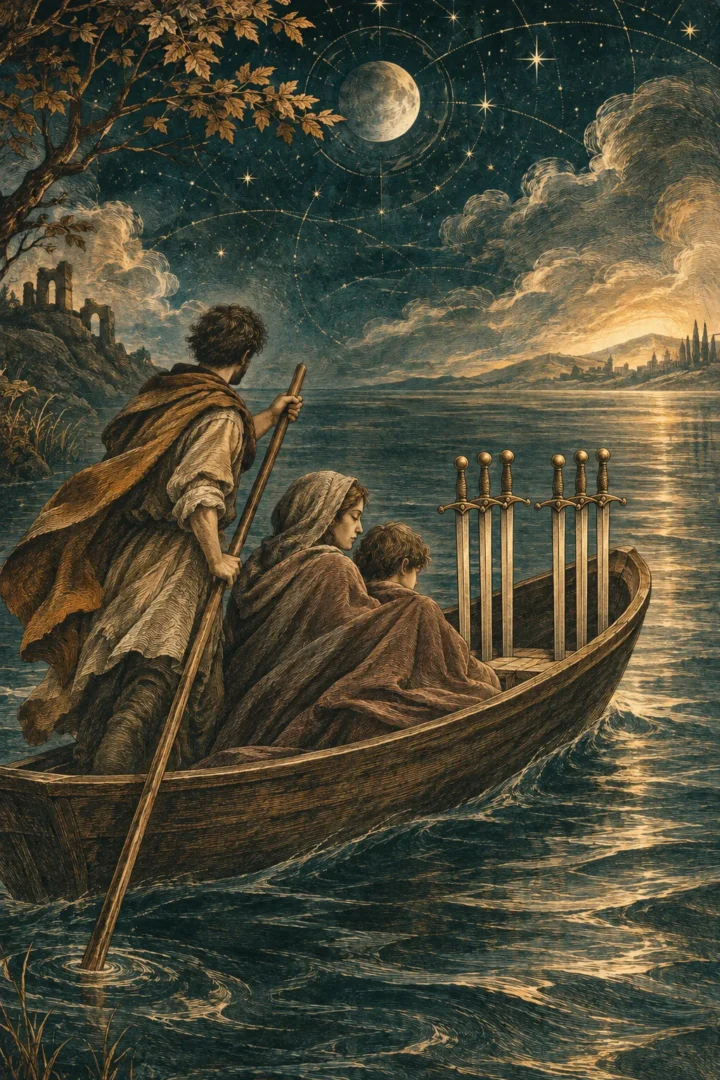 Six · Six of Swords
Upright meaning
transition, passage, gradual recovery
Upright, the Six of Swords describes moving away from a difficult situation with the help, knowledge, or support needed to make the passage.
- transition
- passage
- gradual recovery
Reversed meaning
delayed transition, unfinished business, difficulty leaving
Reversed, the Six may describe a transition that is stalled, a return to an unresolved question, or reluctance to accept the uncertainty of moving on.
- delayed transition
- unfinished business
- difficulty leaving
Card symbolism
-
The boat and ferryman
A standing figure poles a narrow boat across the water, making passage a shared effort.
-
The cloaked adult and child
Two seated passengers travel with bowed heads, suggesting vulnerability and a need for care.
-
The six upright swords
The blades travel with the passengers, showing that changing circumstances does not instantly erase what has happened.
In depth interpretation
A small boat moves across a stretch of water. One person guides it with a pole while two others sit quietly beneath a cloak. Six swords stand upright in the boat beside them. The travelers have left one shore, and the far shore is still ahead.
The Six of Swords is a card of transition, moving away from difficulty, gradual recovery, and accepting help along the way. Upright, it suggests passage toward circumstances that may be easier to navigate. Reversed, it can describe a journey that has stalled or unfinished concerns that make leaving complicated.
The image is tender because nobody is pretending the passage will erase the past. They are traveling with what they have lived through.
The spiritual meaning: carrying wisdom into another season
Some changes arrive with celebration. Others begin because remaining where you are has become too painful or exhausting. The Six belongs to the second kind. It is the quiet decision to seek a different shore.
You may be changing jobs after a disappointing experience, rebuilding a daily routine after loss, or creating distance from an argument that has dominated your thoughts. This is often less about dramatic reinvention than about choosing conditions in which you can breathe.
The swords travel with the people. You do not have to resolve every feeling before you move forward. Memories, lessons, and unanswered questions may accompany you for a while.
Notice the ferryman. Even in a solitary spiritual journey, another person’s help can matter. A friend, mentor, counselor, relative, or practical service may make the passage safer.
The symbols of the Six of Swords
The boat, the water, and the two shores
Pamela Colman Smith shows a narrow boat passing between stretches of water. One side appears more disturbed than the other. Many modern readers see a movement from turbulence toward calmer conditions.
A boat makes progress through the work of navigation. The image offers no magical disappearance of difficulty. It invites a practical question: what would help you make a difficult change possible?
The passengers and their guide
A seated adult and child face away from the viewer while a standing figure directs the boat. Their stillness can suggest fatigue, grief, or quiet trust. We do not know their story.
The arrangement allows a compassionate reading about support. If you are always the one rowing for everyone else, perhaps you need help. If you are able to guide someone through change, consider how to do so without taking away their agency.
The swords that come along
The six upright swords are part of the boat’s cargo. They may represent ideas, memories, or ways of thinking that have formed through experience.
Changing a location does not automatically change every pattern. The card asks which lessons are worth carrying and which burdens you may eventually set down.
Six of Swords upright: progress at a human pace
Upright, the card favors a thoughtful departure from something that has become draining. It can indicate travel, relocation, an emotional transition, or choosing a quieter way to respond.
Imagine deciding to leave a demanding job. You still care about colleagues and feel uneasy about uncertainty, but your decision follows months of reflection. You make a plan, ask for references, and give yourself time to recover. This is the Six’s kind of movement.
Progress may feel subdued rather than triumphant. The card allows you to be sad about what you are leaving while knowing that change is necessary.
It can also mean changing your mental relationship to a situation when leaving physically is not possible. You might stop participating in a recurring argument or set a boundary around how much attention a problem receives.
Six of Swords reversed: why is the journey difficult?
Reversed, the Six often describes a transition with obstacles. You might lack the resources to leave yet, feel drawn back to an old conflict, or worry that change will not lead where you hoped.
Another reading is that you have arrived somewhere new but remain unsettled. The practical move has happened; your emotional adjustment is taking longer.
Waite’s reversed meanings include declaration and publicity, which differ from the modern focus on blocked movement. A reversal should be read with the question and surrounding cards in mind.
If you are dealing with an unsafe situation, prioritize an actual safety plan and trustworthy support. The card is a reflective image, not an instruction to leave without preparation.
Six of Swords in love and relationships
In love, the card may indicate taking distance from tension, moving through a difficult period together, or recognizing that a relationship has changed. Sometimes two people are traveling in the same direction; sometimes the movement is toward separation.
If you are single, you may be making peace with an old disappointment and slowly becoming open to a different kind of connection.
Reversed, check whether unresolved conversations are repeatedly pulling you back. The card cannot promise that an ex will return or that a partner will change.
The Eight of Cups emphasizes choosing to leave an emotional situation that no longer fulfills you. The Six of Swords emphasizes the passage, including how you navigate it.
Six of Swords or Eight of Cups: why are you leaving?
The Eight of Cups often depicts a traveler leaving something emotionally familiar in search of deeper fulfillment. The Six of Swords places the emphasis on passage itself: people travel together, and a guide helps carry them across water. One reading might begin with the reason you want to leave; the other can ask what the transition will require.
Picture someone leaving a workplace that no longer matches their values. The Eight of Cups could explore the decision to seek meaning elsewhere. The Six asks about the notice period, the colleagues who can help, the uncertainty at home, and the knowledge the traveler will carry. Drawing both does not guarantee a painless change. It might illuminate a choice that deserves both spiritual honesty and practical care.
As advice, the Six invites you to plan the crossing and accept support. As an obstacle, it may point to an unfinished departure or a lack of resources. As an outcome, it suggests a stage of movement and adjustment, with the destination still taking shape.
Career, study, and money
At work, the Six can reflect a transition between roles, training after a setback, or moving toward a more sustainable way of working. It favors planning, documentation, and the support of people who know the terrain.
For money questions, it may highlight budgeting for a move or reworking a plan after disappointment. It is not a prediction that a financial loss will automatically reverse.
If reversed, list the practical barriers separately from emotional fears. Some obstacles can be solved with information, while others require time or assistance.
Worked reading: what will help me through this change?
Imagine that you are preparing to move to a new city after a stressful year. You draw the Six of Swords for the present, Six of Pentacles for support, and The Star for what to nurture.
The Six recognizes the effort of passage. The Six of Pentacles asks about fair help and resources. The Star encourages a gentle sense of hope without demanding instant happiness.
Together, the cards suggest a practical plan: accept support, make the move manageable, and build small routines that help the new place feel like home.
If Eight of Swords appeared in place of the Six of Pentacles, the emphasis would move toward barriers and what options you actually possess.
Earned Success in the Golden Dawn
The Golden Dawn calls this card the Lord of Earned Success and associates it with Mercury in Aquarius. This older title highlights effort and skill, a useful counterweight to the modern interpretation of simply floating into calmer water.
Waite’s description stresses a boat journey and a ferryman whose work is within his strength. Smith’s image invites an interpretation about care and transition. The passenger’s feelings remain open to the reader’s context.
Six of Swords as advice: prepare the crossing
Choose one change you are trying to make. Write down what you need to carry, what support is available, and what could be left behind. Take the smallest practical step that makes the crossing safer.
You do not need to feel entirely ready for every part of the journey. You do deserve a thoughtful plan.
Frequently asked questions
Is the Six of Swords a yes or no card?
It often leans toward yes for moving into a more sustainable situation, especially when a transition is already well considered. Its encouragement does not make the destination certain. Reversed, assess what is blocking a responsible move.
Does the Six of Swords mean travel?
Travel is one traditional interpretation, particularly a passage by water in Waite’s account. Modern readers also use the card for emotional and practical transitions.
Does it mean leaving a relationship?
It can, but sometimes it describes traveling through a difficult period together. Consider the rest of the reading and the relationship’s actual circumstances.
Are the swords a bad sign?
They show that experience travels with the people. The image can be read as memory or learning rather than an omen of new harm.
What is the difference between the Six of Swords and Death?
The Death card often marks a profound ending or transformation. The Six focuses on the lived passage from one state to another, with uncertainty and support along the way.
Tradition note: The discussion centers on Pamela Colman Smith’s Rider-Waite-Smith boat, Waite’s travel meanings, and the Golden Dawn’s Earned Success. Contemporary language about recovery and transition extends these images into everyday choices without promising an outcome.

Keep reading
Explore the Swords
Every card page names the tradition behind each meaning, so you can compare readings instead of taking one as fixed.
Cards to explore alongside this one
Their symbols reveal useful similarities and differences for your next reading.

Eight of Cups
departure, searching, emotional dissatisfaction, changing priorities
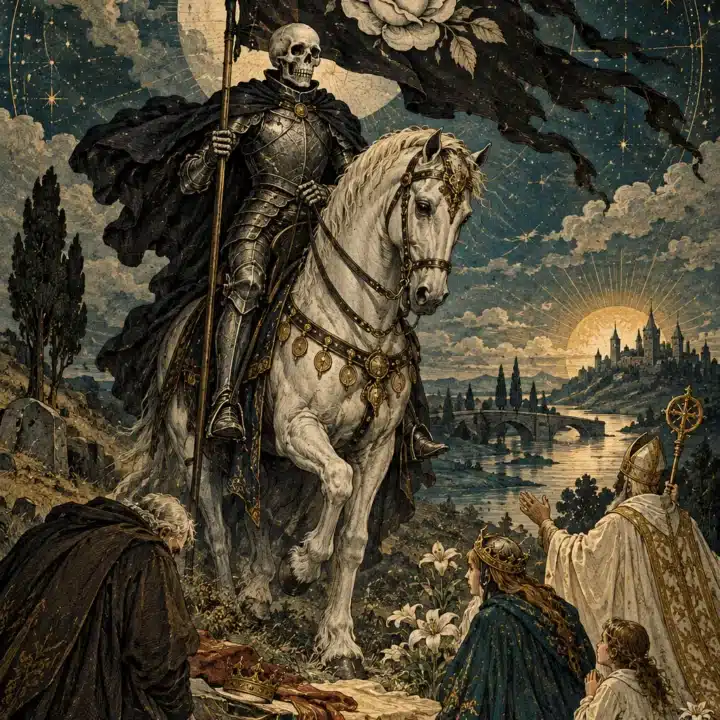
Death
endings, transition, transformation, release

The Star
hope, inspiration, trust, renewal

Six of Pentacles
generosity, assistance, reciprocity, shared resources
Sources and further reading
- A. E. Waite, The Pictorial Key to the Tarot, Part III (Swords, Six of Swords) Read the text
- Golden Dawn, Book T, tarot titles, attributions, and card descriptions Read the text
- The Morgan Library & Museum, Pamela Colman Smith and her tarot art Read the text
- Victoria and Albert Museum, A History of Tarot Cards Read the text