The Tower Tarot Card Meaning
Lightning strikes a crowned tower while two figures fall through the darkness. Explore what The Tower reveals about sudden change, instability, and new understanding.
- upheaval
- revelations
- instability
- sudden change
- disillusionment
Card at a glance
- Number
- XVI
- Element
- Varies by tradition
- Astrology
- Mars (Golden Dawn)
- Keywords
- upheaval, revelations, instability, sudden change, disillusionment
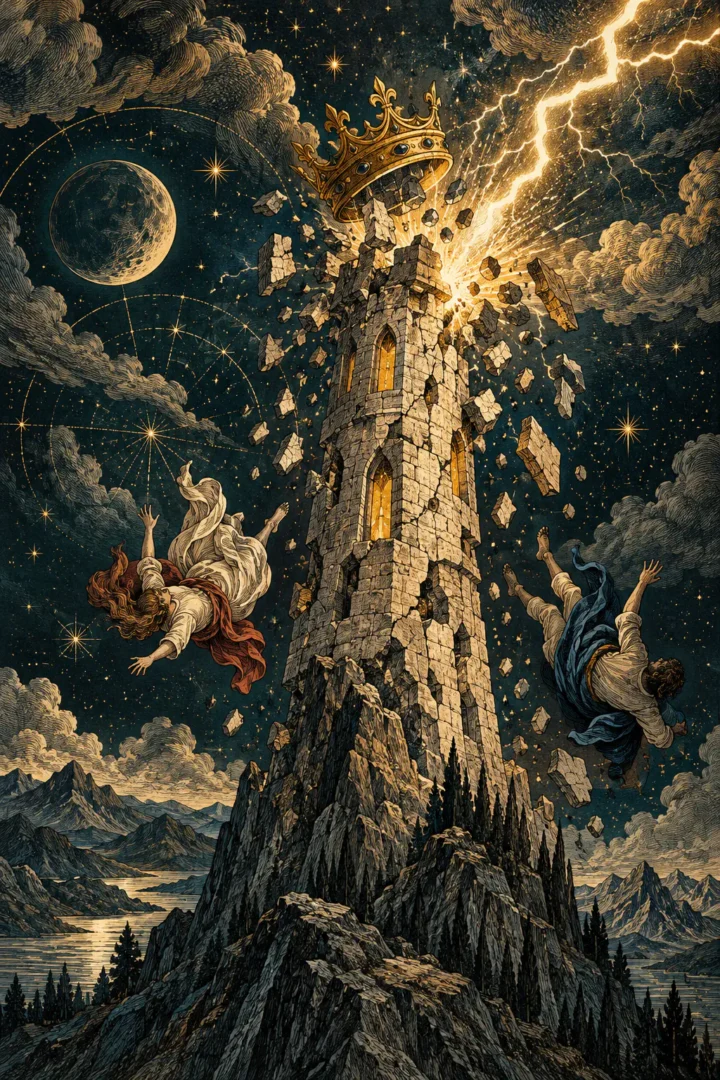 XVI · The Tower
Upright meaning
Upheaval, revelations and instability
Upright, The Tower may appear when your understanding of a situation changes abruptly. An unexpected announcement forces new plans. Something concealed becomes visible. A long-standing arrangement reveals a weakness that requires attention.
- Upheaval
- Revelations
- Instability
- Sudden change
- Disillusionment
Reversed meaning
Avoiding a reckoning, fear of disruption and inner upheaval
Reversed, the Tower often describes the fear of what might happen if a difficult truth is acknowledged. Perhaps you know that a conversation must take place, yet keep postponing it because the outcome is uncertain.
- Avoiding a reckoning
- Fear of disruption
- Inner upheaval
- Prolonged instability
Card symbolism
-
The lightning strike
A jagged bolt enters from the dark sky and reaches the top of the tower. Lightning has long been a dramatic image of sudden power and illumination.
-
The falling crown
A golden crown flies off the tower’s summit. It is an image of authority suddenly displaced.
-
The two falling people
The two figures make the card painfully human. Their clothing and postures differ, but both have been thrown into danger.
-
The rocky peak and isolated tower
The tower rises alone from a difficult mountain. Its position gives it an imposing presence, while also making it seem exposed.
-
The flames against the dark sky
Golden flame-shaped marks scatter across the darkness while fire escapes the building. Some occult readers connect these marks with Hebrew letterforms and spiritual illumination.
In depth interpretation
Lightning tears across a dark sky and strikes the crown of a stone tower. Fire breaks from its windows. Two people fall through the air, their bodies caught in the terrible instant between safety and the ground below. The tower stands high on a rocky peak, far from any comforting shelter. Almost everything in this scene is happening too quickly to grasp.
The Tower speaks of upheaval, sudden revelation, and the collapse of something we believed was secure. Upright, it often appears when a truth or change demands our attention. Reversed, it can reflect a crisis that is being resisted, an inward reckoning, or the difficult aftermath of an earlier disruption.
It is understandable to feel uneasy when you draw this card. Take a moment to notice what part of the image troubles you most. The lightning? The falling crown? The people whose lives have been interrupted? Your response offers a place to begin interpreting the card.
When the world you knew changes
Perhaps you have experienced the moment when a single conversation changes everything. Someone you trusted tells you a truth they have kept hidden. A role you built your days around ends without warning. A belief that once made the world feel orderly no longer explains what you have witnessed.
The Tower has room for the shock of such moments. Its image can reflect the confusion of discovering that your understanding of a situation was incomplete. Even when a change later opens a door, the first experience may be fear, sadness, anger, or disbelief.
There is a spiritual dimension to having certainty interrupted. We grow attached to the structures through which we understand ourselves: the roles we play, the stories we tell, the plans we feel safe inside. Sometimes those structures need repair. Sometimes the entire arrangement has changed and we have to learn how to live differently.
The Tower’s fierce image has led many readers to interpret it as the breakdown of false beliefs or an unstable foundation. That can be a useful reading when the circumstances support it. Yet genuine suffering does not prove that someone built their life wrongly. An unexpected loss is never a lesson a person has to welcome.
The Ten of Swords can help you distinguish upheaval from the aftermath. The Tower captures the moment a structure can no longer hold; the Ten gives attention to the experience of finality once something has fallen. Together, they ask what practical support and gentleness are needed after the shock.
The symbols in The Tower card
Pamela Colman Smith’s Rider-Waite-Smith illustration gives us a scene of destruction whose details carry distinct questions. A reading becomes richer when you pay attention to the part of the tower that matters most to you.
The lightning strike
A jagged bolt enters from the dark sky and reaches the top of the tower. Lightning has long been a dramatic image of sudden power and illumination. In the card, it gives the scene its terrifying speed.
If you are facing a surprise, consider what you actually know about it. There may be an urgent decision to make, or you might need more information before deciding what the event means.
The falling crown
A golden crown flies off the tower’s summit. It is an image of authority suddenly displaced. A belief in invulnerability, an important title, or a leader’s reputation can become part of the interpretation.
Perhaps you once trusted a system because it appeared impressive and permanent. The fallen crown can suggest looking more closely at the people and practices beneath the symbol of power.
The two falling people
The two figures make the card painfully human. Their clothing and postures differ, but both have been thrown into danger. The image reminds us that institutional failure and upheaval affect real lives.
If the card appears during a family or workplace crisis, think about whose experience has been overlooked. Some people have a safe place to land; others need immediate practical support. The image invites compassion for those different circumstances.
The rocky peak and isolated tower
The tower rises alone from a difficult mountain. Its position gives it an imposing presence, while also making it seem exposed. There are few signs of ordinary human life around it.
This detail can raise questions about an arrangement that has become cut off from feedback. Has a plan been developed without listening to the people it affects? Has a relationship become isolated from friends and perspectives that might help?
The flames against the dark sky
Golden flame-shaped marks scatter across the darkness while fire escapes the building. Some occult readers connect these marks with Hebrew letterforms and spiritual illumination. The interpretation is particular to later esoteric tarot, and the image itself leaves plenty of room for reflection.
Even after the lightning has passed, there is work to be done. The flames remind us that the effects of a sudden event may continue to unfold long afterward.
The Tower upright meaning
Upright, The Tower may appear when your understanding of a situation changes abruptly. An unexpected announcement forces new plans. Something concealed becomes visible. A long-standing arrangement reveals a weakness that requires attention.
Imagine an organization that has celebrated its growth while neglecting the people doing the work. When several valued employees leave at once, the leadership can no longer ignore the conditions that made them unhappy. The Tower might describe the moment an existing story about success becomes impossible to maintain.
In a personal reading, the card can be equally intimate. You realize that a friendship has changed, hear news that affects a planned move, or discover a belief you have outgrown. Some revelations lead to relief. Others require time and support before you can decide what comes next.
The Tower encourages responsiveness to reality. If something has actually happened, address the immediate needs first. A reading does not establish that a crisis is inevitable merely because the card appears.
The Tower reversed meaning
Reversed, the Tower often describes the fear of what might happen if a difficult truth is acknowledged. Perhaps you know that a conversation must take place, yet keep postponing it because the outcome is uncertain.
Another possible reading concerns a quieter upheaval. Your outward life looks the same, but a deeply held belief has shifted. You may be reconsidering a career, religious tradition, or relationship before anyone around you knows there is a question.
Sometimes the reversal appears after the crisis itself. The event has passed, though your sense of safety has not returned. You are still learning which parts of the old structure can be trusted and what needs to be rebuilt. Give the aftermath a place in your interpretation.
The Tower in love and relationships
In love, The Tower can bring attention to an event or realization that changes the way a relationship feels. Perhaps an important truth has been withheld. A couple might confront a major disagreement about their future, or circumstances beyond their control may disrupt their plans.
Suppose two people discover they want very different lives after years of assuming they were working toward the same future. The conversation can be painful even when both have acted sincerely. The Tower may symbolize the moment that difference becomes impossible to avoid.
Reversed, the card can suggest that one or both partners are avoiding a difficult conversation, or that a recent conflict has shaken their trust. A meaningful next step might be listening to what each person actually wants before deciding how to proceed.
If you feel afraid of a partner’s reactions, your safety deserves priority. Threats or coercion require practical attention regardless of the cards in a spread.
The Tower as feelings
When asked about someone’s feelings, The Tower may describe shock, surprise, or an emotional realization that has changed the atmosphere between you. Someone might be reconsidering the connection after a difficult disclosure or unexpected encounter.
It cannot tell you the exact thought that caused their reaction. Notice what the person says and does. If you are left guessing after a painful event, a direct conversation may offer more clarity than repeated readings.
The Tower for career and work
At work, the Tower frequently concerns plans or structures that are changing under pressure. A reorganization, an unexpected setback, or the failure of a project can leave people uncertain about what comes next.
Consider a team that has been working toward a deadline while ignoring repeated warnings about the plan. A last-minute failure forces everyone to reconsider the approach. The card can represent the consequences of that breakdown and the need to listen to the information that was previously dismissed.
Reversed, it may point toward a serious problem everyone knows about but nobody wants to name. If your livelihood is affected, gather reliable information, document relevant events, and seek appropriate advice rather than guessing what the card predicts.
The Tower for money
In financial questions, The Tower may evoke an unexpected expense, a major revision to a plan, or an arrangement that needs closer inspection. Its dramatic imagery can also reflect anxiety about losing security even when no specific event has occurred.
A reversed Tower can suggest postponing a difficult look at debt, contracts, or changing circumstances. Review the actual facts and available support. A tarot card cannot predict a market crash or establish that financial disaster is approaching.
The Tower in spiritual practice
The Tower can have a particular resonance when an inherited belief stops making sense. You may discover that a teacher you admired has acted in ways you cannot accept, or find that a familiar spiritual explanation no longer fits your experience.
Such a change can feel disorienting. You may want to step away from a practice for a time, ask difficult questions, or seek a different community. The card’s tower offers an image for that internal disturbance without demanding an immediate replacement for what has fallen away.
In the Golden Dawn system, The Tower corresponds with Mars, the planet traditionally associated with force and conflict. For readers who use that framework, the attribution can deepen the image of an abrupt confrontation with reality.
The Tower as advice: find the ground
Place The Tower before you and name the change or concern behind your reading. Write three short lines: ‘What has actually happened,’ ‘What I still need to know,’ and ‘What needs care right now.’
Begin with the first line, using only facts you can identify. Let the second hold the unanswered questions. The third can be modest: a conversation, a document to retrieve, an evening of rest, or a person you trust who could help.
If there is no actual crisis, allow that to remain true. You do not have to create a disaster to give the card meaning. It may be helping you examine a belief about security or change.
Is The Tower a yes or no card?
The Tower often leans toward caution when you are asking whether a situation will remain stable or proceed exactly as planned. It may be more encouraging when the question concerns addressing a truth that has already become apparent. The card does not predict an accident, betrayal, or catastrophe.
How to read The Tower in a tarot spread
Position matters. In the past, The Tower may describe a disruption that shaped the present. As a challenge, it can suggest fear of a difficult truth or a plan whose foundations deserve attention. As an outcome, it may indicate that a significant change belongs to the story, with the surrounding cards helping you explore its character.
Imagine asking how to move forward after losing a job. You draw The Tower as the present, the Queen of Pentacles as advice, and The Star as a possible direction. The reading could acknowledge the shock, invite you to care for your immediate resources and support, and offer an image of slowly recovering hope. It cannot guarantee a new job or tell you when relief will arrive.
A brief note on tarot tradition
The Tower is an established trump in older European tarot, sometimes called La Maison Dieu. Pamela Colman Smith’s Rider-Waite-Smith illustration, first published in 1909, emphasizes lightning, the falling crown, and two figures cast from the building. Arthur Edward Waite interpreted the image through the collapse of a false spiritual structure, among other meanings. Modern readings also use it for unexpected change and revelation. Its association with Mars belongs to the Golden Dawn system of occult correspondences.
Frequently asked questions
Does The Tower always mean disaster?
The card depicts a violent disruption, so it can express genuine fear or loss. Many modern readings use it for a revelation or sudden change. It cannot establish that disaster will happen, and the question and surrounding cards matter.
Does The Tower predict a breakup?
It may reflect a relationship facing a significant disruption or difficult truth. Whether two people separate depends on their circumstances and choices. The card cannot tell you what a partner will decide.
How is The Tower different from Death?
Death often concerns a chapter reaching its end and the transition that follows. The Tower makes the moment of disruption vivid, particularly when something believed secure is suddenly questioned or lost.
Can The Tower be a positive card?
Some people experience a difficult revelation as the beginning of greater freedom or clarity. The change may remain painful even when it leads somewhere meaningful. There is no obligation to celebrate what has been lost.

Keep reading
Explore the Major Arcana
Every card page names the tradition behind each meaning, so you can compare readings instead of taking one as fixed.
Cards to explore alongside this one
Their symbols reveal useful similarities and differences for your next reading.
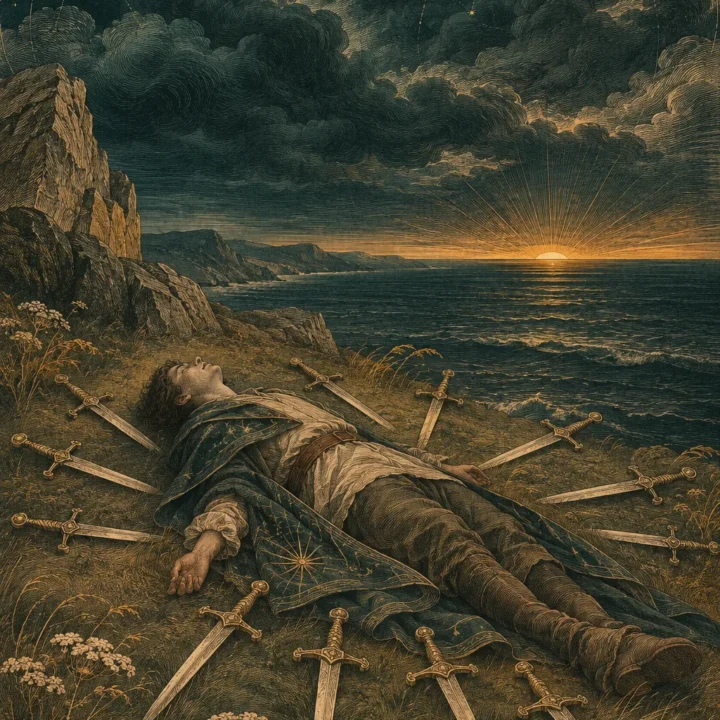
Ten of Swords
painful ending, finality, collapse, release
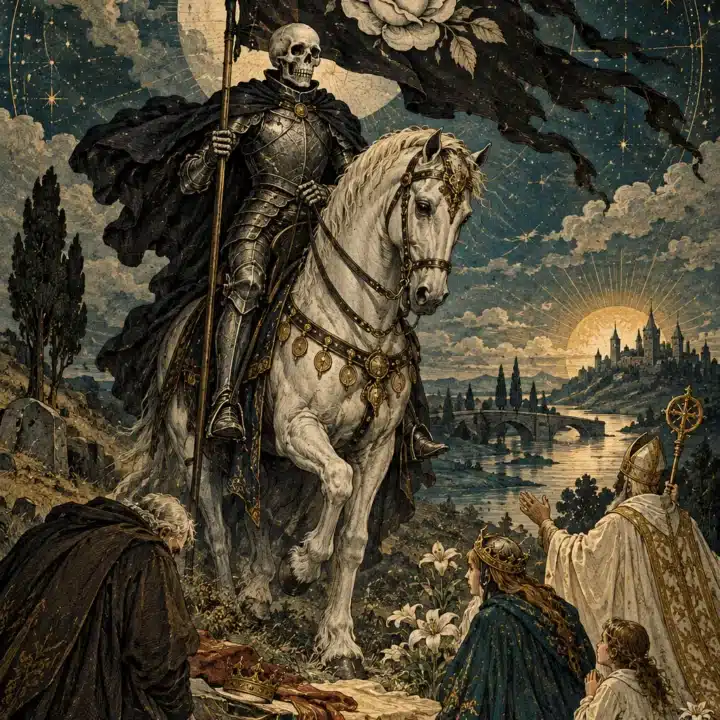
Death
endings, transition, transformation, release

Wheel of Fortune
turning points, cycles, opportunity, changing conditions
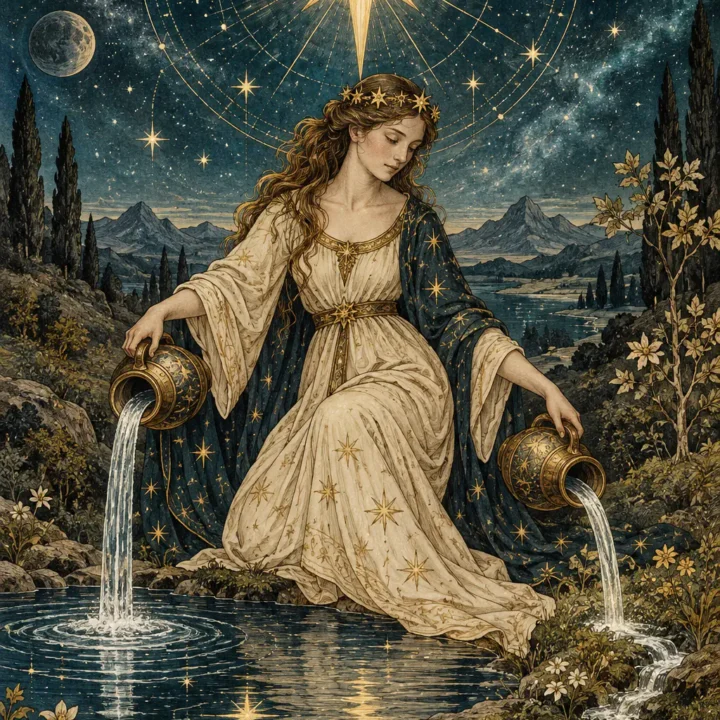
The Star
hope, inspiration, trust, renewal
Sources and further reading
- Arthur Edward Waite, The Pictorial Key to the Tarot, Part II, The Tower Read the text
- Arthur Edward Waite, The Pictorial Key to the Tarot, Part III, divinatory meanings Read the text
- Golden Dawn tarot manuscript, Book T, The Tower/Mars correspondence Read the text
- Victoria and Albert Museum, A history of tarot cards Read the text