The High Priestess Tarot Card Meaning
Between two temple pillars, The High Priestess guards a partly hidden scroll. Explore her meanings for intuition, private feelings, dreams, and the mysteries that deserve patient attention.
- intuition
- contemplation
- inner knowledge
- privacy
- mystery
Card at a glance
- Number
- II
- Element
- Varies by tradition
- Astrology
- the Moon (Golden Dawn)
- Keywords
- intuition, contemplation, inner knowledge, privacy, mystery
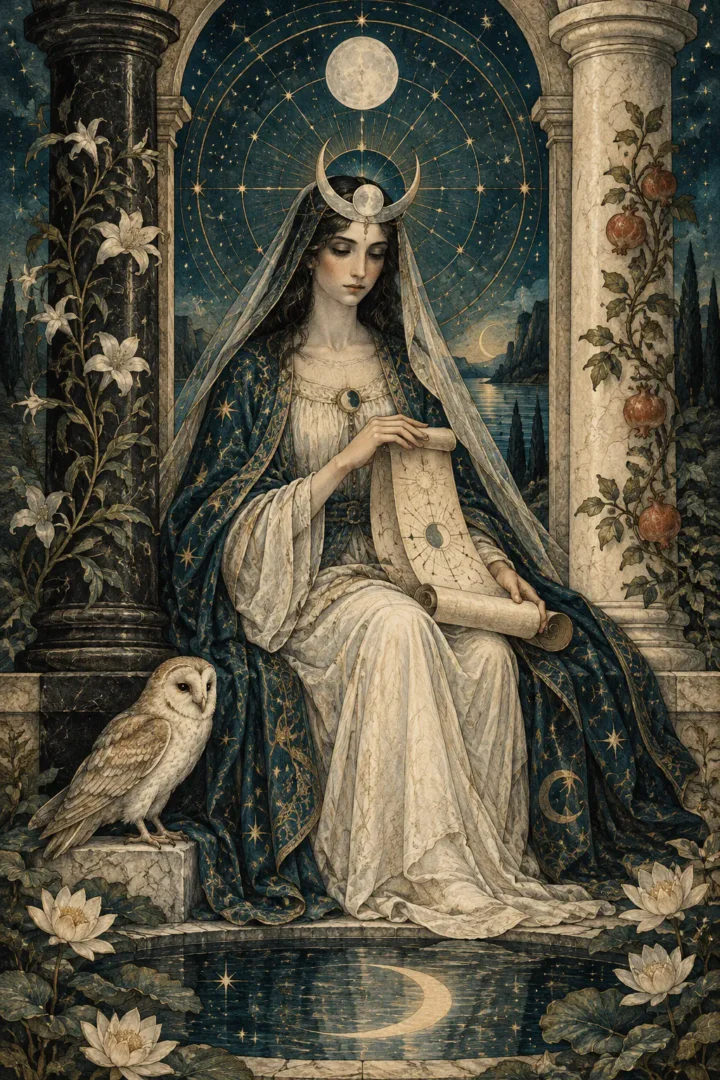 II · The High Priestess
Upright meaning
Intuition, contemplation and inner knowledge
Upright, this card often appears when you need to observe before making a judgment. You may have noticed something important without being able to explain it yet. Rather than demanding an instant conclusion, the reading gives you room to look again.
- Intuition
- Contemplation
- Inner knowledge
- Privacy
- Mystery
Reversed meaning
Confusion, withdrawal and misunderstood signals
Reversed, The High Priestess may suggest that the language of your inner world has become difficult to hear. You might be dismissing a persistent concern because it is inconvenient, or searching every coincidence for a hidden message until nothing feels clear.
- Confusion
- Withdrawal
- Misunderstood signals
- Ignored intuition
- Hidden concerns
Card symbolism
-
The black and white pillars
The black pillar marked B and the white pillar marked J evoke Boaz and Jachin, the pillars associated with Solomon’s Temple. Together they offer an image of contrasting forces held within one sacred space.
-
The pomegranate veil
Pomegranates and palms decorate the veil behind her. These living patterns make the hidden place feel fertile rather than empty.
-
The scroll marked TORA
A scroll bearing the letters TORA rests across her lap. Much of it is covered by her mantle.
-
The moon, the crown, and the waterlike robes
The crescent at her feet and the moonlike headdress draw her into a world of cycles, dreams, and reflected light. Her blue robes spill toward the ground like water.
-
The cross upon her chest
A cross with equal arms rests at the center of her chest. Within the card’s layered sacred imagery, it can suggest a point of balance: the place where reflection becomes a lived belief.
In depth interpretation
The High Priestess sits between two pillars, a veil of pomegranates behind her. A scroll rests in her lap, partly concealed by a blue mantle. At her feet is a crescent moon. Nothing in this image is hurried. The longer you look, the more you begin to wonder what lies beyond the veil.
This card speaks of intuition, inner wisdom, privacy, and mysteries that need time to unfold. Upright, The High Priestess invites a deeper kind of listening. Reversed, she may reflect confusion, withdrawal, ignored instincts, or the temptation to treat guesses as revelations.
If you have drawn her, notice where your eyes go first. Perhaps it is the darkness of one pillar, the hidden scroll, or the moon beneath her robes. A detail that holds your attention can become the beginning of a useful question.
The quiet wisdom of The High Priestess
Some experiences cannot be understood while we are in the middle of them. You leave a conversation feeling strangely unsettled, though every word sounded pleasant. A dream follows you into the morning. A decision that looked simple yesterday feels more complicated after a night of rest. The High Priestess inhabits that space where a feeling has arrived before its meaning.
In spiritual practice, she is often understood as the guardian of an inner sanctuary. Her knowledge is approached through attention: the willingness to sit with a dream, a symbol, or an unresolved question long enough to notice what changes. You are free to keep something private while it takes shape.
Her gift is subtlety. A passing feeling may hold a clue, but it may also reflect tiredness, hope, or fear. The Priestess invites you to become familiar with your inner life so you can recognize its patterns with greater care.
Symbols in The High Priestess card
Pamela Colman Smith placed this figure at a richly decorated temple threshold. The scene gives the feeling that knowledge is close enough to touch, though some of it remains out of sight.
The black and white pillars
The black pillar marked B and the white pillar marked J evoke Boaz and Jachin, the pillars associated with Solomon’s Temple. Together they offer an image of contrasting forces held within one sacred space. The Priestess sits between them. In a reading, her position can suggest the wisdom of remaining attentive when a situation contains truths that are difficult to reconcile.
The pomegranate veil
Pomegranates and palms decorate the veil behind her. These living patterns make the hidden place feel fertile rather than empty. The veil can suggest a boundary around a sacred teaching, a private experience, or knowledge you are still learning to understand. Consider how the boundary feels in your own reading. Is it protective, inviting, or frustrating?
The scroll marked TORA
A scroll bearing the letters TORA rests across her lap. Much of it is covered by her mantle. In Waite’s symbolic explanation, it evokes a deeper law and teachings whose meaning is partly concealed. It is a striking picture of knowledge that asks something of the reader. A truth you have memorized may reveal another dimension when life gives you reason to live by it.
The moon, the crown, and the waterlike robes
The crescent at her feet and the moonlike headdress draw her into a world of cycles, dreams, and reflected light. Her blue robes spill toward the ground like water. These details help explain why many modern readers turn to The High Priestess when exploring a recurring dream or a feeling that changes from day to day.
The cross upon her chest
A cross with equal arms rests at the center of her chest. Within the card’s layered sacred imagery, it can suggest a point of balance: the place where reflection becomes a lived belief. This detail draws the eye back to the still figure at the center of the scene.
The High Priestess upright meaning
Upright, this card often appears when you need to observe before making a judgment. You may have noticed something important without being able to explain it yet. Rather than demanding an instant conclusion, the reading gives you room to look again.
Imagine meeting a potential collaborator who offers exactly what you hoped to hear. The conversation is easy, but afterward you remember a small question they never answered. The High Priestess might encourage you to return to that question, ask it kindly, and see what you learn. Your unease deserves curiosity; it does not establish that the person is dishonest.
The card can also be a blessing for private learning. Perhaps you are studying a spiritual tradition, keeping a journal, or quietly adjusting to a new understanding of yourself. There is no need to make every discovery public while you are still discovering what it means.
The High Priestess reversed meaning
Reversed, The High Priestess may suggest that the language of your inner world has become difficult to hear. You might be dismissing a persistent concern because it is inconvenient, or searching every coincidence for a hidden message until nothing feels clear.
Sometimes silence has stopped serving you. A relationship becomes distant because nobody will name the hurt. At work, a question that needs an answer is left hanging because speaking up feels uncomfortable. The reversal can invite a conversation that restores understanding.
There is also the possibility of mistaking fear for guidance. A troubling dream, for example, may say something about what has been weighing on your mind. It cannot, on its own, prove that danger is coming. Give the feeling space, then consider what evidence and support you have in waking life.
The High Priestess in love and relationships
In a love reading, The High Priestess brings attention to the things that unfold slowly between people. A new connection may carry quiet fascination or a wish to know someone beyond first impressions. You might be surprised by how much a shared silence can communicate.
For an established couple, she often invites more attentive listening. Perhaps your partner has been trying to speak about something tender and you have been quick to offer a solution. There can be intimacy in letting them finish, then asking what they need from you.
Reversed, the card can describe emotional distance or questions neither person wants to ask. A private inner life is healthy; ongoing confusion about the relationship may need an honest conversation. Notice whether the atmosphere changes when you speak plainly.
The High Priestess as feelings
When asked about someone’s feelings, The High Priestess can symbolize emotions kept close to the chest. Someone may be thoughtful, reserved, drawn to you, or uncertain about how to describe what is developing. The card does not tell you which interpretation belongs to that person.
If you are waiting for a confession of love, this card may capture the feeling of waiting more accurately than it describes the other person’s heart. Give their behavior room to speak, and allow direct questions where clarity matters to you.
The High Priestess for career and work
At work, this card may appear during a period of research, preparation, or discreet planning. Think of an editor reading a draft for the third time and noticing what has been left unsaid. The value of that insight comes from patient attention to the material.
If workplace politics feel difficult to read, The High Priestess encourages careful observation. Keep track of what has actually happened. Ask about the expectations that seem unclear. An intuition may help you decide where to look, and the facts you uncover can help you decide what to do.
The High Priestess for money
With money, The High Priestess often calls attention to the parts of an agreement you have not yet explored. A fee buried in the terms, a condition you have not understood, or an old belief about security could all be relevant.
You may also find yourself reluctant to make a decision because the numbers stir up an emotional memory. It can be helpful to acknowledge that feeling while checking the financial details. A tarot reading cannot replace those details.
Dreams and spiritual growth with The High Priestess
The High Priestess has a natural place in dreamwork. A dream can leave a powerful feeling even when its story makes little sense. Try writing down the scene as you remember it, including its smallest details. Later, look for what it reminds you of in your own life. There is no need to choose a single meaning on the first morning.
Meditation, prayer, and time spent with a sacred text can offer a similar kind of intimacy. Let one image or line stay with you. The Priestess invites patience with the experience, and respect for whatever remains unknown.
The High Priestess as advice: intuition or assumption?
When the High Priestess appears as advice, try a small practice with two columns in your journal. In the first, write what you have actually observed: the words spoken, the action taken, the dream image you remember. In the second, write the meaning you have given it.
Notice where a strong feeling has become a conclusion. You may find a pattern worth exploring or realize that a question is still unanswered. If another person is involved, consider whether a gentle, direct conversation could reveal what imagination cannot.
This exercise preserves something precious about intuition. It lets your inner sense guide your attention while giving reality the chance to answer.
Is The High Priestess a yes or no card?
The High Priestess often feels like ‘not yet’ in a yes-or-no reading. Her image suggests a question that still has hidden layers. If you are asking whether to study, reflect, keep something private, or learn more, she can be encouraging. Reversed, she may be pointing to confusion that needs to be addressed before a useful answer emerges.
Reading The High Priestess in a tarot spread
Position gives the card its shape. In the past, it could represent an important instinct you followed or dismissed. As a challenge, the card may suggest missing context, withdrawal, or the difficulty of trusting your own judgment. As advice, it favors attentive observation and thoughtful questions.
Imagine drawing The High Priestess as your present card, the Four of Swords as advice, and the Ace of Swords as an outcome while asking about a difficult conversation. The combination could suggest making room to reflect before speaking, then approaching the subject with clear words and a willingness to hear the answer. The cards help you consider your approach; they cannot tell you in advance how the other person will respond.
A brief note on tarot tradition
This interpretation draws on the Rider-Waite-Smith deck, illustrated by Pamela Colman Smith and first published in 1909. Waite emphasized the temple pillars, the partly concealed scroll, and the crescent moon. In the Golden Dawn’s Book T, The High Priestess is associated with the Moon. Earlier decks often depicted a Popess, a figure with a different visual and religious context; the familiar moonlit temple imagery belongs to the later Rider-Waite-Smith tradition.
Frequently asked questions
Can The High Priestess point to a secret?
She can bring attention to something private or not yet understood. A secret is one possible interpretation, especially with cards that suggest concealment. The High Priestess alone is no evidence that anyone is lying to you.
What does The High Priestess mean as a person?
As a person, she may represent someone reflective, observant, private, or deeply devoted to study. Such a person might have a calm presence and reveal their thoughts gradually.
Does The High Priestess tell me to trust my dreams?
She invites you to take dreams seriously as experiences worth reflecting on. Their images can reveal associations and feelings you had not noticed while awake. A dream does not give reliable proof of future events or another person’s intentions.
How is The High Priestess different from The Moon card?
Both cards use lunar imagery. The High Priestess emphasizes the contemplative figure who receives and holds knowledge. The Moon card takes the reader into a shifting landscape where appearances can be difficult to judge and instinct runs close to fear.
Keep reading
Explore the Major Arcana
Every card page names the tradition behind each meaning, so you can compare readings instead of taking one as fixed.
Cards to explore alongside this one
Their symbols reveal useful similarities and differences for your next reading.

The Moon
intuition, dreams, mystery, imagination
The Hermit
reflection, solitude, discernment, inner guidance
Queen of Cups
compassion, emotional understanding, imagination, intuition
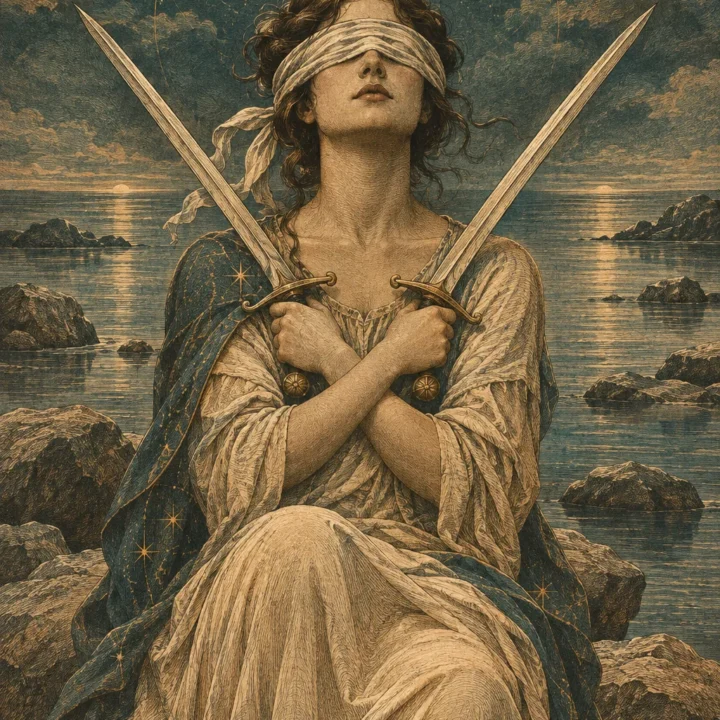
Two of Swords
indecision, guarded peace, boundaries, suspended choice
Sources and further reading
- Arthur Edward Waite, The Pictorial Key to the Tarot, The High Priestess (Rider-Waite-Smith symbolism) Read the text
- S. L. MacGregor Mathers and Harriet Felkin, Book T, The Tarot, table of trump correspondences (High Priestess, Moon) Read the text
- Victoria and Albert Museum, A history of tarot cards Read the text