Ten of Swords Tarot Card Meaning
Ten swords mark a stark ending beneath a dark sky with light on the horizon. The Ten of Swords speaks to finality, grief, and life after a painful chapter.
- painful ending
- finality
- collapse
- release
- aftermath
Card at a glance
- Number
- Ten
- Element
- Air
- Astrology
- Lord of Ruin; Sun in Gemini (Golden Dawn)
- Keywords
- painful ending, finality, collapse, release, aftermath, new perspective
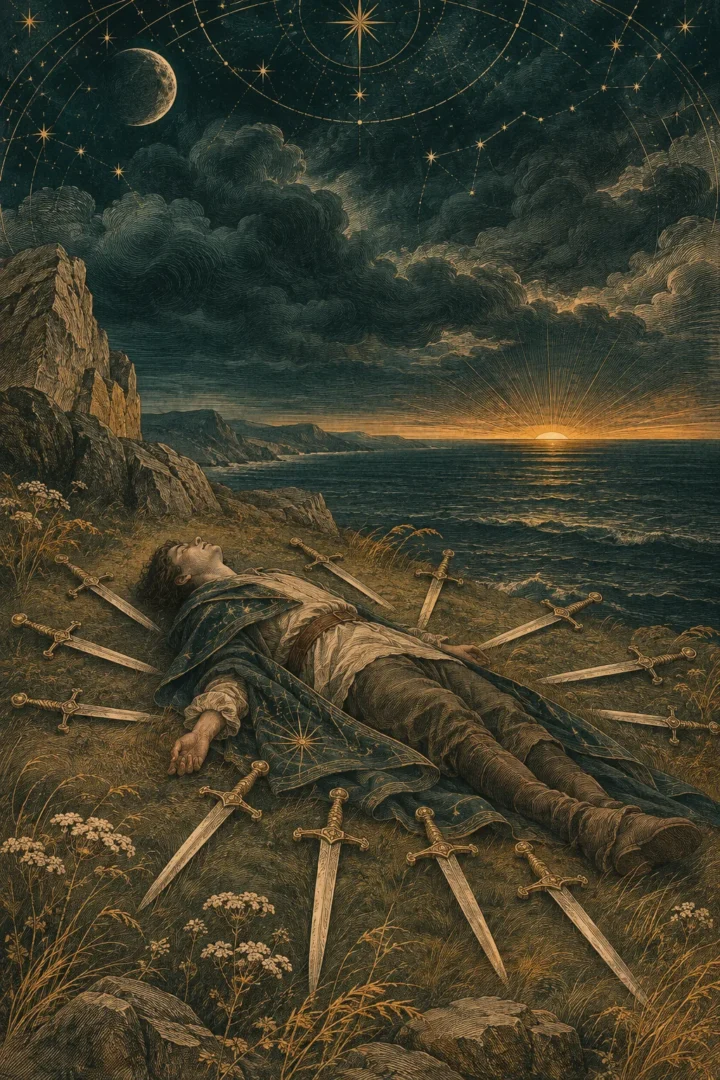 Ten · Ten of Swords
Upright meaning
painful ending, finality, collapse of an old story
Upright, the Ten of Swords acknowledges an ending that feels severe or final. It asks what has truly ended and what support is needed afterward.
- painful ending
- finality
- collapse of an old story
Reversed meaning
lingering aftermath, resistance to closure, early recovery
Reversed, the Ten may describe the difficult aftermath of an ending or the first signs that the experience will no longer define every day.
- lingering aftermath
- resistance to closure
- early recovery
Card symbolism
-
The figure on the ground
Smith shows a prone figure pierced by ten swords, a stark symbol of an ending or a sense of utter defeat.
-
The dark sky and bright horizon
Blackness gives way to a narrow band of gold light, creating a contrast between the present scene and what lies beyond it.
-
The still water
Quiet water beyond the shoreline offers visual stillness after the violent image in the foreground.
In depth interpretation
A figure lies facedown on the ground, pierced by ten swords. The sky above is almost entirely black. At the edge of the horizon, a narrow line of golden light appears over still water.
The Ten of Swords represents a painful ending, defeat, collapse, exhaustion, or the recognition that a particular chapter has reached its limit. Upright, it asks you to acknowledge what has ended. Reversed, it can reflect difficulty releasing the aftermath or the first fragile stages of recovery.
The image is dramatic. It is not a literal prediction of death or violence. The card speaks in the symbolic language of finality.
The spiritual meaning: when an old chapter cannot continue
Some endings unfold slowly enough that you barely notice them. Others arrive as a moment you will remember for years. The Ten is concerned with the experience of reaching a limit.
You may be confronting the end of a relationship, a lost opportunity, the collapse of a plan, or the realization that a way of living has become impossible to sustain.
The card is not asking you to welcome pain. It invites you to stop denying the ending so that you can meet the life that remains.
There may be grief, anger, or disbelief. There may also be practical matters that require attention long before you feel ready. You can acknowledge the weight of both without pretending that a new beginning has already arrived.
The symbols in the Ten of Swords
The prone figure and the ten blades
Pamela Colman Smith draws a body pierced by all ten swords of the suit. The picture is deliberately extreme, placing the feeling of an ending at the center.
Waite explicitly cautioned that the image is not particularly a card of violent death. That historical note is important because the imagery can frighten readers who encounter it unexpectedly.
A useful interpretation asks which part of a story can no longer continue. It does not turn the picture into a prediction about a person’s physical fate.
The narrow light on the horizon
Between the black sky and the distant landscape is a band of warm light. Readers often call it a sunrise, although the image does not tell us precisely what hour it is.
That sliver of light offers contrast rather than instant reassurance. A painful ending can be real, and so can the possibility of another day.
The water beyond the shore
Still water lies behind the foreground. Its quiet does not erase what the image shows. Instead, it provides a place for the eye to rest after taking in the severity of the scene.
In your reading, ask what conditions might allow peace to return over time.
Ten of Swords, Death, and the Tower: three kinds of ending
These three cards are often grouped together because their images feel severe. Each illuminates a different part of change. The Tower shows a structure broken open, often through upheaval or revelation. Death marks a passage in which an old form of life yields to another. The Ten of Swords stays with the moment when something has unmistakably reached its end and you are trying to understand what remains.
Imagine a long-running project closing. The Tower might describe the sudden announcement that interrupted everyone’s plans. The Ten could describe the exhaustion and finality of the last day. Death could help you consider how your identity and direction change after the project is gone. A spread containing all three invites attention to the sequence and the needs of the people involved.
None of these cards proves an impending physical death. Their power comes from facing the actual changes in your life with seriousness, while keeping a little room for tomorrow.
Ten of Swords upright: recognizing what is over
Upright, the Ten may appear when a situation has reached a painful conclusion or when you are exhausted by trying to hold it together. The card can also describe the feeling of having been overwhelmed by repeated disappointments.
Imagine a creative project you spent years developing. After several attempts to revive it, you learn that the funding and team are no longer available. The loss is real. The Ten might invite you to mourn what ended before deciding how any part of the work could live elsewhere.
Sometimes the thing that ends is an assumption. You can no longer believe that a person will behave differently without evidence, or that a plan will succeed simply because you have invested so much in it.
Name the ending as accurately as possible. Avoid extending it into an absolute judgment about your whole future.
Ten of Swords reversed: learning to live after the blow
Reversed, the Ten can point to a period of aftermath. You may be trying to regain energy, untangle practical consequences, or stop revisiting the moment everything changed.
Some readers interpret the reversal as release and recovery. Others see resistance to accepting an ending. Both are possible, and neither creates a fixed timetable.
Waite gave the reversal a temporary advantage or success among its meanings. That differs from the modern idea of healing. A thoughtful reading can acknowledge the difference without forcing every tradition into the same story.
You do not have to turn a painful experience into a gift. It is enough to begin identifying what care and support are possible now.
Ten of Swords in love and relationships
In love, this card may reflect the end of a relationship, an irreparable change, or a moment when trust has been severely shaken. It does not guarantee separation. Sometimes the old pattern must end even if the people choose to stay and rebuild.
If you are reading about another person, resist treating the image as proof of betrayal or cruelty. Look to actual behavior, safety, and the choices both people make.
Reversed, you might be recovering after a breakup or finding it difficult to detach from a story that still feels unfinished. The Death card offers a related but broader image of transition and transformation. The Ten highlights the felt severity of an ending.
Career, creativity, and money
At work, the Ten can echo burnout, a project closure, or the disappointment of realizing that a path will not continue as hoped. It can encourage you to distinguish what has been lost from the capabilities and relationships you still possess.
For money, it may prompt a sober assessment of a failed plan or a financial setback. Do not treat it as a prediction of bankruptcy. Review facts, obligations, and qualified advice when needed.
Reversed, focus on recovery in practical stages. You may need a period of rest before forming a convincing new plan.
Worked reading: how do I begin after a project ends?
Imagine a community project closing after years of work. You draw the Ten of Swords for what has ended, Six of Pentacles for what remains available, and The Star for the quality to cultivate.
The Ten allows the loss to be real. The Six of Pentacles invites you to notice the people who contributed, the help you can still exchange, and the resources that might be shared. The Star offers a careful return of hope.
Together, the cards suggest thanking those involved, documenting what was learned, and allowing time before deciding whether a different form of the idea is possible.
If The Tower appeared with the Ten, the reading might emphasize sudden disruption and the need to secure practical foundations first.
Ruin in the Golden Dawn
The Golden Dawn’s Book T names the Ten of Swords the Lord of Ruin and associates it with the Sun in Gemini. Waite describes desolation but distinguishes the card from a straightforward omen of violent death.
Smith’s bright horizon introduces a visual possibility beyond the ruin. Modern readings of renewal arise naturally from that contrast, though they should not turn into a promise that suffering will end on a particular date.
Ten of Swords as advice: honor what has ended
Write two lists. In the first, name what has actually ended. In the second, name what remains: relationships, skills, routines, resources, or values that have not disappeared.
If the loss is fresh, you can stop there. There is no requirement to create a new goal tonight.
Is the Ten of Swords a yes or no card?
It generally discourages continuing a path that has become damaging or clearly unsustainable. For a different question, its meaning depends on the context. Do not use it to make frightening predictions about someone else’s safety or life.
Frequently asked questions
Does the Ten of Swords mean death?
No. It is not reliable evidence of a physical death. Waite himself distinguished the design from a specific prediction of violent death.
Is the Ten of Swords worse than the Tower?
They express different experiences. The Tower commonly represents sudden collapse or revelation; the Ten of Swords emphasizes the experience of finality, defeat, and aftermath.
Does reversed mean the worst is over?
It can symbolize a movement toward recovery. Actual circumstances and the rest of the reading matter more than any fixed timetable.
Why is there light in the background?
Smith contrasts the dark sky with a golden horizon. Many readers treat it as a sign that another day is possible after an ending, while acknowledging that the foreground remains painful.
Tradition note: This article centers Pamela Colman Smith’s Rider-Waite-Smith design, Waite’s statements about desolation, and the Golden Dawn title Ruin. Its spiritual guidance treats endings symbolically and avoids literal predictions of death.
Keep reading
Explore the Swords
Every card page names the tradition behind each meaning, so you can compare readings instead of taking one as fixed.
Cards to explore alongside this one
Their symbols reveal useful similarities and differences for your next reading.
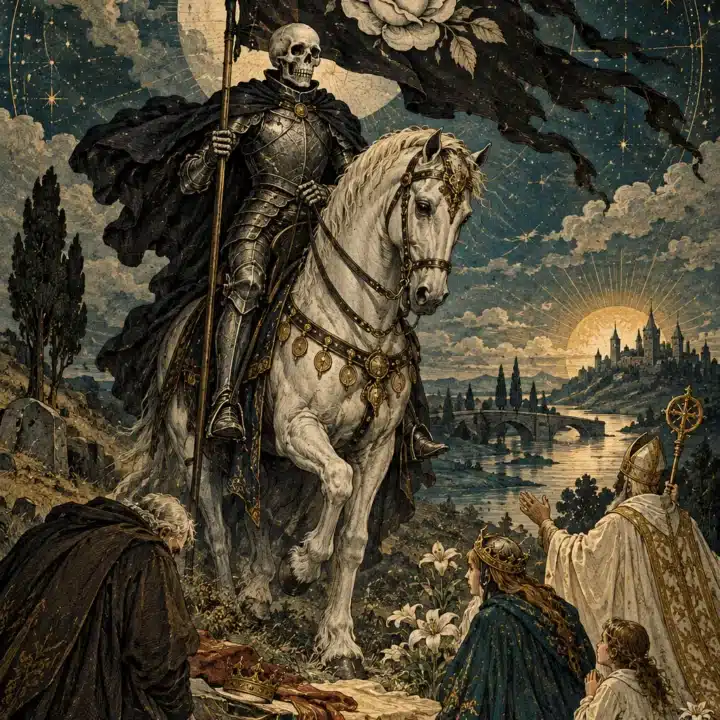
Death
endings, transition, transformation, release
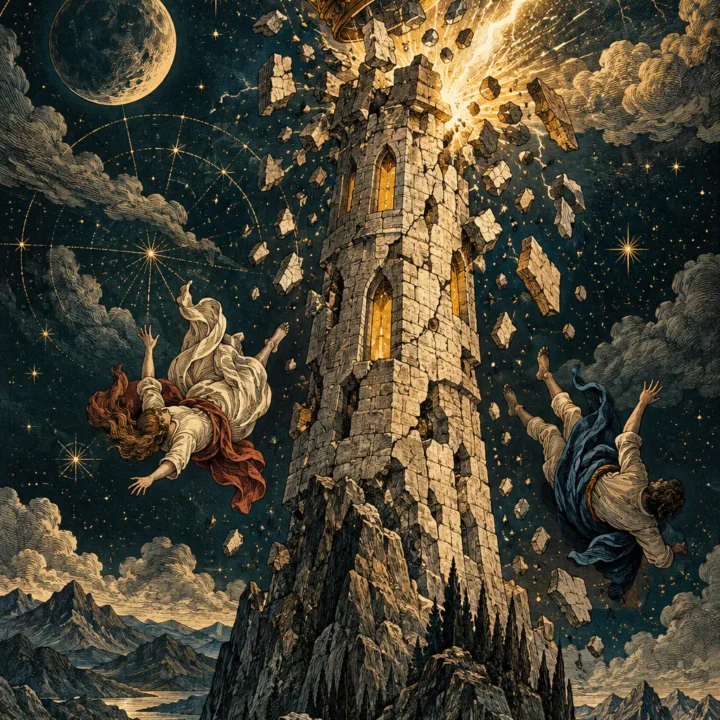
The Tower
upheaval, revelations, instability, sudden change
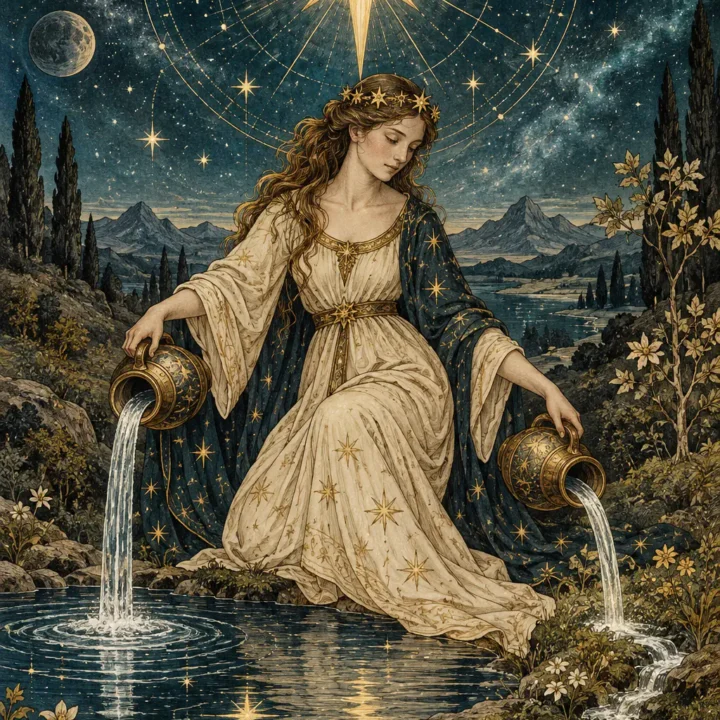
The Star
hope, inspiration, trust, renewal
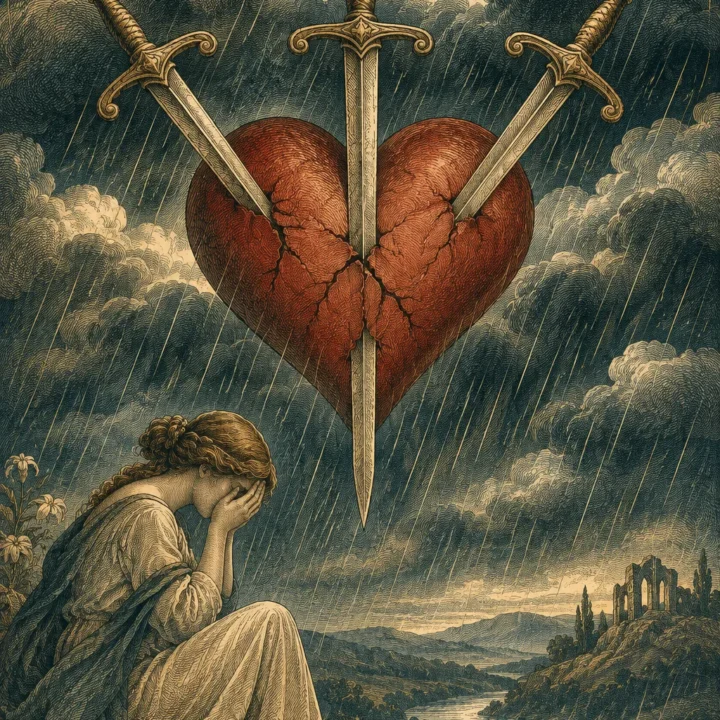
Three of Swords
heartbreak, grief, separation, painful truth
Sources and further reading
- A. E. Waite, The Pictorial Key to the Tarot, Part III (Swords, Ten of Swords) Read the text
- Golden Dawn, Book T, tarot titles, attributions, and card descriptions Read the text
- The Morgan Library & Museum, Pamela Colman Smith and her tarot art Read the text
- Victoria and Albert Museum, A History of Tarot Cards Read the text