King of Cups Tarot Card Meaning
A crowned King sits upon the sea, holding a cup and scepter as waves move around him. The King of Cups explores care, emotional responsibility, and trustworthy judgment.
- emotional steadiness
- compassion
- responsible judgment
- diplomacy
- creative intelligence
Card at a glance
- Number
- King
- Element
- Water
- Astrology
- Prince of the Chariot of the Waters, Air of Water, a court designation whose rank mapping differs among tarot systems.
- Keywords
- emotional steadiness, compassion, responsible judgment, diplomacy, creative intelligence, fairness.
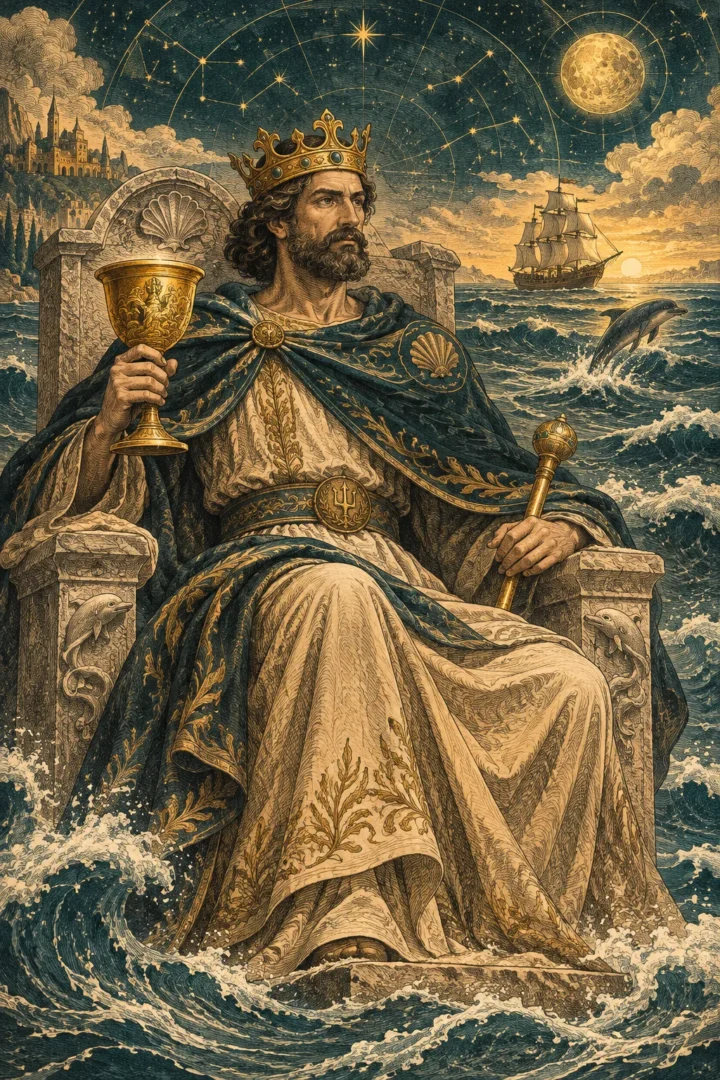 King · King of Cups
Upright meaning
emotional steadiness, compassion, responsible judgment
Upright, the King often appears when the right response requires emotional understanding and an ability to make a considered decision. You may be supporting someone through a difficult change, managing a conflict, or accepting responsibility for an undertaking that affects other people.
- emotional steadiness
- compassion
- responsible judgment
- diplomacy
- creative intelligence
- fairness.
Reversed meaning
emotional manipulation, poor judgment, evasiveness
Modern tarot readers often associate the reversed King of Cups with moodiness, emotional suppression, or manipulation. A person may appear calm while using guilt or affection to influence what others do.
- emotional manipulation
- poor judgment
- evasiveness
- broken trust in contemporary readings; injustice and deception in Waite's historical list.
Card symbolism
-
The cup and the short scepter
Waite describes a large cup in the King's right hand and a short scepter in his left. The two objects can be read as complementary aspects of the role.
-
A throne set upon the sea
The King appears to sit on a solid stone seat surrounded by water. In Waite's own description, the throne is set upon the sea.
-
The ship and the leaping sea creature
A ship passes in the background, and a creature rises from the water on the other side. Waite identified the leaping animal as a dolphin. Many contemporary descriptions of the familiar card call it a fish.
-
The fish ornament and patterned clothing
A fish-shaped ornament appears at the King's neck in many reproductions, with rich blues and golds in his clothing. The details keep him visibly connected to the water of his suit.
In depth interpretation
A crowned king sits on a stone throne surrounded by water. He holds a tall golden cup in one hand and a short scepter in the other. Behind him, a ship travels across the sea, while a creature leaps from the waves. His face remains attentive as the restless water moves around him.
The King of Cups represents emotional wisdom, compassion expressed through responsibility, thoughtful judgment, and the ability to respond well when feelings run high. Upright, he often asks you to bring fairness and understanding into a relationship or decision. Reversed, he can reveal troubled trust, misuse of influence, or a gap between someone's reassuring words and the way they act.
The King is seated in a place that would be difficult for most people to inhabit. The sea still moves. What helps him remain a trustworthy presence when life around him is uncertain?
The spiritual meaning: a steady hand when the water rises
There are moments when someone you care about comes to you carrying a difficult feeling. Perhaps they are angry with you, worried about a change, or unsure how to explain what has happened. Your first response may be to protect yourself, soothe them quickly, or find the words that will make the discomfort disappear.
The King of Cups invites a deeper kind of attention. He sits among moving waters with both a cup and a scepter. In Smith's picture, emotional life and responsibility have arrived in the same place.
The King can represent a person who has learned to remain available during difficult conversations. He can also describe a part of yourself that is growing: the ability to recognize your feelings, understand their effect on others, and make choices you can stand behind.
Perhaps you are leading a group of people who disagree about something important. You want everyone to feel heard, yet the situation will eventually require a decision. The King asks how that decision might be made with care and fairness.
His spiritual strength lives in the relationship between attention and action. Feelings have a place in his world. They influence how he responds without becoming a reason to abandon his responsibilities.
What the King of Cups imagery reveals
The cup and the short scepter
Waite describes a large cup in the King's right hand and a short scepter in his left. The two objects can be read as complementary aspects of the role.
The cup belongs to the realm of feeling, imagination, and relationships. The scepter is a visible emblem of authority. Together, they make the King a compelling figure when the question concerns how to use influence in a way that respects others.
Imagine a team leader who hears that a decision has hurt someone. The cup invites attention to the person's experience. The scepter asks what the leader will do with the responsibility they hold.
The detail also distinguishes the King from the Queen of Cups, who is wholly absorbed in the ornate vessel she carries. The King's cup is held alongside an instrument of office.
A throne set upon the sea
The King appears to sit on a solid stone seat surrounded by water. In Waite's own description, the throne is set upon the sea.
Many contemporary readers describe him as unshaken by emotion, and the visual contrast encourages that interpretation. Yet the image does not prove that the King never feels anger, sorrow, or fear. His surroundings can remind us that emotional life continues even when we have learned to make thoughtful choices.
An actual person may need time, support, or an honest pause during an overwhelming conversation. Those needs do not make them incapable of wise judgment.
If this image draws you in, consider the conditions that help you respond well when feelings rise. Perhaps you need quiet before speaking, the help of a trusted colleague, or enough information to understand the situation.
The ship and the leaping sea creature
A ship passes in the background, and a creature rises from the water on the other side. Waite identified the leaping animal as a dolphin. Many contemporary descriptions of the familiar card call it a fish.
This difference is a useful reminder to examine the original artwork and the deck creator's words without forcing every small detail into a fixed symbol dictionary. The sea contains life beyond the King's throne, and the ship suggests that people continue traveling through a wider world.
In a reading about leadership, the ship may invite reflection on where decisions will carry a group. The leaping creature can symbolize the unpredictable vitality of emotion and imagination.
Those are interpretations of Smith's scene. Waite did not supply a single compulsory meaning for the ship or the animal.
The fish ornament and patterned clothing
A fish-shaped ornament appears at the King's neck in many reproductions, with rich blues and golds in his clothing. The details keep him visibly connected to the water of his suit.
The ornate dress also gives his position a public character. Other people may look to him for guidance. What he says and does will affect how they understand the situation.
The King asks whether your visible role and your private values can remain in a meaningful relationship.
King of Cups upright: wisdom that makes a difference
Upright, the King often appears when the right response requires emotional understanding and an ability to make a considered decision. You may be supporting someone through a difficult change, managing a conflict, or accepting responsibility for an undertaking that affects other people.
Imagine an organizer at a community arts center after two volunteers have argued. Both feel that their contributions have been overlooked. The organizer listens to each account, examines how work has been divided, and invites the group to agree on a more transparent arrangement.
That kind of response belongs to the King's energy. Compassion helps reveal the human significance of the disagreement. Fair process gives the response a form that people can understand.
Waite's historical list is strikingly broad. He links the King with business, law, divinity, equity, art, science, and creative intelligence. These meanings help explain why the card can appear outside romance or counseling. The King may represent an adviser, practitioner, teacher, or leader expected to use judgment responsibly.
If you are the person making a decision, the King invites you to consider the emotional and practical consequences. Who is affected? What information is missing? Is there a fair way to explain the choice?
King of Cups reversed: a problem of trust and power
Modern tarot readers often associate the reversed King of Cups with moodiness, emotional suppression, or manipulation. A person may appear calm while using guilt or affection to influence what others do.
Waite's older reversed meanings are severe. He includes dishonesty, double-dealing, injustice, scandal, and loss. His language makes the moral dimension of entrusted authority unmistakable.
The card itself cannot prove that someone is dishonest or dangerous. It can provide a useful prompt when an actual situation already raises questions about trust.
Suppose a leader repeatedly promises that concerns will be heard, yet important decisions are made privately and explained inconsistently. A reversed King could help you ask about transparency, responsibility, and the gap between reassuring language and observable behavior.
Sometimes the reversal describes your own response to stress. You may have been avoiding a difficult conversation because you fear upsetting someone, while the delay is making the situation harder. The lesson may concern finding a more trustworthy way to speak.
Let the card sharpen your questions. Facts, communication, and boundaries determine what needs to happen in the world.
Does the King of Cups mean emotional maturity?
Emotional maturity is a common and useful modern interpretation. The seated King can symbolize someone who notices their own feelings and responds with enough care to consider other people's experiences.
It is worth making the idea specific. Maturity might mean admitting that you were mistaken, asking for time before answering, or choosing words that reflect what you genuinely intend to do.
The image cannot certify that a person is emotionally healthy merely because they appear composed. Silence and a reassuring manner tell us little about whether someone is honest and fair.
If you are reading the King as advice, look for one behavior that would make your response more reliable. The card becomes most meaningful when its qualities can be practiced.
King of Cups as a person or a role
As a person, the King can evoke a trusted adviser, experienced colleague, supportive parent, creative leader, or someone accustomed to receiving difficult questions.
The traditional figure is masculine, but the role has no necessary age or gender. A young person can show unusual steadiness, and an older leader may still be learning to listen.
As an aspect of yourself, the King could appear when you are ready to guide a group, establish a fair boundary, or participate in a conversation you have been avoiding.
If he represents another person, consider how they behave over time. Their actions will tell you more about their trustworthiness than a single court card.
King of Cups in love and relationships
In a love reading, the King often speaks to a relationship where feelings can be expressed openly and responded to with care. A partner may offer steadiness during a difficult season, or you may be learning how to listen without rushing to defend yourself.
For someone single, the King can help clarify the qualities that make a connection feel secure. Reliability, respect, and the freedom to speak honestly may matter more to you than a dramatic romantic gesture.
For established couples, the card may arise around important shared decisions. Perhaps you are discussing changes to work, family commitments, or the place where you live. A caring response includes attention to what both people need from the arrangement.
Reversed, examine whether one person holds more power over the conversation. A relationship may need stronger boundaries or an agreement about how disagreements are handled. The card cannot declare another person guilty of manipulation without real evidence.
King of Cups as feelings
As feelings, the King can suggest affection with a sense of commitment, respectful concern, or emotional depth that has developed over time. Sometimes it describes the wish to remain composed while experiencing strong emotions.
It cannot establish what someone secretly feels or whether they will make a future commitment. The relationship becomes clearer through what both people choose and communicate.
King of Cups for career and creative work
The King can be especially useful in questions about professional judgment. You may be stepping into a role where people rely on your experience, or you might be seeking someone whose guidance is both considerate and informed.
A teacher may need to give difficult feedback without discouraging a student. A manager may need to make a decision that affects colleagues with different priorities. An artist leading a collective may be responsible for honoring individual creative voices while helping the group finish its work.
The King's historical connection to art, science, law, and business gives these situations an older foundation. His energy concerns decisions made by people whose roles carry responsibility.
In money matters, the cup and scepter can invite you to consider how financial choices affect the people involved. Compassion does not replace clear numbers, contracts, or independent evidence. A reversed King may be useful when an agreement already contains signs of unfairness.
Golden Dawn's Prince of the Chariot of the Waters
In Book T's printed titles, the King of Cups is the Prince of the Chariot of the Waters, associated with Air of Water. The mounted Knight is also styled King of the Hosts of the Sea and corresponds to Fire of Water. These labels explain one common way of comparing the systems, but later tarot writers sometimes match the figures by rank instead of by their vehicles.
Its picture differs sharply from Smith's enthroned King. A winged figure rides in a chariot drawn by an eagle above a still lake. Eagle and scorpion emblems appear on his attire, and a serpent emerges from his cup.
The text describes a complicated temperament: artistic and subtle, with a forceful quality beneath a calm exterior. It can become destructive when poorly dignified. This is a much more volatile image than the modern shorthand of a completely tranquil emotional master.
The Golden Dawn sometimes calls its mounted figure a King even when labeling that card Knight. As a result, an Air-of-Water label for a Rider-Waite-Smith King depends on the mapping being used. The card's emotional and ethical interpretation here rests on Smith's seated King.
For this article, the King is interpreted chiefly through Smith's seated figure and Waite's text. Book T offers a related, differently organized tradition rather than an unquestioned universal correspondence.
The comparison opens an interesting spiritual question: is your calmness a way of being genuinely available to others, or has it become an appearance that hides feelings you have not yet understood?
How the King differs from the Queen and King of Swords
The Queen of Cups looks closely at her covered vessel. Her interpretation often begins with attentive understanding and the imagination that nourishes caring action.
The King holds a cup alongside a scepter. His scene brings responsibility and outward judgment to the foreground, especially in situations that affect other people.
The King of Wands offers a comparison too: his creative leadership is driven by an expansive vision, while the King of Cups asks how authority can honor the emotional lives of those affected. The King of Swords offers another useful comparison. His throne and sword evoke analysis, authority, and judgment through clarity and rules. The King of Cups brings the lived emotional experience of the people involved more directly into the picture.
In a reading about leading a group, the two Kings can invite you to consider both the fairness of a decision and the way it is communicated. Neither card is a substitute for learning the facts.
The King of Swords makes the comparison particularly useful in leadership readings. Where this King asks you to remain steady enough to listen and respond with care, the Swords King focuses on decisions, clear standards, and accountability. When both appear, consider how responsibility can be exercised without losing touch with the people affected.
Worked reading: how should I handle a difficult community dispute?
Imagine you help run a local community group. Two members disagree about how donated resources should be distributed, and the argument has become personal. You draw the King of Cups for your role, Justice for the standard to uphold, and the Three of Pentacles for what might help the group move forward.
The King invites you to take the emotions seriously and respond with integrity. Justice asks whether the decision follows a fair process, with clear information and consistent standards. The Three of Pentacles brings the participants back to the work they are trying to accomplish together.
Together, the cards might suggest arranging a structured conversation, making the resource criteria visible, and giving members a chance to suggest a practical solution. You may still need to decide something that disappoints a person you respect. The important question is whether the decision and the way it was reached can be explained honestly.
If Temperance appeared instead of the Three of Pentacles, the spread would emphasize pacing and the gradual work of repairing relationships after the immediate decision.
This reading cannot determine which allocation is correct. It gives you a way to approach the disagreement while preserving the group's dignity.
King of Cups as advice: respond in a way you can stand behind
Look at the King's cup, then at the scepter in his other hand. Think of a conversation or decision that carries emotional weight.
What are you feeling? How might another person be experiencing the situation? What responsibility belongs to you?
Write down one sentence that communicates your concern clearly. Then consider one action that would make your words trustworthy. Perhaps you need to ask for another person's perspective, explain a decision, or acknowledge a mistake.
The King reminds you that care becomes especially meaningful when it can be relied upon.
Is the King of Cups a yes or no card?
The King of Cups generally leans yes when a decision can be made with emotional understanding, reliable information, and respect for those affected. Reversed, examine unclear intentions, unequal power, or missing accountability before committing. The card cannot guarantee another person's trustworthiness or decide a legal or financial matter.
A note on tradition
This article centers Pamela Colman Smith's Rider-Waite-Smith King of Cups and Waite's meanings involving equity, creativity, law, and responsibility. Waite also described a ship and a leaping dolphin in the sea. His reversed list contains severe associations with dishonesty and injustice, which require care in modern personal readings. The Golden Dawn's Prince of the Chariot of the Waters depicts a different figure with eagle, scorpion, and serpent imagery. Contemporary ideas of emotional maturity can enrich these sources when they are kept in context.
Frequently asked questions
Does the King of Cups mean someone has deep feelings for me?
He can symbolize affection and emotional depth in a relationship reading, though no card can establish another person's private feelings. Look for honest communication and consistent choices.
Is the King of Cups emotionally detached?
The seated King appears composed, but the image does not reveal his inner experience. Modern readers often use him to explore emotional steadiness. A reading about emotional distance needs the context of actual behavior.
Why does Waite call the sea creature a dolphin?
Waite's written description identifies the creature leaping near the throne as a dolphin. Many contemporary guides call it a fish. This minor difference is a reason to distinguish the published text from later descriptions rather than assume every detail has one universal interpretation.
How can the King of Cups guide a difficult apology?
Start by naming the action that caused hurt without asking the other person to reassure you. Listen to its effect, explain what you will do differently, and give them space to respond. The King's cup makes room for feeling; his scepter reminds you that responsibility continues after the conversation.
Why does Golden Dawn tarot associate a Prince with the King of Cups?
Book T's printed title for this position is Prince of the Chariot of the Waters, Air of Water. The mounted Knight is also called a King and is Fire of Water. Some readers match courts by traditional rank, others by which figure rides. Either way, name the chosen system before applying elemental subtypes.

Keep reading
Explore the Cups
Every card page names the tradition behind each meaning, so you can compare readings instead of taking one as fixed.
Cards to explore alongside this one
Their symbols reveal useful similarities and differences for your next reading.
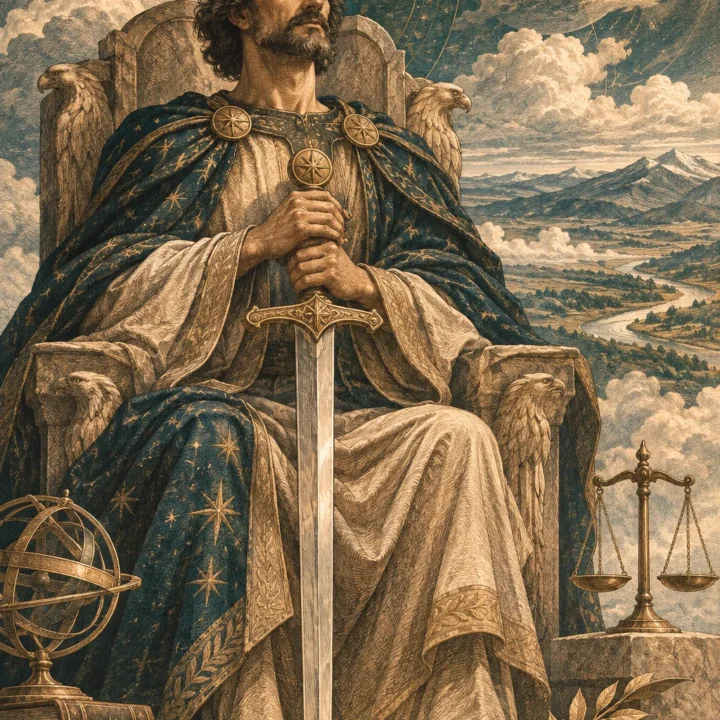
King of Swords
authority, judgment, clear thinking, responsibility
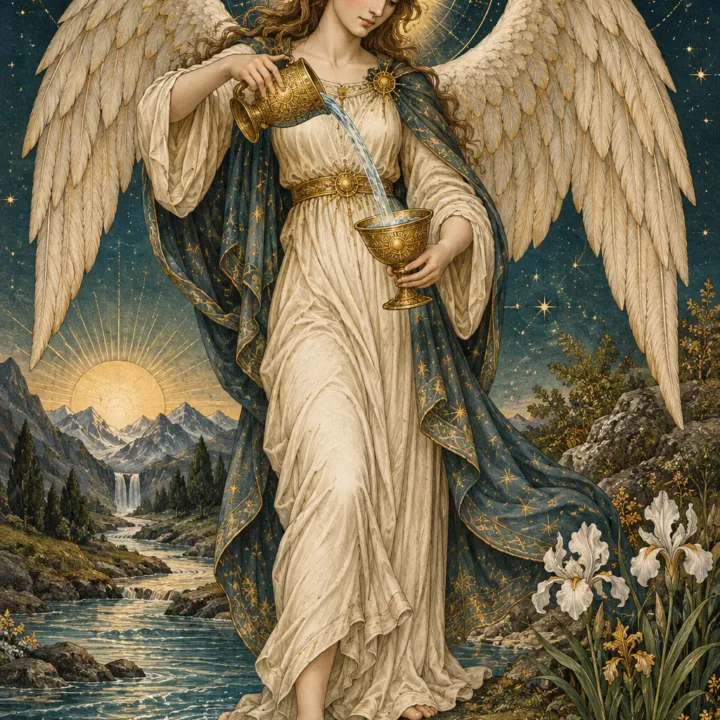
Temperance
moderation, integration, proportion, harmony
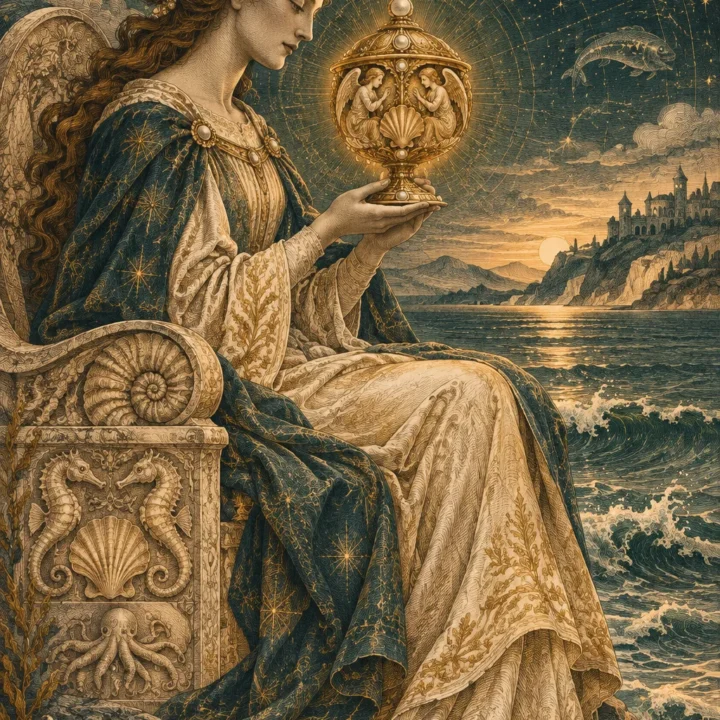
Queen of Cups
compassion, emotional understanding, imagination, intuition
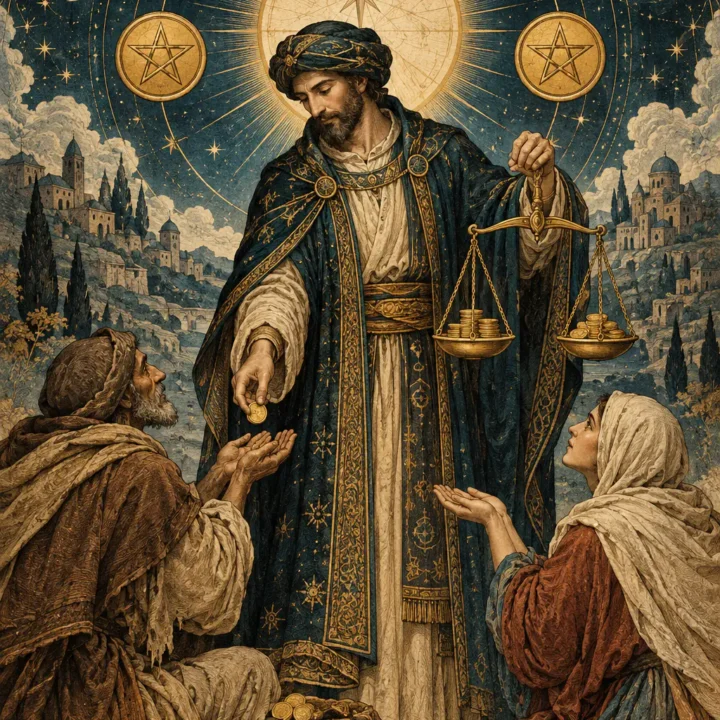
Six of Pentacles
generosity, assistance, reciprocity, shared resources
Sources and further reading
- A. E. Waite, The Pictorial Key to the Tarot, King of Cups Read the text
- Golden Dawn, Book T, Prince of the Chariot of the Waters Read the text
- Biddy Tarot, King of Cups, contemporary practitioner meanings Read the text
- Labyrinthos, King of Cups, modern meanings Read the text