King of Swords Tarot Card Meaning
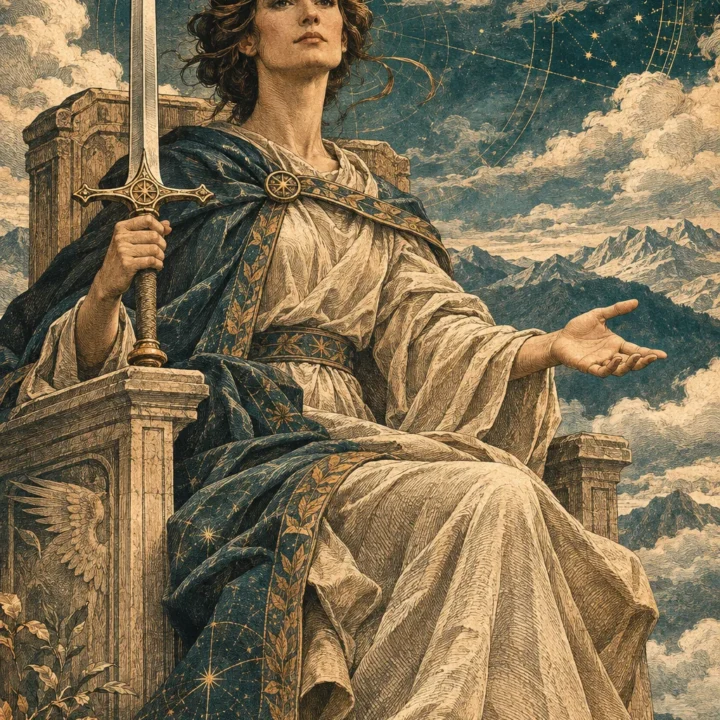
A crowned figure sits with a raised sword and a watchful gaze. The King of Swords explores authority, clear judgment, and responsibility for the words we use.
- authority
- judgment
- clear thinking
- responsibility
- fairness
Card at a glance
- Number
- King
- Element
- Air
- Astrology
- Golden Dawn Book T: King of Swords titled Prince of the Chariot of the Winds (Air of Air); mapping varies by rank or imagery
- Keywords
- authority, judgment, clear thinking, responsibility, fairness, ethical power
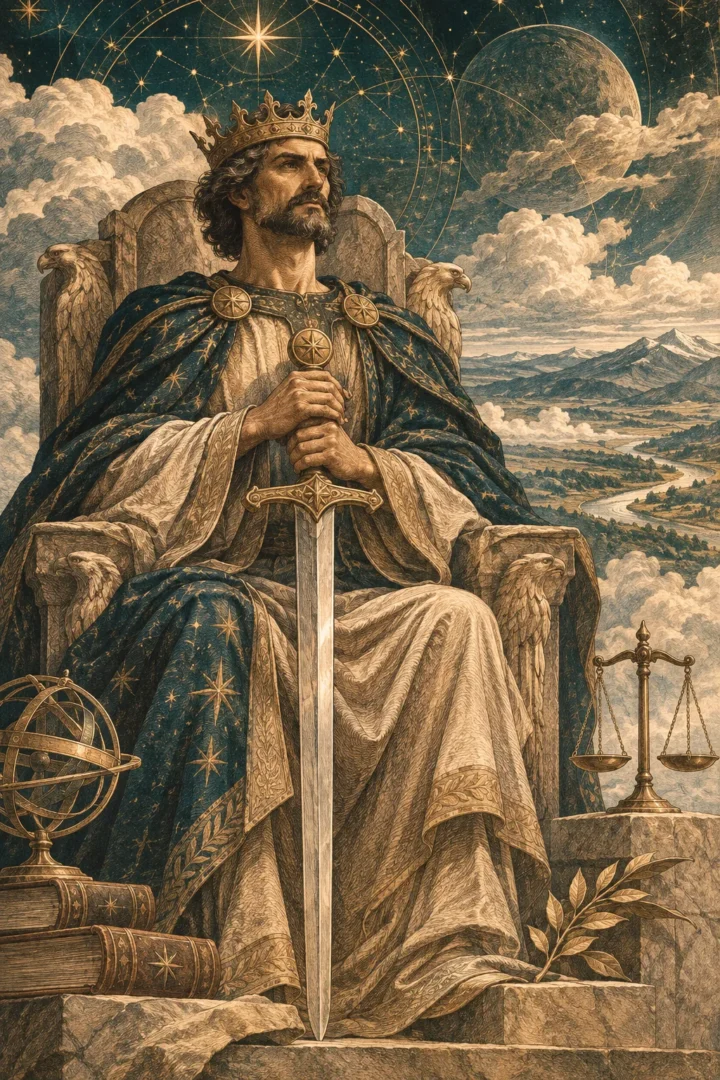 King · King of Swords
Upright meaning
ethical authority, rational judgment, responsibility
Upright, the King of Swords asks you to use expertise, language, and authority with fairness and care for consequences.
- ethical authority
- rational judgment
- responsibility
Reversed meaning
rigidity, misuse of authority, harsh judgment
Reversed, the King can reveal rules used without compassion, intellectual arrogance, or responsibility neglected by someone with power.
- rigidity
- misuse of authority
- harsh judgment
Card symbolism
-
The raised sword
The King holds an upright blade as a visible symbol of judgment and authority.
-
The throne
A seated ruler occupies a formal position, inviting questions about what power is for.
-
Open sky and distant birds
The airy setting places intellect and perspective around the figure, while the still pose contrasts with the charging Knight.
In depth interpretation
A king sits on a throne with an upright sword held before him. His posture is formal, the expression watchful. The landscape around him is broad and airy. He has the ability to judge, and the image asks what he will do with it.
The King of Swords represents clear thinking, authority, responsible judgment, knowledge, and the ethics of leadership. Upright, he encourages decisions grounded in evidence and principle. Reversed, he can show rigidity, unfair use of power, or reasoning that leaves little space for the people affected.
This card is concerned with what happens after knowledge becomes influence.
The spiritual meaning: the responsibility of a clear mind
You may have studied a subject for years, gained the trust of a community, or found yourself responsible for decisions affecting others. The King asks how you will use that authority.
Being knowledgeable can make your work easier. It can also make you less aware of what you have stopped questioning. The spiritual discipline of this card is the willingness to remain answerable.
A fair judgment considers evidence and consequences. It includes the humility to seek further understanding when facts are missing.
The King invites you to be precise. His deeper invitation is to remember that every important decision enters real lives.
The symbols of the King of Swords
The sword of judgment
Pamela Colman Smith gives the King a raised sword. Unlike the Knight, he is not charging toward an opponent. His authority is established and exercised from a seated position.
The blade can symbolize law, reason, boundaries, or a decision that must be made. It is a reminder that words and judgments can have far-reaching effects.
The throne and the seated figure
The throne represents a recognized position of influence. It might refer to a manager, teacher, elder, adviser, parent, or the part of yourself responsible for important choices.
In a reading, ask how that position was gained and what responsibilities accompany it. Authority without accountability can become dangerous.
Sky and distant movement
The open sky and small details in the background give the image perspective beyond the King’s immediate seat.
The scene may encourage you to think beyond a single argument or short-term outcome. A sound decision should be able to withstand wider scrutiny.
King of Swords upright: judgment in service of fairness
Upright, the King often points to clear reasoning, expertise, leadership, or the need for impartial evaluation. He may appear when you must set standards, resolve a disagreement, or make a choice that cannot satisfy everyone.
Imagine overseeing a small team. Two colleagues disagree over responsibility for a missed deadline. Rather than choosing the person you like better, you review the sequence of events, hear both accounts, and establish a clearer process.
This is King of Swords energy expressed well. Decisions remain difficult, but they are made with a defensible method.
You might also encounter the King as a mentor, specialist, or adviser. Notice whether their authority is supported by both knowledge and integrity.
King of Swords reversed: power without listening
Reversed, this card can describe a person or a pattern that treats rules as weapons. The language may sound logical while ignoring relevant circumstances. Decisions may be framed as objective even when they protect the decision-maker’s pride.
Sometimes the reversed King points inward. Perhaps you have become so attached to an explanation that you stop asking whether it is complete.
Waite’s older reversed language is severe and includes cruelty and evil intention. Such meanings belong to the historical record, but a tarot card does not prove that a real person has malicious motives.
Focus on observable conduct. Is there room for questions, appeal, and correction? If not, the problem may involve the structure of authority as well as individual behavior.
King of Swords in love and relationships
In love, the King can describe honest communication, reliable boundaries, and a person who tries to resolve problems through reason. It may also ask whether emotional needs are being heard within a highly analytical relationship.
If you are single, the card might reflect a desire for someone whose actions match their promises. It may also invite you to be clear about your own standards.
Reversed, check whether conversations have become lectures or whether one partner’s opinions always overrule the other’s experience.
In a feelings position, the card can suggest thoughtfulness or restraint, but it does not reveal someone’s private emotions. The King of Cups provides a complementary image of emotional steadiness and care.
Career, contracts, and money
At work, the King of Swords is especially relevant to strategy, leadership, policy, analysis, education, and decisions with consequences for others. It invites rigorous thinking supported by fairness.
For contracts or financial matters, the card encourages careful review and appropriately qualified advice. It does not certify that a deal is safe or a professional trustworthy.
Reversed, ask whose interests a rule serves and what evidence would justify changing it.
King of Swords versus Justice: who carries the responsibility?
Justice asks how facts, consequences, and fairness should be weighed. The King of Swords shows someone who has the authority to act on such reasoning. That distinction matters when a decision affects other people: an admirable principle still needs a responsible decision-maker.
Imagine a school administrator deciding how to distribute limited support. Justice draws attention to consistent criteria and the rights of those involved. The King asks whether the administrator has listened, explained the decision, and provided a way to correct mistakes. Beside the King of Cups, the reading might also ask how emotional steadiness can help authority remain humane.
In an advice position, the King may call for clear standards and the willingness to be accountable. Reversed as an obstacle, he can highlight a rule being used to silence disagreement. The spiritual lesson is that sound judgment remains open to information it did not originally possess.
Worked reading: how should I make a difficult team decision?
Imagine that you need to divide a limited training budget among colleagues. You draw the King of Swords for your responsibility, Six of Pentacles for the ethical concern, and Justice for the standard.
The King asks you to make a decision you can explain. The Six of Pentacles raises questions about access, need, and fair distribution. Justice encourages transparent criteria and consistency.
Together, they support documenting the criteria, inviting relevant information, and explaining the outcome respectfully. Someone may still be disappointed, but the process can remain accountable.
If The Emperor appeared instead of Justice, the reading might emphasize institutional structure and implementation. The King would still be responsible for how reasoning becomes policy.
Why the Golden Dawn calls the King a Prince
In Book T, the card labeled King of Swords is given the esoteric title Prince of the Chariot of the Winds. The Golden Dawn’s Prince corresponds to Air of Air. The source also describes a separate mounted figure, labeled Knight but called the King of the Spirits of Air. This is why tables of tarot court correspondences sometimes disagree.
Readers who match the decks by image commonly align Waite’s seated King with the Golden Dawn’s chariot Prince. Readers who prioritize hierarchy may place Waite’s King with the mounted senior ruler instead. A responsible interpretation names the system it is using rather than presenting one universal equivalence.
Waite’s own King is a figure of judgment and formal authority. Smith seats him on a throne, holding the sword of office. His meaning here rests first on that pictured responsibility; the Golden Dawn relationship adds a carefully bounded historical layer.
King of Swords as advice: make your reasons visible
Before an important choice, write down the evidence you are using, the interests affected, and what would lead you to reconsider. This is especially useful when your decision will shape another person’s opportunities.
If someone asks why, aim to offer an answer you can stand behind.
Frequently asked questions
Is the King of Swords a yes or no card?
He often favors a decision supported by careful reasoning, competence, and clear responsibilities. If you are seeking a quick endorsement without reviewing the facts, he asks you to do the work first.
Does the King of Swords represent a lawyer or authority figure?
It can in traditional and contemporary readings, but the card also symbolizes judgment and accountability as qualities. It does not prove that a specific official will become involved.
Is the King of Swords emotionless?
No. The card emphasizes rational authority. Wise judgment still needs awareness of human experience.
What does the King of Swords reversed mean about a person?
It may highlight rigidity or misuse of power as themes to examine. It cannot diagnose character or establish wrongdoing without evidence.
How is the King different from Justice?
Justice focuses on balance, truth, and accountability as principles. The King of Swords explores the person or role responsible for applying such principles in decisions.
Tradition note: This article centers Pamela Colman Smith’s Rider-Waite-Smith King and Waite’s themes of judgment and authority. Golden Dawn court ranks are handled as a related, differently organized esoteric system.

Keep reading
Explore the Swords
Every card page names the tradition behind each meaning, so you can compare readings instead of taking one as fixed.
Cards to explore alongside this one
Their symbols reveal useful similarities and differences for your next reading.
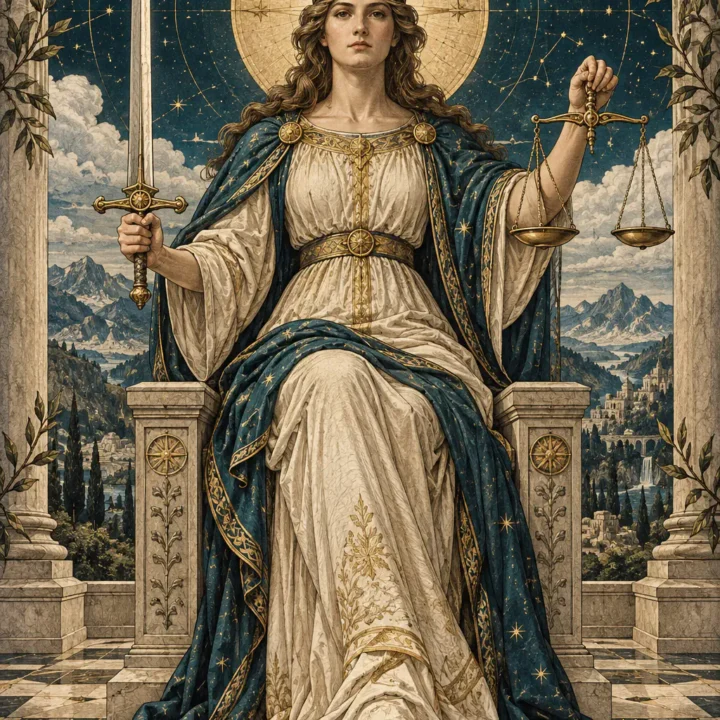
Justice
fairness, honesty, accountability, clarity
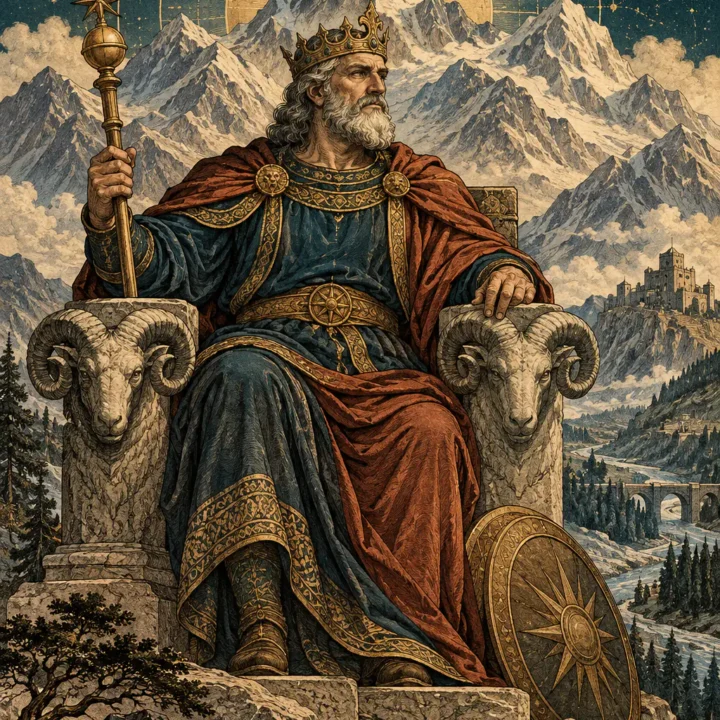
The Emperor
structure, reliability, discipline, leadership
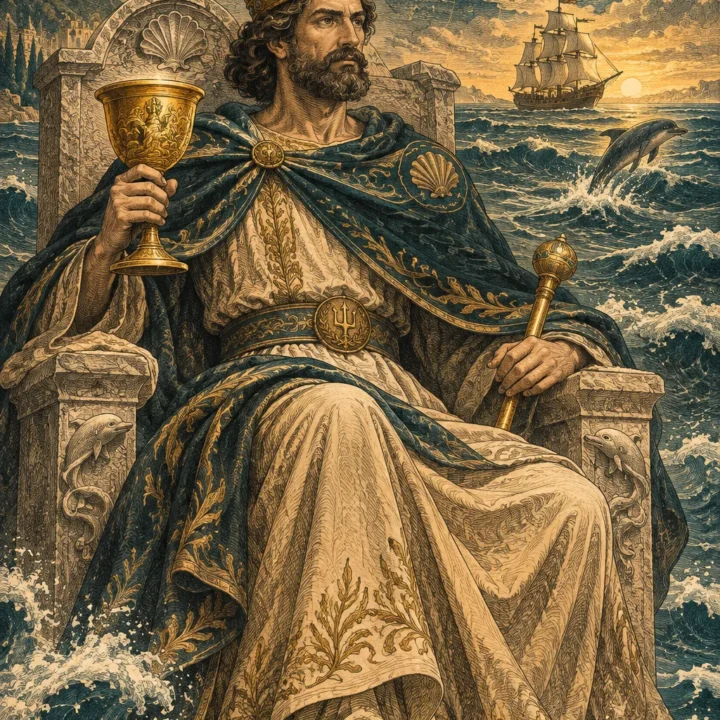
King of Cups
emotional steadiness, compassion, responsible judgment, diplomacy
Queen of Swords
discernment, boundaries, truthful compassion, independence
Sources and further reading
- A. E. Waite, The Pictorial Key to the Tarot, Part III (Swords, King of Swords) Read the text
- Golden Dawn, Book T, tarot titles, attributions, and card descriptions Read the text
- The Morgan Library & Museum, Pamela Colman Smith and her tarot art Read the text
- Victoria and Albert Museum, A History of Tarot Cards Read the text