Queen of Cups Tarot Card Meaning
Beside the sea, a crowned Queen contemplates a closed golden chalice. Her spiritual gift is the intuition that helps loving understanding become thoughtful action.
- compassion
- emotional understanding
- imagination
- intuition
- kindness
Card at a glance
- Number
- Queen
- Element
- Water
- Astrology
- Queen of the Thrones of the Waters, Water of Water.
- Keywords
- compassion, emotional understanding, imagination, intuition, kindness, receptive attention, thoughtful service.
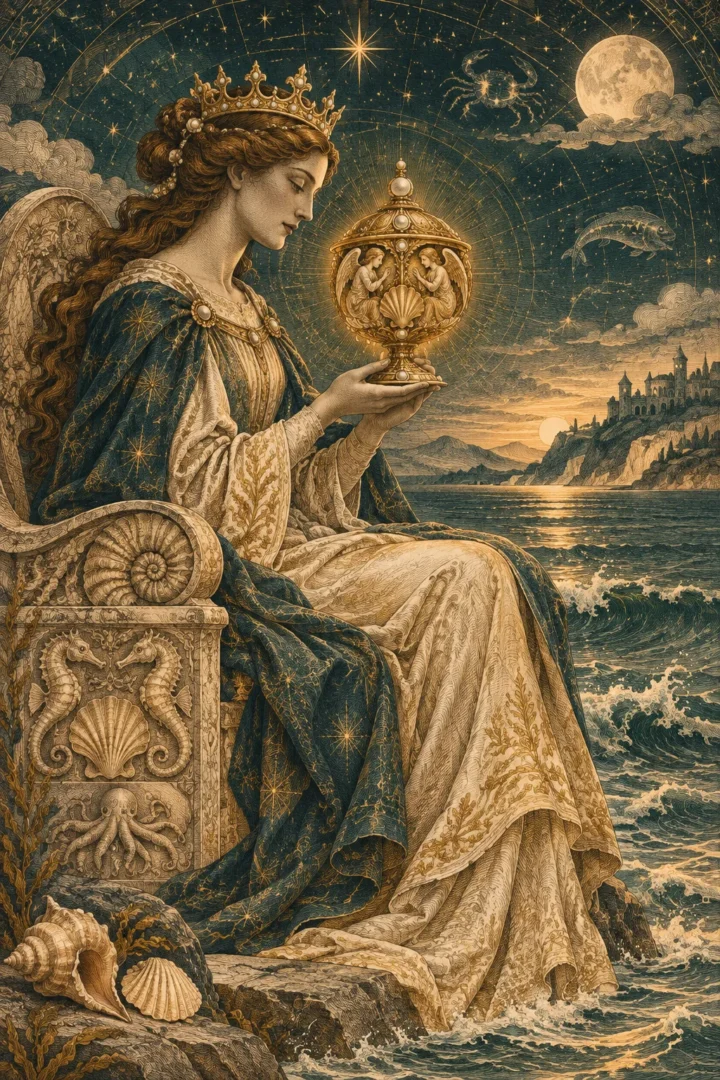 Queen · Queen of Cups
Upright meaning
compassion, emotional understanding, imagination
Upright, the Queen of Cups often describes a season in which listening and imagination are especially valuable. You may be helping a friend through an important transition, learning how to trust your creative instincts, or discovering that a patient conversation changes a relationship.
- compassion
- emotional understanding
- imagination
- intuition
- kindness
- receptive attention
Reversed meaning
emotional overwhelm, insecurity, unclear boundaries in contemporary practice; contradictory readings of goodness and mistrust in Waite's his
Contemporary readings often connect the reversed Queen with emotional exhaustion, blurred boundaries, insecurity, or the feeling that you are responsible for everyone else's wellbeing.
- emotional overwhelm
- insecurity
- unclear boundaries in contemporary practice; contradictory readings of goodness and mistrust in Waite's historical account.
In depth interpretation
A crowned woman sits at the edge of the sea, holding an extraordinary golden cup. It rises between her hands like a little shrine, ornamented with angelic figures and covered by a lid. Shells and sea creatures are carved into the stone throne. The water is close enough to hear, and the Queen's gaze remains gently fixed upon the vessel.
The Queen of Cups represents compassion, intuition, emotional wisdom, imagination, and the loving attention that helps a feeling become understood. Upright, she often appears when someone needs to be heard or when an inner vision is ready to guide a caring action. Reversed, she invites questions about emotional exhaustion, vulnerability, mixed impressions, and the difference between genuine understanding and what we hope to see.
The cup is closed. We cannot look inside it. The Queen has learned to sit with a mystery long enough for it to reveal something worth carrying into the world.
The spiritual meaning: listening deeply enough to act
Have you ever sat beside someone who was trying to explain a feeling they barely understood themselves? Perhaps they spoke in fragments, stopped to think, and tried again. You gave them time. A small change in their voice told you that being heard was helping.
The Queen of Cups understands the power of such a moment. In Pamela Colman Smith's illustration, she sits at the meeting place of land and sea. The landscape feels still around her, although the water continues moving.
She is often called the intuitive Queen, and that is an important part of her character. Yet her deepest gift extends beyond sensing emotion. She allows understanding to shape the way she acts.
Waite made an observation that many modern keyword lists overlook. He described the Queen as a dreamer whose activity nourishes her visions. This gives the card an active spiritual center. The person who listens with compassion can also offer thoughtful help, create something beautiful, or speak a truth that has been waiting for a gentle voice.
You may be that person in a reading. Or you may be longing for the kind of companionship in which your feelings have room to become clear.
The Queen invites you to honor what you know inwardly and discover how it might serve the life unfolding around you.
Beside the Queen of Swords, the invitation to care becomes more specific. This Queen attends closely to the feeling in a situation; her Swords counterpart asks what can be said clearly and what boundary may be needed. A friendship can need both warmth and directness at the same time.
What the covered cup, throne, and shore reveal
The ornate, covered chalice
Smith's Queen holds an elaborate cup with angel-shaped handles and a lid. It differs from the uncovered cup of the Page or the vessel carried by the Knight. The Queen studies something we cannot see.
Many contemporary readers use the closed cup as a symbol of private feeling, intuition, or the mysteries of the inner life. The image supports that contemplative interpretation, though Waite did not provide a fixed meaning for the lid in his short description.
The covered vessel can help you consider what needs time before it is shared. An emotion might be genuine even when you cannot yet explain it. A creative idea can grow quietly before you speak about it. Privacy sometimes allows meaning to ripen.
If you are asking about another person, remember that their inner world is their own. A beautiful tarot symbol does not grant permission to name someone else's secrets.
Her throne beside moving water
The Queen sits on a stone throne at the edge of the sea. Fish, shells, and watery shapes ornament the stone, and her feet rest on pebbles near the water.
There is a sense of contact with feeling without the Queen being physically carried away by the waves. This is one reason many readers associate her with compassionate presence: she can attend to an emotional experience while remaining in a position to respond.
The stones matter in a practical reading. Perhaps you have an instinct about a friendship that deserves attention. You can listen to it, ask a careful question, and remain open to learning more. The Queen's seat gives you an image for staying present as that understanding develops.
The angelic figures on the cup
The covered vessel is elaborately ornamented, including figures reminiscent of angels. Their presence contributes to the card's sacred atmosphere.
You might experience the cup as a place where prayer, creative vision, or tender concern is held with reverence. That interpretation is meaningful when it belongs to your own spiritual practice. It should not be presented as proof that an angel has delivered an instruction or that every dream contains a supernatural message.
The Queen's attentive posture offers a simpler spiritual practice: receive an impression with respect, then consider what wise and caring action it might inspire.
The horizon and the Queen's quiet gaze
The sea reaches toward a clear horizon. The Queen does not look out at us. Her attention remains with the cup.
Sometimes that is exactly what a moment requires. Other people's requests may be loud, and the Queen reminds you to give your own feelings a little room. You can return to the conversation with greater care once you've listened to yourself.
A card about compassion also belongs to the person who is offering it. When you have listened to everyone else, where do you go to be heard?
Queen of Cups upright: compassion with a living purpose
Upright, the Queen of Cups often describes a season in which listening and imagination are especially valuable. You may be helping a friend through an important transition, learning how to trust your creative instincts, or discovering that a patient conversation changes a relationship.
Imagine someone caring for a relative who has recently moved into a new home. The relative complains that everything feels unfamiliar. Instead of rushing to offer solutions, the caregiver sits with them and asks what they miss. They learn that the hardest part is losing a familiar morning routine. Together, they find a small way to bring it into the new place.
The Queen appears in that kind of attentive response. A feeling has been heard closely enough to reveal a useful direction.
Her energy can also be expressed through art, writing, music, and spiritual reflection. You may notice a recurring image in your dreams, make a drawing from it, and discover that the work helps you understand a feeling that had been difficult to name.
The card encourages you to trust the value of thoughtful attention. You can allow an impression to develop and look for a way to bring its meaning into ordinary life.
Queen of Cups reversed: when care becomes difficult to sustain
Contemporary readings often connect the reversed Queen with emotional exhaustion, blurred boundaries, insecurity, or the feeling that you are responsible for everyone else's wellbeing.
That can be a compassionate reading when you are the person who always receives late-night calls, remembers every birthday, or tries to keep a group at peace. You may love the people around you while needing more space than the current arrangement allows.
Waite's older reversed meanings are less consistent. He records a good woman in one account and a distinguished yet untrustworthy person in another, followed by harsher moral judgments. Those descriptions reflect a historical cartomantic vocabulary. They do not establish that a reversed Queen is deceptive, immoral, or dangerous.
Suppose a friend repeatedly asks for advice and becomes upset when you cannot respond immediately. A reversed Queen could help you name the strain. The practical question concerns how to preserve care while creating an agreement that respects both people's needs.
The card also invites you to examine your own impressions. You might feel certain that someone is disappointed in you without having asked. Tenderness can be mixed with worry, especially when a relationship matters deeply.
Listen to the feeling, then give the relationship enough room for a real conversation. That is a faithful way to work with the Queen's intuition.
Is the Queen of Cups a psychic or an empath?
The Queen's covered cup evokes the mystery of an inner life. Readers who work with psychic or empathic traditions may recognize their language of intuition here.
Those associations belong to spiritual interpretation; the image alone cannot reveal anyone else's private thoughts.
Perhaps a dream has stayed with you, or you have noticed a feeling that returns during conversations. Sit with it, then ask what the experience might be showing you about your own needs.
The Queen's dreaming is most meaningful when it shapes a thoughtful act of care.
The Queen of Cups as a person or inner quality
A court card can represent a person, a role, or an aspect of yourself that is becoming more important.
As a person, the Queen may evoke someone who listens deeply, creates beauty, or approaches difficult conversations with care. She might be a trusted friend, a family member, a spiritual companion, or an artist whose work gives feeling a form.
The historical figure is feminine, but the archetype can be expressed by anyone. People of different ages and genders can offer compassionate attention or develop an imaginative inner life.
As a role, the Queen may ask you to create a quieter space for understanding before making a decision. If she appears in a challenge position, the reading could turn toward the costs of caring without enough support.
The question you asked helps determine which meaning belongs at the center.
Queen of Cups in love and relationships
In love, the Queen of Cups often suggests warmth and the desire to be understood. You might be learning how to share feelings more openly, or discovering that a partner responds kindly when you speak about something vulnerable.
For someone single, the Queen may encourage attention to the qualities that make connection feel safe. A thoughtful conversation can be more revealing than an elaborate romantic gesture.
For established couples, she invites you to notice how you listen to one another. A recurring disagreement sometimes contains a need that neither person has expressed clearly. The Queen's patience may help you ask a better question.
Reversed, emotional labor deserves attention. If you are always expected to soothe hurt feelings while your own needs remain unspoken, the relationship may need a different balance.
Queen of Cups as feelings
In a feelings position, the Queen commonly symbolizes affection, kindness, emotional depth, and a desire to care. She cannot reveal what another person secretly thinks. Look at the connection as it exists through conversation, choices, and the ways each person responds.
Queen of Cups for work, creativity, and money
At work, the Queen can describe someone who recognizes the human side of an undertaking. They may be a teacher, colleague, artist, mentor, or person whose listening helps others express ideas clearly.
Imagine a community organizer planning an event for people whose needs are rarely considered. The Queen could symbolize asking participants what would make them feel welcome, rather than relying on assumptions. The answers might change the location, schedule, or format of the event.
In creative work, her covered cup can suggest a project that is still forming. Allowing yourself a private stage of exploration may help the work discover its own voice.
Money readings bring practical questions. Generosity is beautiful, yet it needs to fit your resources. If you are offering financial help, consider what you can sustain and whether the arrangement is clear to everyone involved.
The Queen can remind you that feelings are relevant to decisions with real consequences. Those decisions also need facts, fair agreements, and attention to your own needs.
The Golden Dawn Queen: Water of Water, an ibis, and a crayfish
In the Golden Dawn's Book T, the Queen of Cups is called the Queen of the Thrones of the Waters and associated with Water of Water. Its picture differs noticeably from Smith's seated woman holding an ornate covered vessel.
The Golden Dawn figure sits over flowing water with lotus flowers. An ibis appears beside her and in the emblems she wears. She carries a cup from which a crayfish emerges, while her other hand holds a lotus.
That design gives imagination a different shape. The Queen is surrounded by living emblems of water and creatures that appear openly in the image. Smith's Queen gazes at a closed cup whose contents remain private.
Book T also describes her as impressionable, poetic, and influenced by surrounding conditions. Its tradition allows a shadow of dependence on what is nearby. That nuance can enrich a reading about sensitivity without turning every sensitive person into someone unable to act.
The two designs belong to related but distinct esoteric settings. You can explore their echoes while preserving the individuality of each artist's symbolism.
How does the Queen differ from the High Priestess and the King of Cups?
The High Priestess sits between pillars, holding a sacred scroll in an image associated with hidden knowledge and spiritual mystery. The Queen of Cups belongs to the human realm of relationship and emotional understanding. Her inner listening becomes meaningful through the care she offers in the world.
The King of Cups presents a different challenge. His throne rests upon the sea, with a ship and a leaping creature nearby. His role can involve making fair decisions while remaining attentive to people's feelings. The Queen of Wands brings a different kind of warmth, where creative confidence encourages others to grow.
If Queen and King appear together, consider whether a situation needs more understanding, a clearer response, or both. The Queen can illuminate what is felt. The King may ask how that understanding should guide action that affects others.
These differences are especially useful when several court cards appear in one spread.
Worked reading: how can I support a grieving friend without exhausting myself?
Imagine a friend has been calling frequently after a painful loss. You want to be present for them, but you have begun to feel overwhelmed and worry that saying so would seem unkind. You draw the Queen of Cups for your intention, Strength for how to respond, and the Six of Pentacles for the balance to consider.
The Queen honors your tenderness and willingness to listen. Strength brings patience and gentle courage, including the ability to have an uncomfortable conversation with care. The Six of Pentacles asks how help is being given, whether it can be sustained, and which additional forms of support may be available.
Together, the cards could suggest offering a regular time to talk, asking what kind of company would help most, and encouraging a wider circle of trusted people to share the care where appropriate.
If Temperance appeared instead of the Six of Pentacles, the reading might place greater emphasis on rhythm, timing, and gradual adjustment.
The spread cannot tell you what your friend is feeling without asking them. It offers a way to remain genuinely present without making promises you cannot keep.
Queen of Cups as advice: give your intuition a gentle task
Look at the Queen's covered cup. Imagine holding something private that matters to you: a feeling, a dream, a hope, or a question that has not yet found words.
Write down what you know about the experience and what you are still wondering. Notice whether you are interpreting a real event or filling in details because you are afraid of what someone might think.
If the feeling calls for action, choose a small one. You might ask an honest question, offer a kindness, or spend time making art from an image that has stayed with you.
The Queen's cup is worthy of reverence. So is the life that waits beyond it.
Is the Queen of Cups a yes or no card?
The Queen of Cups generally leans toward a compassionate yes when a decision involves sincere care, creative reflection, or an opportunity to listen more deeply. Reversed, examine whether the arrangement supports your wellbeing and whether your understanding rests on clear information. The card cannot guarantee another person's response.
A note on tradition
This reading centers on Pamela Colman Smith's Rider-Waite-Smith Queen of Cups, first published in 1909, and Waite's description of a visionary figure whose actions help nourish her dreams. His reversed associations are contradictory and belong to their historical context. The Golden Dawn's Queen of the Thrones of the Waters has a different image, including an ibis and a crayfish. Modern readings about boundaries, empathy, and self-care can enrich the picture when treated as contemporary interpretation.
Frequently asked questions
Why is the Queen of Cups holding a closed cup?
Smith's Queen holds an unusually ornate vessel with a lid. Contemporary readers often take it as a symbol of private feelings, intuition, or an inner world not readily shared. Waite did not assign the lid one compulsory meaning.
How can I work with the Queen's intuition?
Try a quiet cup meditation: notice one feeling that has been returning, then write what it seems to ask of you. Before acting, distinguish the impression from what you know about the situation. The Queen's wisdom becomes useful when it helps you offer care, create something, or ask an honest question.
Is the reversed Queen of Cups always emotionally unstable?
No. Modern interpretations include overwhelm and difficulty with boundaries, while Waite recorded inconsistent and sometimes favorable reversed accounts. The relevant question is what is happening in the situation, not whether the card can label a person.
How is the Queen of Cups different from the Queen of Pentacles?
The Queen of Cups emphasizes emotional understanding and imaginative attention. The Queen of Pentacles is more concerned with material care, practical resources, and a nurturing environment. Together, they invite you to ask what someone needs emotionally and what practical support could help.
Does the Queen of Cups indicate motherhood?
Waite included motherhood and the ideal of a spouse among his historical meanings. The Queen can describe caring qualities in many relationships and roles. There is no requirement that the card represent a mother or predict pregnancy.

Keep reading
Explore the Cups
Every card page names the tradition behind each meaning, so you can compare readings instead of taking one as fixed.
Cards to explore alongside this one
Their symbols reveal useful similarities and differences for your next reading.

Queen of Swords
discernment, boundaries, truthful compassion, independence
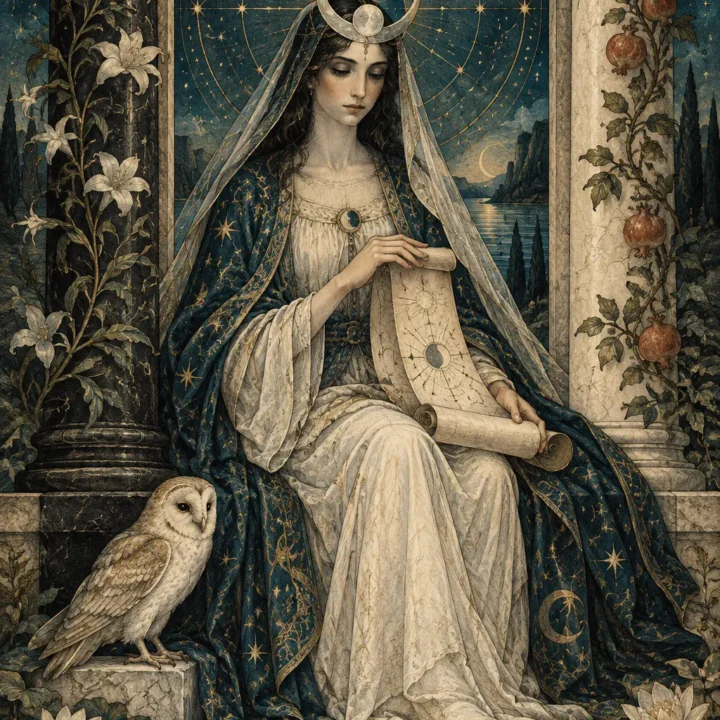
The High Priestess
intuition, contemplation, inner knowledge, privacy
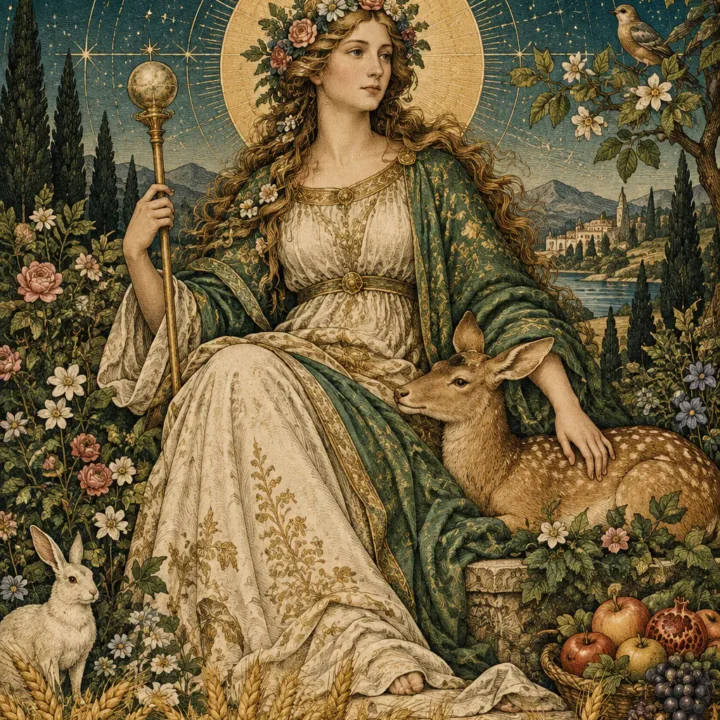
The Empress
creativity, generosity, sensuality, pleasure

King of Cups
emotional steadiness, compassion, responsible judgment, diplomacy
Sources and further reading
- A. E. Waite, The Pictorial Key to the Tarot, Queen of Cups Read the text
- Golden Dawn, Book T, Queen of the Thrones of the Waters Read the text
- Biddy Tarot, Queen of Cups, contemporary practitioner meanings Read the text
- Labyrinthos, Queen of Cups, modern meanings and imagery Read the text