Three of Wands Tarot Card Meaning
Three planted staffs overlook ships crossing a golden sea. The Three of Wands reveals what happens when your hopes become a living undertaking, and why its reversal has more than one tradition.
- established strength
- expansion
- enterprise
- cooperation
- progress
Card at a glance
- Number
- Three
- Element
- Fire
- Astrology
- Lord of Established Strength, the Sun in Aries (Golden Dawn)
- Keywords
- established strength, expansion, enterprise, cooperation, progress, horizons opening
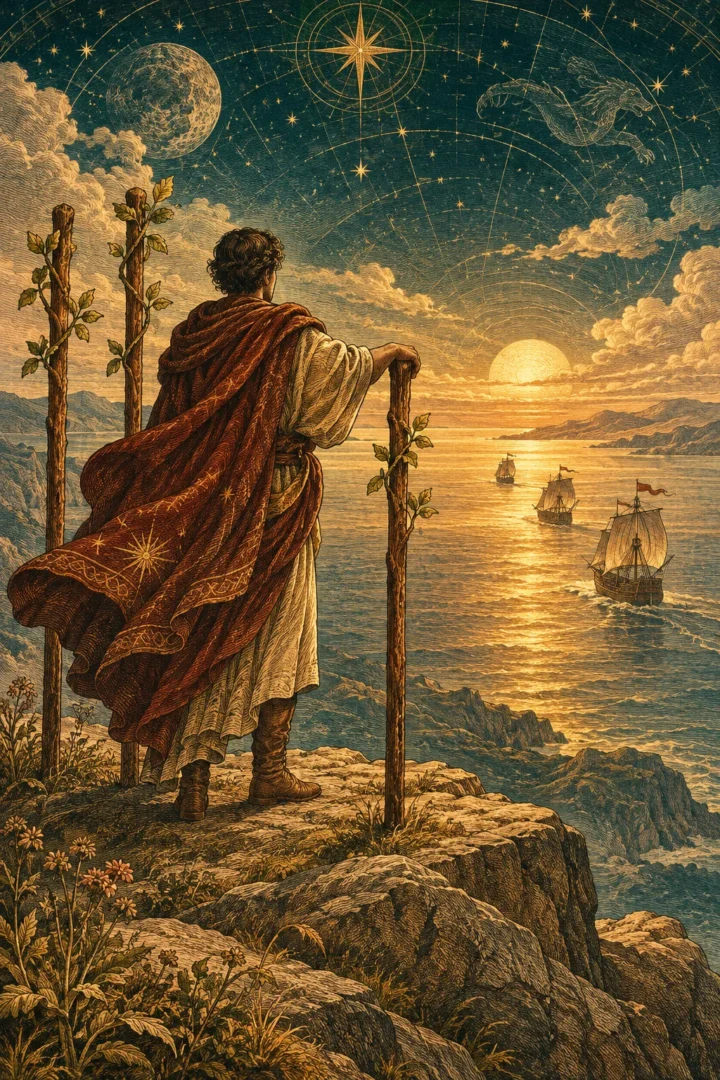 Three · Three of Wands
Upright meaning
Established strength, expansion and enterprise
The upright Three of Wands suggests that effort is beginning to develop reach. You have passed the first moment of inspiration and have something real underway. The next stage may involve people, markets, travel, or possibilities that did not exist when you started. Imagine a singer who has performed locally for years and has finally released a small collection of songs. Listeners begin sharing them, and a musician in another city offers to collaborate. The Three is present in the widening circle. It also speaks to the singer's experience, because she has already learned enough to recognize a promising invitation. This is an especially useful card for cooperation. Waite gave the image a commercial setting and associated it with someone capable of helping another person in business. In a contemporary reading, that could mean an informed partner, a mentor, or a genuine opportunity to work across boundaries. The horizon can be exciting and uncertain. Look for evidence of movement: work completed, relationships formed, people responding, lessons learned. If the answer is still pending, the card asks you to tend the undertaking while allowing time for the wider world to respond.
- Established strength
- Expansion
- Enterprise
- Cooperation
- Progress
- Horizons opening
Reversed meaning
Delays or restricted growth and relief from adversity
The reversed Three of Wands is a good example of why tarot meanings need context. In many contemporary guides, the reversal suggests stalled expansion, delays, or plans that need rethinking. That approach treats the upright card's outward momentum as constrained. If you have launched something and keep encountering logistical barriers, this reading may fit the lived situation. Waite's account is surprisingly different. His reversed meaning describes adversity and disappointment coming to an end. In that tradition, the same reversed card can suggest a burden lifting or the closure of a frustrating period. These readings lead to different questions. If a collaborator has missed three deadlines and nothing has changed, consider the modern emphasis on obstacles and what you can renegotiate. If an exhausting dispute has finally been settled, Waite's more hopeful reversal may resonate. You do not need to make both meanings fit. Choose a reversal method before reading when possible, then use the question, the card's position, and its neighbors to explore what the image brings into focus. The reversal alone cannot establish whether a promised result is about to arrive.
- Delays or restricted growth
- Relief from adversity
Card symbolism
-
The figure with his back turned
Pamela Colman Smith lets us look toward the same horizon as the figure.
-
Three planted staffs and a resting hand
The staffs are anchored in the ground, and the figure leans slightly on one.
-
The ships on the golden sea
The ships are the heart of this card.
In depth interpretation
A cloaked figure stands high above the sea, one hand resting on a planted wand. Two more staffs rise beside him. His back is turned to us, and out on the golden water, ships are sailing. Whatever he has begun is now traveling into a world he cannot see from end to end.
The Three of Wands represents established effort, expansion, enterprise, and the courage to let your work meet the wider world. Upright, it often speaks of a project gaining reach, a partnership taking shape, or progress you can finally see beyond your own hands. Reversed, interpretations differ: many contemporary readers see delays, while A. E. Waite's older description associates this reversal with troubles coming to an end.
There is something quietly powerful in the figure's stillness. He has already done enough to give the ships a journey. Now he must learn what his effort can become beyond him.
The spiritual meaning: your work has entered the world
Consider the moment after you share something you have poured yourself into. You send a manuscript to an editor, open registration for a class, or ask someone to collaborate on a dream. The work was yours while you held it close. Now other people have a part in its future.
The Three of Wands lives in that change. In the Rider-Waite-Smith image, the figure stands securely on the cliff, looking at ships in open water. His presence is calm. He has reached a point where he can watch what he has begun and judge what it needs next.
The story has a more active center than the usual idea of waiting for good news. Waite described these vessels as belonging to the person on the cliff, carrying his merchandise across the sea. Read this way, the card is about an undertaking that exists beyond private imagination. There are consequences, relationships, and possibilities already moving.
If this card appears for you, consider what you have actually set in motion. A heartfelt wish is important, and the Three asks you to recognize the effort that has already given it a place in the world. You may also need to loosen your grip on how everything unfolds.
What the symbols in the Three of Wands reveal
The figure with his back turned
Pamela Colman Smith lets us look toward the same horizon as the figure. His face and mood remain hidden. We can imagine confidence, anticipation, or a certain loneliness, though none is specified by the image.
His back is a useful detail in questions about visibility. Perhaps you have been working without much recognition, or are beginning to understand that the work matters beyond the praise you receive for it. What would you still want to bring into the world if the outcome arrived quietly?
Three planted staffs and a resting hand
The staffs are anchored in the ground, and the figure leans slightly on one. They offer an image of something established enough to support him while his attention travels outward.
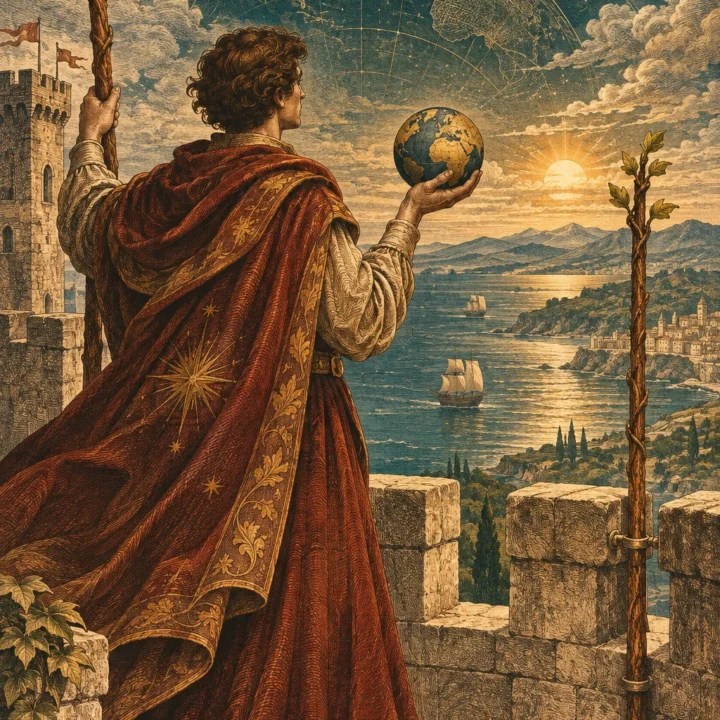
This gives the Three a different atmosphere from the Ace of Wands, with its unclaimed gift, or the Two of Wands, where someone holds a globe while standing within a fortified domain. The Three has the weight of an endeavor that has begun.
In practice, that might mean skills you have developed, people you have already contacted, or work already delivered. Name the foundations before deciding whether you have made progress.
The ships on the golden sea
The ships are the heart of this card. They represent commerce and discovery in Waite's written interpretation, and many modern readers take them as symbols of expansion, travel, or opportunity.
An important detail is often lost: the image and Waite's description do not tell us that the ships are returning with a reward. They are passing over the sea. The card therefore gives a stronger basis for reading movement and enterprise than for promising a specific message or reunion.
If the vessels draw your eye, ask what is moving through other people's hands now. A collaborator may be reviewing your proposal. A friend is considering an invitation. An audience has encountered your work. What part of the voyage still needs your attention?
Three of Wands upright meaning: established strength
The upright Three of Wands suggests that effort is beginning to develop reach. You have passed the first moment of inspiration and have something real underway. The next stage may involve people, markets, travel, or possibilities that did not exist when you started.
Imagine a singer who has performed locally for years and has finally released a small collection of songs. Listeners begin sharing them, and a musician in another city offers to collaborate. The Three is present in the widening circle. It also speaks to the singer's experience, because she has already learned enough to recognize a promising invitation.
This is an especially useful card for cooperation. Waite gave the image a commercial setting and associated it with someone capable of helping another person in business. In a contemporary reading, that could mean an informed partner, a mentor, or a genuine opportunity to work across boundaries.
The horizon can be exciting and uncertain. Look for evidence of movement: work completed, relationships formed, people responding, lessons learned. If the answer is still pending, the card asks you to tend the undertaking while allowing time for the wider world to respond.
Three of Wands reversed meaning: delay or the end of trouble?
The reversed Three carries two different possibilities worth holding with care.
In many contemporary guides, the reversal suggests stalled expansion, delays, or plans that need rethinking. That approach treats the upright card's outward momentum as constrained. If you have launched something and keep encountering logistical barriers, this reading may fit the lived situation.
Waite's account is surprisingly different. His reversed meaning describes adversity and disappointment coming to an end. In that tradition, the same reversed card can suggest a burden lifting or the closure of a frustrating period.
These readings lead to different questions. If a collaborator has missed three deadlines and nothing has changed, consider the modern emphasis on obstacles and what you can renegotiate. If an exhausting dispute has finally been settled, Waite's more hopeful reversal may resonate.
Choose the interpretive method you normally use, and consider what is happening in the situation. A delay asks for a different response than the welcome end of a difficult season.
Three of Wands in love and relationships
In love, the Three of Wands often belongs to the stage when a connection begins asking for shared decisions. You might be talking about visits, moving closer, meeting important people in each other's lives, or discovering what a future together would involve.
For a long-distance relationship, the ships can be especially moving. They evoke the effort of crossing distance and staying connected while other parts of life continue. Practical questions matter here: who will travel, when will you next meet, and what are you each willing to build?
If you are single, the card may reflect greater openness to meeting people beyond your familiar circle. For established partners, it can suggest a shared project or a fresh experience that gives the relationship room to grow.
Reversed, consider the method you use. A contemporary shadow reading may highlight uncertain plans or unequal effort. A historically informed reading might instead describe a difficult stretch easing. Give more weight to what both people actually say and do than to the promise of a ship on the horizon.
Three of Wands as feelings
As feelings, the Three of Wands suggests interest in possibilities beyond the present moment or a desire to see how a connection develops. It cannot confirm that someone intends to return or commit. Look for participation in actual plans and care shown over time.
Three of Wands for career and money
For career questions, this card commonly speaks of enterprise that has outgrown its first setting. A growing project may need collaborators, a wider audience, or clearer arrangements about how the work will be shared.
Suppose a small craft business receives requests from people abroad. The Three can express the excitement of a wider market, including the need to learn about delivery, customer expectations, and whether the new demand is sustainable. Its strength comes from what has already been built.
In financial matters, a venture in motion is an invitation to review actual evidence. Look at costs, agreements, demand, and the people involved. The Three is not a guarantee of profit, even when the picture feels expansive.
Reversed, the useful questions involve what has changed. Perhaps a partner is withdrawing, the timeline has slipped, or an old obstacle is finally being resolved. Determine which story the circumstances support.
How to read the Three of Wands with surrounding cards
The Three often represents movement beyond a decision you have already made. In a present position, it can describe existing progress and dependence on others. As advice, it points toward cooperation and reviewing the horizon from a stable base. As an outcome, it suggests that an undertaking could develop reach, while leaving the specific result open.
Worked reading: should I continue a creative project after a slow launch?
Imagine a three-card reading with the Three of Wands in the present, the Three of Pentacles as the challenge, and the Seven of Pentacles as advice.
The Three of Wands shows that the work has left your private world. You have launched something and are watching how it travels. The Four of Wands imagines the welcome that may follow when a stage of that work can be celebrated. The Three of Pentacles draws attention to shared craftsmanship. Are your collaborators clear about their roles? Are you receiving the feedback needed to improve the work? The Seven of Pentacles asks you to assess what has grown, how long growth takes, and whether the results justify another season of effort.
Together, the cards favor an honest review of the undertaking. You might seek feedback and revise the offering before deciding whether to invest more. There is no prediction that growth is guaranteed.
If the Three of Wands were reversed, the reading would change with your chosen reversal approach. A modern reading could emphasize the stalled launch; Waite's approach might invite you to notice whether the period of frustration is nearing resolution. The surrounding Pentacles encourage you to investigate the work and its results either way.
Sun in Aries and the Lord of Established Strength
In the Golden Dawn's Book T, the Three of Wands bears the title Lord of Established Strength and corresponds to the Sun in Aries. That system associates the card with realized effort, strength, and hope taking form. It also recognizes pride and overconfidence as possible shadows.
These are Golden Dawn correspondences. The Golden Dawn's own card design differs from Smith's sea-facing figure, so it helps to treat the astrological title as a complementary tradition rather than as a secret explanation of every visual detail.
Spiritually, the title brings you back to a simple question: what strength have you already cultivated, and how will you use it once your undertaking reaches other people?
Three of Wands as advice: a practice for the waiting shore
Set the card before you and imagine three things: the ships, the staffs, and the stretch of sea between them. In your journal, name one undertaking already moving beyond your direct control. Then write what supports it, who else is involved, and what you can learn while it travels.
Choose one action that genuinely helps the process, such as a thoughtful follow-up or a request for feedback. Give yourself permission to leave the rest alone for a little while. Constant checking cannot steer a vessel already at sea.
Is the Three of Wands a yes or no card?
The Three of Wands usually leans toward continuing an undertaking that has a sound foundation and room to grow. It asks you to recognize real progress and the part other people play. Reversed, an answer depends particularly on whether you read the card through contemporary delays or Waite's older association with relief from difficulties.
A note on tradition
This interpretation centers on Pamela Colman Smith's Rider-Waite-Smith illustration, first published in 1909, and distinguishes it from the Golden Dawn's earlier occult framework. Waite's meanings include enterprise, discovery, trade, and cooperation, with a reversed association that is more favorable than many modern keyword lists. Book T associates the Three with established strength and the Sun in Aries.
Frequently asked questions
Does the Three of Wands mean travel?
Travel and overseas opportunities are common modern readings, supported by the ships and distant sea. The card does not confirm a booking or a journey. Consider whether your actual question concerns distance, expansion, or a venture involving other places.
Are the ships in the Three of Wands arriving or leaving?
The Rider-Waite-Smith image shows ships passing across the water. Waite describes them as the figure's ships carrying goods, without specifying a homecoming. This is why the card can speak clearly about enterprise and movement while leaving the exact destination unresolved.
Does the Three of Wands mean someone will come back?
The ships sometimes inspire reunion interpretations, especially in relationship readings. There is no guarantee of someone's return. Look for signs of communication and mutual effort outside the cards.
What is the difference between the Two and Three of Wands?
The Two of Wands shows a person considering a wider world from a castle. The Three places a figure on the cliff above ships already moving at sea. The interpretive shift is from choosing a direction toward engaging with an undertaking already in progress.

Keep reading
Explore the Wands
Every card page names the tradition behind each meaning, so you can compare readings instead of taking one as fixed.
Cards to explore alongside this one
Their symbols reveal useful similarities and differences for your next reading.
Two of Wands
vision, established power, longing, ambition

Eight of Wands
speed, momentum, communication, travel
Six of Swords
transition, moving on, passage, recovery

Wheel of Fortune
turning points, cycles, opportunity, changing conditions
Sources and further reading
- A. E. Waite, The Pictorial Key to the Tarot, Part III, Wands Read the text
- Golden Dawn Tarot material, including Book T titles and the Sun-in-Aries attribution Read the text
- The Morgan Library & Museum, Pamela Colman Smith and the Rider-Waite-Smith deck Read the text
- Biddy Tarot, Three of Wands, contemporary reversed interpretation Read the text
- Labyrinthos, Three of Wands, contemporary reading Read the text