Eight of Pentacles Tarot Card Meaning
A craftsperson works at a bench beneath a row of finished pentacles. Discover the Eight of Pentacles and the quiet art of growing skilled through repeated care.
- diligence
- learning
- craft
- deliberate practice
- improvement
Card at a glance
- Number
- Eight
- Element
- Earth
- Astrology
- Sun in Virgo; Lord of Prudence (Golden Dawn)
- Keywords
- diligence, learning, craft, deliberate practice, improvement
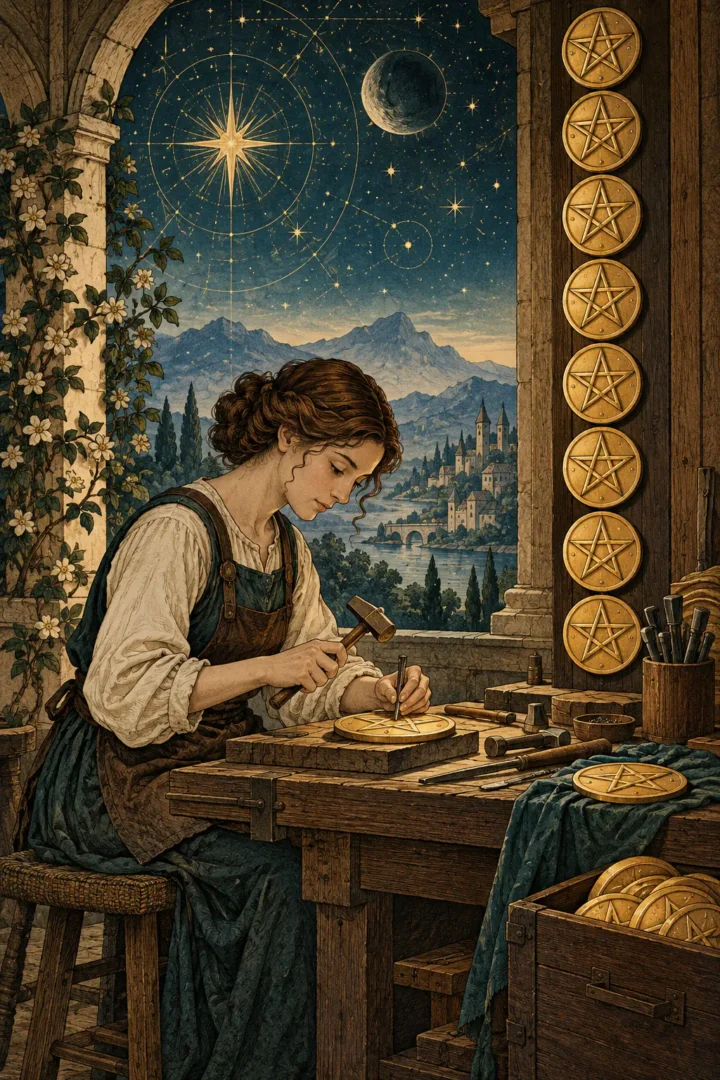 Eight · Eight of Pentacles
Upright meaning
Diligence, learning and craft
Upright, the Eight of Pentacles often appears when a skill needs deliberate practice. You may be learning a craft, studying for a qualification, refining a professional process, or discovering the value of a steady creative routine.
- Diligence
- Learning
- Craft
- Deliberate practice
- Improvement
Reversed meaning
Perfectionism, shortcuts and monotony
Reversed, the workshop may have become an uncomfortable place. You keep polishing a detail long after it has stopped improving the result. A project is never ready to share because you can always find one more flaw.
- Perfectionism
- Shortcuts
- Monotony
- Misdirected effort
- Exhaustion
Card symbolism
-
The craftsperson seated at the bench
The worker bends close to the pentacle in front of him. His posture suggests that the task deserves attention, and his body is positioned to carry it out with precision.
-
The hammer and work in progress
A hammer is raised over the newest disk. The tool makes the process visible, including the small possibility of an error.
-
The finished pentacles and the one below
Six disks are displayed in a vertical row, and another rests on the ground. The arrangement lets you see work that has already been completed alongside the piece now taking shape.
-
The distant town
Buildings appear far behind the work area. The craftsperson has found some distance from the activity of ordinary social life.
In depth interpretation
A craftsperson sits at a wooden bench, hammer raised over a golden pentacle. Six finished disks hang in a neat row beside him, another lies at his feet, and the newest piece receives his full attention. A little town stands in the distance. For now, his whole world seems to fit beneath the small movement of his hand.
The Eight of Pentacles is the tarot card of practice, craftsmanship, apprenticeship, and the devotion that grows through repeated effort. Upright, it often appears when you are learning something worth doing well or refining a skill you already possess. Reversed, it can draw attention to perfectionism, careless work, lost motivation, or the risk of spending all your energy on details that no longer serve the larger purpose.
If you drew this card, listen for the imagined sound of the hammer. What would you love to become better at, one careful attempt at a time?
The quiet magic of doing something again
Perhaps you remember the first time you tried to make something with your hands. The dough would not hold together, the paint looked different from what you imagined, or your fingers stumbled over the first notes of a melody. The result was awkward, and you tried again.
Much later, you notice how naturally the action comes. Your hands have learned a movement you once had to think through carefully. You can give more attention to the person who will enjoy the meal, the feeling of the music, or the shape of the thing you are making.
The Eight of Pentacles honors that kind of becoming. It is intimate and physical. Progress arrives through the relationship between attention and action, especially when you are willing to learn from what the material tells you.
There is a spiritual quality to returning to a task with care. A familiar prayer can take on a new shade of meaning. A craft practiced over years can become a way to notice beauty. Even a routine that looks ordinary from the outside may have a quiet dignity when it expresses your values.
The card has room for difficulty too. Repetition can become dull, the demand to improve can become harsh, and valuable skill can be used in work that leaves a person exhausted. The craftsperson offers an image of dedication worth contemplating alongside the conditions that make such dedication possible.
The Page of Swords brings another kind of student into the room. The Page questions, observes, and gathers evidence; the Eight of Pentacles stays with a skill until the hands know it. Drawing both can invite a practical rhythm: ask the right question, then give yourself time to learn through doing.
Symbols in the Eight of Pentacles
Pamela Colman Smith filled the Rider-Waite-Smith card with evidence of actual labor. The tools, disks, and little town help make a moment of concentrated work feel almost tangible.
The craftsperson seated at the bench
The worker bends close to the pentacle in front of him. His posture suggests that the task deserves attention, and his body is positioned to carry it out with precision.
You may recognize this feeling when an activity absorbs you so fully that time seems to pass differently. That experience can be nourishing when you have chosen the work and have room to rest afterward.
The scene invites a useful question: what would help you give meaningful attention to the thing you are learning?
The hammer and work in progress
A hammer is raised over the newest disk. The tool makes the process visible, including the small possibility of an error. Each strike changes the material.
When the hammer catches your eye, consider the methods you rely on. A good tool or a thoughtful teacher can make practice easier. You might be ready to learn a more effective technique instead of repeating an approach that has begun to frustrate you.
The finished pentacles and the one below
Six disks are displayed in a vertical row, and another rests on the ground. The arrangement lets you see work that has already been completed alongside the piece now taking shape.
There is something encouraging about keeping earlier efforts in view. A musician’s first recordings, a gardener’s photographs, or a writer’s early drafts can reveal progress that daily practice makes difficult to notice.
The image also raises a question about purpose. Are these pieces being made for a specific person or project? What will happen to them once the worker leaves the bench?
The distant town
Buildings appear far behind the work area. The craftsperson has found some distance from the activity of ordinary social life.
Focus can be precious, especially when a task needs uninterrupted attention. Yet the town remains part of the picture. The work will eventually belong in a world filled with people and relationships. That connection can help you decide how much of your life you want to devote to it.
Eight of Pentacles upright meaning
Upright, the Eight of Pentacles often appears when a skill needs deliberate practice. You may be learning a craft, studying for a qualification, refining a professional process, or discovering the value of a steady creative routine.
Imagine someone learning to play a simple piece on the piano. At first, the left hand arrives a moment late, and the rhythm falls apart. A teacher suggests practicing two short passages slowly before playing the entire piece again. The following week, the music has begun to flow. The Eight can describe that satisfying moment when a small change in method produces real improvement.
It can also recognize work that has become invisible through familiarity. You may have developed a useful skill over years, and other people now rely on it without seeing the care involved. Take time to acknowledge what your knowledge contributes.
The card encourages curiosity about quality. What is the next thing worth learning? Which part of the process would benefit from a thoughtful revision? Consider the answers in relation to the life you want the work to support.
Eight of Pentacles reversed meaning
Reversed, the workshop may have become an uncomfortable place. You keep polishing a detail long after it has stopped improving the result. A project is never ready to share because you can always find one more flaw.
Another expression is carelessness born of boredom or pressure. Perhaps you are rushing through tasks that once mattered to you, or your work conditions give you no chance to learn from mistakes.
The Golden Dawn’s older title, Lord of Prudence, carries a particularly interesting warning: attention to small matters can come at the expense of larger ones. You might spend an afternoon adjusting a document’s formatting while avoiding the difficult decision the document is meant to support.
If the reversal speaks of exhaustion, look at the demands surrounding the task. A better method may help, and so might reasonable expectations, proper compensation, or time away from the bench. Your worth does not depend on an endless demonstration of productivity.
Eight of Pentacles in love and relationships
In love, this card often speaks through repeated gestures of care. A partner remembers how you like to begin the morning. Someone learns to listen more patiently during disagreements. Two people return to a difficult conversation with the hope of understanding it better.
Imagine a couple who regularly misunderstand each other’s messages during busy days. They agree to talk about important subjects in person whenever possible. The adjustment is simple, yet it might change the way their relationship feels.
For someone single, the Eight of Pentacles can suggest becoming more aware of your own habits in relationships. You may be learning to express a need clearly or recognize when your energy is not being met with care.
Reversed, the card can reveal a relationship that feels like constant work. Repair and learning have a place in love, but a connection should also make room for enjoyment, safety, and mutual willingness. Consider whether the effort is being shared.
Eight of Pentacles as feelings
A person represented by this card might value reliability and show affection through actions, especially when they find it easier to do something kind than to make a grand declaration. The figure’s attention can also suggest someone absorbed in work or study.
Notice how the person participates in your real relationship. Tarot cannot tell you how they privately feel, and continued effort on your part cannot create mutual interest where it is absent.
Eight of Pentacles for career and work
Career readings are a natural setting for the Eight of Pentacles. It can describe training, an apprenticeship, a demanding craft, or the stage when you refine your own standards of quality.
Consider a new nurse learning to perform a routine procedure confidently. She studies, practices under supervision, and becomes more attentive to the people she cares for. The growing skill has practical consequences for others, giving the work significance beyond personal achievement.
If your role has become repetitive, the card may suggest looking for a new challenge or a more thoughtful method. It might also bring attention to the value of teaching someone else a skill you have mastered.
Reversed, examine conditions that reward speed while undermining quality. A workplace may demand perfection without giving people enough time or support to do their work properly. Changing the system can matter as much as improving an individual’s technique.
Eight of Pentacles for money
In financial questions, the Eight often connects earning potential with knowledge, experience, and practical ability. You might be learning a skill that could improve your employment options or investing resources in useful training.
The card can also raise the question of value. Are you being paid fairly for skilled work? Do the costs of further study make sense for your circumstances? The answers deserve real research.
Reversed, it may suggest overspending on tools or courses without a clear plan, or taking on detailed work whose compensation does not reflect the effort involved. The card cannot guarantee that a qualification will bring a higher salary.
Eight of Pentacles in spiritual life
There is a natural connection between the Eight of Pentacles and spiritual practices shaped by repetition. A craftsperson may say a short prayer while working, someone may learn calligraphy to copy sacred words, or a person might return to the same place each morning to sit quietly.
These acts gain meaning through the attention you bring to them and the tradition in which they belong. You might experience a moment of peace in a familiar practice, followed by an ordinary day when your thoughts wander constantly. Both experiences can be part of learning.
The Golden Dawn associated the Eight with the Sun in Virgo and called it Lord of Prudence. Its older reading contains both industriousness and the danger of becoming excessively focused on small matters. That tension enriches the image of Smith’s absorbed worker.
Eight of Pentacles as advice: practice one small thing well
Choose a skill or practice you care about. It could be writing, a craft, a musical passage, a prayer you wish to learn, or a practical task that would make your days easier.
For the next five occasions when you practice, give yourself a modest focus. Perhaps you want to improve the way you hold a tool, memorize a short section, or learn to notice one recurring mistake. Record what you discover after each attempt.
At the end, place your first and most recent efforts side by side if possible. Look for a change you can describe. Then ask whether the practice still serves a purpose that matters to you, and what conditions would help you continue with care.
Is the Eight of Pentacles a yes or no card?
The Eight of Pentacles often leans yes for study, skill-building, apprenticeship, and projects that benefit from steady practice. It is less definite when the question concerns immediate results or outside recognition. Reversed, it may invite a review of the method, workload, and goal before committing more effort.
How to read the Eight of Pentacles in a spread
In the past, the Eight may represent training or repetitive work that developed a skill. As a challenge, it might suggest a lack of confidence, poor conditions for practice, or perfectionism. As advice, it often directs attention toward the method of learning.
Imagine asking whether to share a collection of handmade objects with potential customers. You draw the Eight of Pentacles in the present, the Page of Wands as advice, and the Six of Pentacles as a possible direction. You might read the combination as a sign that craft has reached a promising stage, an encouragement to approach the opportunity with curiosity, and a reminder to think carefully about fair pricing and exchange. The work remains yours to present and develop.
A brief note on tarot tradition
The Rider-Waite-Smith Eight of Pentacles, illustrated by Pamela Colman Smith and first published in 1909, depicts a craftsperson making and displaying pentacles. Waite’s published meanings emphasize skill, employment, and craftsmanship. The Golden Dawn’s Book T instead describes an arrangement of pentacles with a rose branch, gives the card the title Lord of Prudence, and links it to the Sun in Virgo. Its warnings about excessive caution give modern readings of diligence a more complicated history.
Frequently asked questions
Does the Eight of Pentacles mean I will get a job?
The card frequently concerns employment and the development of useful skills. It cannot promise an offer. It can help you consider which abilities to strengthen and how to show the work you have already done.
Is the Eight of Pentacles always about hard work?
Focused effort is one of its central themes. It can also describe enjoying a craft, learning something new, or developing confidence through repeated practice. The quality and purpose of the work matter.
How is it different from the Three of Pentacles?
The Three places a skilled worker in conversation with others about a shared project. The Eight turns our attention to practice at the bench, where ability develops through repeated attempts. One card may suggest seeking feedback while the other encourages refining technique.
Can the Eight of Pentacles mean perfectionism?
Yes, especially reversed or in a challenging position. The card may appear when endless correction is preventing progress. Consider what standard the work genuinely needs and whether more polishing will make a meaningful difference.

Keep reading
Explore the Pentacles
Every card page names the tradition behind each meaning, so you can compare readings instead of taking one as fixed.
Cards to explore alongside this one
Their symbols reveal useful similarities and differences for your next reading.

Page of Pentacles
study, careful observation, apprenticeship, practical news
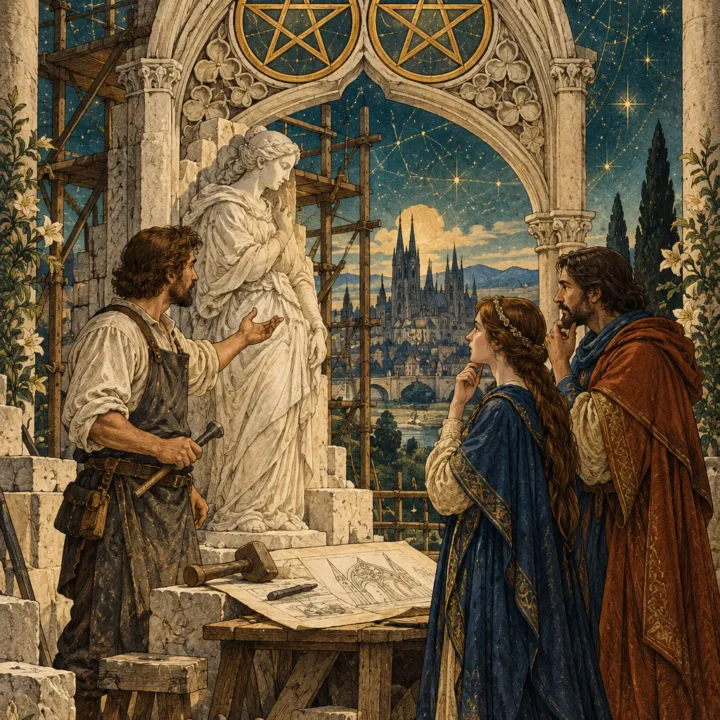
Three of Pentacles
skill, collaboration, apprenticeship, useful feedback
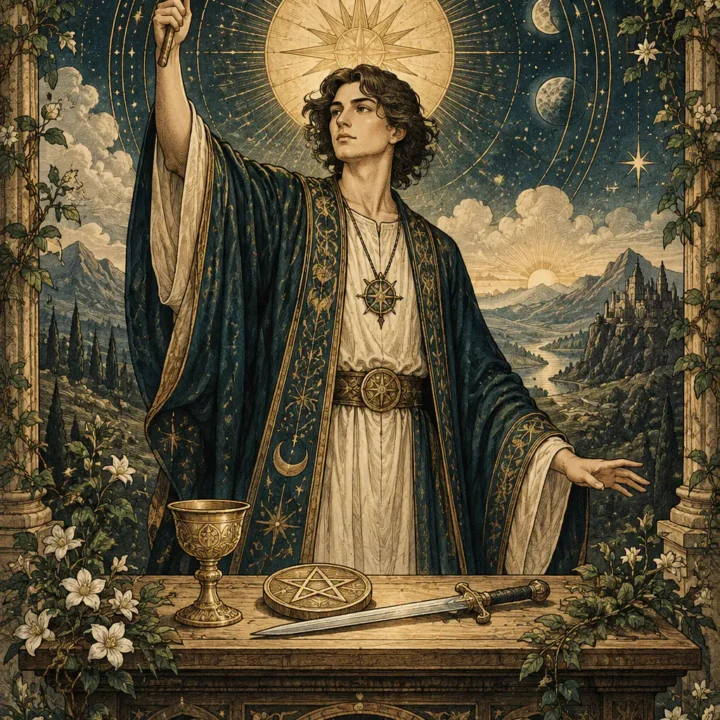
The Magician
resourcefulness, focused will, skill, communication

Eight of Wands
speed, momentum, communication, travel
Sources and further reading
- Arthur Edward Waite, The Pictorial Key to the Tarot, Part III, Eight of Pentacles Read the text
- Golden Dawn, Book T, Lord of Prudence and Sun in Virgo Read the text
- Victoria and Albert Museum, A history of tarot cards Read the text