Ten of Pentacles Tarot Card Meaning
An elder rests beneath an archway as a child greets the dogs and family life unfolds nearby. Discover the Ten of Pentacles and the legacy we leave in other lives.
- legacy
- belonging
- inheritance
- continuity
- property
Card at a glance
- Number
- Ten
- Element
- Earth
- Astrology
- Mercury in Virgo; Lord of Wealth (Golden Dawn)
- Keywords
- legacy, belonging, inheritance, continuity, property
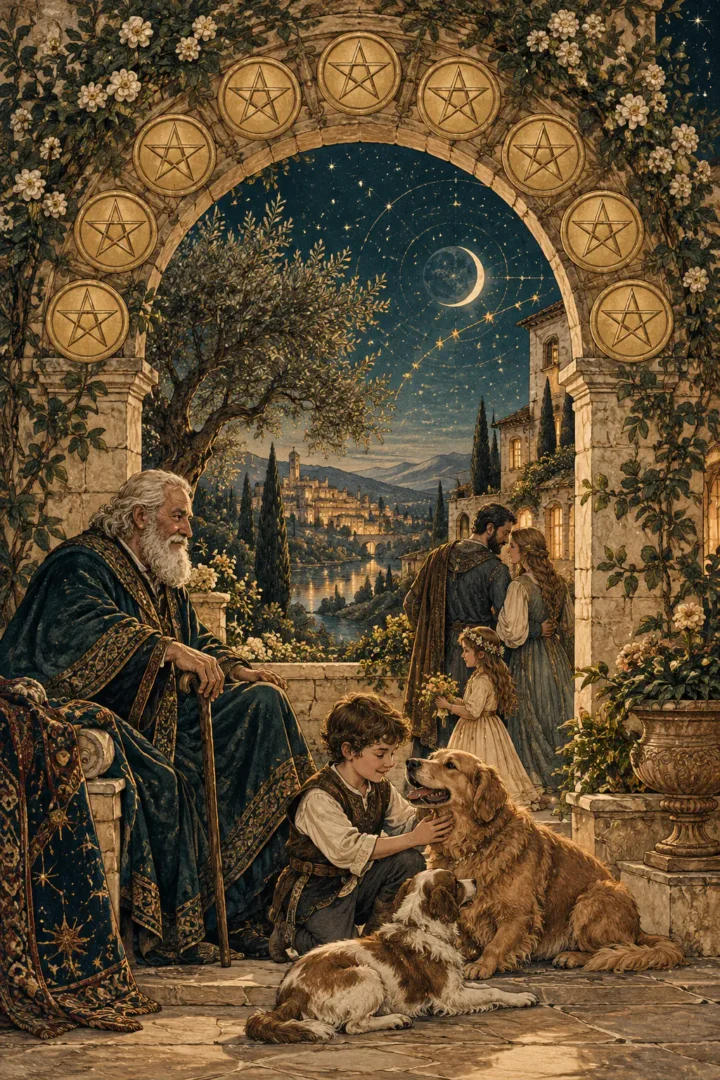 Ten · Ten of Pentacles
Upright meaning
Legacy, belonging and inheritance
Upright, the Ten of Pentacles often describes a foundation that has become durable enough to support other people. A family may be celebrating a milestone, a shared household may feel secure, or a project might be ready to pass into capable hands.
- Legacy
- Belonging
- Inheritance
- Continuity
- Property
Reversed meaning
Disputes, exclusion and insecure foundations
Reversed, the Ten of Pentacles can bring tension within a family or another enduring structure into focus. People disagree about an inheritance, a long-standing expectation feels unfair, or the security of a household has become uncertain.
- Disputes
- Exclusion
- Insecure foundations
- Inherited burdens
- Loss
Card symbolism
-
The elder in the patterned cloak
The seated elder wears a richly embroidered garment. His presence offers an image of age, memory, and the long accumulation of experiences.
-
The child and the two dogs
The child bends toward the dogs, absorbed in an immediate and affectionate encounter. While adults stand beneath the archway, the child’s attention belongs to the living creatures at the elder’s feet.
-
The couple and stone archway
Two adults stand within a passage that leads toward a house or estate. Their presence places relationships inside a setting of long-term material life.
-
The ten pentacles across the scene
The coins are placed throughout the illustration rather than held by a single figure. Their arrangement is often read by later esoteric interpreters as resembling the ten sephiroth of the Kabbalistic Tree of Life.
-
The buildings and heraldic details
Stone walls, an archway, and decorative symbols suggest an established place with its own history. A household can become a repository of memories long after the people who made them are gone.
In depth interpretation
Beneath a stone archway, an elderly figure sits wrapped in an elaborate cloak. Two dogs greet him while a child reaches toward one of them. A couple stands nearby, with a house and courtyard opening beyond the arch. Ten golden pentacles float over the scene, as though someone has laid a beautiful pattern across an ordinary moment of family life.
The Ten of Pentacles is a tarot card of lasting security, inheritance, belonging, and the many things we pass from one generation to the next. Upright, it often speaks of family support, long-term achievement, a stable home, or resources that can benefit people beyond yourself. Reversed, it may reveal conflict over values or money, fragile arrangements, or the difficulty of belonging within an inherited structure.
If this card has found you, imagine stepping through the archway. What makes a place feel like home to you, and whose presence makes that feeling possible?
The life that continues beyond us
There are things we receive without remembering their beginning. A recipe has been passed through so many hands that nobody knows who first changed it. A familiar saying returns when you’re comforting a child. You use a skill someone patiently taught you years ago, and for a moment you can almost hear their voice.
The Ten of Pentacles gathers these kinds of inheritance into one crowded picture. Family life unfolds in layers, with an elder, adults, a child, animals, and the shelter of buildings that have stood long enough to become familiar. It asks us to consider the world we enter and the ways we will shape it for those who come after us.
Material security has an important place in this vision. A dependable home, savings, property, or a well-run business can create breathing room across generations. The card also brings attention to the quieter things that help people feel rooted: stories, customs, care, knowledge, and the assurance that someone will remember them.
An inherited world is never simple. Some families pass down tenderness and useful wisdom. Others carry silences, debts, exclusions, and rules that have caused harm. The Ten can be a card for considering both kinds of legacy with care.
Your own definition of family matters here. You may have been raised by relatives, chosen companions, or people whose relationship to you was built through devotion rather than ancestry. The image invites you to think about the communities that hold your life together.
What the symbols in the Ten of Pentacles reveal
Pamela Colman Smith’s Rider-Waite-Smith illustration feels full of history. Little details create the impression that the scene existed before we entered it and will continue after we leave.
The elder in the patterned cloak
The seated elder wears a richly embroidered garment. His presence offers an image of age, memory, and the long accumulation of experiences. He occupies the foreground, while the daily life of the household unfolds nearby.
You may think of someone whose words you still carry, or of a person who has grown old amid people they helped care for. Sometimes the wisdom that survives a lifetime is surprisingly practical: how to mend something, how to host a guest, or how to return after an argument.
The elder may also raise questions about care in later life. Who listens to him? Who helps when independence becomes difficult? A lasting family structure needs room for the needs of every generation.
The child and the two dogs
The child bends toward the dogs, absorbed in an immediate and affectionate encounter. While adults stand beneath the archway, the child’s attention belongs to the living creatures at the elder’s feet.
This detail can be touching when you think about what children remember. They might grow up with stories about a grandparent’s wealth or achievements, yet cherish the ordinary mornings spent with that person most.
In a reading about your own legacy, consider which everyday experiences you want the people close to you to remember.
The couple and stone archway
Two adults stand within a passage that leads toward a house or estate. Their presence places relationships inside a setting of long-term material life. The archway feels like a meeting place between the public street and the world of the household.
What would it mean for your home to welcome the people you care about? The answer might involve boundaries, accessible space, predictable routines, or conversations about the kind of life you want to share.
An arch can welcome, and a gate can keep someone out. If belonging has been difficult in your family or community, the image may invite a more searching reflection on who is included.
The ten pentacles across the scene
The coins are placed throughout the illustration rather than held by a single figure. Their arrangement is often read by later esoteric interpreters as resembling the ten sephiroth of the Kabbalistic Tree of Life.
For readers working within that occult framework, the pattern offers a way to contemplate material life as part of a larger spiritual order. Other readers may see simply how wealth and responsibility touch many parts of the household.
The coins cannot tell us how fairly the resources are shared. That remains one of the questions the card leaves with us.
The buildings and heraldic details
Stone walls, an archway, and decorative symbols suggest an established place with its own history. A household can become a repository of memories long after the people who made them are gone.
Think about a place you associate with belonging. Its importance may come from the conversations, celebrations, and difficulties that have unfolded there. Sometimes a home continues to live in memory after its occupants have moved away.
Ten of Pentacles upright meaning
Upright, the Ten of Pentacles often describes a foundation that has become durable enough to support other people. A family may be celebrating a milestone, a shared household may feel secure, or a project might be ready to pass into capable hands.
Imagine someone who has run a neighborhood bookstore for thirty years. She knows generations of customers, has trained younger booksellers, and has found a successor who shares her love of the place. The achievement includes the business itself and the community that has grown around it.
The card can also mark planning for the future. You might be thinking about housing, care for older relatives, long-term savings, or the kind of support a child will need as they become independent.
Sometimes its significance is emotional. A person who spent years without a reliable home may finally have a place where they can invite friends, rest, and put down roots. That sense of continuity can be precious even when resources are modest.
Ten of Pentacles reversed meaning
Reversed, the Ten of Pentacles can bring tension within a family or another enduring structure into focus. People disagree about an inheritance, a long-standing expectation feels unfair, or the security of a household has become uncertain.
The problem may concern values as much as money. Perhaps relatives expect you to pursue a particular profession, observe a custom, or accept a role that no longer suits your life. The card can help you name where loyalty and personal freedom are pulling in different directions.
In other readings, the reversal may reflect real financial vulnerability: a business without a succession plan, an unexpected expense, or dependence on resources controlled by someone else.
Some inherited patterns deserve repair, while others need clear limits. The goal is to understand the situation you are in and what kind of future you would be proud to help create.
Ten of Pentacles in love and relationships
In love, the Ten often speaks of a relationship becoming part of a shared life. A couple may be moving into a home, making decisions about children, joining extended families, or learning how to support older relatives.
For someone dating, it can evoke the wish to build something enduring with a partner. Notice how you discuss practical matters, what each person expects from family life, and whether your visions of home can meet comfortably.
It can also appear when a relationship feels deeply supported by friends and community. Belonging does not depend on following one traditional family model.
Reversed, the card may highlight conflict about family boundaries, financial dependence, or a partner’s expectations about the future. If an arrangement feels controlling or unsafe, take that experience seriously and seek support suited to your circumstances.
Ten of Pentacles as feelings
When this card appears in a question about another person’s feelings, it can suggest a desire for stability, shared routines, or a connection that fits into the wider pattern of their life. Sometimes the person asking the question is longing for reassurance that a relationship has a future.
The card cannot disclose a private decision about marriage, commitment, or children. Those choices call for conversations in which both people can speak freely.
Ten of Pentacles for career and work
In career readings, the Ten can describe an established organization, a family business, a long-standing professional network, or work that is becoming a legacy in its own right.
Picture a craftsperson who has developed a method over many years and begun teaching it to younger colleagues. The work now has a life beyond the person who first mastered it. The card could symbolize that continuity and the responsibility involved in passing knowledge onward.
Reversed, the Ten may reveal an organization relying on outdated customs or an unclear succession plan. It can also draw attention to the people whose contributions have been taken for granted while others receive the recognition.
Consider whether the structures you are part of are supporting the work they were created to sustain.
Ten of Pentacles for money and inheritance
The Ten is strongly associated with wealth, property, family resources, and arrangements intended to last. It might arise around retirement planning, a home purchase, estate matters, or supporting someone who depends on you.
The Golden Dawn’s title, Lord of Wealth, emphasizes the completion of material gain. Its older commentary also recognized the stagnation that can follow great success, as though a system has reached its peak and no longer knows how to grow.
Reversed, pay careful attention to legal documents, shared ownership, obligations, and disagreements about money. The card cannot predict an inheritance or resolve a dispute. Important decisions require accurate information and professional guidance where needed.
Ten of Pentacles in spiritual practice
The Ten offers a beautiful setting for remembering people whose lives shaped yours. You might prepare a meal using a family recipe, tell a child a story about someone they never met, or preserve a photograph with the name and history of the people in it.
Some traditions honor ancestors through formal observances, prayers, or communal ceremonies. Their specific meanings belong to those traditions and deserve to be learned respectfully. A personal practice of remembrance can be simple and still feel sacred.
You might also consider what you want to change. A legacy can include a choice to end a harmful pattern so that the people who follow have a different experience.
The Golden Dawn linked this card with Mercury in Virgo. In that system, communication and practical intelligence become part of the symbolism of lasting material structures.
Ten of Pentacles as advice: make a small legacy map
Take a page and draw three simple circles, one behind another like rooms you could walk through. Label them ‘What I received,’ ‘What I am building,’ and ‘What I want to pass on.’
Fill the first circle with things you inherited or learned. They may include resources, habits, stories, or an expectation you are still examining. In the second, record what your everyday choices are creating now.
For the third, imagine someone you care about remembering your life many years from now. What would you hope they learned from the way you treated people or cared for your home and community?
Choose one small act that connects those circles. It could be sharing a story, updating an important document, teaching a skill, or making a family conversation safer and more open.
Is the Ten of Pentacles a yes or no card?
The Ten of Pentacles often leans yes for questions about durable arrangements, a shared home, and long-term planning. Its encouraging symbolism still needs the context of the spread and the people involved. Reversed, consider whether the foundation is as secure or inclusive as it appears.
How to read the Ten of Pentacles in a spread
In a past position, the Ten may describe a family structure or inheritance shaping your present choices. As advice, it can encourage consideration of long-term effects and the people who depend on an arrangement. As a challenge, it may point to obligations or family expectations that have become difficult to carry.
Imagine asking how to care for an aging relative while maintaining your own household. You draw the Ten of Pentacles in the present, Temperance as advice, and the Six of Pentacles as a possible direction. The reading might encourage you to consider the family’s shared responsibilities, discuss a sustainable rhythm of care, and explore how resources could be distributed more fairly. The cards help frame a conversation that belongs to the people involved.
A brief note on tarot tradition
Pamela Colman Smith gave the 1909 Rider-Waite-Smith Ten of Pentacles a richly populated scene: an elder, family members, dogs, and a household setting beneath ten coins. Waite’s published meanings emphasize riches, family matters, ancestral records, and the family home. The Golden Dawn’s Book T calls the corresponding card Lord of Wealth and assigns Mercury in Virgo. Later esoteric readers have connected Smith’s arrangement of the coins with the Tree of Life. The modern themes of legacy and shared belonging grow from the card’s richly populated scene.
Frequently asked questions
Does the Ten of Pentacles mean marriage or children?
It can suggest family commitments or plans for a shared household, especially when those concerns belong to the question. The card cannot predict marriage or confirm a pregnancy. Its symbolism includes many ways of building a lasting life together.
Is the Ten of Pentacles always about inherited money?
Inheritance is a traditional association, though the card can also describe a home, a business, knowledge, cultural practices, and forms of care passed between generations. There is meaning in what a family creates even when money is scarce.
What does the Tree of Life arrangement mean?
Many esoteric readers see the ten coins as resembling the ten sephiroth in the Kabbalistic Tree of Life. That is a specific interpretive lens, and the symbolic framework deserves respectful study rather than being treated as a universal meaning.
Can the Ten of Pentacles be difficult in a family reading?
Yes. It can bring attention to inherited expectations, exclusion, unequal control of resources, or conflicts about the future of a household. Reversed, those themes may become more prominent. Actual relationships and agreements should guide your response.

Keep reading
Explore the Pentacles
Every card page names the tradition behind each meaning, so you can compare readings instead of taking one as fixed.
Cards to explore alongside this one
Their symbols reveal useful similarities and differences for your next reading.
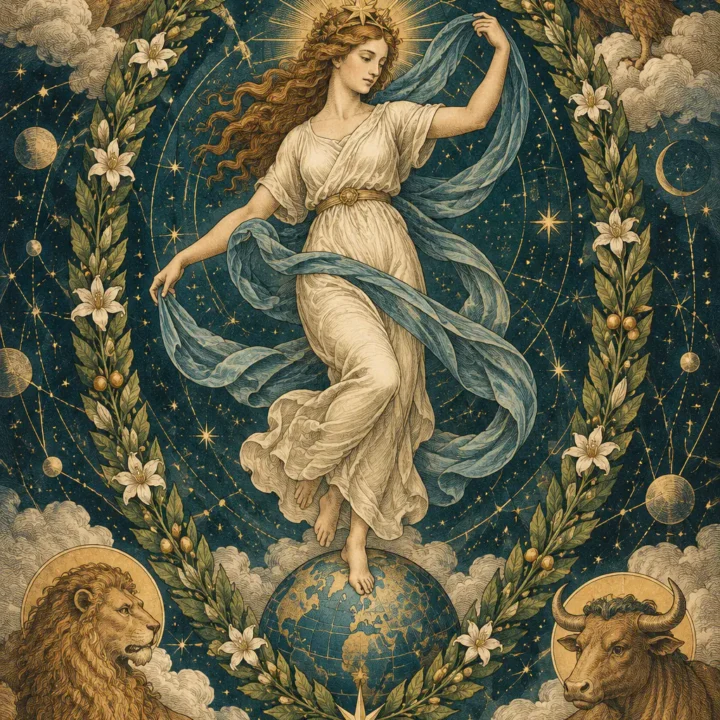
The World
completion, fulfillment, integration, accomplishment
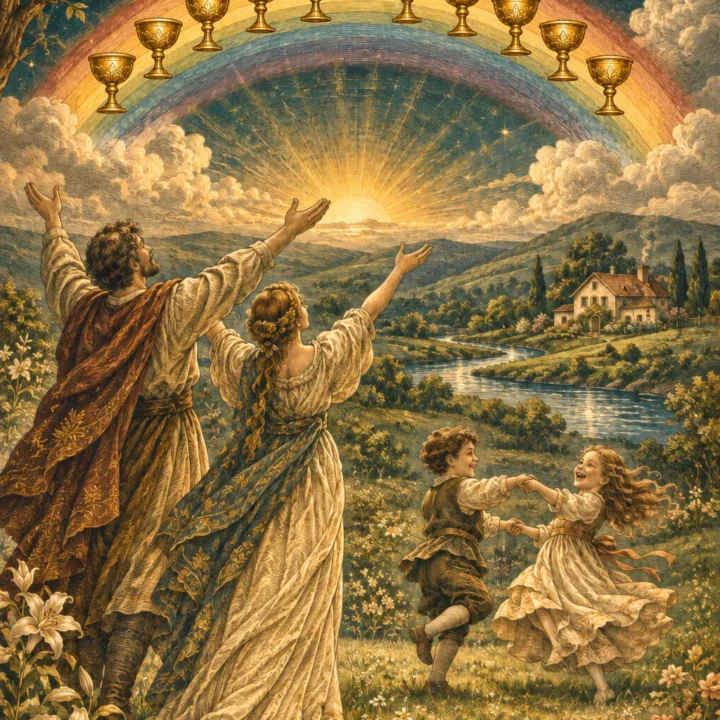
Ten of Cups
emotional fulfillment, family and chosen family, shared joy, harmony
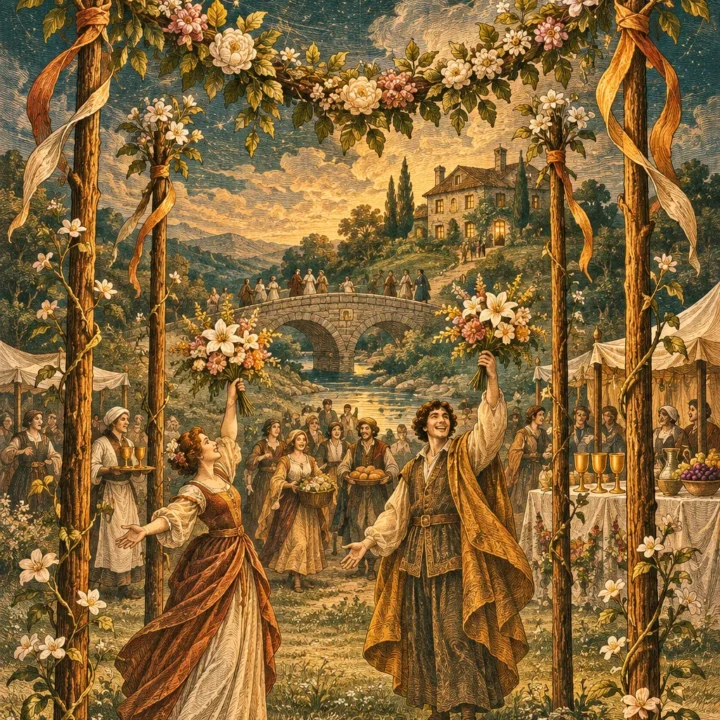
Four of Wands
welcome, celebration, peace, refuge
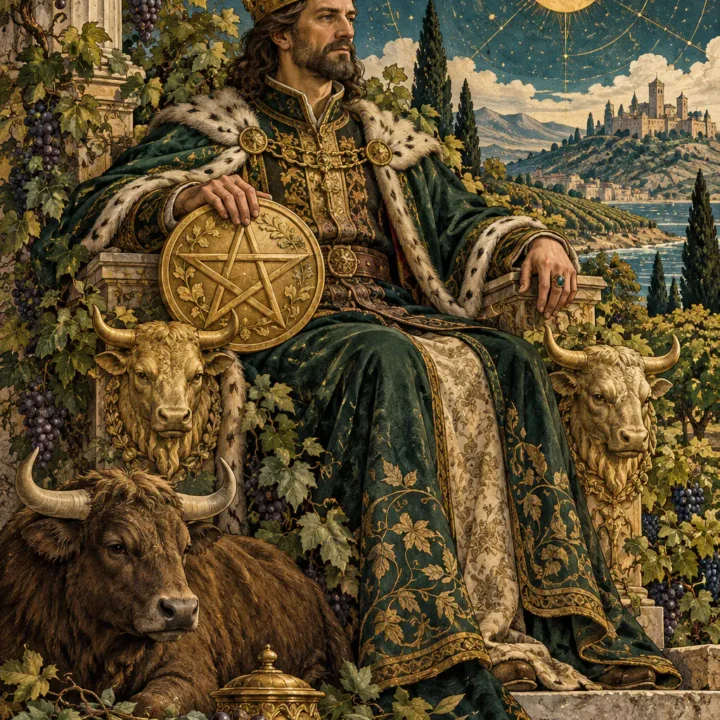
King of Pentacles
stewardship, experience, material security, sound judgment
Sources and further reading
- Arthur Edward Waite, The Pictorial Key to the Tarot, Part III, Ten of Pentacles Read the text
- Golden Dawn, Book T, Lord of Wealth and Mercury in Virgo Read the text
- Victoria and Albert Museum, A history of tarot cards Read the text