Six of Pentacles Tarot Card Meaning
A merchant holds scales as coins pass into waiting hands. Discover how the Six of Pentacles explores generosity, dignity, and the obligations behind an exchange.
- generosity
- assistance
- reciprocity
- shared resources
- fairness
Card at a glance
- Number
- Six
- Element
- Earth
- Astrology
- Moon in Taurus; Lord of Material Success (Golden Dawn)
- Keywords
- generosity, assistance, reciprocity, shared resources, fairness
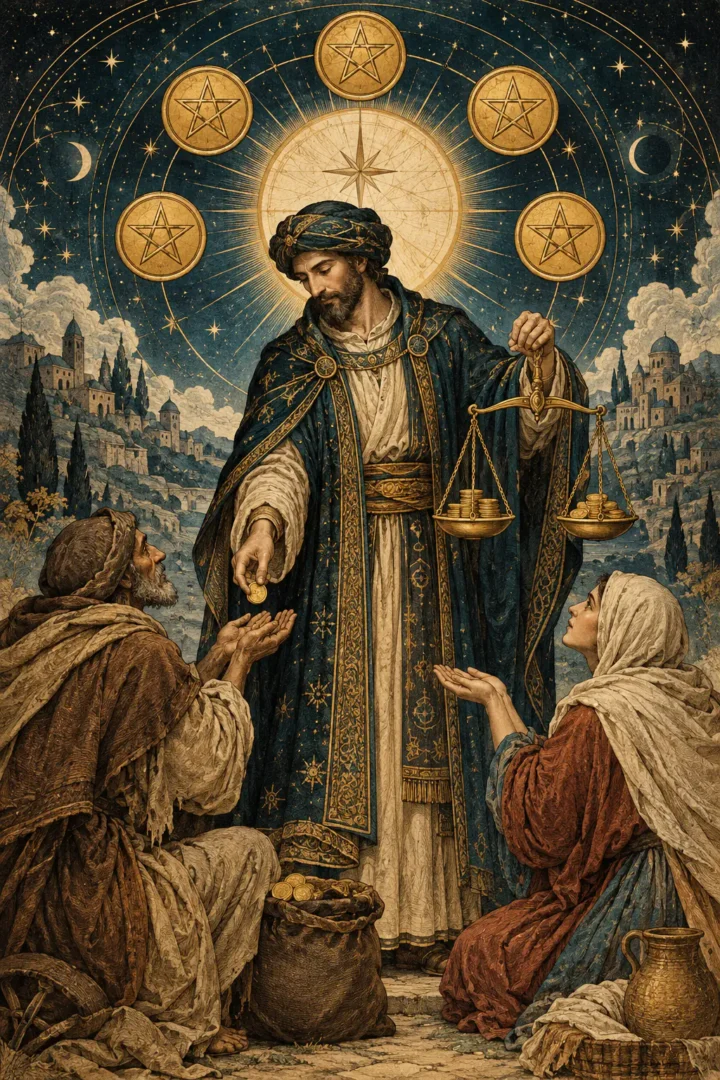 Six · Six of Pentacles
Upright meaning
Generosity, assistance and reciprocity
Upright, the Six of Pentacles often arrives with a chance to exchange something valuable. You might receive assistance during a difficult period, be rewarded fairly for a contribution, or find yourself in a position to make another person’s life easier.
- Generosity
- Assistance
- Reciprocity
- Shared resources
- Fairness
Reversed meaning
Strings attached, uneven exchange and debt
Reversed, the act of giving may have become uncomfortable. A gift comes with expectations that were never discussed. Someone reminds you repeatedly of what they paid for. You feel unable to decline another request because a person helped you in the past.
- Strings attached
- Uneven exchange
- Debt
- Favoritism
- Uncomfortable obligation
Card symbolism
-
The scales held above the exchange
The giver holds a small pair of scales, much like the familiar emblem of Justice. They suggest measurement and the possibility of fairness.
-
The coins passing from hand to hand
Coins fall from the standing figure’s hand toward one of the kneeling people. The movement is the heart of the image.
-
The two kneeling figures
Both figures are lower than the person giving. One appears to be receiving coins while the other remains nearby.
-
The giver’s clothing and the distant buildings
The standing figure’s richly colored clothing distinguishes him from the two people before him. Buildings rise in the background, making the exchange feel part of a wider social world.
In depth interpretation
A well-dressed figure stands between two people kneeling in the street. He holds a little pair of scales in one hand and lets coins fall from the other. One person reaches toward the gift. The second waits nearby. It is a quiet act of generosity, made strangely solemn by the scales suspended above it.
The Six of Pentacles speaks of giving, receiving, generosity, fairness, and the unequal positions people sometimes occupy when help changes hands. Upright, it can reflect welcome assistance, a fair exchange, or the chance to use what you have for someone else’s good. Reversed, it may bring attention to an obligation that feels burdensome, resources distributed unfairly, or an offer whose conditions need closer inspection.
If you drew this card, notice which figure you identify with first. Are you the person who can give, the one reaching out, or the person still waiting to be seen?
The sacred weight of an ordinary gift
Think about a kindness you remember years after it happened. Someone cooked for you while you were overwhelmed. A friend helped you move when you had no money to hire anyone. A teacher lent you a book that changed what you believed you could become.
What stays with us is often the way the help was given. Perhaps the person made the offer so naturally that you felt comfortable accepting. Perhaps they seemed to understand exactly what you needed without making the moment into a spectacle.
The Six of Pentacles brings this intimate side of material life into a tarot reading. Food, time, money, knowledge, and reliable attention all become ways of meeting another person’s needs. There is something deeply spiritual in recognizing that our lives are connected through such ordinary exchanges.
Look again at the kneeling figures. A gift can bring relief and still leave the recipient feeling exposed. The person with resources has choices that the person asking for help may not share. The scales invite a thoughtful question about the terms of generosity: can someone receive this help while keeping their dignity and freedom?
Sometimes the card belongs to you as a giver. At other times it asks you to accept what is freely offered, especially if pride or earlier disappointment has made receiving difficult. You do not have to earn every act of care by proving how much you have suffered.
Where the gift affects a whole group, the King of Swords can sharpen the reading. He brings attention to the standards behind a decision, especially when someone has the power to distribute help. Compassion still matters, and so does explaining why one person receives support before another.
Symbols in the Six of Pentacles
Pamela Colman Smith’s Rider-Waite-Smith image brings generosity into a public setting. Its tension comes from the way a single gesture is shaped by money, authority, and need.
The scales held above the exchange
The giver holds a small pair of scales, much like the familiar emblem of Justice. They suggest measurement and the possibility of fairness. Yet a scale can only weigh what has been placed upon it, and the card leaves us wondering who is deciding how much each person should receive.
If you are sharing money, attention, or responsibility, consider what fairness would mean in this specific situation. Two people may have very different needs. Equal amounts and fair treatment are not always the same thing.
The coins passing from hand to hand
Coins fall from the standing figure’s hand toward one of the kneeling people. The movement is the heart of the image. Something possessed by one person is becoming available to another.
When this detail catches your eye, consider what resource is actually moving in your life. Perhaps you have time to listen but little money to spare. Perhaps someone has offered you a professional introduction, or you have an opportunity to support a person whose work you value.
A useful gift has to meet a real need. The card invites attention to the person receiving it, whose experience matters just as much as the giver’s intention.
The two kneeling figures
Both figures are lower than the person giving. One appears to be receiving coins while the other remains nearby. We cannot tell how the exchange will continue or whether either recipient feels comfortable with the arrangement.
The uncertainty gives the image its moral complexity. An act can be generous and still take place within an unequal relationship. If your question concerns a workplace, family, or community, think about whose needs have been heard and whose have been overlooked.
The giver’s clothing and the distant buildings
The standing figure’s richly colored clothing distinguishes him from the two people before him. Buildings rise in the background, making the exchange feel part of a wider social world.
There may be structures around a gift that deserve consideration: an employer’s policies, family expectations, a charity’s rules, or the terms of a loan. Individual kindness matters. So do the conditions that determine who receives help in the first place.
Six of Pentacles upright meaning
Upright, the Six of Pentacles often arrives with a chance to exchange something valuable. You might receive assistance during a difficult period, be rewarded fairly for a contribution, or find yourself in a position to make another person’s life easier.
Imagine a small business owner whose first year was saved by the patience of a supplier. Years later, the business has become stable. The owner notices a new entrepreneur struggling with the same difficulties and offers practical guidance without asking for a favor in return. The Six can describe the way support becomes part of a longer human story.
The card also belongs to fair agreements. Perhaps a friend has been doing more than their share of a common task, or you are preparing to pay someone for work that matters to you. Ask what the exchange requires and whether both people can speak about their needs.
When help is offered to you, notice its quality. Are the terms clear? Does the person respect your choices? Receiving can be a meaningful part of the card’s upright expression.
Six of Pentacles reversed meaning
Reversed, the act of giving may have become uncomfortable. A gift comes with expectations that were never discussed. Someone reminds you repeatedly of what they paid for. You feel unable to decline another request because a person helped you in the past.
In other readings, the problem is unequal access. One member of a team receives opportunities while equally capable colleagues are overlooked. A family arrangement assumes the same person will always provide money or care, regardless of their changing circumstances.
The reversal can also point toward overgiving. Your wish to help is sincere, yet you have begun neglecting commitments you must meet yourself. There is wisdom in recognizing the limits of what you can offer.
Look at the details before deciding what the reversal means. A person may feel indebted even when the giver has attached no conditions. A clear conversation can sometimes separate an old fear from an actual expectation.
Six of Pentacles in love and relationships
In love, the Six of Pentacles often speaks through practical gestures. Someone brings dinner to a partner after a hard day, offers to handle an errand, or makes time for a conversation that matters. Small acts can become a language of devotion.
For a couple, the card can raise questions about how time, money, emotional labor, and care are shared. Imagine one partner paying most of the bills while the other does much of the unpaid work at home. A fair relationship requires them to understand the value of both contributions.
If you are newly dating, notice whether generosity leaves room for choice. An expensive gift can be thoughtful, though nobody owes affection or intimacy in return for it.
Reversed, pay attention to patterns that create resentment or dependence. Relationships can survive periods of imbalance when both people acknowledge what is happening and act with care. Threats, coercion, and financial control deserve practical support beyond a tarot reading.
Six of Pentacles as feelings
When the question concerns another person’s feelings, this card can evoke gratitude, affection expressed through actions, or a wish to be helpful. It may also describe discomfort about owing something or concern that an exchange has become one-sided.
The card does not reveal a private intention. Observe whether the person treats you respectfully when you cannot give them what they want. That can tell you a great deal about the relationship.
Six of Pentacles for career and work
At work, the Six of Pentacles can appear around fair pay, mentoring, workplace benefits, and the distribution of opportunities. A manager may have the power to share recognition or decide who receives training. A colleague may be able to make an introduction that helps someone grow.
Consider a team where senior employees consistently receive the most interesting projects. The arrangement might have developed without anyone intending unfairness. The card encourages a closer look at how opportunities are allocated and whether newer employees have a meaningful chance to contribute.
Reversed, it may reflect unequal compensation, favors that feel obligatory, or unpaid work being treated as a sign of loyalty. Review the actual terms and seek qualified advice if your rights or livelihood are affected.
Six of Pentacles for money
In financial readings, the Six can suggest a gift, grant, fair payment, assistance, charitable giving, or a loan. It may also reflect a period when you have enough room in your budget to support a person or cause you care about.
The Golden Dawn title, Lord of Material Success, adds an older emphasis on having acquired resources and influence. Smith’s illustration makes us ask how that success is shared.
Reversed, pay close attention to repayment terms, fees, family obligations, and any offer that creates pressure. Generosity is meaningful when the details are understood. A card cannot guarantee a payment or establish that a financial arrangement is wise.
Six of Pentacles in spiritual practice
You can bring this card into a practice of gratitude by remembering someone whose generosity helped you at an important moment. The memory may be joyful, complicated, or both. Think about what made their help feel respectful and what you learned from receiving it.
Some spiritual communities express generosity through shared meals, charitable funds, volunteering, or mutual care. The card can invite participation in these practices while making room for questions about dignity and access.
Its Moon-in-Taurus correspondence belongs to the Golden Dawn system. Readers who work with astrological symbolism may see an additional connection between emotional security and the material ways people care for one another.
Six of Pentacles as advice: follow the gift
Draw three small circles in your journal. Label them ‘What I have received,’ ‘What I can offer,’ and ‘What needs to be fairer.’
Write one honest example in each circle. The first might be support you have not fully acknowledged. The second could name a practical contribution within your means. The third may bring to light a situation in which expectations need to be discussed.
Choose an action that respects the people involved. You might offer help without making assumptions, thank someone specifically, or clarify the terms of a shared commitment. Let the scales remind you that care becomes more trustworthy when everyone can speak.
Is the Six of Pentacles a yes or no card?
The Six of Pentacles often leans yes for questions about fair cooperation, giving or receiving help, and agreements that are genuinely mutual. Reversed, it suggests examining obligations or the balance of power before accepting an offer. The answer depends on the real conditions of the exchange.
Reading the Six of Pentacles in a tarot spread
As a present card, the Six can show resources being shared or a relationship shaped by unequal access to them. In a challenge position, it might point to a difficult obligation. As advice, it can encourage generosity that respects personal limits.
Imagine asking how to improve a friendship strained by repeated favors. You draw the Six of Pentacles in the present, the Queen of Swords as advice, and the Three of Cups as a possible direction. The reading might encourage you to discuss the arrangement directly, explain what you can realistically offer, and create room for the friendship to feel enjoyable again. Both people still have a voice in what comes next.
A brief note on tarot tradition
Pamela Colman Smith illustrated the Rider-Waite-Smith Six of Pentacles in 1909 as a merchant distributing money while holding scales. Waite emphasized gifts and present prosperity among its divinatory meanings. The Golden Dawn’s earlier Book T gives the card the title Lord of Material Success and associates it with the Moon in Taurus, emphasizing success, influence, and the possibility of generosity or pride. The contemporary focus on unequal power grows naturally from Smith’s scene and should be understood as an interpretation of that image.
Frequently asked questions
Does the Six of Pentacles mean someone will give me money?
It can be read as a sign of possible material assistance when that fits the question. The card also describes sharing time, knowledge, and care. It cannot promise a particular gift, benefit, or payment.
Is the Six of Pentacles always positive?
Its upright meaning often has a generous quality, but the kneeling figures and scales also invite attention to dependence and fairness. A gift can be welcome while an arrangement around it deserves scrutiny.
Does it mean I should lend money to someone?
A reading cannot establish whether a loan is affordable or likely to be repaid. Consider the amount, your responsibilities, the relationship, and written terms before making a decision.
How is the Six of Pentacles different from the Five?
The Five shows people exposed to hardship outside a lit building. The Six brings the exchange of resources into the foreground. Read together, they can raise questions about what assistance is available and how it reaches people in need.

Keep reading
Explore the Pentacles
Every card page names the tradition behind each meaning, so you can compare readings instead of taking one as fixed.
Cards to explore alongside this one
Their symbols reveal useful similarities and differences for your next reading.
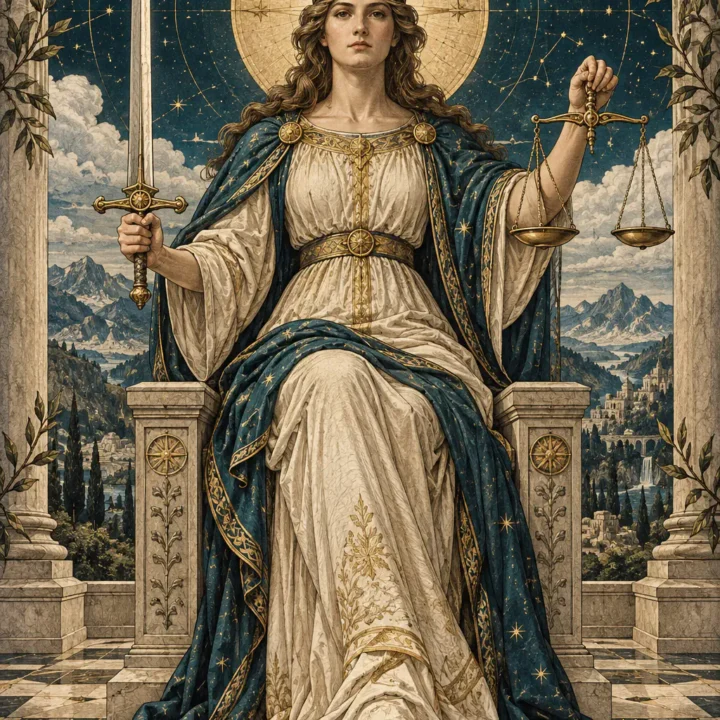
Justice
fairness, honesty, accountability, clarity
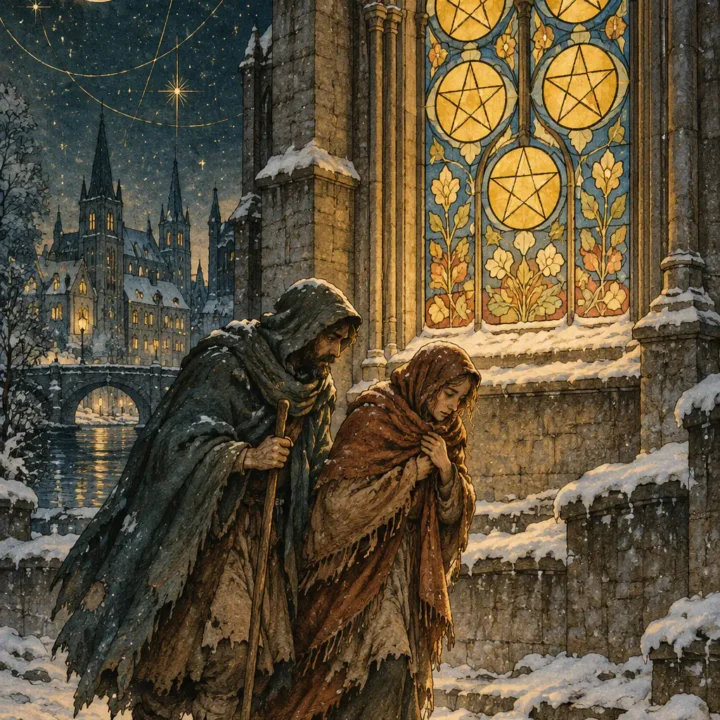
Five of Pentacles
hardship, scarcity, insecurity, exclusion

King of Pentacles
stewardship, experience, material security, sound judgment
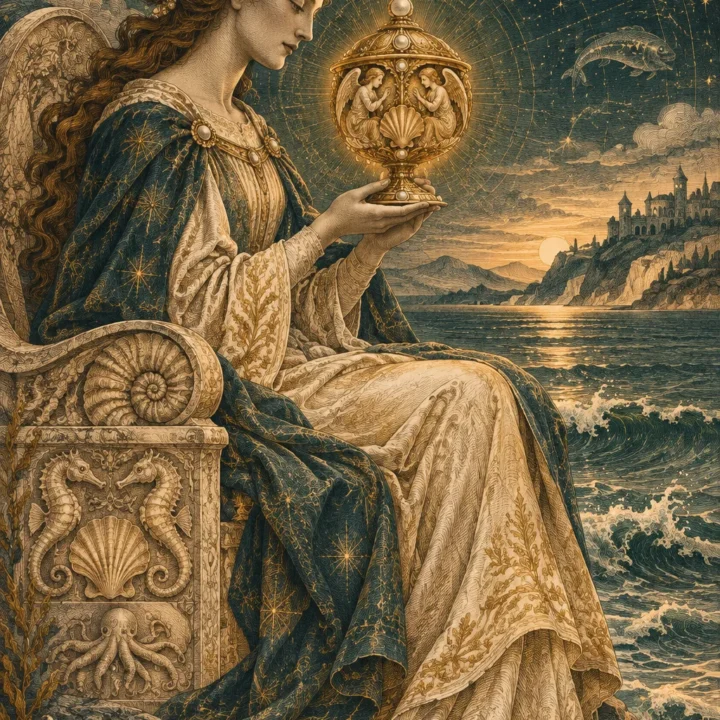
Queen of Cups
compassion, emotional understanding, imagination, intuition
Sources and further reading
- Arthur Edward Waite, The Pictorial Key to the Tarot, Part III, Six of Pentacles Read the text
- Golden Dawn, Book T, Lord of Material Success and Moon in Taurus Read the text
- Victoria and Albert Museum, A history of tarot cards Read the text