Seven of Pentacles Tarot Card Meaning
A gardener leans on his tool and studies pentacles growing among the leaves. Discover how the Seven of Pentacles invites an honest look at what your efforts have produced.
- cultivation
- evaluation
- patience
- invested effort
- delayed rewards
Card at a glance
- Number
- Seven
- Element
- Earth
- Astrology
- Saturn in Taurus; Lord of Success Unfulfilled (Golden Dawn)
- Keywords
- cultivation, evaluation, patience, invested effort, delayed rewards
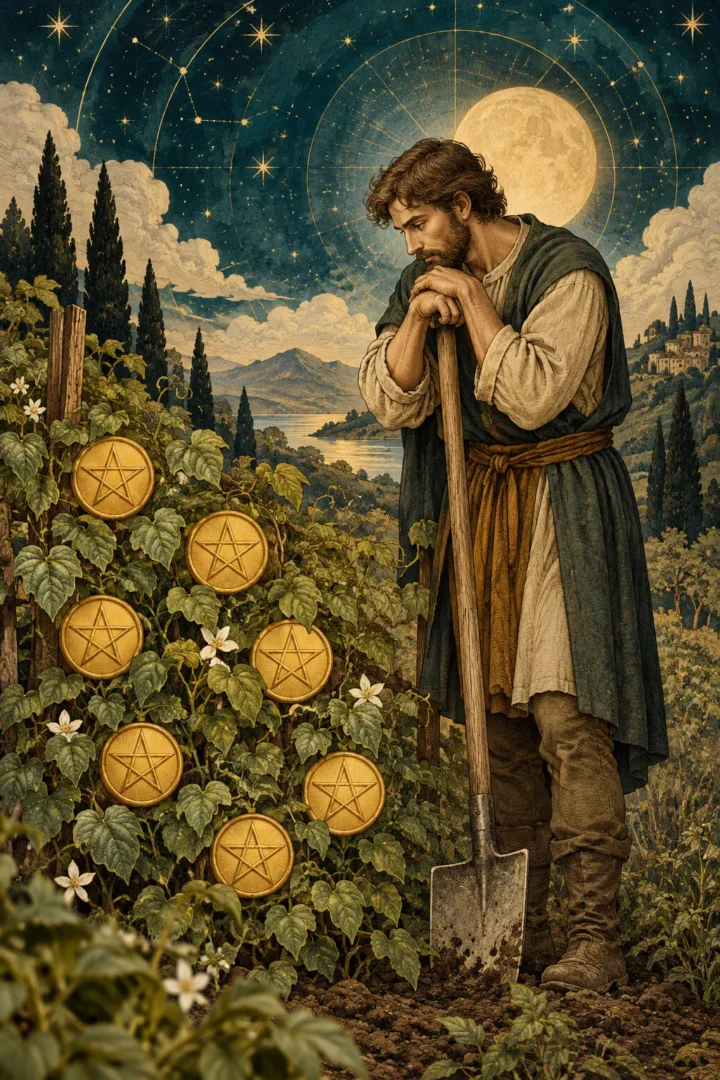 Seven · Seven of Pentacles
Upright meaning
Cultivation, evaluation and patience
Upright, the Seven of Pentacles often appears when a plan has been underway long enough to deserve an honest review. You may be waiting for the results of study, building a business, improving your health with appropriate support, or developing a relationship through steady attention.
- Cultivation
- Evaluation
- Patience
- Invested effort
- Delayed rewards
Reversed meaning
Discouragement, poor returns and unrealistic expectations
Reversed, the gardener may be realizing that the harvest will be smaller than hoped. You could be disappointed after giving a great deal to a job, creative practice, relationship, or financial commitment.
- Discouragement
- Poor returns
- Unrealistic expectations
- Costly persistence
Card symbolism
-
The gardener resting on his tool
The young man leans forward, resting on the shaft of a hoe or similar implement. He has stopped working, but the tool remains in his hands.
-
The pentacles among the leaves
Golden coins appear in and around the plant. They show that something valuable has been produced, even if its usefulness remains open to question.
-
The uneven arrangement of the coins
Six pentacles gather in the foliage, while one rests lower to the ground. The scene does not present a neat, completed harvest.
-
The quiet earth around the plant
The background is simple, with soil beneath the gardener’s feet and a pale sky beyond. There is little to distract from his encounter with what he has grown.
In depth interpretation
A gardener leans on the handle of his tool and studies a leafy plant. Six golden pentacles shine among the leaves, with another near the ground. His work clothes are plain, and his expression is difficult to read. He could be pleased with what has grown. He could be wondering whether all his effort has been worthwhile.
The Seven of Pentacles is a tarot card of patient investment, reflection, delayed results, and the uncomfortable question of whether to keep going. Upright, it often asks you to examine what your efforts are producing. Reversed, it can bring disappointment, impatience, poor returns, or the realization that a familiar plan needs to change.
If you have drawn this card, stand beside the gardener in your imagination. What are you hoping the plant will give you, and what has it already cost to grow?
The question that arrives after the work
There is a point in a long undertaking when excitement fades and the results remain uncertain. You have sent the applications, practiced the instrument, tended the garden, or tried to repair the friendship. Time has passed. Something has changed, yet you cannot tell whether the future you imagined is any closer.
The Seven of Pentacles belongs to that moment of reckoning. The figure’s stillness makes space for a question that is difficult to ask while you’re busy: what is happening because of all this effort?
Sometimes the answer is encouraging. Your abilities have grown, the soil is healthy, or the relationship has become more honest in ways that are easy to overlook. Other times the answer is disappointing. You have invested deeply in a plan that cannot offer what you need.
The card’s spiritual wisdom lives in your willingness to see the actual growth. A gardener learns the seasons, observes where sunlight falls, and notices which plants are struggling. That attention becomes a kind of devotion when it is given with care.
A season can end before the harvest you wanted arrives. The image can help you grieve an expectation and discover whether another form of growth deserves your energy. You are allowed to change your mind after learning something important.
What the Seven of Pentacles shows us
Pamela Colman Smith’s illustration is remarkable for the expression on a single face. The gardener seems to be considering his own work. The pentacles are present, but his attention reaches beyond the mere fact of their existence.
The gardener resting on his tool
The young man leans forward, resting on the shaft of a hoe or similar implement. He has stopped working, but the tool remains in his hands.
You may recognize this posture after spending months on a task. Your body remembers the effort, and you finally have a moment to observe what has changed. The card invites you to include rest in the process of understanding. A pause can make information visible that constant activity conceals.
The pentacles among the leaves
Golden coins appear in and around the plant. They show that something valuable has been produced, even if its usefulness remains open to question.
Consider a project that has brought you knowledge or relationships while falling short of its original goal. Those gains are real. You can acknowledge them and still decide whether the project deserves another season.
The uneven arrangement of the coins
Six pentacles gather in the foliage, while one rests lower to the ground. The scene does not present a neat, completed harvest. Its asymmetry makes the picture feel unfinished.
That detail can suggest different stages of development within one life. Your work may be advancing while your personal relationships need care. One part of a project may be successful while another keeps consuming resources. It is useful to examine each part on its own terms.
The quiet earth around the plant
The background is simple, with soil beneath the gardener’s feet and a pale sky beyond. There is little to distract from his encounter with what he has grown.
The bare landscape can help you return to essentials. What conditions does your undertaking actually depend on? You might need different tools, clearer expectations, or more time. The answers become easier to see when you stop measuring the work against an imagined perfect result.
Seven of Pentacles upright meaning
Upright, the Seven of Pentacles often appears when a plan has been underway long enough to deserve an honest review. You may be waiting for the results of study, building a business, improving your health with appropriate support, or developing a relationship through steady attention.
Imagine someone who began teaching herself to paint a year ago. Her pictures still look different from the work she admires, and some days she is tempted to quit. When she places her first drawing beside a recent one, she can see changes in line, color, and confidence. The Seven could capture the value of noticing progress that daily comparison conceals.
The card also asks what kind of result you are seeking. Perhaps you have achieved a milestone that no longer feels meaningful, or the circumstances around your original plan have changed. You may need to adjust the goal before deciding what to do next.
Patience has an active quality here. It includes observation, questions, realistic expectations, and the freedom to choose a new approach when the evidence calls for one.
Seven of Pentacles reversed meaning
Reversed, the gardener may be realizing that the harvest will be smaller than hoped. You could be disappointed after giving a great deal to a job, creative practice, relationship, or financial commitment.
The Golden Dawn’s title, Lord of Success Unfulfilled, gives this card a harsher history than the familiar modern advice to be patient. Its older interpretation includes effort that fails to produce a worthwhile return. That possibility belongs in an honest reading, especially when the facts already suggest it.
Another expression of the reversal is impatience. A plan might need more time, but fear has begun to demand immediate proof that it will succeed. You change the strategy so often that you never discover what could have worked.
The way forward depends on which situation you are actually in. Review what you’ve learned. Ask what would need to change for continuing to make sense, and recognize when you have done enough.
Seven of Pentacles in love and relationships
In a love reading, the Seven of Pentacles may appear when a relationship has moved past its early excitement and its longer shape is becoming visible. You begin to notice patterns of care, reliability, conflict, and repair.
Imagine two people who have spent a year discussing where they will live together. Both care about the relationship, yet the same conversation ends without a decision every time. The card could encourage them to ask whether their goals are genuinely compatible and what progress would look like.
For someone single, it might describe a period of reflection after dating experiences that have taught you more about what you need. A pause can be useful when it helps you choose more consciously.
Reversed, the card may point to frustration with a connection that has not grown as you hoped. Effort matters in relationships, and mutual participation matters too. Watch whether the other person is making choices that support the future you have discussed.
Seven of Pentacles as feelings
This card can evoke affection that has developed slowly, uncertainty about the future, or a serious wish to understand whether a connection has lasting potential. The person asking the question may be tired of waiting for clarity.
You cannot know someone else’s private hopes from the image of a gardener. Conversation and consistent behavior can reveal whether both people want to keep tending the relationship.
Seven of Pentacles for career and work
At work, the Seven of Pentacles often appears when effort has accumulated and the next decision requires perspective. You may be preparing for a performance review, evaluating a long project, or wondering whether a professional path still offers room to grow.
Suppose a small team has spent months developing a service that attracts interest but few paying customers. They have learned a great deal, and the business may still need to change direction. The Seven invites them to consider the evidence before committing another season of work.
Reversed, the card might reveal a demanding role with little recognition or advancement. It can also describe a person whose ambitions have grown beyond the opportunities available. Seek information about alternatives rather than assuming the years you’ve invested must determine your next choice.
Seven of Pentacles for money
The Seven can raise questions about savings, investments, debt repayment, and long-term financial plans. Its imagery naturally connects with a period when you have committed resources and are waiting to see what they produce.
It is tempting to ask the card whether an investment will finally pay off. A more useful question concerns your assumptions: what return were you expecting, what has actually happened, and what risk can you afford to carry?
Reversed, it may express disappointment or anxiety about money already committed. That feeling is worth acknowledging. Decisions about financial arrangements should be based on current figures, obligations, and qualified guidance when needed.
Seven of Pentacles in spiritual life
Some spiritual practices are cultivated for years before their meaning becomes clear. You repeat a prayer, learn a sacred language, or return to a meditation practice through different seasons of life. The practice may change your responses to ordinary difficulties before you realize anything has happened.
The gardener’s pause invites you to notice those subtler fruits. Has the practice made you more attentive, generous, curious, or connected to your community? Has it become burdensome in a way you need to understand?
For readers who work with Golden Dawn correspondences, the card belongs to Saturn in Taurus. That combination brings time, limits, and material stability into the symbolic field of cultivation. It can deepen a reading about the cost of persistence.
Seven of Pentacles as advice: examine the harvest
Choose one undertaking that has taken longer than you expected. Draw a simple plant on a page, with roots below the soil and leaves above it.
Beside the roots, write what you have invested: time, money, effort, care, and opportunities you set aside. Beside the leaves, record what has actually grown. Include gains that differ from your original goal, and acknowledge disappointments without softening them.
Now write one question you need answered before making your next decision. Perhaps you need feedback from a collaborator, more information about the costs, or an honest conversation with someone involved.
Return to the gardener’s tool. Would the next useful action be to keep tending, change the conditions, gather the harvest that’s available, or stop investing? Your answer can be provisional. The purpose is to see the situation more clearly.
Is the Seven of Pentacles a yes or no card?
The Seven of Pentacles rarely gives an immediate yes or no. It often suggests evaluating progress before committing further resources. A yes may be reasonable when a slow process is producing worthwhile results. Reversed, it calls for particular attention to disappointment, unrealistic expectations, or a plan that is no longer sustainable.
How to read the Seven of Pentacles in a spread
In the past position, this card may describe effort invested over time. As a challenge, it can suggest frustration or an inability to assess results accurately. As advice, it asks for an honest look at what the undertaking is producing.
Imagine asking whether to keep working toward a qualification. You draw the Seven of Pentacles in the present, the Hermit as advice, and the Two of Wands as a possible direction. The cards could encourage a careful review of your progress, a conversation with someone who knows the field, and an exploration of the opportunities the qualification would actually create. The choice depends on your circumstances and the options available.
If you are considering what comes after assessing the harvest, Eight of Pentacles explores the work of refining a skill through practice.
A brief note on tarot tradition
Pamela Colman Smith’s Rider-Waite-Smith Seven of Pentacles, published in 1909, depicts a young man leaning on a tool and contemplating coins among greenery. Waite recorded conflicting divinatory meanings for this card, including business, barter, and quarrels, while expressing concern about money lent in the reversed position. The Golden Dawn’s earlier Book T called the card Lord of Success Unfulfilled and associated it with Saturn in Taurus. Modern interpretations of patience and reassessment arise naturally from the gardener’s pose, while the older tradition preserves the possibility of genuine disappointment.
Frequently asked questions
Does the Seven of Pentacles promise success if I wait?
No. The image can encourage patience, yet the older Golden Dawn meaning explicitly allows for work that fails to bring the hoped-for result. Look at the actual progress and conditions rather than relying on time alone.
Can the Seven of Pentacles mean I should quit?
It can raise the question when continuing has become costly or the goal no longer fits your life. The card does not make the decision for you. Consider what you have learned and what your alternatives would require.
How is this different from the Eight of Pentacles?
The Seven depicts someone pausing to examine what earlier effort has produced. The Eight shows a craftsperson actively refining work through repetition. They can appear together when a project needs both careful assessment and skilled practice.
Does the Seven of Pentacles mean an ex will return?
Waiting is a common theme, though the card offers no reliable prediction about another person’s actions. If you’re hoping for renewed contact, consider what has actually been communicated and whether waiting remains healthy for you.

Keep reading
Explore the Pentacles
Every card page names the tradition behind each meaning, so you can compare readings instead of taking one as fixed.
Cards to explore alongside this one
Their symbols reveal useful similarities and differences for your next reading.

Eight of Pentacles
diligence, learning, craft, deliberate practice

The Hanged Man
suspension, insight, surrender, reconsideration

Knight of Pentacles
reliability, planning, perseverance, consistency

Ace of Pentacles
opportunity, stability, resources, practical progress
Sources and further reading
- Arthur Edward Waite, The Pictorial Key to the Tarot, Part III, Seven of Pentacles Read the text
- Golden Dawn, Book T, Lord of Success Unfulfilled and Saturn in Taurus Read the text
- Wikimedia Commons, Rider-Waite-Smith Seven of Pentacles artwork Read the text
