The Fool Tarot Card Meaning
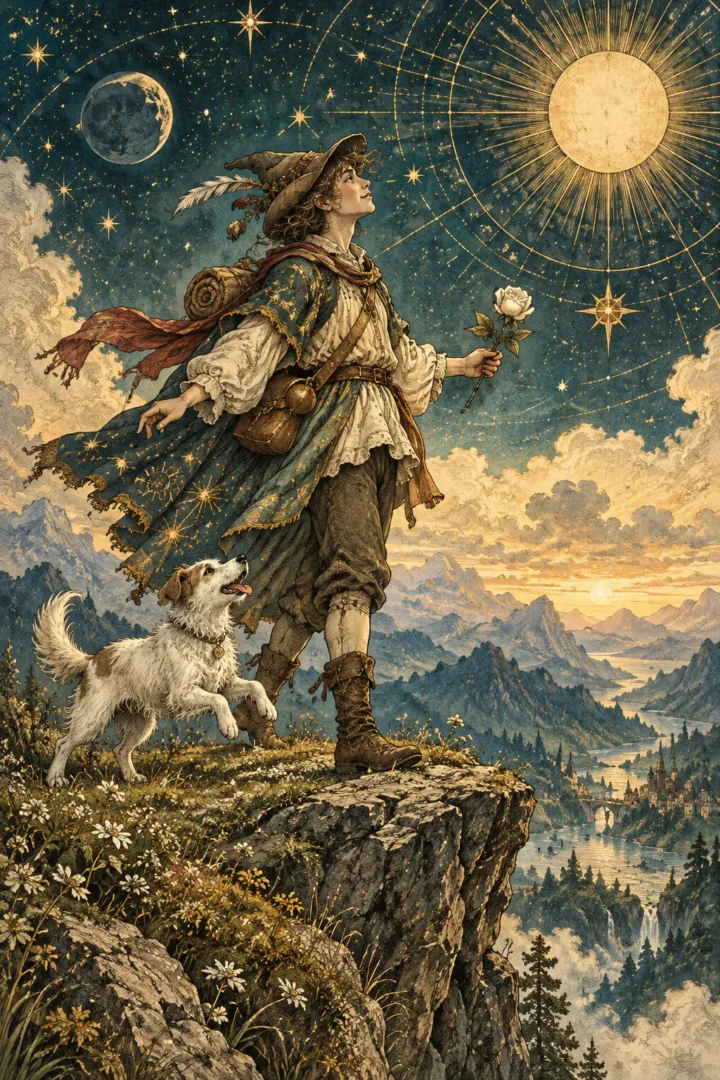
The Fool stands at a cliff’s edge with a white rose and a lively dog. Explore what this tender, unpredictable card reveals about discovery, uncertainty, and the courage to begin.
- new beginnings
- curiosity
- openness
- independence
- adventure
Card at a glance
- Number
- 0
- Element
- Air
- Astrology
- Air (Golden Dawn); Uranus is a later attribution
- Keywords
- new beginnings, curiosity, openness, independence, adventure
 The Fool
Upright meaning
New experiences, openness and curiosity
Upright, The Fool often appears when you feel drawn toward something you have never tried. A new friendship, a creative pursuit, a move, or a change of belief can all carry his energy. There is a lively sense that the experience itself will teach you what comes next.
- New experiences
- Openness
- Independence
- Curiosity
- Unexpected opportunities
Reversed meaning
Reckless choices, avoidance and self-doubt
Reversed, The Fool asks you to examine the way you approach the unknown. Perhaps you are swept up in the excitement of leaving, ready to make promises before you understand what they require. That can be costly, particularly when someone else is relying on your decision.
- Reckless choices
- False starts
- Avoidance
- Self-doubt
- Fear of the unfamiliar
Card symbolism
-
The cliff and the lifted face
The cliff is the part of the picture that asks for our attention. The traveler’s gaze is elsewhere, so the viewer notices the edge for him.
-
The dog
The little white dog is wonderfully ambiguous. It may be playing, sounding an alarm, or keeping him company.
-
The white rose
Against the vast landscape, the white rose looks almost fragile. It is commonly associated with innocence and sincerity, and The Fool holds it with care.
-
The small bundle
His possessions fit into a small cloth bundle. The image reminds us that a first step rarely comes from nowhere.
-
The sun and distant mountains
The sun shines over a landscape that stretches toward distant, snow-covered mountains. The journey has a scale the traveler cannot yet appreciate.
In depth interpretation
A young traveler stands at the edge of a cliff. His face tilts toward the sun; a white rose rests in his hand, and a little dog leaps at his heels. He looks as though the world has just offered him something wonderful. Only the viewer sees how close his foot is to the drop.
The Fool speaks of the beginner’s heart: curiosity, freedom, and the willingness to follow an unfamiliar calling. Upright, he brings the possibility of a fresh chapter. Reversed, he can reveal an impulsive choice or a door you have been afraid to open.
The soul of The Fool
Zero feels like a fitting number for someone still at the beginning of his story. Other figures in the Major Arcana have their titles, tools, and places in the world. The Fool carries a small bundle, a white rose, and the hope of whatever lies beyond the cliff. We meet him before experience has given him a name.
Many readers see him as the soul setting out into the world, ready to discover its joys and complications. There is something tender about that innocence. We spend so much of life anticipating what could go wrong that we can forget the pleasure of meeting something without a verdict already prepared. The Fool lets that possibility breathe.
If the beginning asks for a clearer decision, the Ace of Swords is a useful companion. The Fool carries an openness to the unknown. The Ace offers a flash of understanding about the path ahead. It can help you name one important truth before taking the next step.
The symbols in The Fool card
Look closely at Pamela Colman Smith’s Rider-Waite-Smith Fool. The sky is luminous and the traveler seems delighted, yet the cliff is very real. Every object in this scene complicates the story of a carefree adventurer.
The cliff and the lifted face
The cliff is the part of the picture that asks for our attention. The traveler’s gaze is elsewhere, so the viewer notices the edge for him. In a reading, it can bring one practical question into focus: what have you missed because you were enjoying the view?
The dog
The little white dog is wonderfully ambiguous. It may be playing, sounding an alarm, or keeping him company. If it catches your eye first, consider who or what is trying to get your attention: a trusted friend, a quiet instinct, or a small detail you have overlooked.
The white rose
Against the vast landscape, the white rose looks almost fragile. It is commonly associated with innocence and sincerity, and The Fool holds it with care. Perhaps this new experience matters because something tender and deeply personal is invested in it.
The small bundle
His possessions fit into a small cloth bundle. The image reminds us that a first step rarely comes from nowhere. Even when you feel unprepared, you carry memories, skills, and old assumptions into unfamiliar places. Some will serve you well on the road ahead.
The sun and distant mountains
The sun shines over a landscape that stretches toward distant, snow-covered mountains. The journey has a scale the traveler cannot yet appreciate. We see the promise of a beautiful day, along with a horizon he has not explored.
The Fool upright meaning
Upright, The Fool often appears when you feel drawn toward something you have never tried. A new friendship, a creative pursuit, a move, or a change of belief can all carry his energy. There is a lively sense that the experience itself will teach you what comes next.
Imagine signing up for a dance class after years of saying you have no rhythm. On the first evening, you miss the steps and laugh at yourself. To your surprise, you want to go back. The Fool often describes that moment when discovery becomes more appealing than looking accomplished.
The Fool reversed meaning
Reversed, The Fool asks you to examine the way you approach the unknown. Perhaps you are swept up in the excitement of leaving, ready to make promises before you understand what they require. That can be costly, particularly when someone else is relying on your decision.
Or perhaps you have been standing at the threshold so long that the doorway has become a familiar place to hide. You have researched the course and saved the application, but keep finding reasons not to send it. The question may be whether the obstacle is real or you fear being a beginner.
The Fool in love and relationships
The Fool brings a certain buoyancy to a love reading. You may meet someone who makes ordinary conversation feel like an adventure, or find yourself curious about a person you would once have overlooked. This card gives that initial delight a voice. What grows from it will become clearer through time together.
In a long-term relationship, The Fool can appear when life has become very predictable. Perhaps you know each other’s routines so well that you rarely do anything simply for the pleasure of it. A shared adventure, even a small one, might help you see each other with fresh eyes.
Reversed in love, the card can describe a romance moving too quickly, or hesitation after past hurt. Pay attention to whether both people feel free to express what they want and choose a comfortable pace.
The Fool as feelings
Asked about someone’s feelings, The Fool points to playful curiosity and an urge to get to know you. The person may enjoy the connection while still discovering what place it has in their life. If you are hoping for commitment, notice whether their actions begin to match that excitement.
The Fool for career and work
At work, The Fool often appears at the beginning of an unfamiliar role. You may feel capable of learning, yet strangely vulnerable about leaving behind the expertise you have built elsewhere. The card gives beginnerhood a dignity of its own.
If you are considering a career change, try meeting the work firsthand. Speak with someone in the field, take a class, or test a small project. Such experiences can show whether the pull is meaningful, and reveal demands you might not have imagined from a distance.
The Fool for money
Money questions bring the cliff back into focus. The Fool can accompany spending on travel, study, relocation, or the first steps of a business. These choices may enrich your life, and their cost deserves a place in the picture before you decide.
Reversed, the card can draw attention to impulse spending, vague promises, or fear of loss that keeps you from investing in yourself. Check the terms and your resources in the real world. The reading can help you understand why an opportunity appeals to you.
The Fool in spiritual growth
Spiritually, The Fool is the seeker before certainty. He invites you to encounter mystery firsthand, with enough openness to be changed by what you discover. You may feel his presence when you begin a new practice, return to prayer after years away, or realize that your old beliefs no longer explain everything you have lived.
The Fool as advice: a small card-reading exercise
Set The Fool before you and spend a moment with the scene. Begin at the traveler’s face and follow his gaze. What do you imagine he sees? Now let your eyes move to the dog and the drop below. Notice whether a different feeling arrives.
Write two lines in your journal: “What is calling me?” and “What have I not yet looked at?” Give yourself a moment before answering. The words may help you hear a genuine wish more clearly and recognize a concern that deserves attention.
Is The Fool a yes or no card?
The Fool often leans yes when the question is about exploring, learning, or trying something new. With questions about security, commitment, or serious consequences, the card offers no firm promise. Reversed, it may be worth revisiting what you know before acting.
How to read The Fool in a tarot spread
Begin with the card’s position. In the past, The Fool can describe the spontaneous choice that set the story in motion. As a challenge, it may reveal inexperience or reluctance to settle. As an outcome, it suggests a chapter whose details are still taking shape.
Suppose you ask about returning to study and draw The Fool in the present, the Eight of Pentacles as advice, and The Star as an outcome. The Fool captures your eagerness to try. The Eight of Pentacles calls for patient practice, while The Star offers an image of renewed hope in your direction. Together, the cards could encourage you to take the course seriously and remember what first drew you to it.
Questions to sit with
- Where in my life am I holding too tightly to an old assumption?
- What do I already carry that could help me on unfamiliar ground?
- Who or what is playing the dog’s role in my situation?
- Which part of the journey would benefit from a closer look?
A brief note on tradition
This interpretation follows the Rider-Waite-Smith deck illustrated by Pamela Colman Smith and first published in 1909. Earlier tarot traditions pictured The Fool differently, and their divinatory meanings could be harsher. Waite’s own list included folly, carelessness, and extravagance. These older associations remain useful alongside the modern understanding of a fresh beginning.
The Golden Dawn system associated The Fool with the element Air. Linking it to Uranus is a later development. There is no single zodiac-sign correspondence shared across tarot traditions.
Frequently asked questions
Can The Fool represent a person?
Yes. It may describe someone curious, restless, inexperienced, or eager to explore. In one reading that could be a newcomer finding their feet; in another, a free-spirited friend or someone hesitant to settle down.
How is The Fool different from The Magician?
Think of the Magician as the next stage after the Fool’s first encounter with the unknown. The Magician knows what tools are available and begins using them deliberately. When both cards appear, curiosity may be turning into purposeful action.
Does The Fool always mean something new?
Often, though ‘new’ does not have to mean a change in circumstances. The card can invite you to approach a familiar place, relationship, or creative practice with the attention you gave it when you first discovered it.
Is The Fool a warning card?
It can be, especially in a challenge position. The cliff and lively dog can point to a detail or risk that deserves your attention. Consider the question and surrounding cards before drawing conclusions.

Keep reading
Explore the Major Arcana
Every card page names the tradition behind each meaning, so you can compare readings instead of taking one as fixed.
Cards to explore alongside this one
Their symbols reveal useful similarities and differences for your next reading.
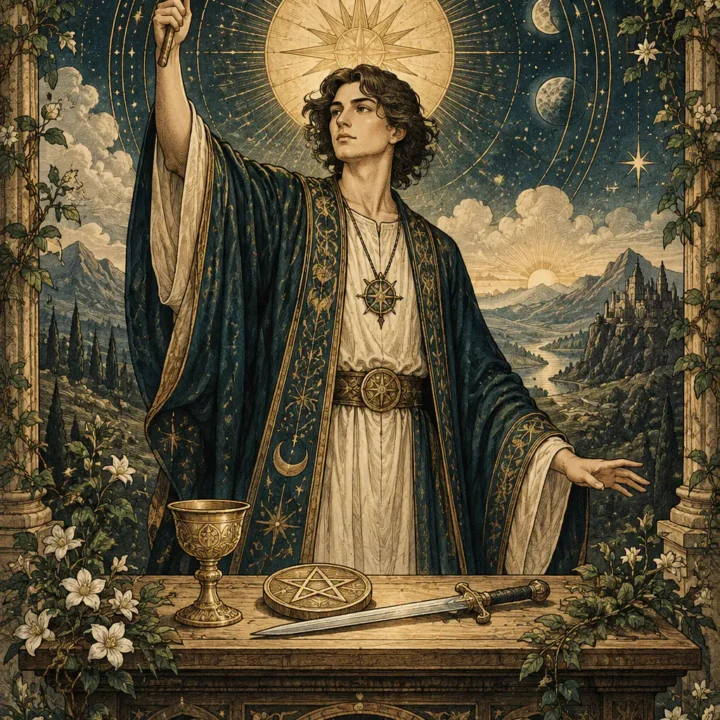
The Magician
resourcefulness, focused will, skill, communication
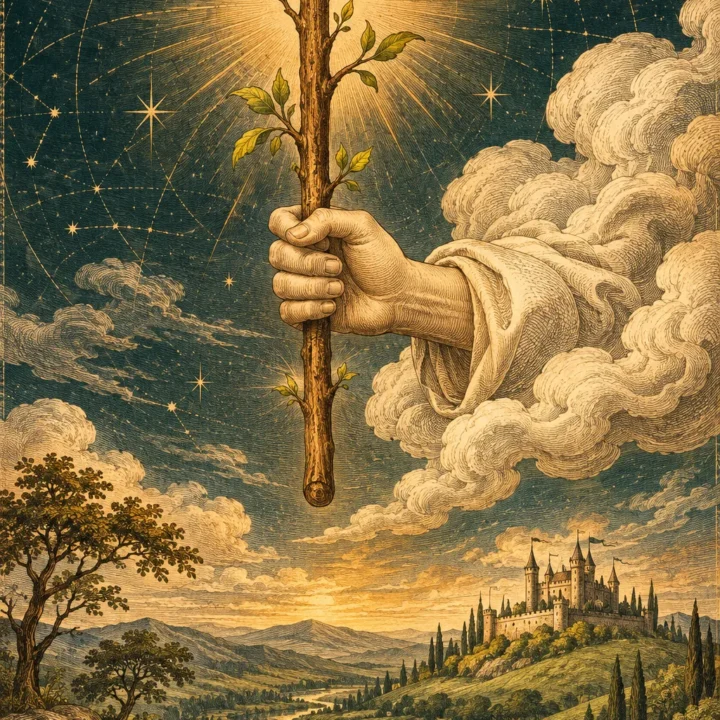
Ace of Wands
inspiration, creative force, desire, beginnings
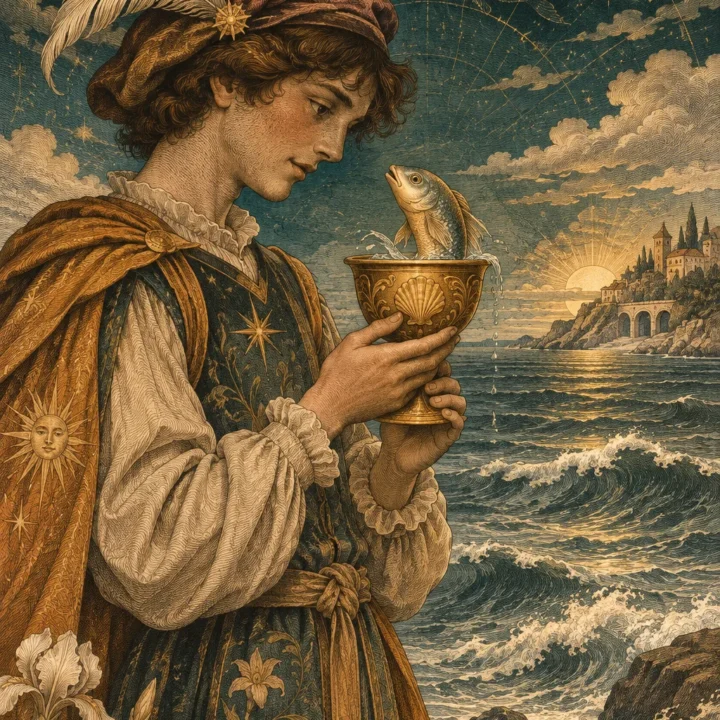
Page of Cups
imaginative insight, emotional news, kindness, study

Two of Wands
vision, established power, longing, ambition
Sources and further reading
- Arthur Edward Waite, The Pictorial Key to the Tarot, Part II, symbolism of The Fool Read the text
- Arthur Edward Waite, The Pictorial Key to the Tarot, Part III, divinatory meanings Read the text
- The Equinox, Vol. I, No. 8 (1912), Book T, Fool/Air attribution Read the text
- The Morgan Library & Museum, Pamela Colman Smith and the 1909 deck Read the text