
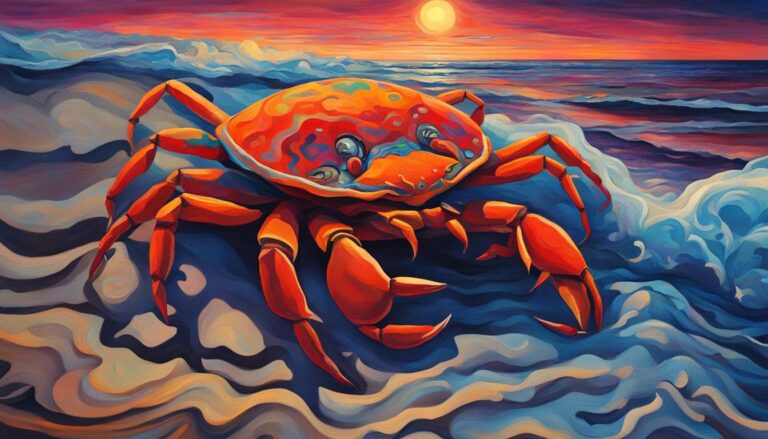
What Does it Mean to Dream About Crabs?
Quick answer
Dreaming about crabs most often signals that you are holding on too tightly — to a situation, a grievance, or an identity — and that this grip is costing you forward movement. Crabs also appear when you are navigating a transition sideways rather than head-on, feeling emotionally armored, or protecting something tender underneath a hard exterior.
Had a different dream? Describe it and get a reading.
Interpret my dream →Why this dream sticks
Crabs live between worlds — sea and shore, water and land. That boundary position is exactly why the image lands with such weight. When your mind reaches for a crab in sleep, it is usually mapping something in your waking life that does not fit neatly into one category: a relationship neither fully in nor fully out, a decision you keep circling rather than making, an emotion you have shelled over so thoroughly you have almost forgotten it is there.
The crab’s sideways movement is not evasion for its own sake — it is the animal’s most efficient path. Your dreaming mind may be telling you that the indirect route you are taking is not weakness; it is strategy. Or it may be asking whether the sideways move has gone on long enough.
The claws carry their own meaning. Claws grip, pinch, and defend. If the crab in your dream was using its claws on you or on something you value, pay attention to where in waking life you feel grabbed at — or where you yourself are holding on past the point of usefulness. For more on how animals signal emotional states in sleep, see our guide to common dream symbols and the broader framework in how to interpret your dreams.
What the common variations mean
| Dream variation | What it tends to reflect |
|---|---|
| A crab pinching or clinging to you | Someone or something in waking life is holding you back or demanding more than feels fair — or you are the one clinging to a situation that has already ended |
| Many crabs on a beach or ocean floor | A cluster of unresolved small tensions; emotions suppressed long enough to multiply |
| Eating crab calmly at a meal | Successfully integrating a difficult experience; taking nourishment from something that required effort to open |
| A crab you try to catch that keeps escaping | A goal or conversation you keep approaching but cannot pin down; anxiety about timing or readiness |
| A dead or injured crab | A defense mechanism that has outlived its purpose; armor you were relying on that is no longer working |
| A giant or unusually large crab | The core theme — grip, protection, or sideways strategy — feels outsized relative to the actual situation |
| A hermit crab switching shells | A transition in identity, home, or role; the vulnerable moment between one form of safety and the next |
| A crab that speaks or behaves like a person | A specific person in your life who is defensive, indirect, or protective in a way that is currently affecting you |
Specific scenarios
Crabs are defensive animals — armoured, sideways-moving, pincered — so these dreams tend to be about protection rather than attack. A pinch is the most common form and the most direct: something has a hold on you that you have been minimising, and the sensation is a feeling demanding acknowledgement rather than a warning of harm. Being chased by crabs describes an emotionally charged situation that keeps pace with you however fast you move, and as with most chase dreams the useful move is turning around.
Some variations point at people. A single large crab, still and watching, is often a stand-in for someone guarded and territorial who is hard to read — or for that same quality in you. Crabs walking sideways across your path is one of the more specific images in the library, and it asks a genuinely useful question: progress is happening but not in the direction you expected, so is your indirect approach to a current problem wise or is it evasion?
Two are more encouraging than they appear. Dead or dying crabs usually mark the end of a period of emotional withdrawal — a defensive posture that did its job and is no longer needed. A soft-shell crab, exposed without armour, reads as vulnerability arriving before you felt ready, and it more often notes courage you had not recognised in yourself than warns you of danger.
What this dream is not
This dream is not a medical or astrological sign. Despite the zodiac association with Cancer, dreaming of a crab does not mean your health is at risk or a fixed fate is being communicated. Dreams surface your own psychological material — associations, tensions, memories — not external prophecies.
It is also not automatically negative. The crab’s shell is protection, and protection is sometimes exactly right. If you dreamed of a crab and woke feeling calm or satisfied, your mind may simply be affirming that your current boundaries are appropriate. Not every armored image is a warning to open up.
Finally, context matters. A one-off crab dream after a beach trip is not the same signal as a recurring crab dream during a period of relational stress.
A short practice
Before the details fade, write down answers to these three prompts — quickly, without editing yourself:
- What was the crab doing, and how did it make you feel in the moment of the dream (not afterward)?
- Is there a situation in your life right now where you are either gripping too hard or being gripped at?
- What would it look like to set that thing down — even briefly — today?
You do not need to act on what you write. The practice is to surface what the dream already knows. The answer to the third question usually reveals whether the grip is protective or merely habitual — and that distinction is where the useful work begins. For a structured method, see our full guide at how to interpret your dreams.
FAQ
Does dreaming about a crab attacking me mean I have an enemy?
Not literally. An attacking crab most often represents something within your own experience — a suppressed emotion, a boundary that has snapped, or resentment building without an outlet. It can also reflect a real person whose behavior feels threatening, but the image is your mind’s translation of that dynamic, not a direct report. Related patterns appear in spider dreams, where something feels threatening but the source is often closer than it seems.
What does it mean if the crab in my dream was red?
Color in dreams is personal, but red tends to amplify the emotional charge: urgency, anger, passion, or a situation running hotter than you are acknowledging. If the red struck you as alarming, ask where in waking life something feels overheated. If the red seemed natural or even beautiful, the intensity may be neutral or positive.
I keep dreaming about crabs repeatedly. Should I be concerned?
Recurring dreams are worth paying attention to — not because they predict harm, but because repetition usually means the underlying tension has not shifted. Your mind returns to the same image because the situation it is mapping has not been addressed. Treat the recurrence as useful data: a relationship, a boundary, or a decision you are circling is asking for direct attention. This is not a medical symptom. If the dreams are significantly disturbing your sleep, speaking with a therapist who works with dreams is a practical next step.
This content is for reflective and educational purposes only and does not constitute medical or psychological advice.
Author

Explore the next dream


Dreams are not medical, legal, or financial advice. The Dream Symbolist offers symbolic interpretation to support reflection, not diagnosis.