
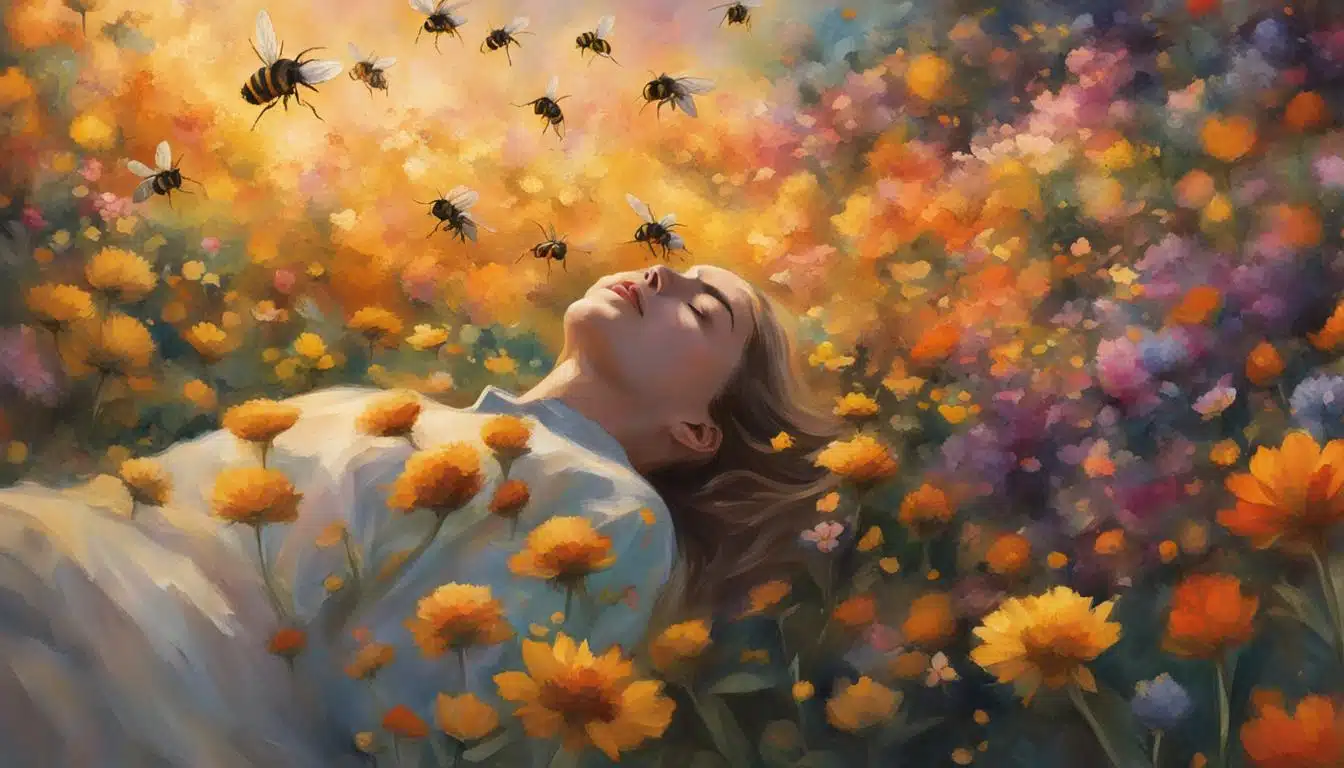
What Does it Mean When You Dream About Bees?
Quick answer
Dreaming about bees most often signals that your waking life is demanding collective effort, sustained focus, or a confrontation with something that feels threatening but is actually productive. Bees in dreams rarely predict literal danger — they point toward work, community, instinct, and the anxiety or satisfaction that comes with both.
Had a different dream? Describe it and get a reading.
Interpret my dream →Why this dream sticks
Bees carry near-universal cultural weight: industrious, hierarchical, capable of sweetness and of pain. Your brain reaches for them when processing situations that hold that same tension — something that can reward or hurt you depending on how you handle it. The vividness often comes from the hive-mind quality: many moving parts, all coordinated, none under your individual control. That feeling maps directly onto workplaces, families, and communities.
The emotional tone is the sharpest signal. Calm observation of bees working is almost always positive. Fear, swarming, or stinging shifts the meaning toward conflict or a situation that has escalated past the point where you feel in control. For a fuller framework on reading emotional tone across dream types, the dream interpretation guide covers that method in detail.
Common variations and what they mean
| Variation | Core reading |
|---|---|
| Being stung by a bee | A specific criticism, betrayal, or consequence you have been bracing for — or ignoring. Note where the sting lands: hands suggest work or creative output; face suggests reputation or identity. |
| A swarm surrounding you | Overwhelm from a collective source: too many obligations, a group whose expectations feel suffocating, or anxious thoughts that move in clusters rather than one at a time. |
| Bees in your home or bedroom | Work or communal demands that have crossed into personal space. Something that belonged outside has moved inside your boundaries without invitation. |
| Harvesting or eating honey | Receiving the reward of sustained effort — your own or someone else’s. Often appears after a long project nears completion or when a relationship reaches a new depth. |
| A dying or dead hive | A project, relationship, or community that has lost its organizing energy. Can also reflect grief over a structure that once gave your life rhythm. |
| Being the queen bee | Leadership anxiety or desire — the question of whether you want to carry the responsibility that comes with being the central figure others depend on. |
| Bees chasing you | A responsibility or consequence you are actively running from. The chase rarely ends well in the dream because avoidance rarely resolves the waking issue. |
| A single bee, calm and close | A quiet signal about precision and purpose — often appears when you are on the right track with something but have not yet acknowledged it to yourself. |
The biblical reading
Bees carry a double meaning in scripture, and holding both is what makes this reading useful. They are the source of honey — the land flowing with milk and honey, the sweetness that Psalm 19 compares to God’s judgements — and they are also a swarm, which appears as an image of pursuit. The same insect stands for provision and for consequence depending on what it is doing.
On the provision side, watching bees make honey peacefully reads as covenant provision and the fruit of steady, faithful work, and bees building a hive in or near your home extends that to the household: something being established, a season of structured blessing rather than a windfall. Bees landing on you without stinging is read as favour or marking — being set apart for a particular role. Being a beekeeper shifts the dream into stewardship, a call to tend something that will only respond to patience.
On the other side, a swarm chasing you has a direct anchor in Deuteronomy 1:44, where enemies pursue Israel as bees do, and the tradition reads it as consequence catching up rather than as random threat. A single sting is gentler and generally read through Hebrews 12:11, where discipline is unpleasant in the moment and yields something afterwards: correction rather than punishment, or a boundary you crossed and felt.
What this dream is not
A bee dream is not a literal warning about bees, allergies, or physical danger. Swarming typically represents pressure, not malice. It is also not a generic stress dream with nothing specific to decode — the particular details (species, color, setting, your reaction) each narrow the meaning. A bumblebee in a garden carries different weight than a wasp nest inside a wall, and your mind chose the image it did for a reason. This content is not medical or psychological advice; if recurring dreams are causing significant distress, a licensed professional is the right resource.
For related reading on how animals function as symbols, see the animal dreams guide and the insects in dreams guide.
A short reflection practice
- Write down three things in your current life that require coordinated effort — work, a relationship, a personal project.
- For each one, ask: am I the worker, the queen, or someone standing outside the hive watching?
- Note which role appeared in the dream. The gap between your waking role and your dreamed role is usually where the insight lives.
- Sit with the emotional residue of the dream for sixty seconds before analyzing it. Fear, pride, calm, and disgust each point toward different underlying concerns.
Frequently asked questions
Does being stung in a dream mean someone is going to hurt me?
Not in a predictive sense. A bee sting most commonly points to something that has already happened — a sharp word, a disappointment, a boundary crossed — that you have not fully processed. It can also represent anticipated pain from a difficult conversation you are putting off. The dream brings it into focus; it does not forecast new events. For more on how to distinguish warning dreams from processing dreams, the interpretation framework is a useful starting point.
Why do I keep having bee dreams during stressful work periods?
The hive is one of the brain’s most efficient metaphors for collective labor under pressure. When you are embedded in a demanding workplace — deadlines, hierarchies, the sense that everything depends on everyone performing simultaneously — bees surface as the ready-made image for that structure. Dreams tend to intensify when you feel either invisible within the system (a worker among thousands) or over-exposed (the queen with no shelter). They typically ease when the workload changes or when you shift how you relate to it.
What does it mean if the bees in my dream are calm and I am not afraid?
That combination is one of the more straightforwardly positive configurations this dream produces. Bees going about their work while you observe without fear usually reflects a stable relationship with effort and productivity — either something in your life is flowing well, or you are moving toward that state. It can also appear during periods of creative momentum, where industrious energy feels generative rather than oppressive. Notice what you were doing alongside the bees; that activity often names the area of life where things are quietly going right.
Author

Explore the next dream



Dreams are not medical, legal, or financial advice. The Dream Symbolist offers symbolic interpretation to support reflection, not diagnosis.