
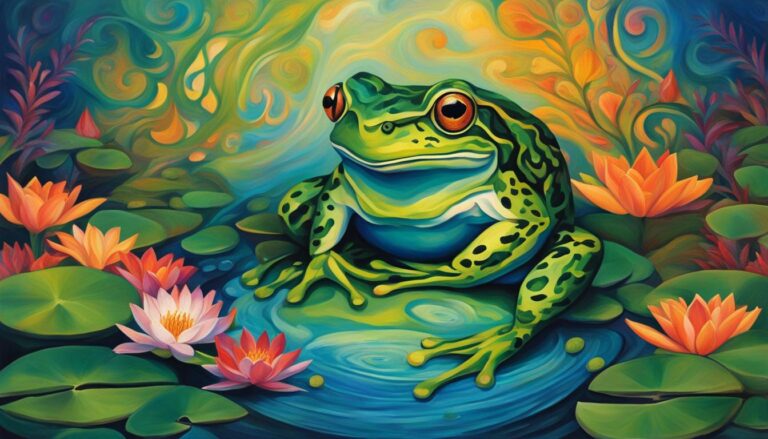
What Do Frogs Represent in Dreams?
Quick answer
Frogs in dreams most often point to personal transformation already underway — a life stage ending and another beginning. They also carry themes of emotional cleansing, adaptability between two worlds, and the release of something held too long. The dream is usually a quiet confirmation, not a warning.
Had a different dream? Describe it and get a reading.
Interpret my dream →Why this dream sticks
A frog belongs to two environments at once — water and land, feeling and action, the unconscious and the waking world. When one appears in a dream, the image tends to linger because some part of you recognizes the metaphor before your waking mind does.
Water in dreams commonly represents the emotional or unconscious layer of experience. A frog emerging from water onto land is a vivid picture of something internal becoming external — an insight surfacing, a decision crystallizing, an old self being shed. That transition is why the dream feels significant even when nothing dramatic happens in it.
Frogs also move in leaps. If you are weighing a big change — a career pivot, ending a relationship, committing to creative work — your dreaming mind may reach for this image as shorthand for the jump you are contemplating. The frog does not deliberate. It leaps.
For how context, color, and emotion sharpen any single symbol’s meaning, visit the dream interpretation guide.
Common variations and their most likely meaning
| Dream variation | Most likely reading |
|---|---|
| A single frog sitting still, watching you | An invitation to pause before a transition; patience over rushing |
| Many frogs — a pond, a field, a swarm | Emotional overwhelm or small unresolved issues that have multiplied; address them one by one |
| A frog leaping toward you | A change or opportunity arriving faster than expected; often precedes a real-life acceleration |
| Holding a frog gently | Acceptance of a sensitive situation; comfort with something previously avoided |
| A frog you are afraid to touch | Reluctance to engage with an emotional truth you already know; avoidance costing more than the thing itself |
| A frog transforming into something else (or back) | A direct signal of identity shift — you are in the middle of becoming, not yet arrived |
| A dead or dying frog | The end of a phase, not a loss; something that served its purpose is now complete |
| A bright or unusually colored frog (red, gold, blue) | Heightened emotional charge; the color adds a layer — red signals urgency, gold signals value, blue signals communication |
What this dream is not
This dream is almost never a bad omen. Older folk traditions sometimes coded frogs as signs of rain, illness, or unwanted visitors, but those readings reflect the anxieties of agricultural societies, not a universal truth about the symbol.
It is also not a directive. A frog dream does not mean you must quit your job, end a relationship, or make any specific move. It surfaces a theme — transformation, adaptability, emotional release — and invites you to consider where that theme lives in your current life.
If the dream felt threatening, that emotional tone matters more than the frog itself. Fear in a dream usually points to resistance, not danger: something real is changing, and a part of you is not ready. That is useful information, not a prediction. This content is for reflective purposes only and is not a substitute for professional mental health support.
A short practice
Within a day of the dream, spend five minutes with these three questions. Write the answers rather than just thinking them — writing tends to surface what the dream was reaching for.
- Where in my life am I between two states right now — not fully in the old, not yet in the new?
- What have I been postponing that I already know needs to move?
- What would I do differently if I were comfortable with the leap?
You do not need to act on the answers immediately. Naming the territory the dream was mapping is usually enough to let it settle.
For more on working with recurring or vivid dreams, see the guides on water in dreams and transformation dreams — both share significant symbolic ground with frog imagery. You can also browse the full symbol library at /dreams/ to find adjacent images from the same dream.
Frequently asked questions
Does the size of the frog change the meaning?
Yes. A very large frog amplifies the core theme — the transformation feels pressing, hard to ignore. A tiny frog often suggests something early in development: a change barely begun, an insight still forming. If the size felt notable, treat it as the dream underscoring something rather than introducing a separate symbol.
What if the frog was speaking or behaving like a person?
When any animal takes on human qualities in a dream, it usually signals that the symbol represents a specific person or an unacknowledged part of yourself. Consider whether the frog’s manner — its voice, its attitude, what it said — reminded you of anyone. If it felt more like a version of you, ask which part: the part that waits, the part that leaps, the part that belongs to two worlds at once.
I dreamed about frogs more than once this month. Does repetition matter?
Repetition almost always means the theme is unresolved in waking life. The dreaming mind does not repeat a symbol without reason. If frogs keep appearing, the question is not what the symbol means in the abstract but what specific situation in your life it keeps pointing at. Try the short practice above after each occurrence and compare your answers — the pattern in your responses will usually show you exactly what the dream is circling.
Author

Before you read a fixed meaning, ask:
What happened — the central image or event, in one plain sentence.
How it happened — calm or violent, easy or forced, sudden or slow.
Who was watching — alone, one person, or a crowd.
Those three usually matter more than the symbol name alone.
Meanings reflect widely shared symbolism; your own context comes first.
Explore the next dream



Dreams are not medical, legal, or financial advice. The Dream Symbolist offers symbolic interpretation to support reflection, not diagnosis.